-
-
Project Overview
-
Health Report
-
Voicing Action
Inspiration
Walk through Triana in Seville, or any town square in Spain, and you'll meet ceramicists, tailors, bike mechanics, photographers and other autónomos running real businesses. Their customers are locals, hotels, restaurants and tourists who fly home to London or Boston. The work gets done, but the invoice waits until the end of a long day. Payments slip, chasing customers feels awkward, and when the quarter ends there is no tidy record to hand to the gestor or the bank.
These business owners already talk to customers all day. We asked a simple question: what if getting paid was as easy as saying who owes you? That became VoiceIt.
What it does
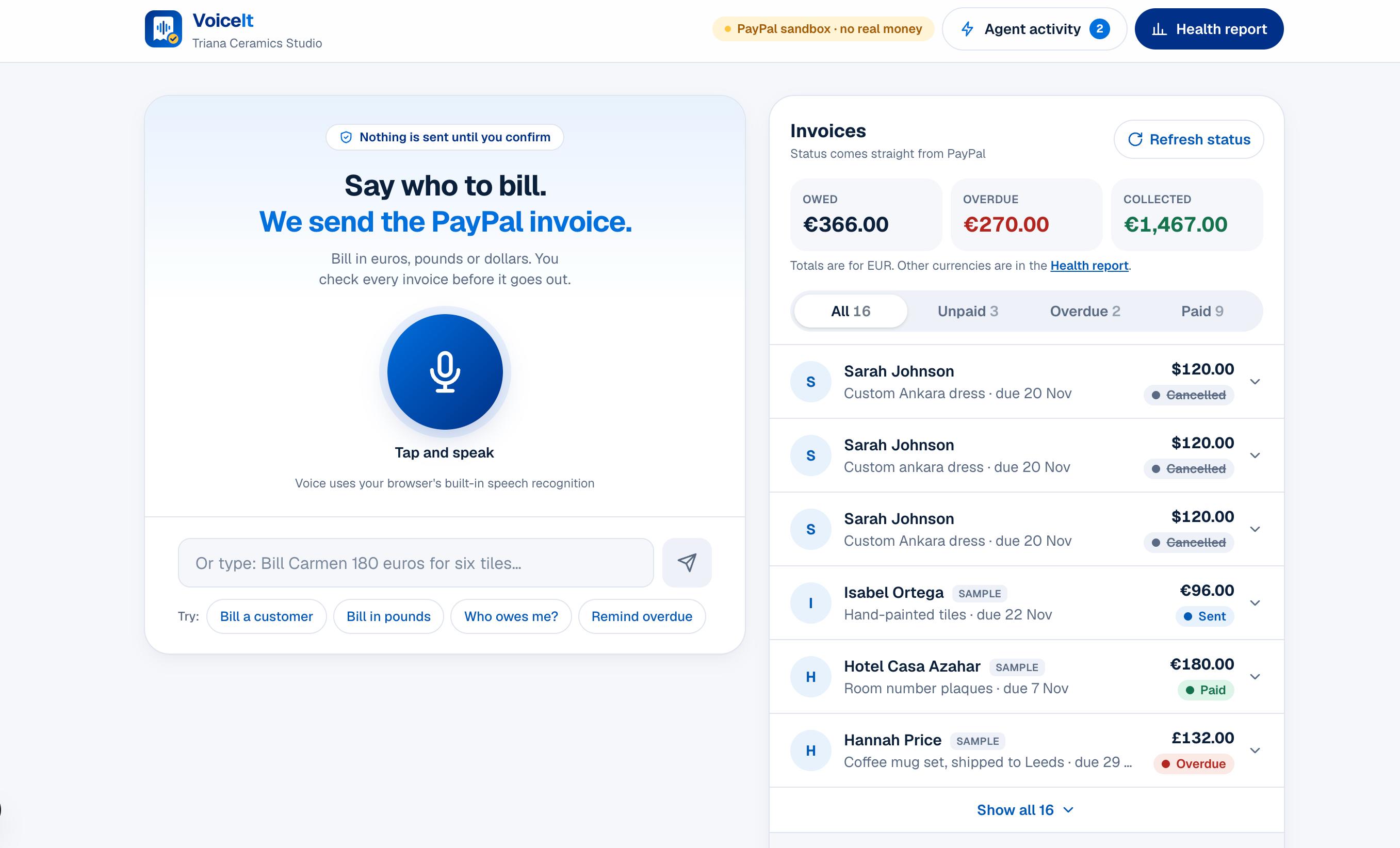
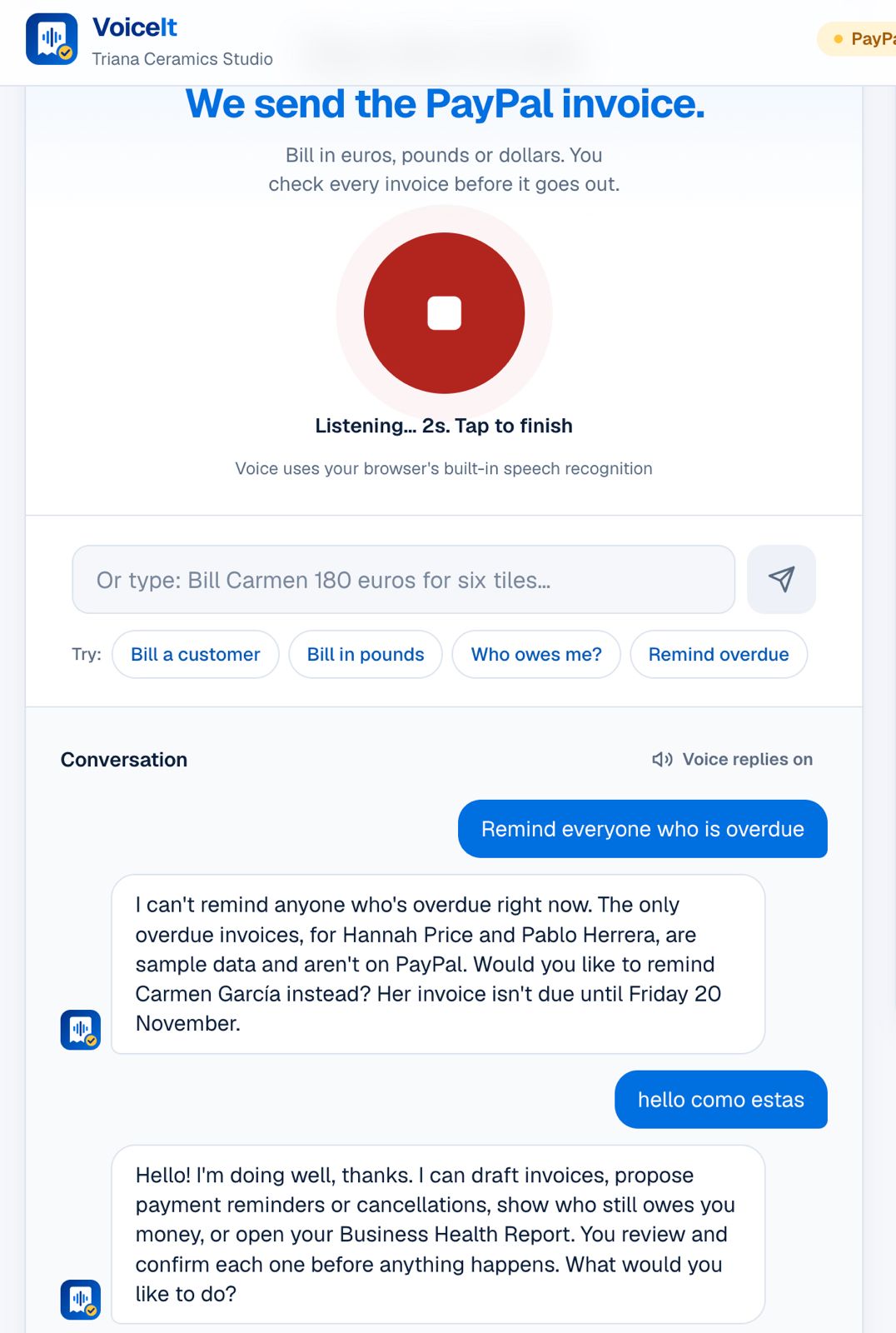
VoiceIt is a voice-first AI agent that turns a spoken sentence into a real PayPal invoice.
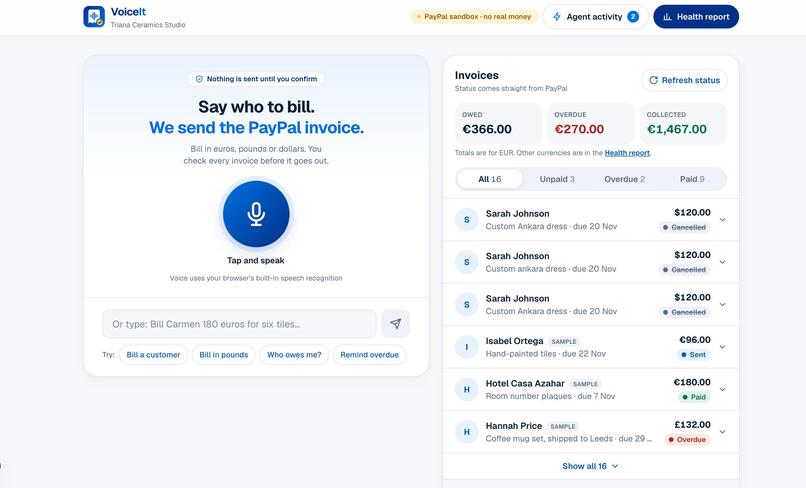
- Speak or type naturally, in English: "Bill Carmen García, [email protected], 180 euros for six hand-painted tiles, due next Friday." Spanish names, places and products are kept exactly as said.
- AI understands it. It extracts the customer, items, quantity, unit price, currency and due date, and asks one short follow-up if something is missing (like an email address). It bills in euros by default, or in pounds or dollars for customers in the UK and US.
- You confirm on a clear review card. VoiceIt never sends anything without your explicit approval.
- A real PayPal invoice is created and sent, with a payment link and QR code you can share on WhatsApp or show at the counter.
- VoiceIt tracks payment and updates the dashboard from Sent to Paid automatically.
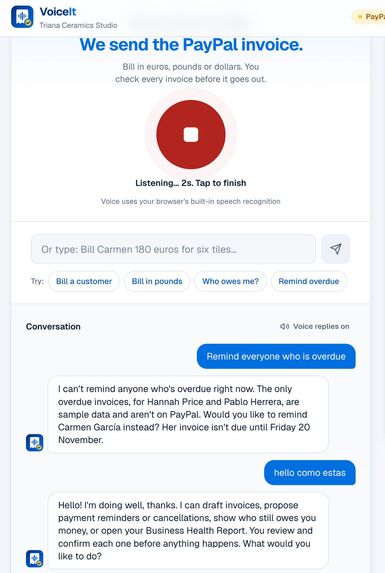
- Ask it anything: "Who still owes me?", "Remind everyone who's overdue", "Cancel Carmen's invoice."
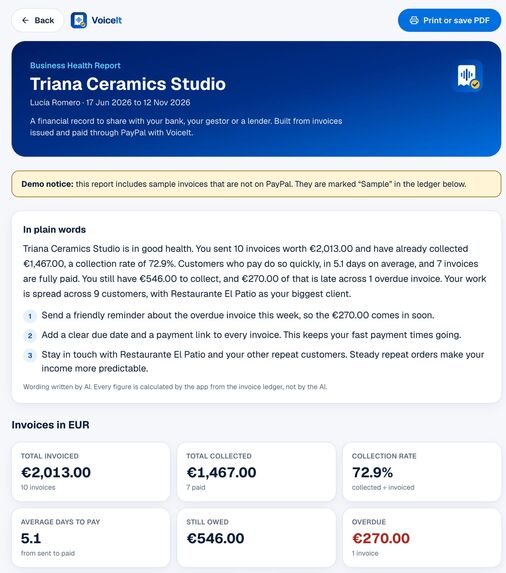
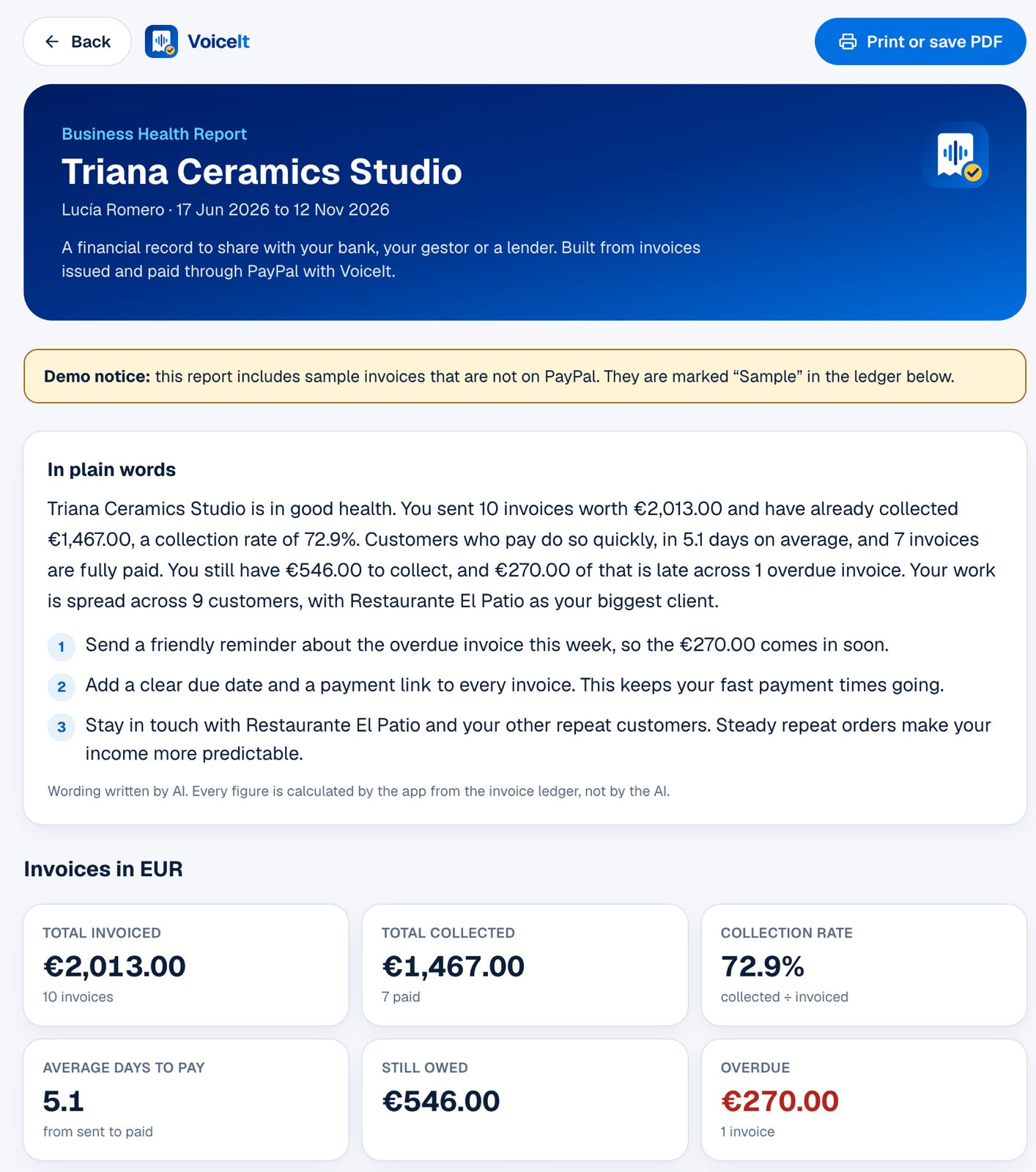
- Business Health Report: one tap gives total invoiced, total collected, collection rate, average days to get paid and top customers, explained in plain language with practical tips. It's a printable financial record to share with a bank, a gestor or a lender.
How we built it
- Frontend: Next.js and TypeScript with Tailwind CSS, mobile-first with a large mic button. It has its own visual identity built on PayPal's navy and blue, and a logo of a receipt carrying a voice wave with a gold "paid" check.
- AI: Claude Opus 5.5 (Anthropic) via the Vercel AI SDK, using tool calling and structured output validated with Zod schemas. Speech is captured with the browser's built-in speech recognition (server-side transcription is optional), with typed input as a fallback.
- PayPal: the official PayPal Agent Toolkit, which lets the AI agent call PayPal Invoicing tools directly (create, send, list, remind, cancel, QR code). It's backed by the Invoicing API v2 and signature-verified PayPal webhooks for payment status. Everything runs in the PayPal sandbox.
- Data: PostgreSQL with Prisma as our ledger, with PayPal as the source of truth for invoice status.
- Deployment: Render.
An Agent Activity drawer, one tap from the header, shows exactly which PayPal tools the AI called and why, with inputs and outputs. A badge counts new steps, so the agent's actions are never a black box, and the main screen stays focused on billing.
For the Business Health Report, every number is computed in code, never by the AI. For example:
$$\text{Collection rate} = \frac{\text{Total collected}}{\text{Total invoiced}} \times 100\%$$
The language model only writes the explanation and tips around those verified figures, so it can't invent numbers about someone's livelihood.
Challenges we ran into
- One business, three currencies: customers in Spain pay in euros, but tourists and online buyers in the UK and US expect pounds or dollars. The agent defaults to euros and switches only when the owner says so. If the owner names any other currency, it explains the limit and asks, rather than silently converting amounts.
- Spanish names in an English conversation: customers are called José Peña or Restaurante El Patio, and titles like Sr. and Sra. are part of the name. The agent keeps names, accents and titles exactly as spoken, and the review card is where the owner fixes anything the speech recognizer misheard. Relative dates ("next Friday") and totals split across items ("180 euros for six tiles") also had to become precise invoice data. Strict schema validation plus targeted follow-up questions kept the agent accurate.
- Trust and safety: an agent that sends invoices on your behalf must never act on a misheard sentence. We built a mandatory human confirmation step and duplicate-send protection, so one double-tap never creates two invoices. In code, the AI is only given PayPal tools after the owner confirms, and every tool call is checked against what was approved.
- Reliable payment status: webhooks can be slow in testing, so we added a polling fallback to keep the dashboard accurate.
- Time: we built this under a tight deadline, which forced us to ship a complete end-to-end flow first and polish second.
Accomplishments that we're proud of
- A full loop from spoken sentence to a real, paid PayPal invoice in seconds.
- An AI agent that is genuinely useful and genuinely safe: it acts through PayPal's tools but always asks before sending.
- A Business Health Report that turns everyday sales into a clear financial record a small business can take to its bank or gestor.
- A product that feels like it belongs next to PayPal: a clean PayPal-blue interface, its own logo, and an audit trail that stays out of the way until you open it.
What we learned
- Agentic commerce is powerful, but trust is the product. Confirmation steps and transparency matter as much as intelligence.
- Let AI do what it's good at (understanding messy human language) and let code do what it's good at (exact numbers and money).
- PayPal's Agent Toolkit dramatically shortens the path from idea to working payments, letting us focus on the user instead of API plumbing.
- PayPal's multi-currency invoicing fits Spain well: one tool covers local customers in euros and visitors paying from home in pounds or dollars.
What's next for VoiceIt
- WhatsApp integration, so owners can send a voice note to VoiceIt in the app they already use every day.
- Spanish and Catalan voice input, then other European languages.
- IVA and NIF on invoices, to meet Spanish invoicing requirements.
- Bank and gestor sharing, so the Business Health Report can be sent directly, with the owner's consent, to help small businesses access fair credit.
- Smarter collections, like suggesting the best time to remind each customer, and partial payment plans.
- Piloting with real artisans and shop owners in Seville to refine VoiceIt with the people it was built for.
Built With
- anthropic-claude
- github
- mediarecorder-api
- next.js
- node.js
- openai
- paypal
- paypal-agent-toolkit
- paypal-invoicing-api
- paypal-sandbox
- paypal-webhooks
- postgresql
- prisma
- react
- render
- speech-to-text
- tailwindcss
- typescript
- vercel-ai-sdk
- zod

