Inspiration
Voice cloning has become increasingly realistic, creating a serious risk of impersonation in banking, customer support, emergency communication, and high-value transactions. We were inspired by the need for a practical system that can analyze a voice in real time and identify signals associated with synthetic or spoofed speech before an impersonation attack causes harm.
For Problem Statement 26104 — AI-Powered Real-Time Detection and Prevention of Voice Cloning Impersonation Attacks, we wanted to build more than a simple voice classifier. Our goal was to create an end-to-end system that combines machine learning, acoustic analysis, contextual signals, risk scoring, and actionable alerts.
What it does
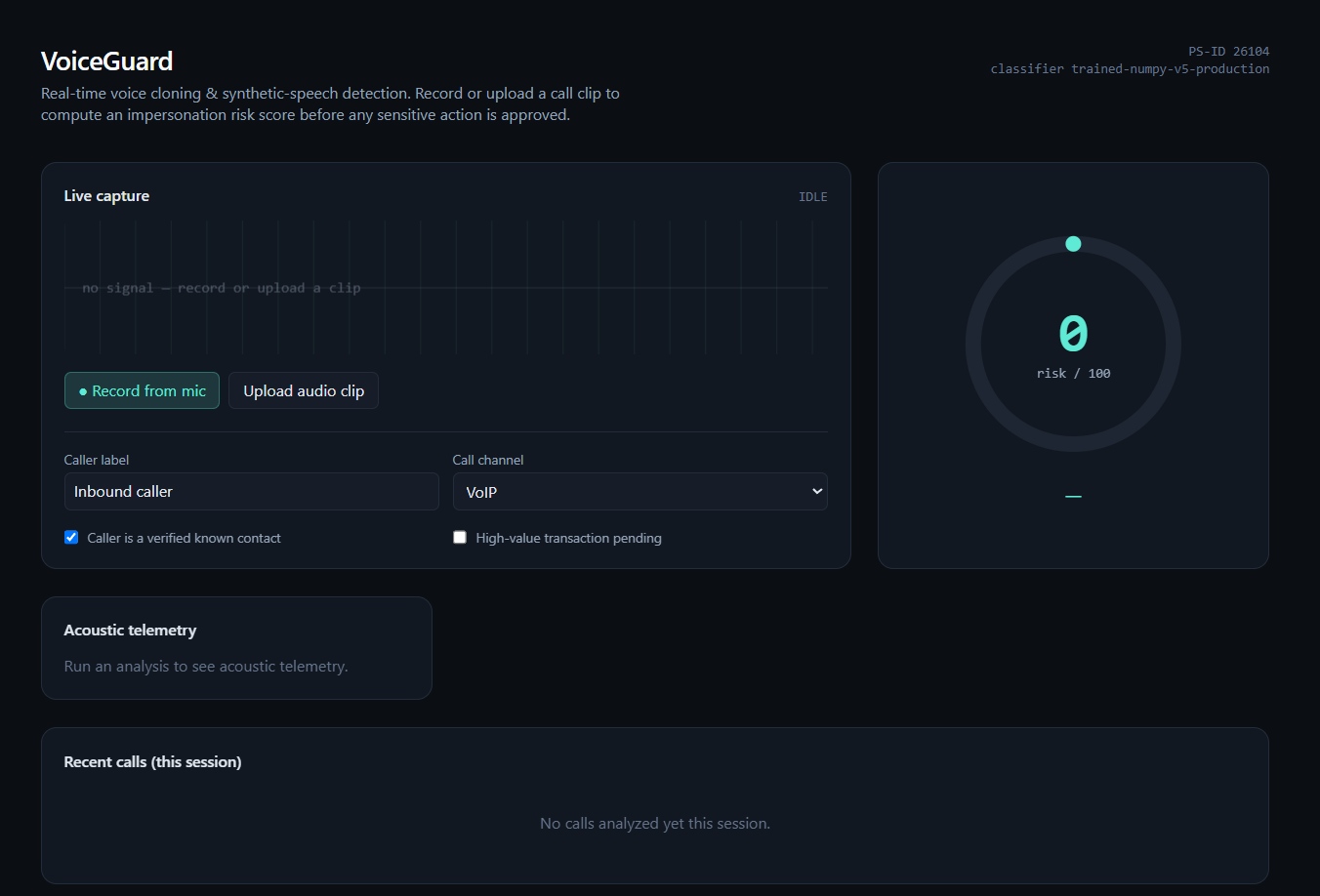
VoiceGuardAI analyzes an uploaded or recorded voice clip and produces a dynamic impersonation risk score.
The system:
Records audio directly through the browser or accepts an uploaded call clip Decodes audio using the Web Audio API Converts audio into mono 16 kHz PCM Extracts a 45-dimensional acoustic feature vector Analyzes spectral, cepstral, and prosodic characteristics Runs an ML-based spoof classifier Combines ML predictions with rule-based detection Incorporates call context such as: Known or unknown contact High-value transaction Call channel Generates a dynamic risk score Detects suspicious acoustic patterns Displays real-time alerts and recommendations Maintains an analysis history Provides REST APIs for future integration with banking, telecom, and contact-center systems
Most importantly, raw audio stays inside the browser. Only the derived feature vector is sent to the server for analysis.
How we built it
VoiceGuardAI uses a browser-first, serverless architecture designed around the limitations of platforms such as Vercel.
Microphone / Audio File ↓ Web Audio API ↓ Audio Decoding ↓ Mono 16 kHz PCM ↓ 45-Dimensional Features ↓ /api/analyze ↓ ML Spoof Classifier ↓ Rule-Based Detection ↓ Contextual Risk Engine ↓ Risk Score + Flags ↓ Alerts + Recommendations Frontend
Built with Next.js, the browser handles audio processing using the Web Audio API.
The feature extraction pipeline analyzes:
Spectral centroid Spectral flatness Spectral rolloff Spectral bandwidth 13 MFCC coefficients MFCC statistics Fundamental frequency / F0 Pitch variation Jitter Shimmer Other acoustic and prosodic characteristics Machine Learning
The classifier is implemented in pure JavaScript as a lightweight neural network:
45 Features ↓ Linear Layer ↓ ReLU ↓ Linear Layer ↓ Sigmoid ↓ Spoof Probability
The model weights are stored in model_weights.json, allowing the classifier to execute inside a Vercel serverless function without requiring a GPU or native ML runtime.
Risk Engine
The ML probability is not used alone.
riskEngine.js combines:
ML Probability + Acoustic Rule Flags + Call Context ↓ Dynamic Risk Score ↓ Risk Level ↓ Recommended Action
This creates a multi-layer detection system rather than relying on a single classifier output.
API Layer
VoiceGuardAI exposes REST endpoints such as:
POST /api/analyze GET /api/history
This makes the architecture suitable for future integration with financial platforms, telecom systems, call centers, and other communication platforms.
Challenges we ran into
One of the biggest challenges was designing an ML pipeline that could work within a serverless environment without native audio codecs or GPU acceleration.
Instead of sending raw audio to the backend and attempting to decode it there, we moved audio processing into the browser. Modern browsers already provide the necessary audio decoding capabilities through the Web Audio API.
Another challenge was making the system lightweight enough for serverless execution. We therefore used a compact neural network and a pure-JavaScript inference pipeline.
We also had to think carefully about privacy. Sending raw voice recordings to a server introduces additional privacy and data-storage concerns, so VoiceGuardAI processes the audio locally and sends only derived features for analysis.
A further challenge was making the system useful even without a large production-grade spoofing dataset. The shipped model is therefore explicitly treated as a demonstration model, with its weights encoding example spoof-detection patterns rather than claiming production-level fraud accuracy.
Accomplishments that we're proud of Built a complete end-to-end voice spoof detection pipeline Created browser-based audio processing without requiring native codecs Extracted a 45-dimensional acoustic feature vector Implemented a lightweight neural-network classifier in pure JavaScript Built a contextual impersonation risk-scoring engine Combined ML predictions with rule-based detection Added real-time alerts and recommended actions Designed the system around privacy-first processing Created REST APIs for future platform integration Made the architecture deployable on Vercel without GPU infrastructure Designed the system to be extensible toward multilingual and Indian-accent datasets What we learned
We learned that building an AI system for a real-world security problem is not just about training a classifier.
The surrounding system matters just as much:
data → feature extraction → ML → rules → context → risk scoring → alert → action
We also learned that deployment constraints should influence architecture from the beginning. By moving audio decoding and feature extraction to the browser, we were able to build a lightweight serverless inference pipeline instead of depending on expensive infrastructure.
Most importantly, we learned to distinguish between a working prototype and a production-ready ML security system. A demo model can demonstrate the complete architecture, but real-world fraud detection requires representative labeled datasets, rigorous validation, adversarial testing, calibration, monitoring, and continuous retraining.
What's next for VoiceGuardAI
Our next step is to move from a demonstration classifier toward a properly trained and validated voice-spoof detection model.
Planned improvements include:
Training on larger real and synthetic speech datasets Adding Indian-language and Indian-accent speech samples Detecting modern voice-cloning and voice-conversion attacks Improving model calibration and threshold selection Adding streaming analysis for continuous calls Implementing temporal risk tracking across an entire conversation Adding speaker verification alongside spoof detection Improving adversarial robustness Adding stronger authentication signals Building integrations for banking and contact-center platforms Adding model monitoring and drift detection Conducting privacy and security testing Benchmarking against established voice-spoof detection datasets
The long-term vision is to turn VoiceGuardAI from a prototype into a privacy-conscious, real-time voice authenticity and impersonation prevention layer that can sit between a communication platform and a high-risk decision.
Built With
- deeplearning
- nextjs


Log in or sign up for Devpost to join the conversation.