
Inspiration
It all started with a personal story — my mother’s.
She often attends community meetings in our neighborhood and records the discussions on her phone. But there was one big problem: she can’t read, and she had to re-listen to the entire recording multiple times just to understand or remember a few key points.
This was time-consuming, frustrating, and sometimes led her to miss important decisions.
That’s when I realized: what if technology could help her — and others like her — access information more easily? So I built VoiceFlow, an intelligent voice assistant that transcribes, summarizes, and translates voice recordings, making them easier to understand — even for those who don’t read or write.
What it does
VoiceFlow is a mobile app that helps users turn voice recordings — like meetings, interviews, or personal notes — into useful, structured, and multilingual summaries.
Here’s what it does:
🎙️ Transcribes audio into clean, readable text using AI (Whisper)
✨ Generates summaries with emojis and bullet points to highlight key information
🌍 Translates summaries into African languages like Wolof, Ewe, and Dioula
🔊 Reads summaries aloud, so even users who cannot read can still understand the content
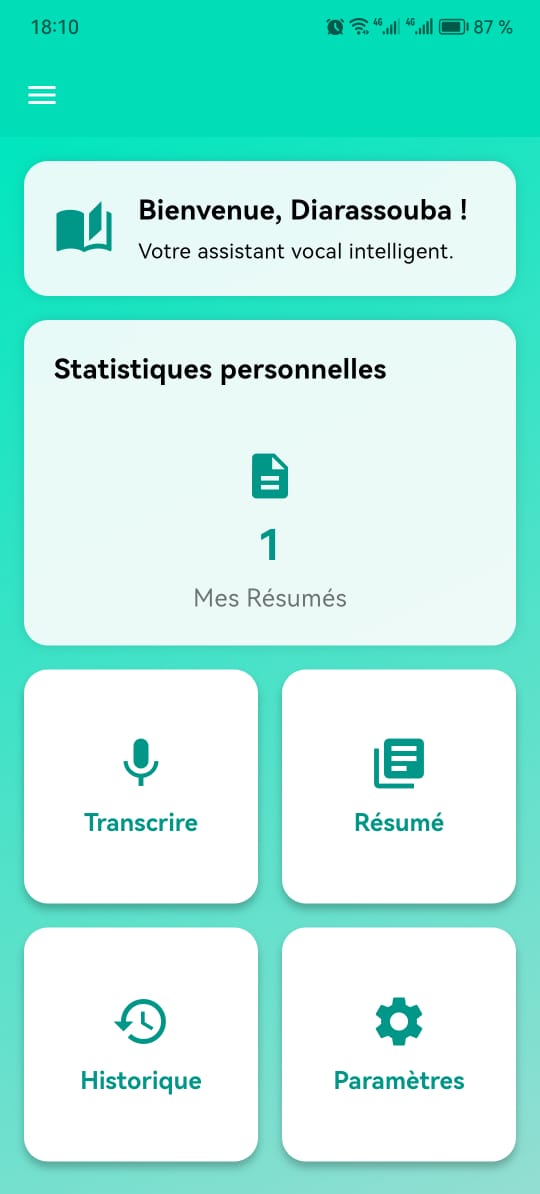
📁 Stores everything in the cloud, organized by user, with access from a simple dashboard
How we built it
In just 3 word : Flutter , Firebase and Gemini 😁 it's simple because i want to resole a specifique probleme
Challenges we ran into
While building VoiceFlow, we faced several real and technical challenges:
🔊 Poor audio quality: Community recordings often include background noise, overlapping voices, and informal speech, making transcription harder.
🌍 Local accents and languages: Whisper and other AI models struggle with non-standard accents or when speakers mix French with African languages.
📉 Limited translation support: Languages like Wolof, Ewe, or Dioula are not well-supported by mainstream translation tools, so we had to test many workarounds.
📵 Non-literate user design: Designing an app for users who can’t read meant relying on icons, voice feedback, and audio UI, which required a different approach than traditional mobile apps.
⏱️ Processing time: Keeping the transcription and summarization fast, without losing accuracy, was a technical challenge — especially on mobile devices with slow connections.
🔐 Privacy concerns: Handling personal voice data meant we had to be careful about how we store and secure user information in Firebase.
Accomplishments that we're proud of
------First My Mother life is better because her son resolve her probleme ----
- 🌍 Championing African languages: We enabled translations in underrepresented languages like Wolof, Ewe, and Dioula—making technology more inclusive and locally relevant.
- 📲 A seamless mobile experience: Built with Flutter, Firebase, and Gemini, our app is fast, lightweight, and works well even with poor audio or low-bandwidth connections.
- 🛠️ Innovative UI design for accessibility: Designing with voice commands, emojis, and icons ensured a usable experience for non-readers and those unfamiliar with tech.
- 🔐 Respecting user privacy: We implemented secure cloud storage with Firebase, ensuring personal recordings remain protected and organized by user.
What we learned
- 🗣️ Tech must speak everyone's language: Accessibility isn’t just about UI—it’s about recognizing linguistic diversity and creating tools that work for people who speak underrepresented languages or can’t read.
- 🎙️ Audio is messy—but valuable: We learned how to clean up community recordings with background noise, overlapping voices, and informal speech, making them usable with AI tools like Whisper and Gemini.
- 🌍 Cultural context matters: Supporting African languages highlighted major gaps in mainstream tech—and taught us to innovate around limited translation resources and unique local expressions.
- 🎨 Designing for non-readers is powerful: Building an audio-first interface with emojis, icons, and voice feedback pushed us to rethink how mobile apps communicate meaning.
- 🔐 Privacy and trust are non-negotiable: Handling personal recordings reminded us that good tech must be secure, respectful, and built for people—not just users.
What's next for VoiceFlow
- Expand Language Support We’re researching better ways to support more African languages and dialects, and we aim to crowdsource translations with help from local communities.
- Offline Mode & Lighter AI Models We plan to integrate on-device transcription and summarization so users in low-connectivity areas can still access key insights.


Log in or sign up for Devpost to join the conversation.