-
-
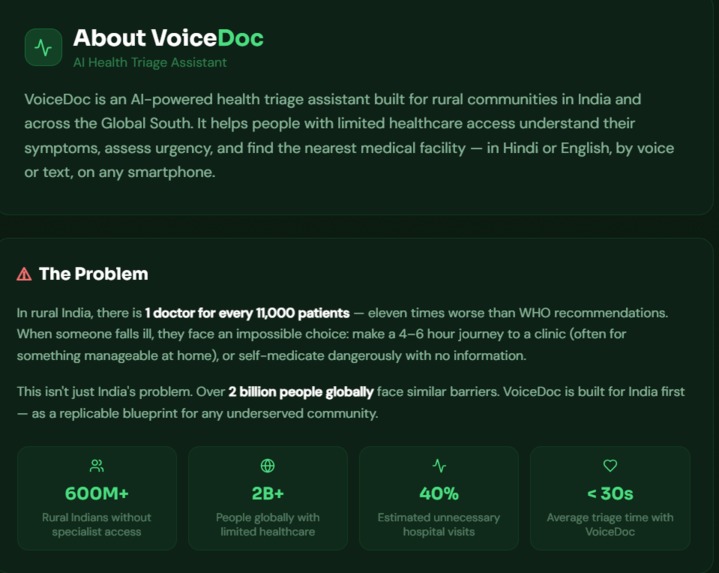
ABOUT THE PROJECT
-
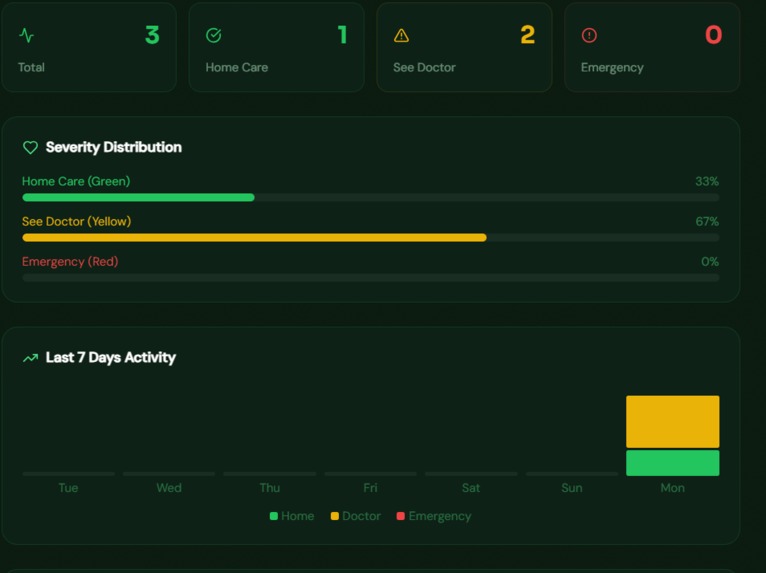
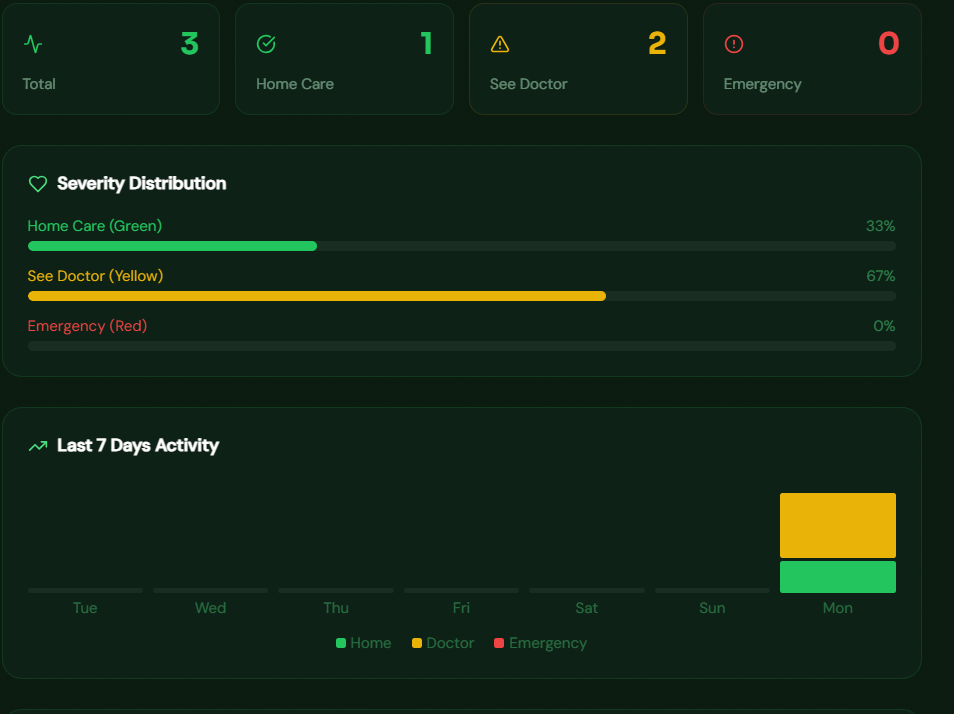
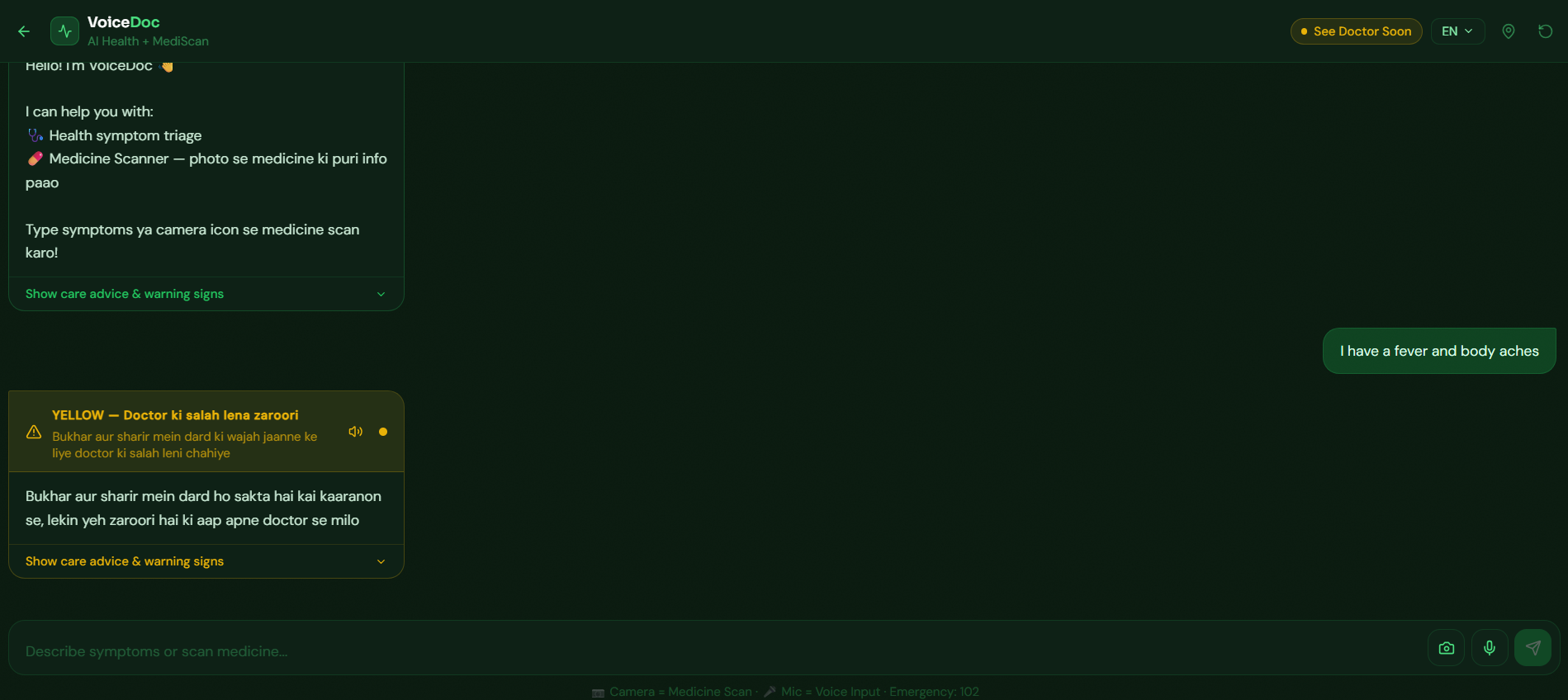
SEVERITY OF THE PROBELM RED YELLOW GREEN DEPEDNING UPON THE PROBLEM
-
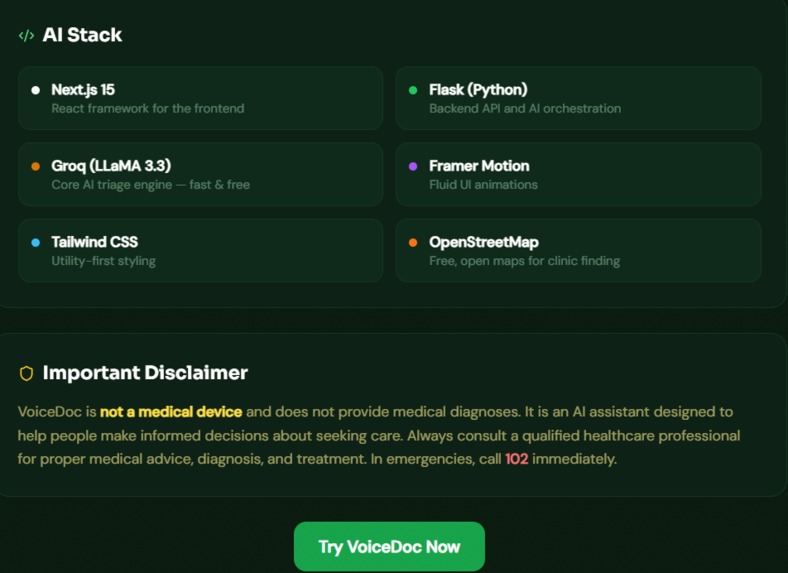
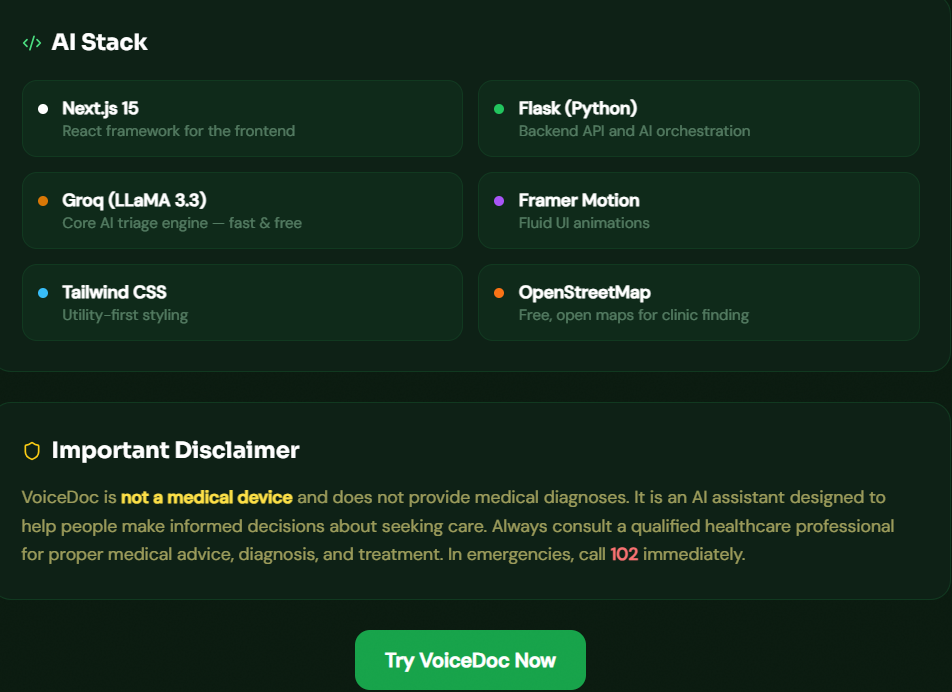
Tech Stack of our project
-
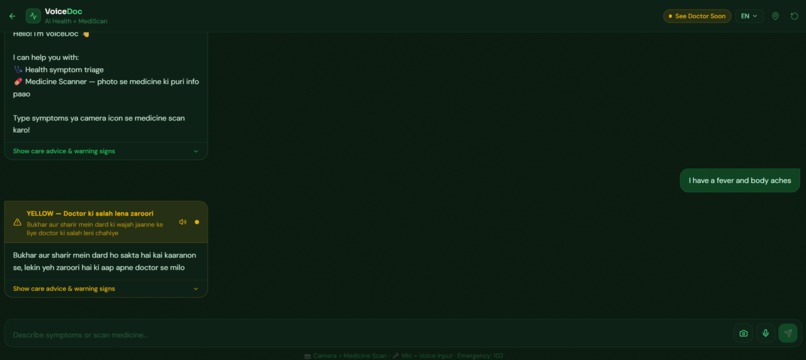
Our Project suggest the path to follow for the problem in local language
-
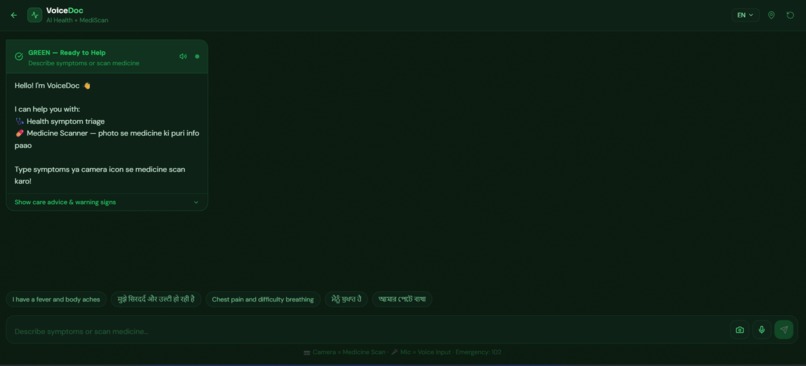
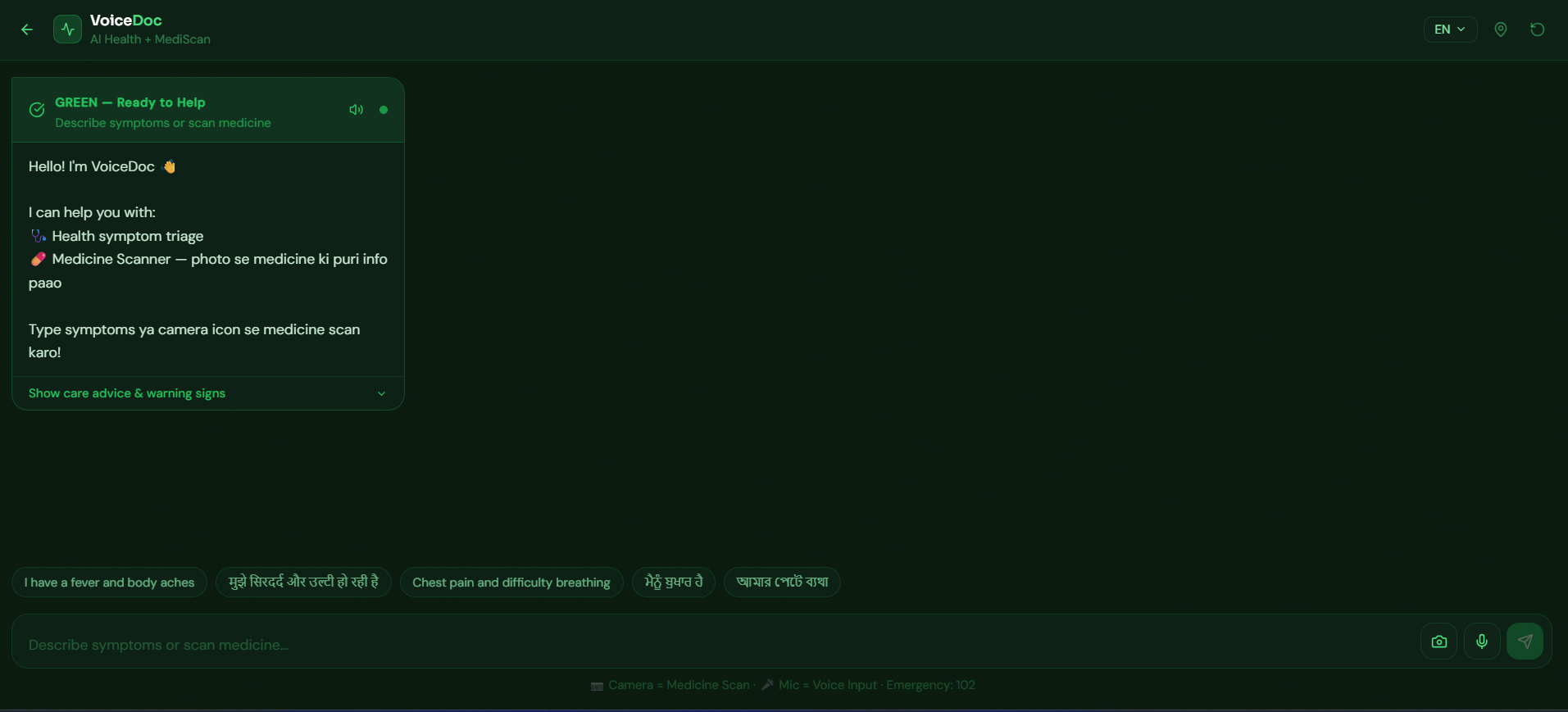
Patient Can ask about their problem
-
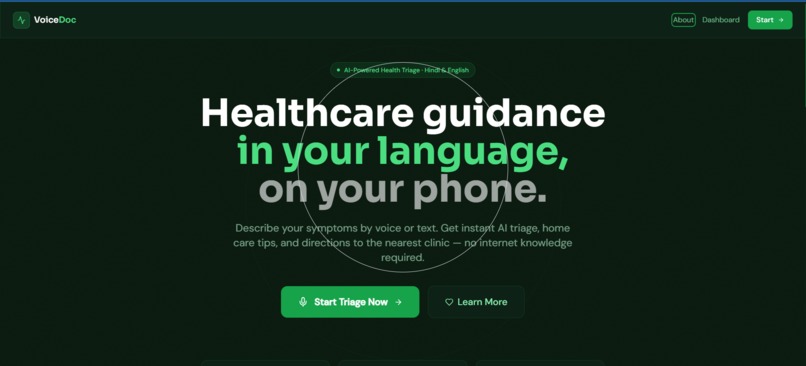
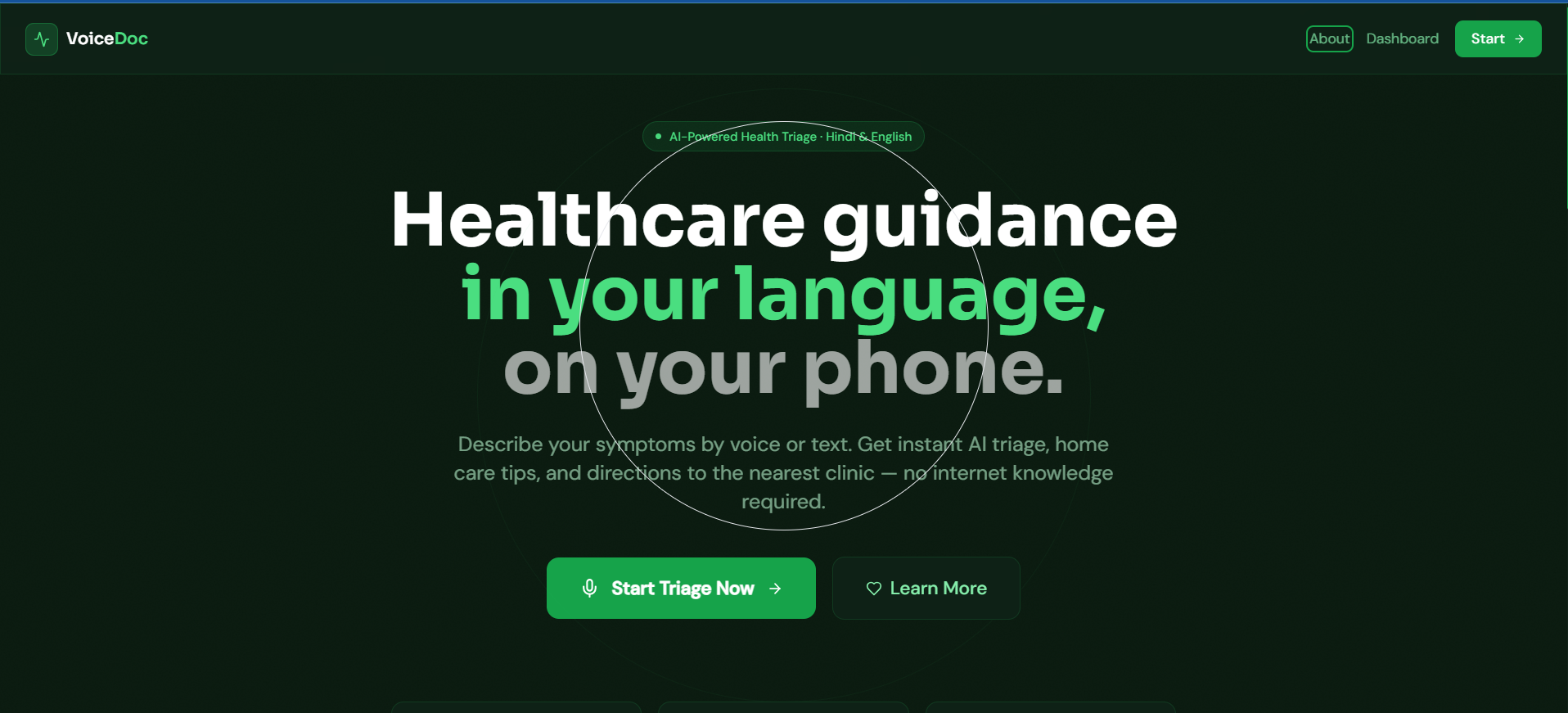
Landing Page of our project
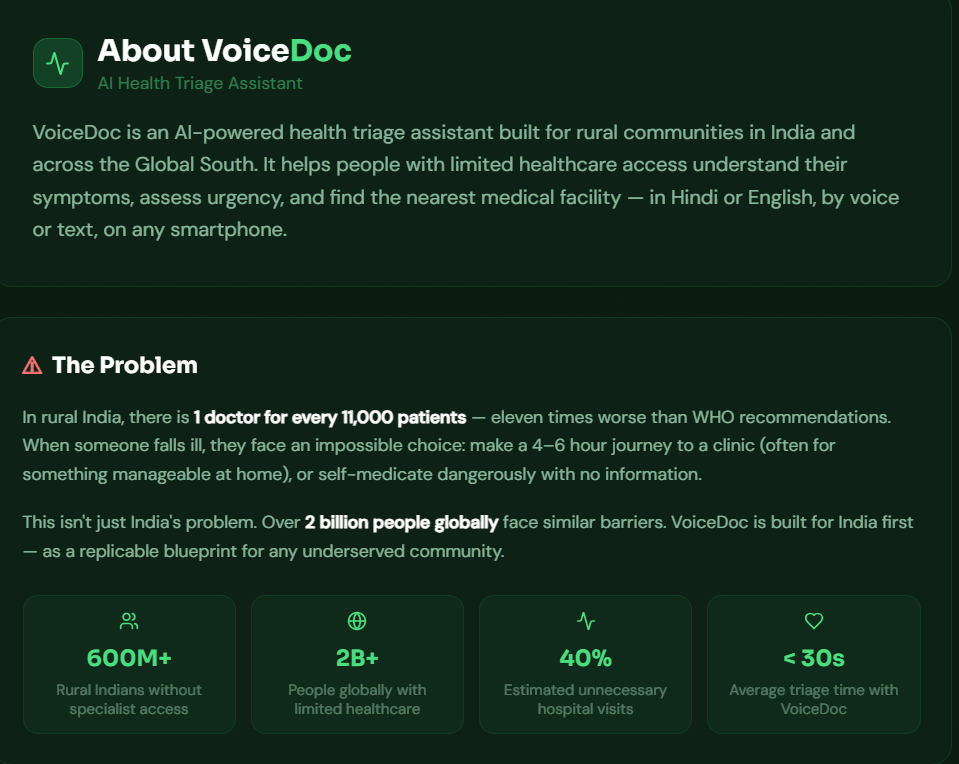
Inspiration 700 million Indians live in rural areas where the nearest doctor is hours away. Language is a barrier. Literacy is a barrier. Cost is a barrier. We asked — what if healthcare could speak your language, understand your symptoms, and guide you instantly — no doctor, no internet, no English required? VoiceDoc was born from that question.
What it does VoiceDoc is an AI-powered multilingual voice health triage system built for rural India. Users speak their symptoms in Hindi or 7 regional languages — the system understands, triages severity, and gives instant health guidance. Key features:
Voice Health Triage — speak symptoms, get AI diagnosis guidance MediScan — identify medicines via camera Emergency SOS — one-tap emergency alert 8 Indian Languages — Hindi, Bengali, Tamil, Telugu and more Patient Analytics Dashboard — track health trends over time
How we built it
Frontend: Next.js 14 deployed on Vercel Backend: Flask REST API deployed on Render AI Engine: Groq + LLaMA for ultra-fast multilingual inference Voice Processing: Web Speech API + custom NLP pipeline Database: MongoDB for patient records and analytics Camera/Vision: MediScan module for medicine identification
Challenges we ran into
Python 3.14 and pydantic-core incompatibility on Render — fixed by pinning Python 3.11.9 and pydantic 1.10.2 Hardcoded localhost URLs breaking production — resolved via Vercel environment variables react-leaflet dependency conflict causing Vercel build failures — fixed by cleaning package-lock.json Making voice recognition accurate across Indian accents and dialects with limited training data Balancing AI response speed with accuracy for low-bandwidth rural environments
Accomplishments that we're proud of
Fully functional live product — not just a prototype Real multilingual voice triage working across 8 Indian languages MediScan working in real-time with just a phone camera End-to-end deployment: Vercel + Render + MongoDB in production Built a system that could genuinely save lives in underserved communities
What we learned
Deploying AI systems for Bharat means optimizing for low-end devices and patchy connectivity Dependency management in Python for production is brutally unforgiving — always pin versions Groq's inference speed is a game changer for real-time voice applications Designing for rural users means rethinking every UX assumption — voice-first is not optional, it's essential
What's next for VoiceDoc VoiceDoc is not just a hackathon project — it is a long-term mission to make quality healthcare a right, not a privilege, for every Indian regardless of language, location, or literacy. Phase 1 — Offline First (Next 3 months) Full offline triage capability using on-device compressed LLMs so VoiceDoc works even in zero-connectivity villages. No internet. No problem. Phase 2 — ASHA Worker Toolkit (3-6 months) A dedicated dashboard for India's 1 million ASHA workers — the real frontline of rural healthcare. Automated patient tracking, symptom history, and AI-assisted referral recommendations built into their daily workflow. Phase 3 — Affordable IoT Integration (6-9 months) Sync with low-cost health wearables to capture real-time vitals — heart rate, SpO2, temperature — and feed them directly into the triage engine for more accurate, data-driven diagnosis guidance. Phase 4 — Government Health Stack Integration (9-12 months) Deep integration with Ayushman Bharat Digital Mission and the National Health Authority stack — making VoiceDoc a recognized tool within India's public healthcare infrastructure, not just a standalone app. Phase 5 — All 22 Scheduled Languages (12 months) Expanding beyond 8 languages to cover every scheduled language in the Indian Constitution — ensuring no community is left behind, from Manipuri to Konkani to Dogri. The vision is simple: by 2027, a farmer in rural Jharkhand should be able to describe chest pain in Santali, receive accurate triage guidance in 3 seconds, and get connected to the nearest government hospital — all from a basic Android phone. VoiceDoc makes that possible.
Built With
- flask
- groq
- html5
- javascript
- leaflet.js
- llama-3
- mongodb
- next.js-14
- oracle-cloud-infrastructure
- python
- react
- render
- rest-api
- tailwindcss
- vercel
- web-speech-api

Log in or sign up for Devpost to join the conversation.