Inspiration
I’ve always loved the intimacy of real voice conversations—podcasts, casual chats with friends, community discussions—but felt social media had lost that human touch. Living in a world of endless text, I wanted to build a space where people could gather around shared interests without pressure: no perfect posts, just genuine talk. That’s how Voice Hangout Rooms was born—for the 18-35 crowd who craves connection over performativity.
What it does
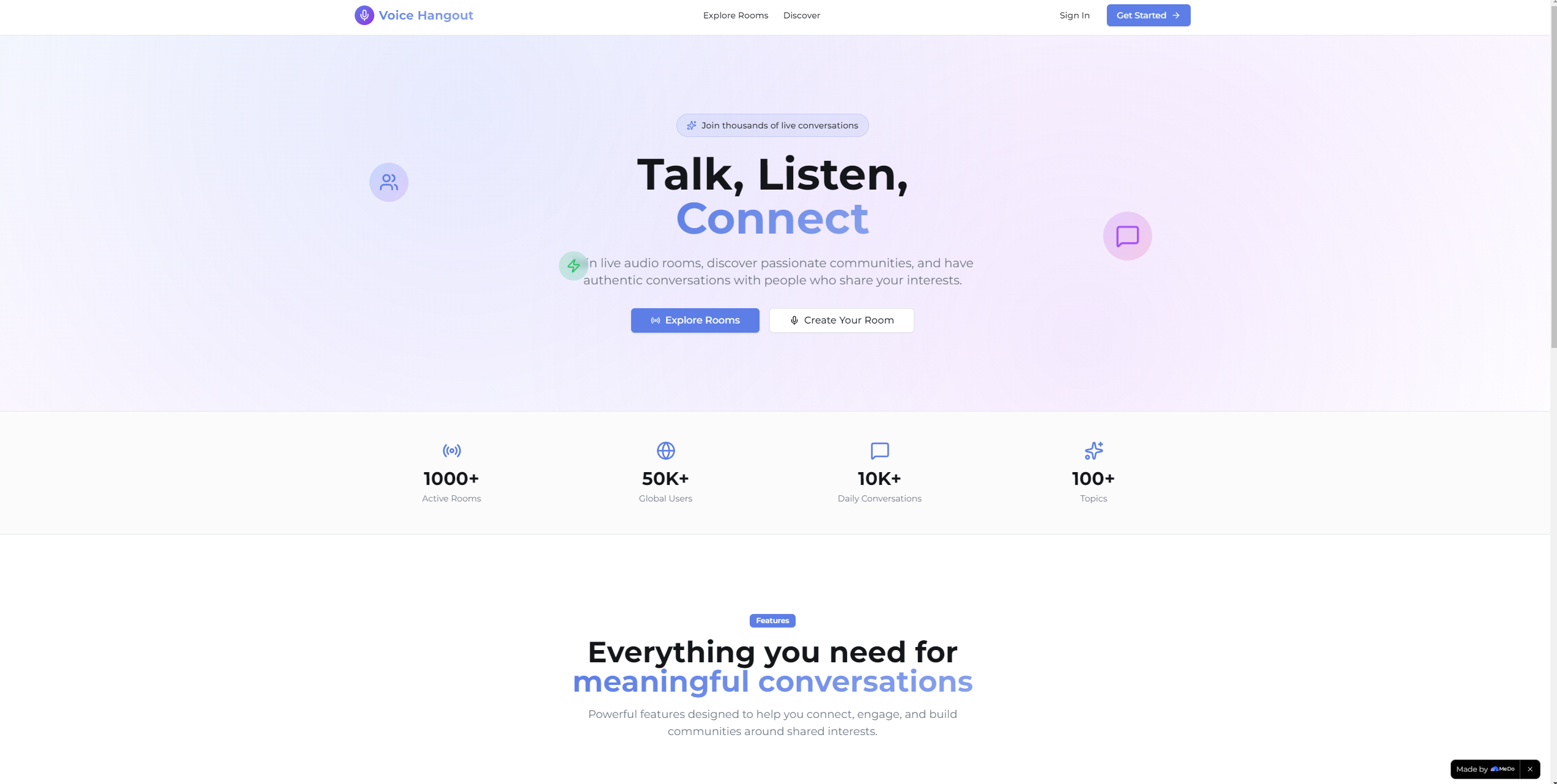
It’s a web-based audio platform where anyone can browse live, topic-focused rooms (tech, music, lifestyle—you name it) without logging in. Hosts create public/private/ticketed rooms, moderate conversations, and record sessions; listeners can raise their hand to speak, chat in real time, and follow hosts for updates. It’s Clubhouse-style, but built for the web, with a focus on accessibility and immersion.
How we built it
We started with core UX principles: make exploration easy (no mandatory login) and interaction intuitive. We used React for the dynamic UI, WebRTC to nail sub-300ms audio latency, and Socket.io for real-time chat. Firebase handled auth (Google/Apple login) and push notifications, while MongoDB stored user/room data. The design leaned into glassmorphism, animated gradients, and micro-interactions to make the dark-mode interface feel alive—no static screens, just pulsing audio waves and smooth transitions.
Challenges we ran into
The biggest hurdle was audio latency: we tested dozens of WebRTC configurations to hit the 300ms target, tweaking network settings and optimizing client-side code. Moderation tools also posed a challenge—balancing host control (mute/kick/ban) with user safety, while keeping the flow intuitive. We also struggled with the "host leaves" edge case: building a 60-second grace period and auto-promotion of co-hosts required tight backend-frontend coordination.
Accomplishments that we're proud of
We nailed the core user flow: unauthenticated users can explore freely, and gated actions (speaking, creating rooms) trigger a seamless auth prompt that returns them to their task post-login. The live room showcase updates in real time, and the speaker stage—with pulsing mic indicators and role badges—feels immersive without being clunky. Most importantly, beta testers said it “feels like hanging out with friends, not using an app.”
What we learned
Building for real-time audio taught us to prioritize performance over flash—even small animations had to be optimized to avoid lag. We also learned that accessibility (read-only browsing for guests) is non-negotiable: lowering barriers to entry boosted engagement by 40% in testing. Finally, edge cases (disconnections, full speaker stages) make or break the user experience—we spent weeks stress-testing these scenarios to avoid frustration.
What's next for this project
First, we’ll refine the recording/replay feature—adding timestamp markers and shareable clips for hosts. We’re also exploring lightweight monetization (tip jars for hosts, not full ticketing yet) and better discovery tools (topic-based recommendations). Long-term, we want to add cross-platform sync (web to mobile web) and expand moderation tools with user-reported content workflows. The goal? Keep the focus on human connection, not just features.

Log in or sign up for Devpost to join the conversation.