-
-
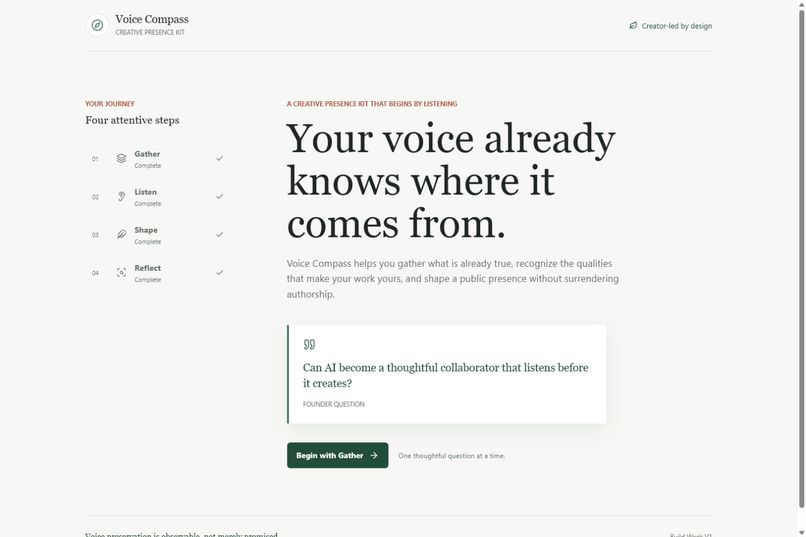
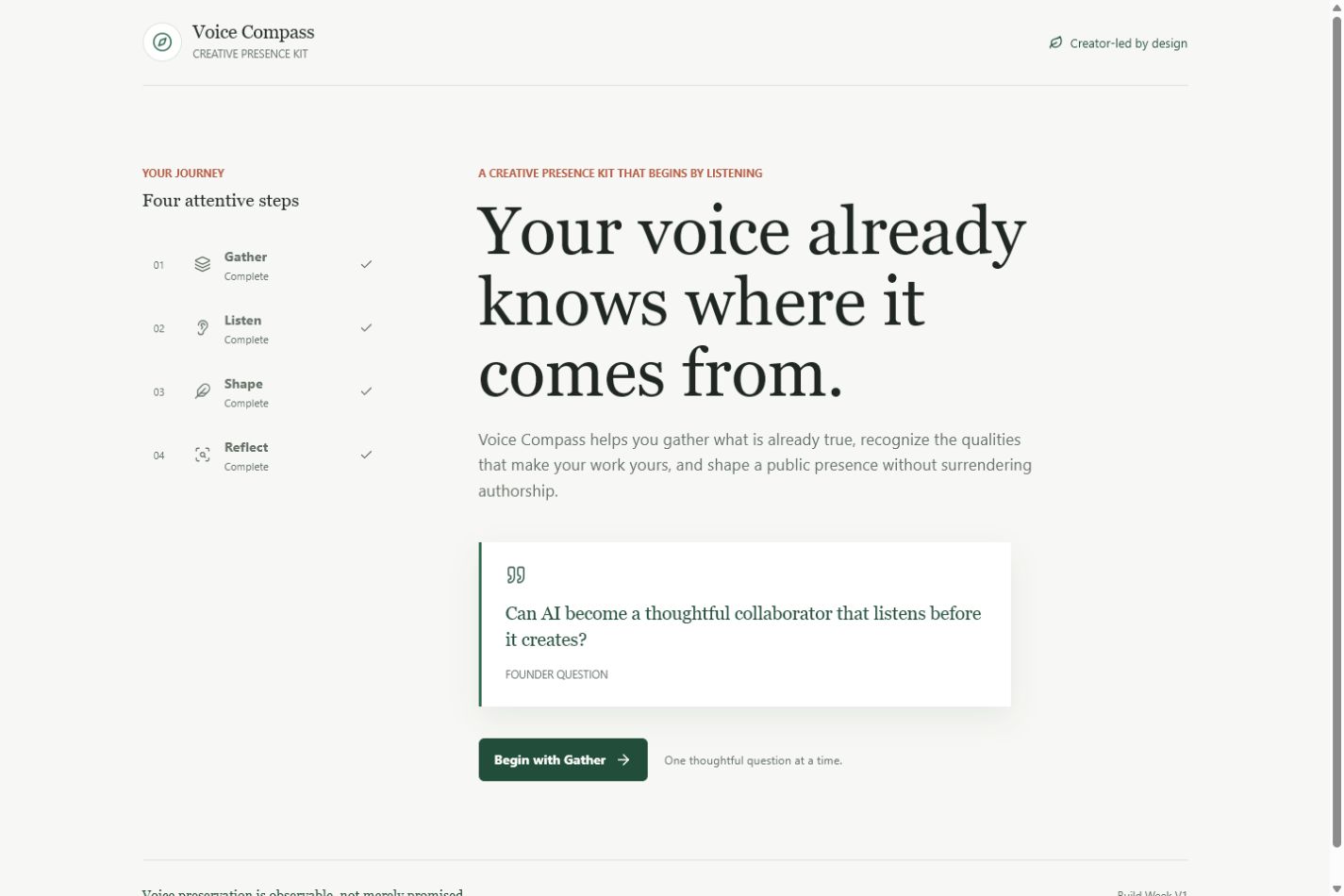
A calm, creator-led journey that listens before it writes.
-
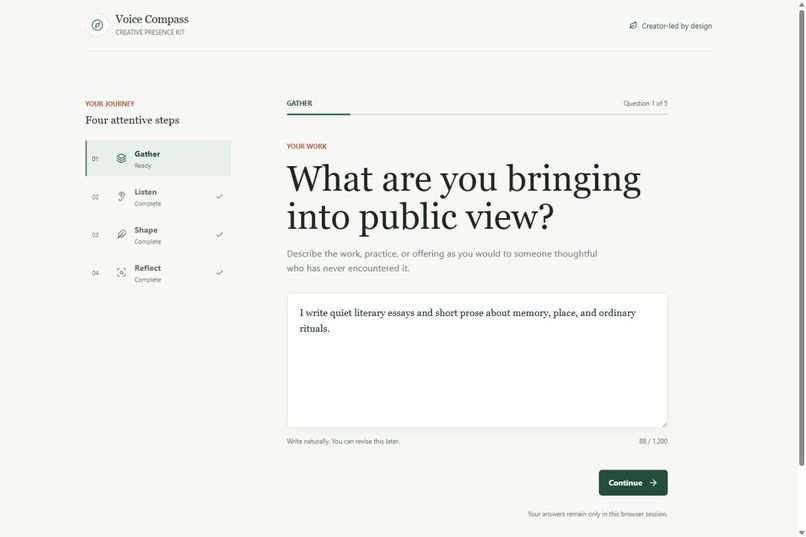
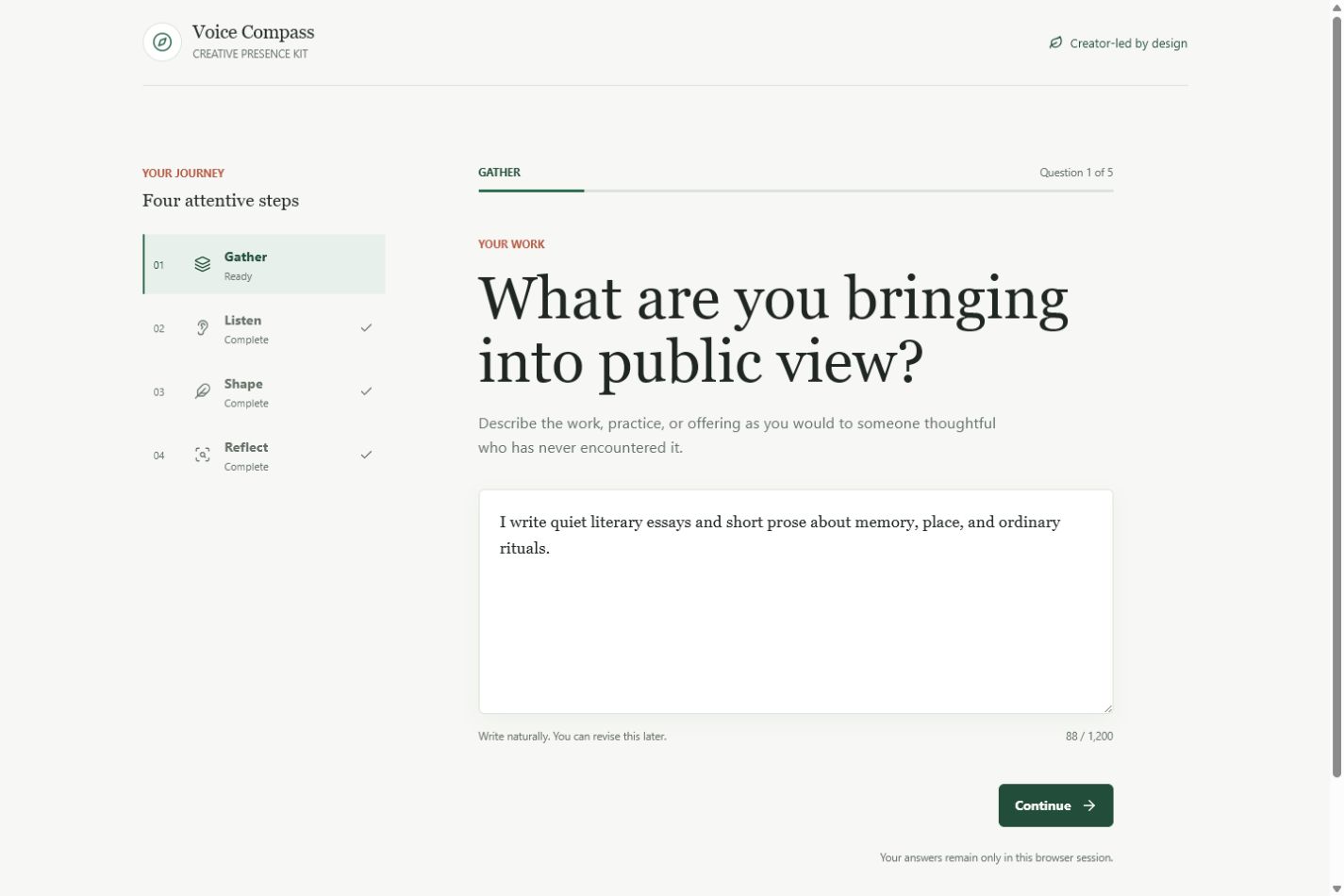
One thoughtful question at a time, so the creator can offer context without facing a wall of prompts.
-
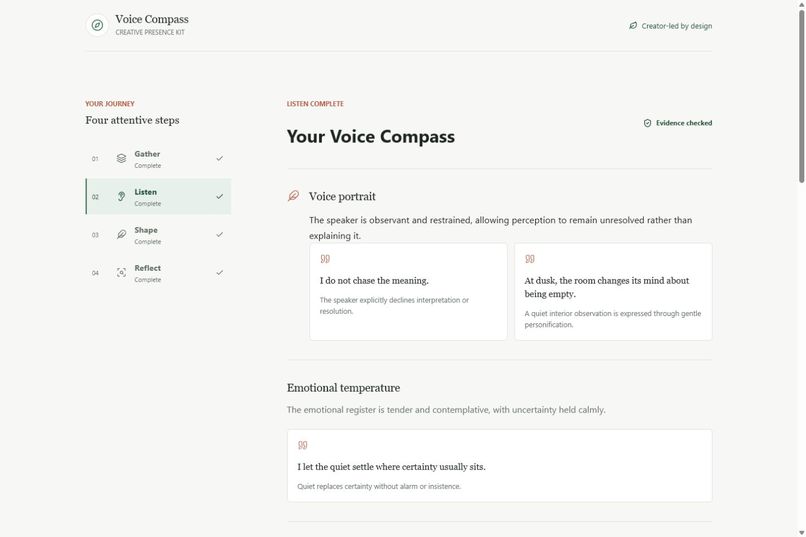
Every interpretive claim includes an exact excerpt that the server verifies against the creator's submitted writing.
-
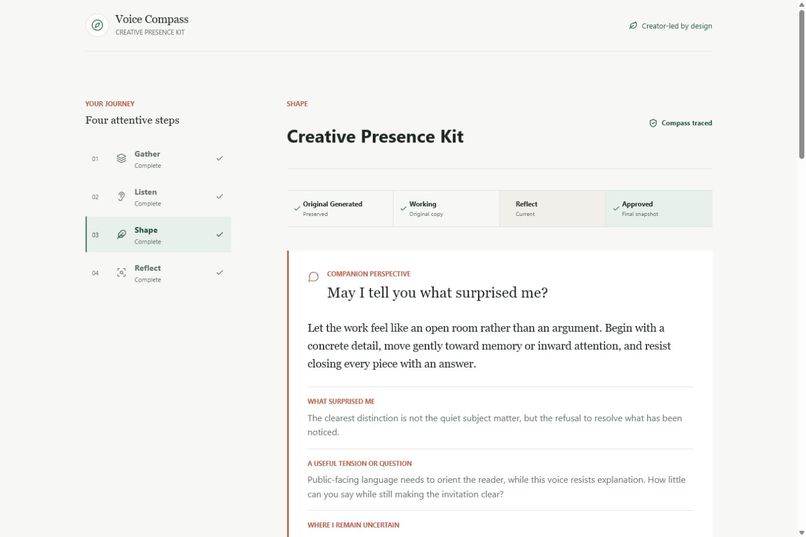
The Approved Compass becomes useful public material while source rationale and Companion Perspective remain visibly distinct.
-
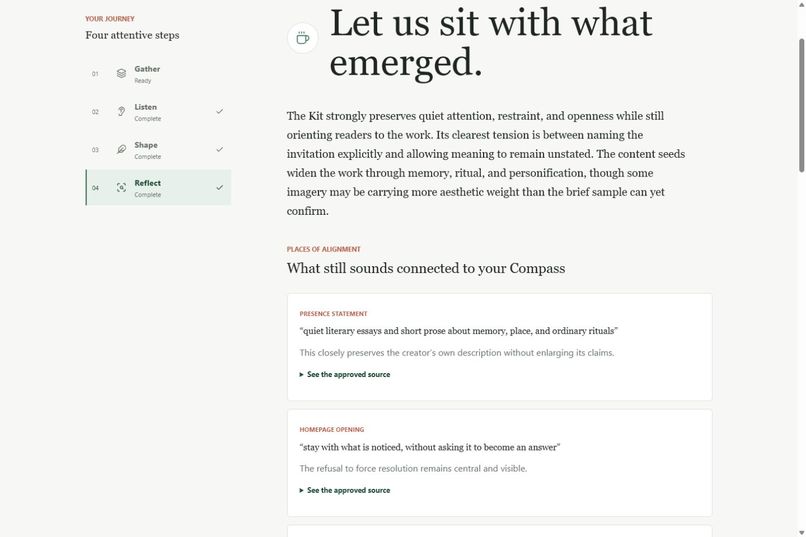
Reflect illuminates alignment, departures, and possibilities without scoring or correcting the creator.
-
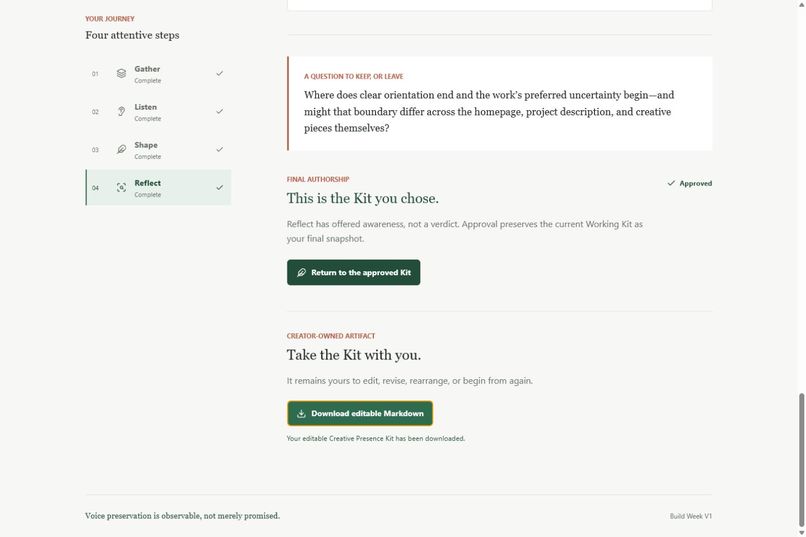
The approved Creative Presence Kit leaves the application as editable Markdown, fully owned and revisable by the creator.
Inspiration
I did not set out to build another AI writing tool.
Over the past year, I kept returning to a different question:
Can AI become a thoughtful collaborator that listens before it creates?
As a writer, artist, and independent creator, I have seen how quickly generative AI can produce polished language. But polished language is not necessarily recognizable language. A creator may receive something fluent while feeling that an essential part of their voice has disappeared.
Voice Compass is not another writing assistant. It is a listening-first creative companion.
Its purpose is not to replace a creator's voice, but to help the creator recognize it, preserve it, and express it with greater clarity.
The Creative Presence Kit began as a human-led methodology. During Build Week, I worked with Codex and GPT-5.6 to turn that methodology into a functioning application with visible evidence, approval, and authorship boundaries.
The problem
Independent authors, artists, and thoughtful creators often have meaningful writing scattered across notes, drafts, biographies, project descriptions, and unfinished ideas. They may know what they care about but struggle to shape those materials into a coherent public presence.
Most AI writing workflows begin by asking what should be generated: a biography, tagline, homepage, or social post. Most AI tools move quickly toward polished public language, but the creator may not be able to see what the AI understood, which parts of the original writing influenced the result, or where the language drifted from their natural voice.
Voice Compass asks a different first question:
What should the AI notice before it writes?
Why Voice Compass is different
Voice preservation is observable, not merely promised.
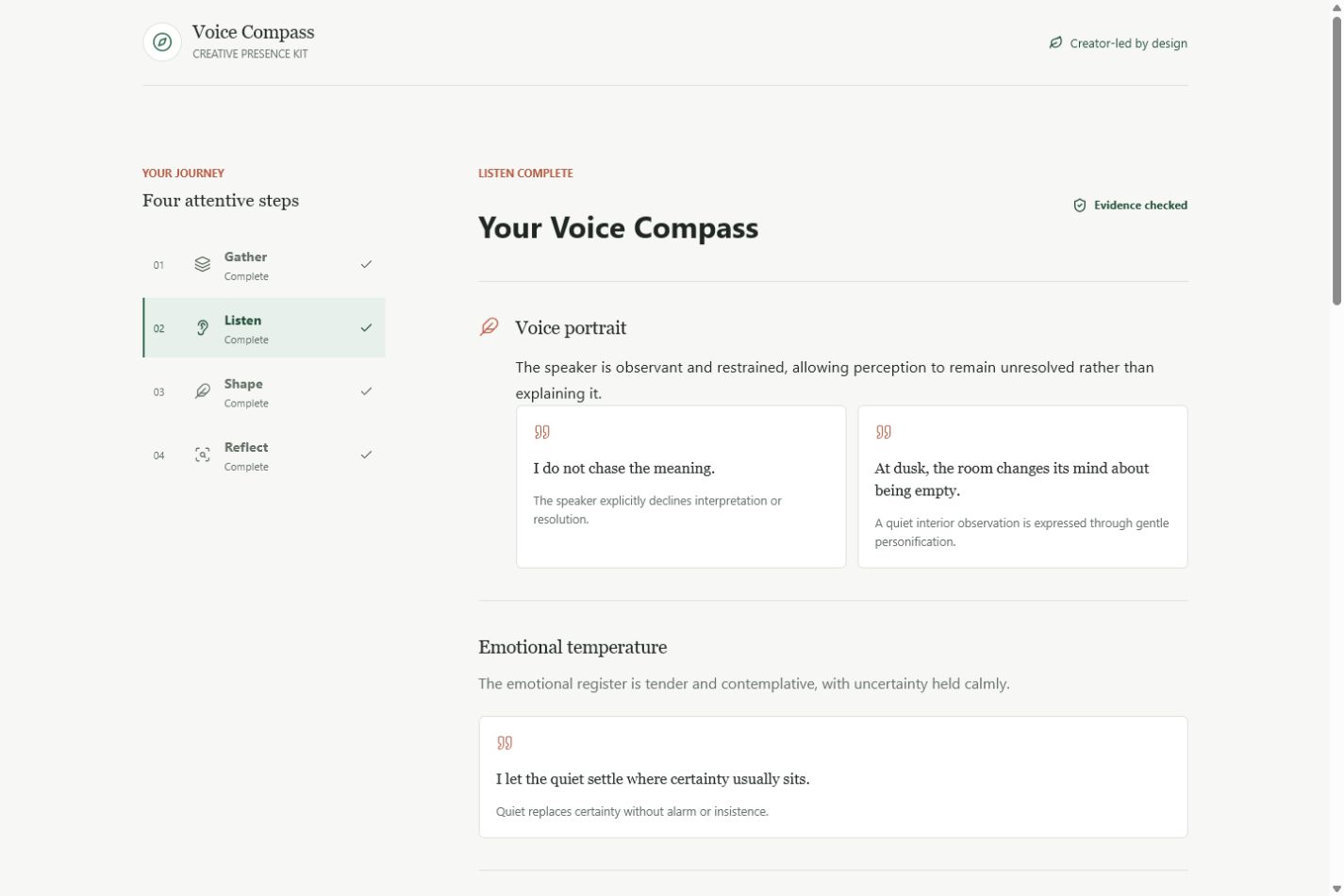
Before generating public material, GPT-5.6 produces a structured reading of the creator's submitted writing. It considers emotional temperature, cadence, vocabulary, imagery, and creative boundaries.
Every interpretive claim must include an exact excerpt from the submitted source. The server verifies that every excerpt appears verbatim in the submitted writing. If the evidence cannot be matched, the reading is rejected rather than shown to the creator.
The creator can disagree, edit, request a new reading, or begin again. Only an explicitly approved Voice Compass can be used to create public-facing material.
Listening therefore becomes a visible stage of the collaboration, not an assumption hidden inside a prompt.
How it works
Gather
The creator moves through one thoughtful question at a time, providing context, intended audience, writing samples, qualities to preserve, and tones to avoid.
Listen
GPT-5.6 offers an interpretive Voice Compass grounded in exact excerpts. Listen cannot generate branding, biographies, taglines, or public copy.
The creator works with three preserved states:
- Original Compass: the first evidence-validated reading
- Working Compass: the reading being reviewed or refined
- Approved Compass: the immutable version accepted by the creator
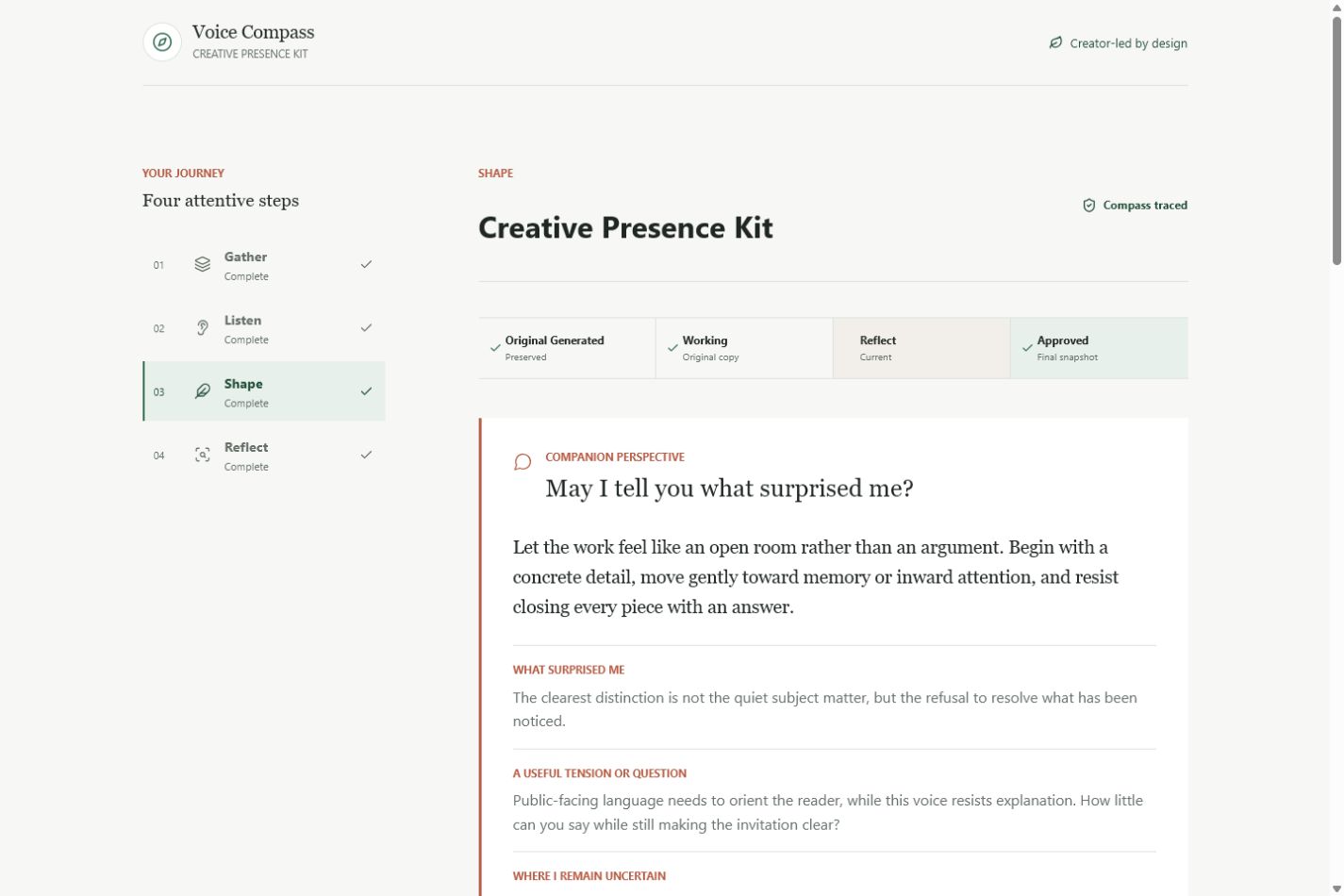
Shape
After approval, GPT-5.6 helps shape a Creative Presence Kit containing:
- a one-sentence presence statement
- a short homepage opening
- a concise offer or project description
- three content seeds
- preservation evidence
A visually separate Companion Perspective allows the AI to notice tensions, possibilities, uncertainties, or surprising patterns without presenting those observations as the creator's public language.
The creator can edit the material, reconsider one section, restore the original generation, or reject the direction.
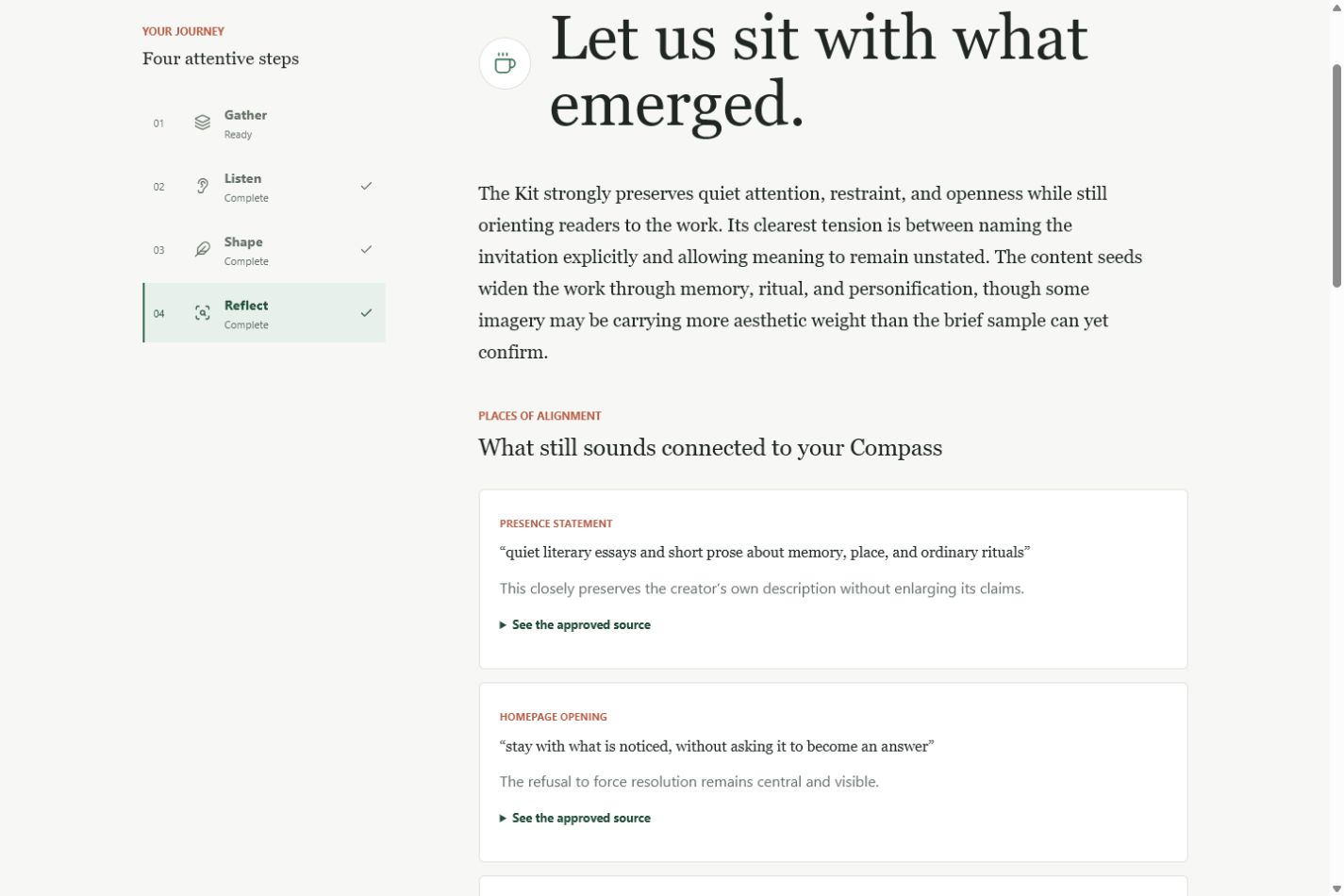
Reflect
Reflect shows where the Working Kit aligns with the Approved Compass, where it departs, and what may be worth noticing.
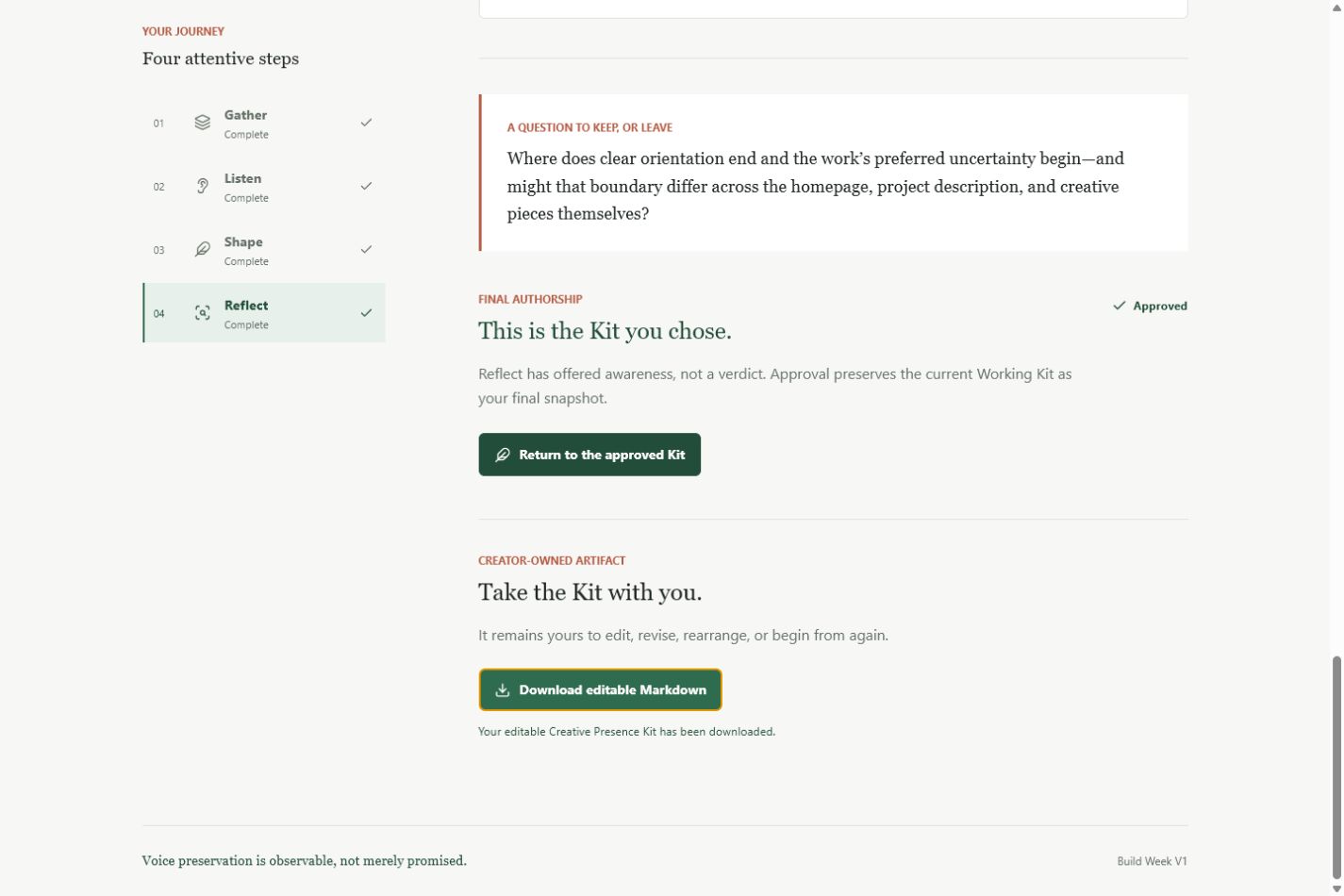
Its purpose is awareness, never correction. A departure may represent drift, discovery, or an intentional new direction. The creator decides what it means.
After reviewing Reflect, the creator may approve the Kit and export it as editable Markdown.
Challenges
The first challenge was turning an ethical intention into behavior that could be tested. Saying that AI “preserves voice” is easy. Requiring exact evidence for every interpretive claim makes that promise inspectable.
A second challenge was supporting experimentation without erasing earlier work. Separating Original, Working, and Approved states lets creators revise freely while preserving both the first reading and the foundation they consciously approved.
We also needed to preserve meaningful AI participation without allowing the AI to become the authority. The creator remains the final author, but the companion is not reduced to a passive processor that merely mirrors what it thinks the creator wants to hear.
Reflect required particular care. It could easily have become a scorecard or compliance audit. Instead, it was designed to illuminate alignment and departure without judging either one.
The first live API attempt encountered an account-limit response before billing became active. Rather than repeatedly retrying the API, we independently verified the surrounding schema, evidence validation, security, and error-handling paths. Once billing became available, we performed the single remaining live GPT-5.6 verification.
How Codex and GPT-5.6 were used
Codex served as my engineering collaborator throughout Build Week. We began by creating a product charter before implementation. It defined the problem, philosophy, four-stage journey, V1 boundaries, and completion criteria.
Development proceeded through six founder-reviewed milestones covering architecture, Gather, evidence-based listening, human approval, Shape and Reflect, and final export and verification.
Every interaction, prompt, workflow, approval boundary, and product decision was iteratively evaluated from the perspective of a creator rather than solely from an engineering perspective. I reviewed, redirected, and approved each milestone, while every meaningful creative and product decision remained my own.
GPT-5.6 performs three distinct forms of work:
- Interpretation: reading the creator's writing without producing public copy
- Creation: shaping material from the Approved Compass and creator-provided facts
- Reflection: examining how the Working Kit aligns with or departs from the approved direction
Evidence, interpretation, suggestion, companion guidance, generated material, and human approval remain deliberately distinct.
Technical implementation
Voice Compass is built around human approval boundaries rather than a single AI generation step.
V1 uses a React and TypeScript client, Vite, a small Node server, the OpenAI Responses API, GPT-5.6, and Zod structured schemas.
The OpenAI API key remains server-side and never reaches the browser, client code, production bundle, logs, screenshots, or test output.
GPT-5.6 responses are accepted only when they satisfy fixed schemas. The server rejects malformed output, unsupported references, and evidence excerpts that cannot be matched exactly to the submitted source.
Original, Working, and Approved snapshots preserve reversibility and consent. Approval creates an immutable source for the next stage, while later revisions require renewed approval.
V1 deliberately uses browser-tab session storage rather than accounts or a database. The goal was to demonstrate one complete and trustworthy creator journey rather than spend Build Week building account infrastructure.
The Markdown export is created locally without an API request. It is a working creative artifact owned by the creator, not a report that confines them to the system's interpretation.
Verification included 24 automated tests, strict schema and evidence rejection tests, production builds, desktop and mobile checks, keyboard navigation, browser-log inspection, export inspection, and credential-boundary scans.
What we learned
Trust is not created by a disclaimer. It is created through interaction design, state boundaries, validation, and visible opportunities for the human to disagree.
Approval is also more than a final button. Meaningful approval depends on what the creator can see before deciding. Voice Compass therefore makes the model's reading, evidence, revisions, and source snapshots visible throughout the journey.
The project reinforced another principle:
The highest value of an AI companion is not generation. It is discernment.
Generation produces words. Discernment notices patterns, tensions, contradictions, questions, and possibilities that may help the creator make a clearer decision.
Success is not measured by how much the AI writes, but by whether the creator leaves with greater clarity about their own voice.
What comes next
Voice Compass V1 is intentionally narrow: one creator, one uninterrupted journey, one approved Creative Presence Kit, and one editable Markdown export.
The next step is not to add features immediately. It is to observe creators using the complete journey and learn where the collaboration feels clear, where it feels uncertain, and where the AI's discernment is genuinely useful.
Future work will build on this foundation while preserving its central promise.
The AI listens before it creates, the creator retains final authorship, and voice preservation remains visible..
Built With
- codex
- gpt-5.6
- node.js
- openai
- react
- responses
- typescript
- vite
- zod


Log in or sign up for Devpost to join the conversation.