Inspiration
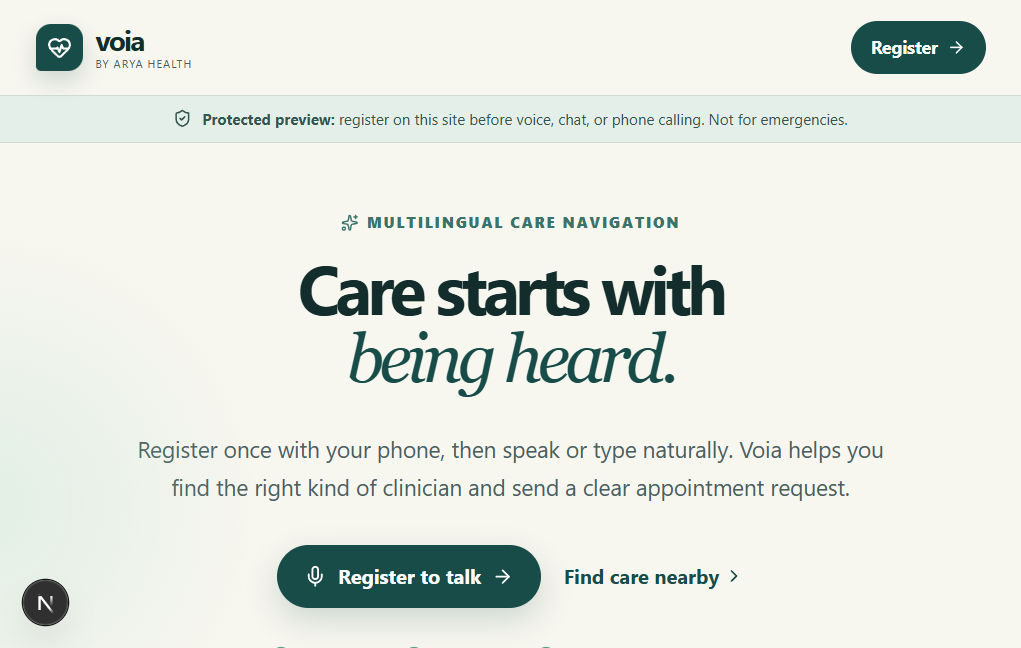
Healthcare access often fails before someone ever sees a clinician. People get stuck in phone trees, unclear specialty choices, and intake forms that ask them to repeat the same story. We wanted care to start with being heard.
That led to a simple idea: conversation is context. While someone books care, the agent should listen for cues in their voice and words, urgency, continuity vs a new concern, language preference, what kind of clinician they need, and turn that into a clearer next step. Not a diagnosis. Navigation.
What it does
Voia by Arya Health is a multilingual care-navigation assistant for web voice, web chat, phone, and SMS.
Patients register on the website first (phone + OTP), then can talk with Voia. During booking, Voia:
Helps them describe what they need in English or Español Asks whether the issue is new or a continuation Routes them toward an appropriate specialty and nearby public provider listings Submits a pending appointment request (not a fake “confirmed” slot) Watches for emergency red flags and stops routine booking when needed Sends consented SMS follow-ups, including clear disclosure that voice disease screening did not run The experience is built around listening during the booking conversation — using that conversation as context for safer, clearer care navigation.
How we built it
We built an end-to-end preview around one continuous conversational agent and shared backend logic:
Frontend: Next.js + React care experience (registration gate, voice/chat, booking form) Conversational AI: ElevenLabs agent driven by config/voia-agent-prompt.md, with authenticated webhook tools Telephony/SMS: Twilio for inbound voice (registration-gated) and SMS OTP/follow-ups Provider discovery: Nimble public listings, queried without patient identity or free-text symptoms Persistence: appointment requests, consents, notifications, registration/OTP, webhook receipts Safety: emergency keyword gating, consent separation, encrypted contact storage in live mode, signed webhooks The agent and web form share the same appointment, validation, and consent rules so voice and UI stay consistent.
Challenges we ran into
Honesty vs. aspiration. We wanted cue-aware booking, but refused to claim voice disease detection without a validated model, so screening stays disabled, and messages explicitly say no disease was inferred. Registration before calling. Phone callers bypass the website unless voice is routed through an app gate that checks registered numbers. Language switching. Asking for Español wasn’t enough; we had to limit to English/Español and pass real en/es session overrides so ASR/TTS actually switch. Messaging gaps. Conversations were ephemeral; SMS only existed for optional appointment receipts. We added consented follow-up messaging and post-call hooks. Trustworthy booking language. The system can request care, not confirm slots, every status path had to avoid “booked” unless a real scheduler exists. Minimum necessary data. Collecting less (no name), hashing/encrypting contact details, and never sending PHI into provider search.
Accomplishments that we're proud of
A full patient path: register → converse → discover providers → request appointment → SMS follow-up Clear product boundaries enforced in code and agent policy Multilingual English/Español support with real session language overrides New vs. continuation issue typing during intake Emergency gating that prioritizes safety over booking completion A care experience that treats conversation as the context for navigation, not as a chatbot gimmick What we learned In health UX, what you refuse to claim matters as much as what you ship Voice agents need explicit language, consent, and tool contracts, prompts alone aren’t enough Telephony, web, and chat only feel coherent when they share one policy and one backend Patients shouldn’t re-enter identity theater; phone verification can unlock care without collecting a name “Conversation is context” only works if follow-up systems (SMS, issue type, screening disclosure) close the loop
What's next for Voia
Connect a real scheduling / FHIR / EHR adapter so requests can become truly confirmed Add clinically validated voice cue / screening models behind proper consent and review Stronger returning-patient history after OTP (prior requests, continuation matching) Broader language support beyond English and Español Harden production HIPAA posture (vendor BAAs, retention controls, audit trails) Richer post-conversation care summaries for patients and care teams — still minimal, still consented

Log in or sign up for Devpost to join the conversation.