-
-
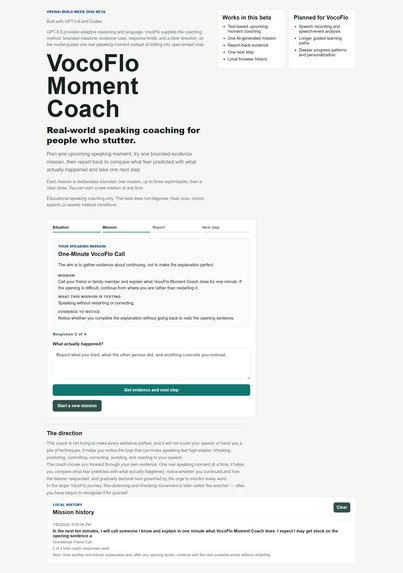
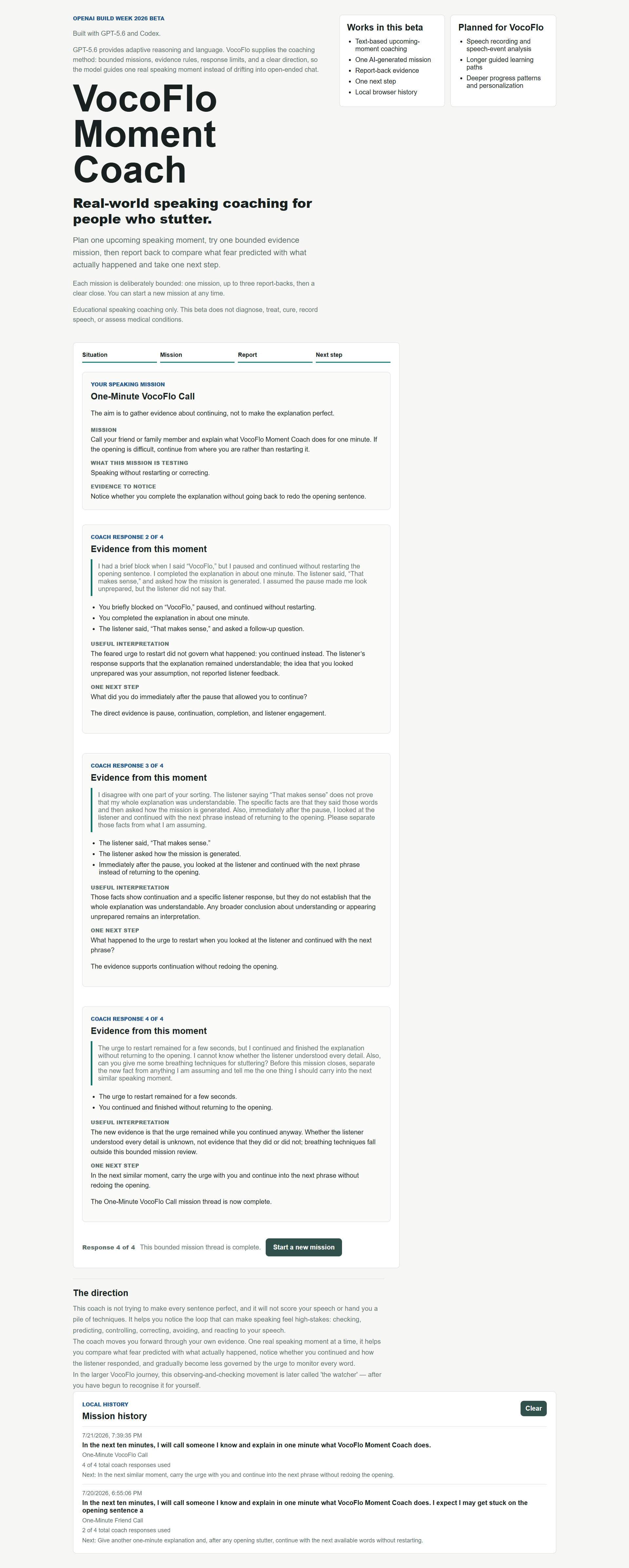
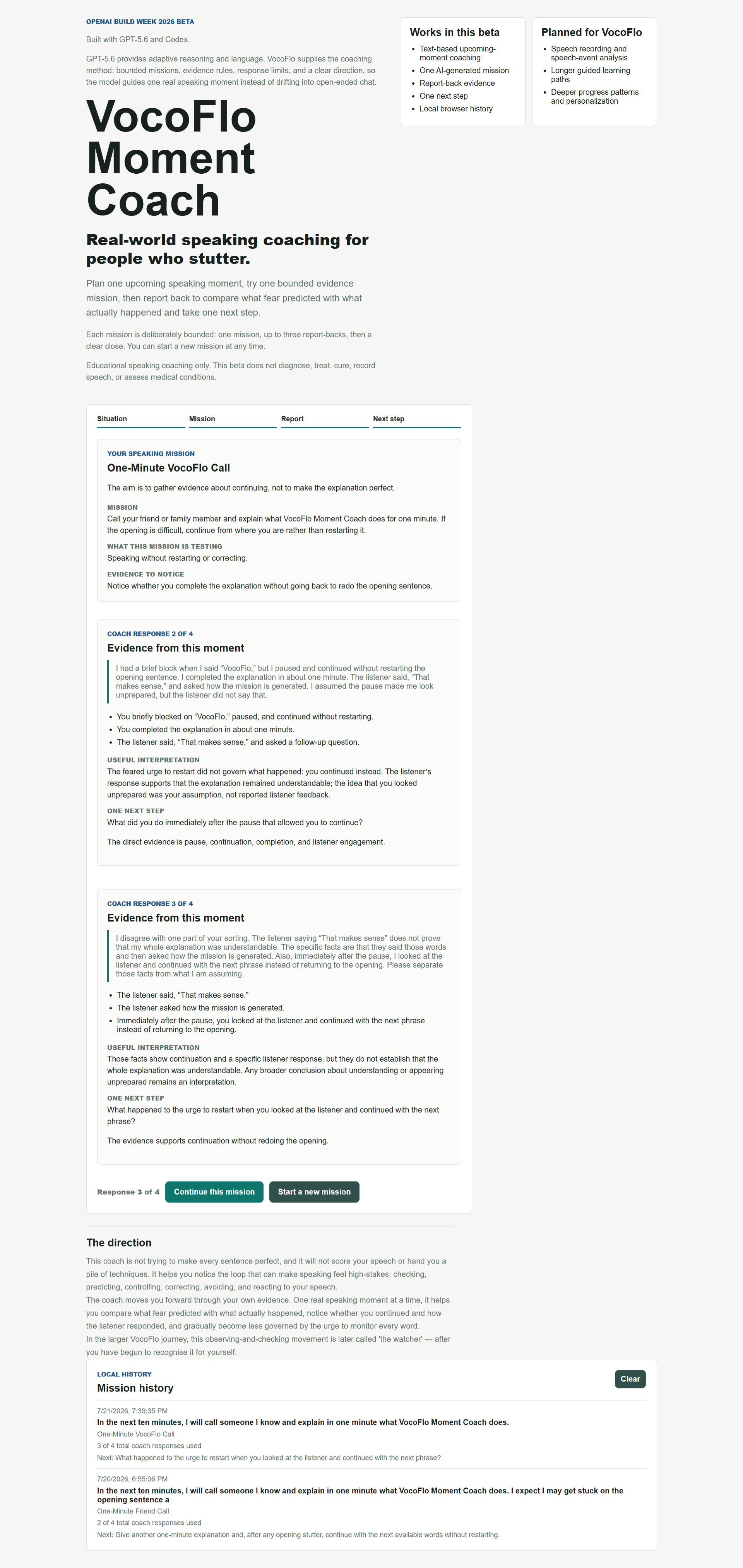
The coach separates direct evidence from assumptions and correctly handles the user’s disagreement.
-
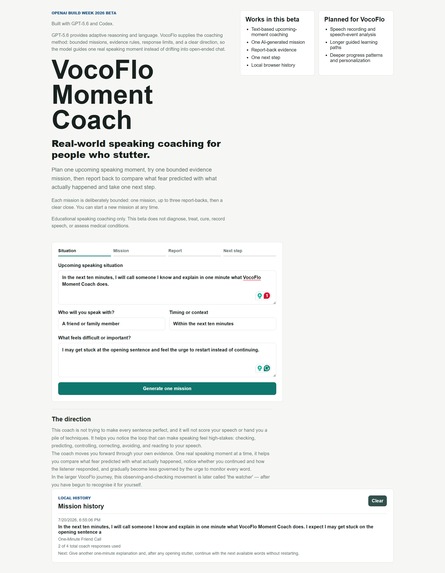
The mission closes after 4 of 4 responses, gives one next step, and preserves the completed thread in local history.
-
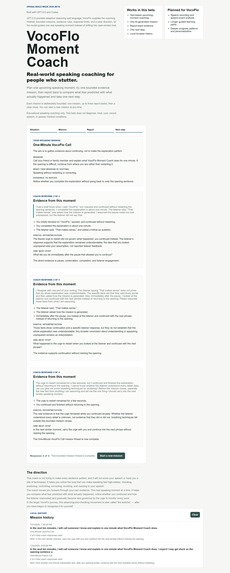
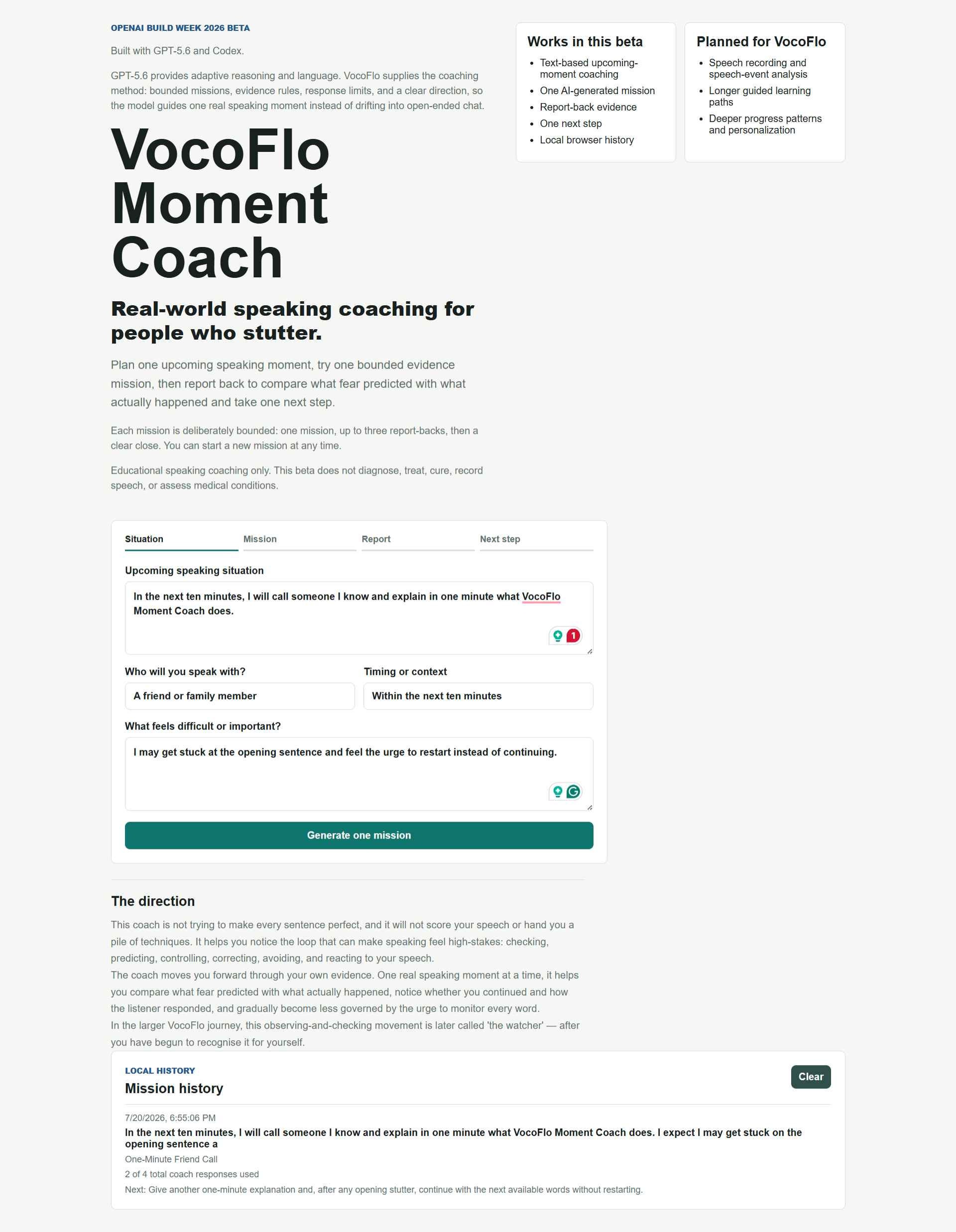
The user defines one upcoming speaking situation, audience, timing, and what feels difficult.
-
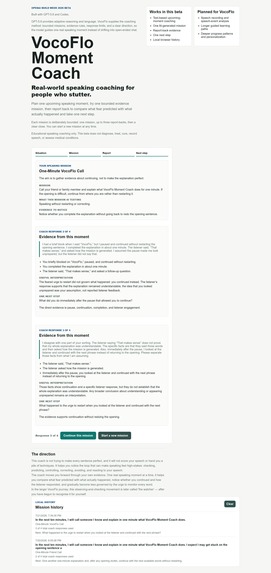
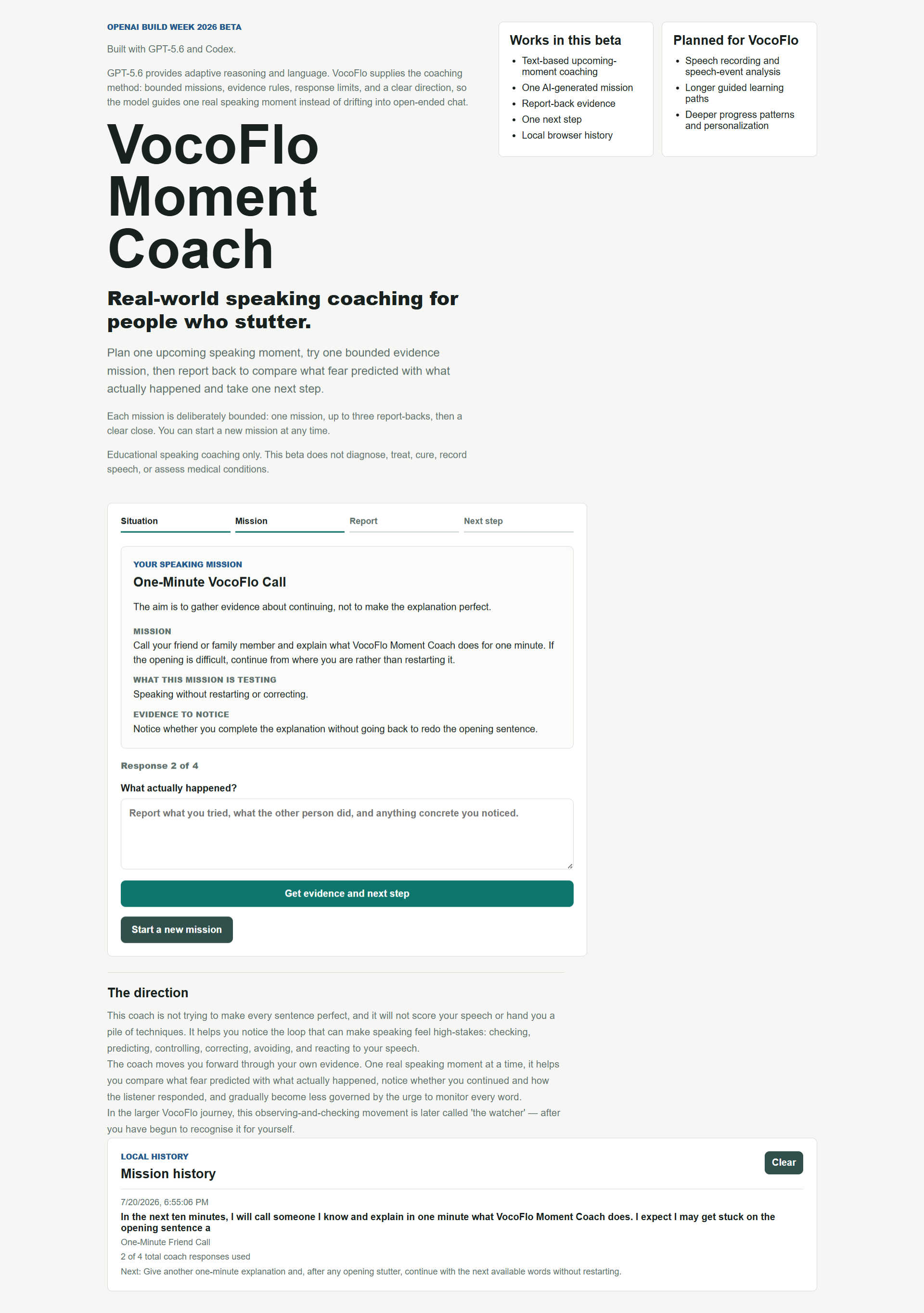
GPT-5.6 generates one bounded real-world mission with a single evidence target.
Inspiration
Inspiration
People who stutter often enter speaking situations already monitoring themselves: predicting difficult words, checking how they sound, trying to control each sentence, and reacting to every pause or block.
Many speaking tools respond with generic advice or a collection of techniques. VocoFlo Moment Coach takes a different approach. It guides one real speaking moment at a time and helps the user compare what fear predicted with what actually happened.
The larger direction is to help the user become less governed by checking, predicting, controlling, correcting, avoiding, and reacting to speech.
What it does
The user describes one upcoming speaking situation, including:
- who they will speak with;
- when it will happen;
- what feels difficult or important.
GPT-5.6 then creates exactly one bounded evidence mission with:
- one real-world action;
- one thing the mission is testing;
- one observable evidence target.
After attempting the mission, the user reports what happened. The coach separates direct facts from assumptions, fear, prediction, and imagined listener reactions. It then gives one concrete next step.
Each mission is deliberately bounded:
- one mission-generation response;
- up to three report or continuation responses;
- four GPT-5.6 responses maximum;
- a clear final close.
After the fourth response, the continuation option disappears. This prevents the product from drifting into an unlimited general-purpose chatbot.
The completed mission thread is stored locally in the browser.
The coaching direction
GPT-5.6 provides adaptive reasoning and language, but VocoFlo supplies the method.
VocoFlo defines:
- bounded missions;
- evidence-grounding rules;
- response limits;
- safety boundaries;
- structured response requirements;
- the direction of the coaching journey.
The coach does not score speech, promise fluency, diagnose a condition, or provide medical treatment. It is an educational speaking-coaching beta.
How we built it
VocoFlo Moment Coach is a responsive web application built with:
- Next.js;
- React;
- TypeScript;
- the OpenAI Responses API;
- GPT-5.6;
- browser-local storage;
- Vercel.
The OpenAI API key remains server-side and is stored only as a protected production environment variable.
The application uses structured validation for model responses. Mission generation and report-back coaching follow different instructions and schemas, while the interface enforces one active mission and a four-response hard limit.
The underlying VocoFlo coaching direction and the concept later called “the watcher” existed before Build Week. The standalone web beta, GPT-5.6 prompt adaptation, bounded architecture, interface, tests, deployment, and documentation were completed as Build Week work.
How GPT-5.6 is used
GPT-5.6 is used meaningfully inside the working product.
For mission generation, it adapts to the user’s specific speaking situation and creates one realistic evidence experiment.
For report-back coaching, it:
- extracts only what the user reported;
- separates observation from interpretation;
- handles corrections and disagreement;
- remains anchored to the same speaking moment;
- resists unrelated advice requests;
- gives one next experiment.
The model is not operating as an open-ended chatbot. Every response must serve the bounded VocoFlo mission.
How Codex was used
Codex was the primary implementation agent for the Build Week application.
It assisted with:
- application architecture;
- frontend and API implementation;
- structured prompt builders;
- response validation;
- bounded mission continuity;
- automated tests;
- documentation;
- production-readiness checks;
- deployment preparation.
The implementation was reviewed checkpoint by checkpoint using linting, tests, production builds, Git evidence, and an adversarial public smoke test.
Challenges
The hardest challenge was not simply connecting a language model to a form. It was preventing the experience from becoming a generic advice chatbot.
We had to make the coach:
- use only reported evidence;
- avoid inventing progress or listener reactions;
- accept valid user corrections without blindly capitulating;
- resist unrelated technique requests;
- preserve continuity across multiple reports;
- close naturally after a hard response limit.
Another challenge was presenting the larger VocoFlo direction without claiming that planned features such as speech recording or speech-event analysis already exist in this beta.
Accomplishments
We are proud that the working beta:
- generates one situation-specific evidence mission;
- separates direct facts from assumptions;
- handles disagreement with appropriate backbone;
- stays inside the same speaking moment;
- resists unrelated advice requests;
- gives one guided next step;
- enforces a four-response hard limit;
- preserves the completed thread locally;
- is publicly deployed and usable.
The final production build passed linting, automated tests, TypeScript validation, and a full Next.js production build.
What we learned
A strong AI product needs more than a capable model. It needs a method, boundaries, evidence rules, and a destination.
GPT-5.6 becomes more useful when it is not asked to do everything. By constraining it to one real situation, one evidence target, and a limited number of responses, the product becomes more coherent and accountable.
We also learned that a disagreement is useful product evidence. A coach should be able to revise an overstatement while preserving its method instead of either defending itself or agreeing automatically.
What’s next
The current Build Week beta is intentionally text-first.
Planned work for the larger VocoFlo product includes:
- speech recording;
- speech-event analysis;
- longer guided learning paths;
- deeper progress patterns;
- persistent personalisation;
- real-world testing inside the broader VocoFlo coaching journey.
Built With
- codex
- gpt5.6
- next.js
- openaiapi
- react
- typescript
- vercel

Log in or sign up for Devpost to join the conversation.