-
-
Application
-
Being able to actually purchase things with OpenAI + Stripe
What Vocari does, in one line
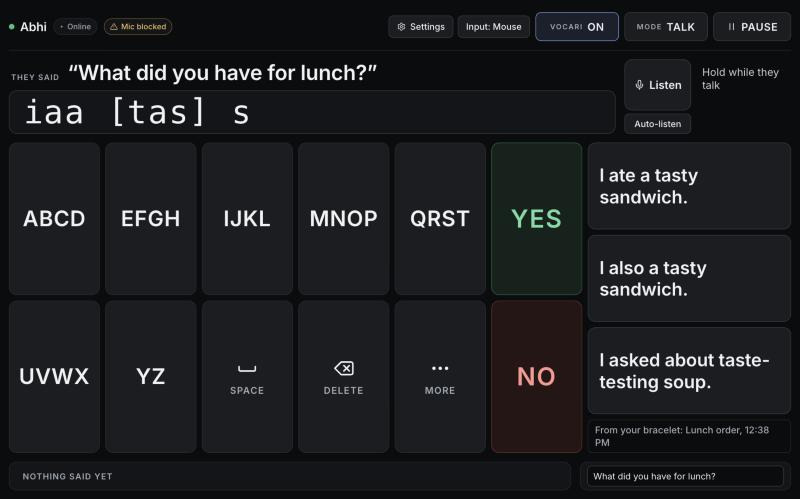
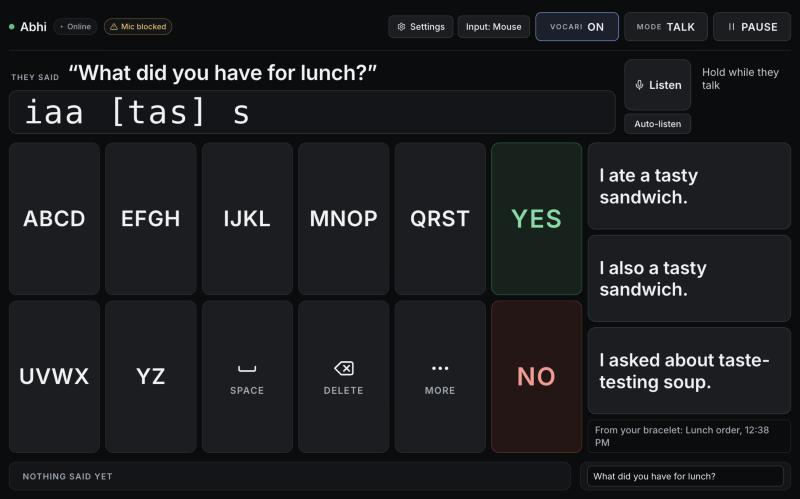
Vocari gives a voice back to people who can't speak. You type only the first letter of each word, and Vocari speaks the whole sentence out loud. It uses what your Vexo band heard earlier today to get the sentence right.
Example: a friend asks, "What did you eat for lunch?" You type five letters: hacps. Vocari offers "Had a chicken pesto sandwich." You pick it, and it is spoken. It knew because the band heard the lunch order earlier.
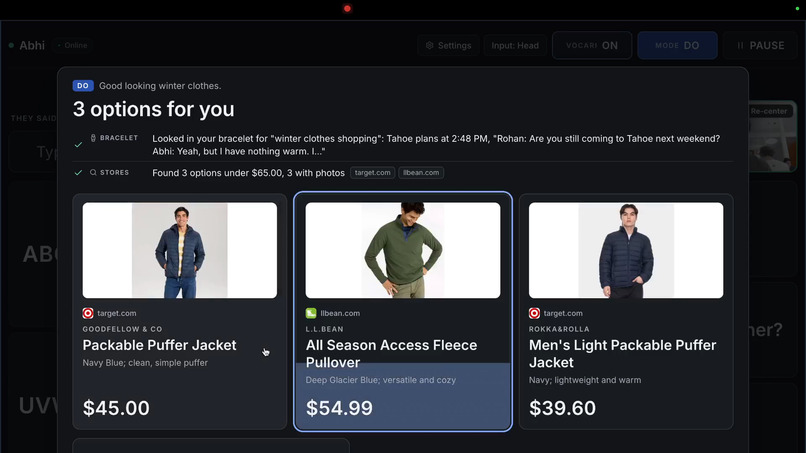
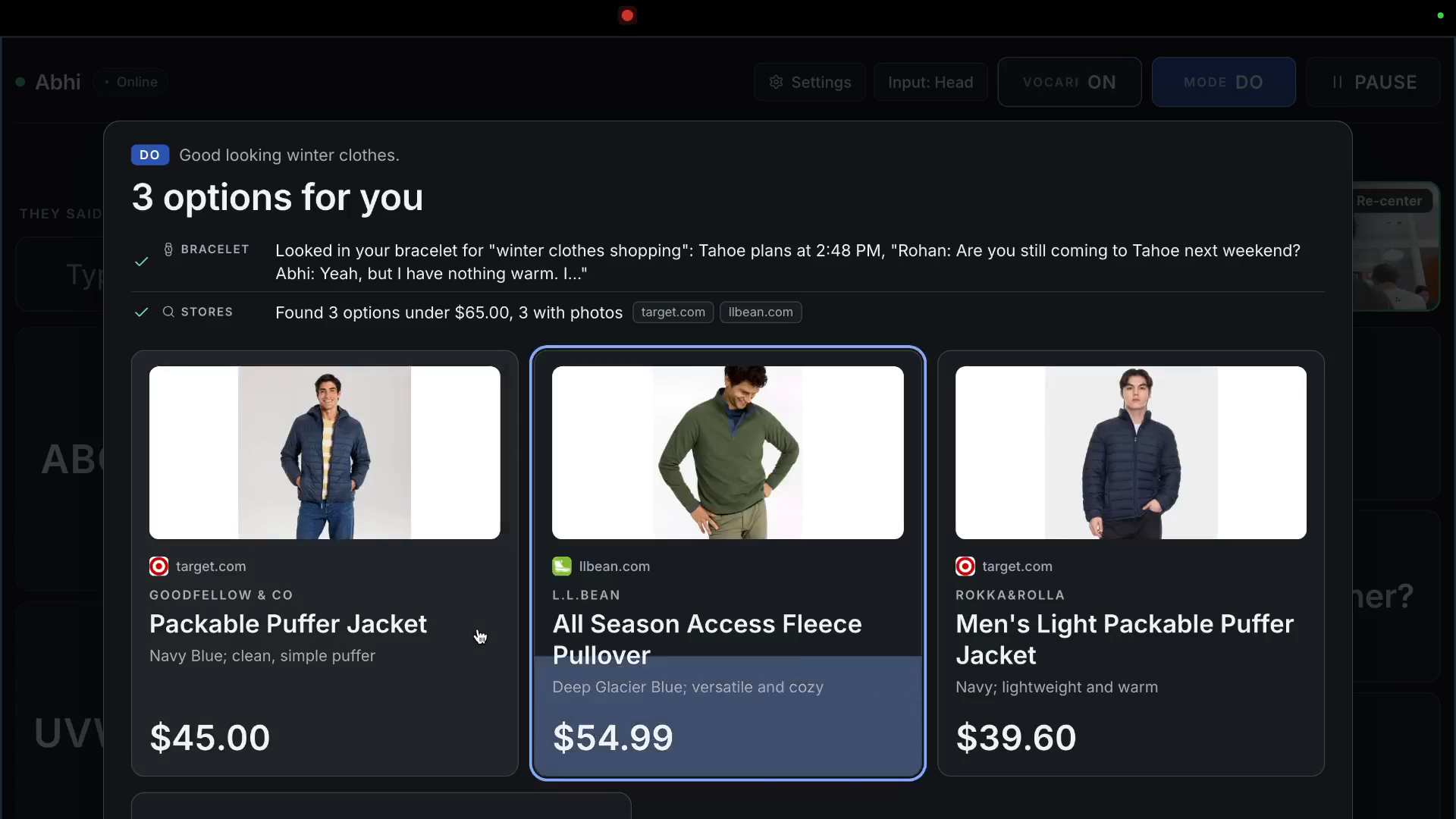
DO mode: Vocari can also act for you. Type glwc ("Good looking winter clothes.") and it remembers what you said earlier (men's medium, navy or charcoal, under $150), finds 3 real products with photos and prices, and pays with Stripe only after you press PAY.
Inspiration
People who lose their voice (ALS, stroke, cerebral palsy, spinal cord injury) type with their eyes or their head at about 8 words a minute. A normal conversation moves at about 150. By the time they finish a sentence, the conversation has moved on. Today's speech devices cost over $6,000. Google's SpeakFaster research showed that turning first letters into full sentences works for people with ALS, but the model was never released. We built an open version that runs on a laptop.
How it works
- The other person speaks. A clip-on mic and Whisper (on the laptop) turn it into text on screen.
- The band remembers your day. A memory agent (OpenAI) finds the one fact this question needs, like what you ordered for lunch.
- You type the first letters. Our own fine-tuned model (NVIDIA Nemotron 3.5 Lightning, running on the laptop) suggests 3 full sentences.
- Code checks every card. A letter filter (code, not AI) drops any sentence that doesn't match what you typed.
- You pick one, and it is spoken with ElevenLabs (online) or Kokoro (offline). Nothing is ever said without your choice.
The Vexo band: it is Vocari's memory of the day, a double-tap opens HELP, and its light shows what Vocari is doing (green ready, white speaking, green blink paid).
How we built it
- Our own model: NVIDIA Nemotron 3.5 Lightning (30B total, 3B active), fine-tuned with LoRA on open dialogue data plus AAC-style conversations, compressed to about 20 GB and served by llama.cpp on a MacBook. It works with the Wi-Fi off.
- Memory agent: OpenAI GPT-5.4 mini online, or a small local search offline, pulls the right fact from the band's memory.
- DO mode: an OpenAI agent decides what you want, reads the band's memory and uses OpenAI web search for answers and real products. Every step it takes shows on screen live.
- Safe payments with Stripe: the AI never sets a price. Code checks every purchase against the caregiver's limits, uses Stripe test mode, and nothing is paid until you press PAY. Each action is recorded so a caregiver can replay it.
- Built for eye gaze, head tracking or a mouse: big keys that never move, YES / NO always on screen, and a HELP alarm.
Challenges we ran into
- Letting an AI spend money safely. The model can only point at an option. Code checks the price and the limits, and the app never sends a price back.
- Real store results. Web search sometimes returned product links that don't exist, so Vocari checks every page and drops the dead ones.
- Speed on a laptop. A 30B model has to suggest sentences in about a second.
Accomplishments we're proud of
- On 100 hand-written ALS-style test conversations, our offline model ties GPT-4o (49% vs 49% right in the top 3), with no internet.
- With the band's memory, questions about earlier in the day go from 27% to 77% right.
- A real Stripe test payment from four typed letters, with every step visible and approved by the user.
What we learned
Memory is what makes a short guess correct: hacps means nothing until the band remembers lunch. And an AI that spends money is only safe if code, not the AI, holds the rules.
What's next for Vocari
The band's own live memory in place of today's scripted day, the user's own cloned voice, caregiver tools, and trials with AAC users and clinics. Speaking will always be free.
Built With
- elevenlabs
- fastapi
- kokoro
- llama.cpp
- nvidia-nemotron
- openai
- python
- react
- stripe
- typescript
- vexo
- web-bluetooth
- whisper.cpp