-
-
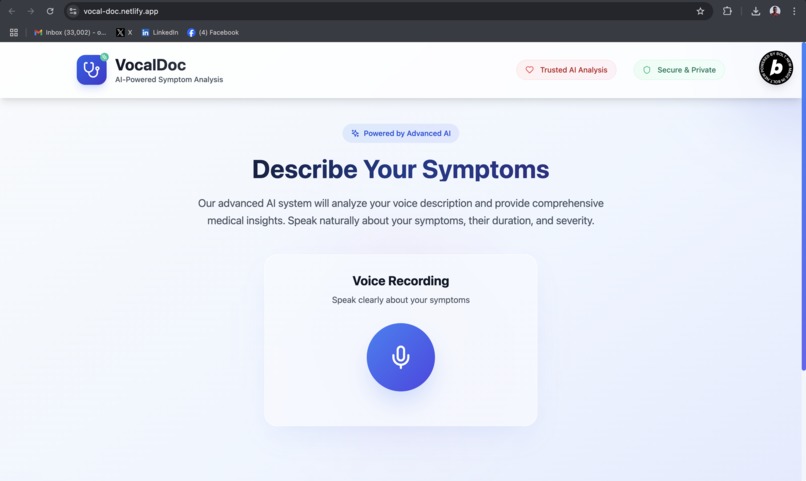
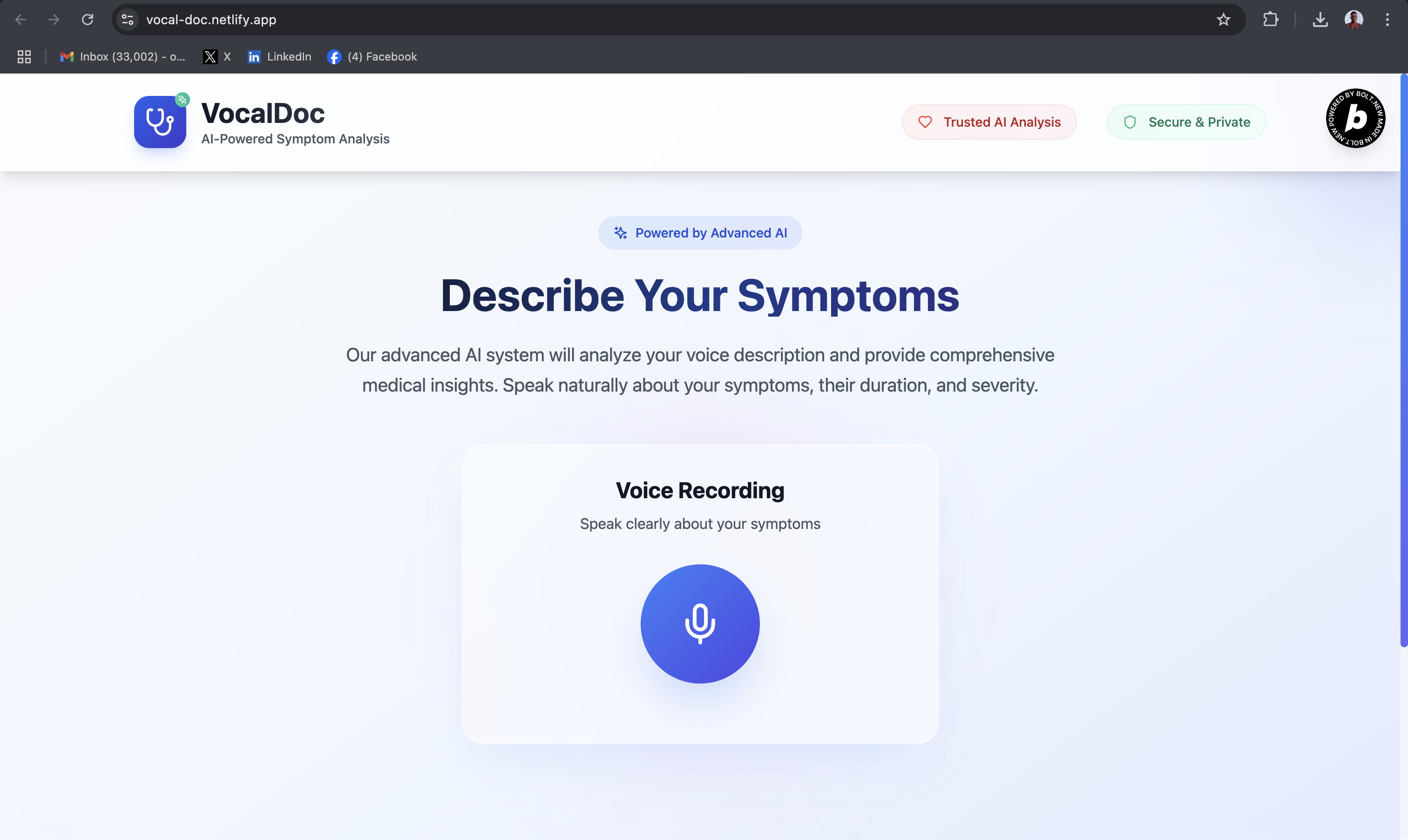
vocal-doc web app
Inspiration
Healthcare accessibility remains a global challenge. Many people struggle to articulate their symptoms effectively to medical professionals or lack immediate access to guidance. We were inspired to create VocalDoc after realizing that voice-based interaction could bridge this gap — making symptom analysis more intuitive and accessible to everyone, regardless of their medical knowledge or writing abilities.
What it does
VocalDoc is an AI-powered medical assistant that transforms spoken symptom descriptions into actionable health insights. Users speak naturally about their symptoms, and our system provides:
- Real-time voice transcription with contextual understanding
- AI-powered symptom interpretation using OpenAI for natural language processing
- Likely condition suggestions with confidence scores
- Severity indicators (mild, moderate, severe)
- Emergency flags for potentially critical symptoms
- Personalized next steps and self-care suggestions
- Accessible, intuitive interface designed for all users
⚠️ Disclaimer: VocalDoc is not a substitute for professional medical advice, diagnosis, or treatment. Always consult a licensed healthcare provider.
How we built it
Frontend Architecture
- React 18 + TypeScript for modern, type-safe development
- Tailwind CSS for responsive and elegant UI styling
- Vite for ultra-fast development and production builds
- Web Audio API for real-time audio recording and waveform rendering
- MediaRecorder API for audio capture with format fallback support
Backend Infrastructure
- ElysiaJS for high-performance, type-safe API development
- Google Cloud Run for scalable, serverless deployment
- RESTful API with secure authentication layers
- OpenAI API to analyze symptom descriptions and extract medically relevant insights
- Multi-format audio support (WebM, MP4, OGG, WAV)
Key Technical Features
- Smooth real-time waveform animation while recording
- Dynamic audio format detection and conversion
- Fully responsive, mobile-first interface
- Robust error handling and user feedback system
- Production-ready deployment pipeline with CI/CD
Challenges we ran across
- Audio Format Compatibility: Different browsers support different audio formats. We built a dynamic detection layer with fallback support.
- Real-time Audio Processing: Maintaining performance while rendering waveforms required careful Web Audio API optimization.
- AI Interpretation Accuracy: Translating free-form voice input into meaningful symptom summaries demanded prompt engineering and responsible AI design.
- Cross-Browser Issues: MediaRecorder API inconsistencies across browsers required testing and polyfills.
- UI/UX Balance: Making the interface both trustworthy (medical) and accessible (approachable) was a delicate design challenge.
Accomplishments that we're proud of
- Built a production-ready medical voice assistant in record time
- Seamlessly integrated voice input with AI interpretation and actionable suggestions
- Achieved real-time waveform visualization
- Deployed a scalable backend on Google Cloud Run
- Designed a fully accessible and mobile-responsive UI
- Implemented responsible AI practices with clear disclaimers and user protections
What we learned
- Advanced Web Audio API handling and waveform techniques
- Building APIs with the ElysiaJS framework
- Scalable deployment with Google Cloud Run
- Navigating AI ethics in healthcare, including risk management and disclaimers
- Browser quirks in audio recording and playback
- Full-stack production deployment with CI/CD and monitoring
What's next for VocalDoc
- Multi-language support for broader accessibility
- Wearable device integration for continuous health tracking
- Custom-trained medical AI models to improve condition matching
- Doctor handoff integration for seamless escalation
- iOS and Android app development
- Telemedicine features for real-time consultations
- Symptom history and health insights dashboard
Built With
- ai/ml-apis
- bolt
- css3
- elysiajs
- google-cloud-run
- html5
- javascript
- lucide-react
- mediarecorder-api
- node.js
- openai
- react
- rest
- tailwind-css
- typescript
- vite
- web-audio-api

Log in or sign up for Devpost to join the conversation.