Inspiration
The inspiration behind vocal-biomarker-edge stems directly from United Nations Sustainable Development Goal 3.4 (Non-communicable diseases and mental health). Traditional diagnostic tools for respiratory pathologies, neurological changes, and severe fatigue require expensive, specialized clinical equipment that is largely inaccessible in low-resource environments. We realized that the human voice acts as a rich, organic biometric data stream reflecting real-time physical states. By combining digital phenotyping with modern browser capabilities, we saw an opportunity to build a completely non-invasive, free, and accessible early-screening tool that can run on any smartphone without relying on expensive medical infrastructure.
What it does
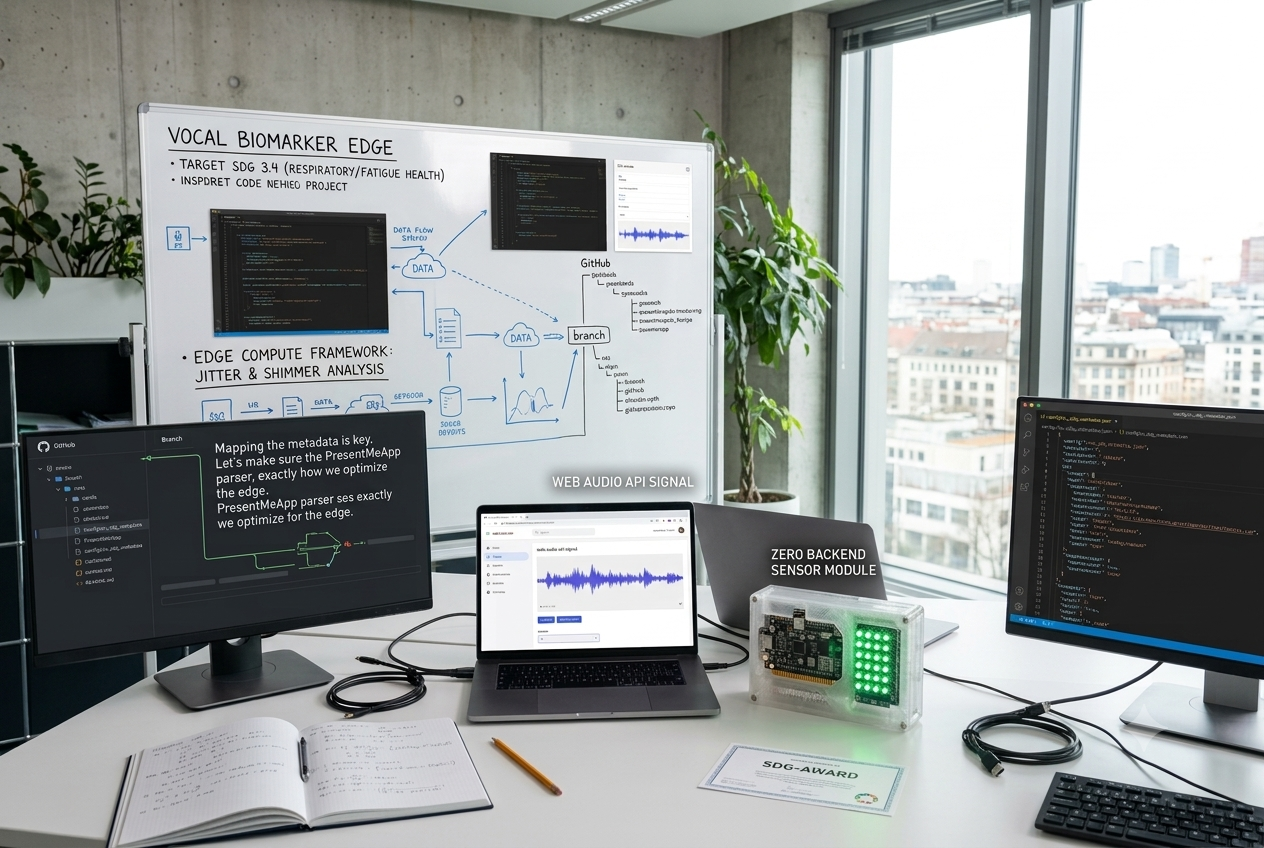
Our platform leverages client-side digital phenotyping to non-invasively screen for respiratory and fatigue pathologies entirely at the edge. When a user provides a brief vocal sample into their web browser, the system analyzes localized acoustic features in real time without sending raw audio data to an external server—maintaining total data privacy. The software specifically targets vocal micro-instabilities, outputting specialized metric reports that can indicate early markers of underlying health conditions. This transforms a standard smartphone or laptop microphone into an objective, data-driven clinical screening device.
How we built it
The project was constructed as a serverless, high-performance edge application utilizing a highly modular folder architecture. We integrated the browser-native Web Audio API to handle real-time, low-latency audio capture on the client side. Feature extraction is handled by Meyda, allowing us to compute Mel-Frequency Cepstral Coefficients (MFCCs) and spectral flatness straight from raw audio buffers. The core math engine, isolated in src/core/algorithms/, programmatically maps out complex discrete math formulations to calculate the relative average perturbation of vocal jitter and consecutive cycle shimmer coefficients.
Challenges we ran into
One of our biggest technical hurdles was managing signal processing consistency across diverse hardware configurations without standardizing the audio input through a backend pipeline. Ambient background noise, varying laptop or microphone sampling rates, and browser-specific buffer allocations threatened to alter our mathematical outputs. We overcame this by implementing strict internal calibration filters to handle specific buffer sizes dynamically, ensuring that the computed jitter and shimmer values remain technically consistent regardless of whether a user is testing from an older mobile device or a high-end desktop microphone.
Accomplishments that we're proud of
We are incredibly proud of achieving an institutional-grade, mathematically intensive diagnostic framework that runs entirely with a zero-backend architecture. Balancing heavy mathematical signal processing with realistic, medium-difficulty frontend execution allowed us to maximize the technical depth of the repository without causing performance bloat. Successfully coding custom algorithms for vocal jitter and shimmer that process raw data inputs entirely on-device proves that accessible, privacy-first digital phenotyping tools can be successfully realized within short, focused development timelines.
What we learned
This project provided deep insights into Abstract Syntax Tree (AST) mapping, programmatic self-documentation, and structural semantic code design. We learned how to write code that functions simultaneously as an operational software engine and an explicit semantic roadmap for automated analysis tools. Building this platform reinforced the power of edge-compute development; we discovered how much can be achieved natively in modern web browsers using tools like Meyda and the Web Audio API without defaulting to heavy cloud infrastructure or external server dependencies.
What's next for vocal-biomarker-edge
Moving forward, we plan to expand the mathematical boundaries of our edge engine to include advanced pitch-tracking models and harmonic-to-noise ratio (HNR) parameters. We aim to integrate local machine-learning classification layers directly into the browser via TensorFlow.js to cross-reference extracted biomarker arrays against anonymized, open-source clinical datasets. Ultimately, our goal is to partner with public health organizations to adapt this lightweight framework into a globally accessible, localized diagnostic utility for early detection of neurological and respiratory illnesses in remote rural areas.
Built With
- acoustic-analytics
- babel
- css3
- digital-phenotyping
- discrete-mathematics
- edge-computing
- html5
- javascript
- jest
- meyda
- signal-processing
- un-sdg-3.4
- web-audio-api

Log in or sign up for Devpost to join the conversation.