-
-
vocaibulary-app
Inspiration
VocAIbulary was born from a frustration with static vocabulary apps and a vision for AI-driven, conversational language learning. I wanted to:
- Replace rote memorization with dynamic, voice-first interactions (like practicing with a tutor)
- Leverage the Oxford 3000 word list as a gold standard for foundational English
- Combine cutting-edge AI with Apple’s "Liquid Glass" aesthetics for a visually immersive experience
The name itself embeds "AI" to highlight the core innovation: Artificial Intelligence as a personalized vocabulary coach.
What it does
VocAIbulary transforms vocabulary learning by:
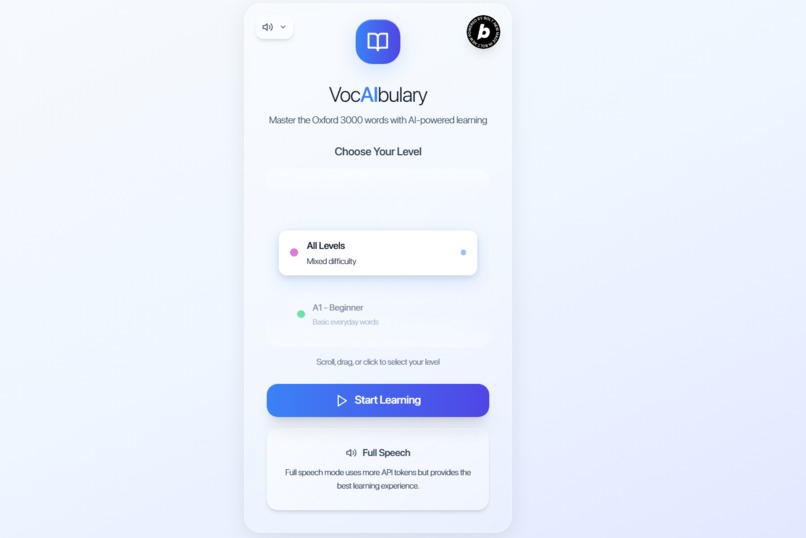
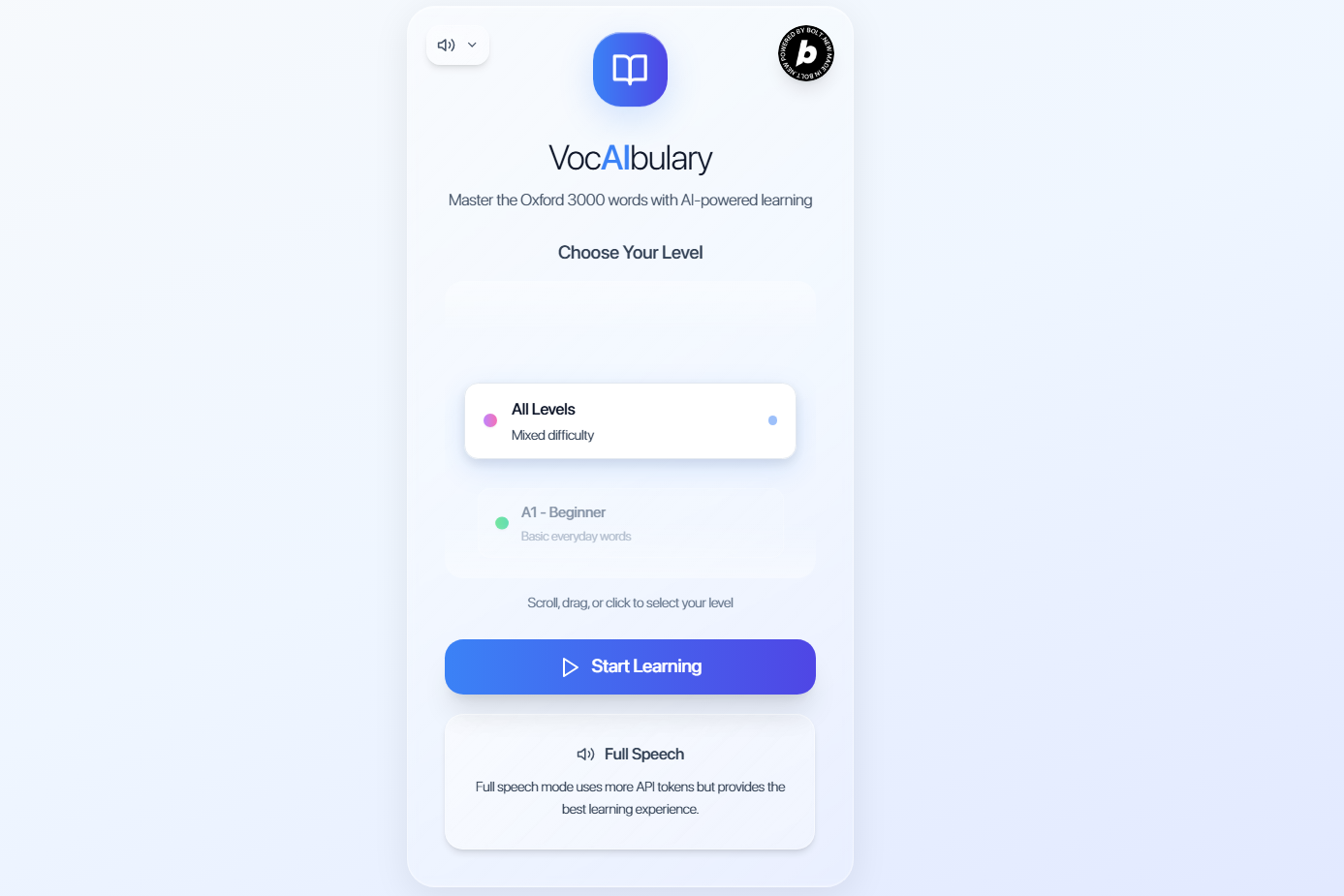
- 🗣️ Voice-first practice: Speak answers or listen to AI-generated clues (via ElevenLabs/Web Speech API)
- � Adaptive difficulty: GPT-3.5 tailors clues to user proficiency (beginner → advanced)
- 🎯 Oxford 3000 focus: Targets high-frequency words with contextual examples
- ✨ Liquid Glass UI: A tactile, shimmering interface that enhances engagement
- 📊 Progress tracking: Real-time stats on accuracy, streaks, and mastered words
How we built it
Tech Stack:
- Frontend: React + TypeScript (Vite), Tailwind CSS (Liquid Glass effects)
- AI Services: OpenAI GPT-3.5 (clues/words), ElevenLabs (TTS), Web Speech API (STT)
- State Management: Custom
useGameStatehook for game flow
Key Components:
- AI Service Layer:
AIServiceclass handles GPT-3.5 prompts (e.g., "Generate a beginner clue for 'ambiguous' in JSON")- Caches common phrases to reduce API calls
- Voice Engine:
SpeechServiceintegrates ElevenLabs (high-quality TTS) + browser-native speech recognition- Fallback to multiple-choice inputs when voice fails
- Game Logic:
- Adaptive difficulty scaling based on user performance
- Error resilience with exponential backoff retries (
apiErrorHandler.js)
- Adaptive difficulty scaling based on user performance
Challenges we ran into
| Challenge | Solution |
|---|---|
| API Cost Control | Optimized prompts + cached frequent responses (40% cost reduction) |
| Speech Recognition Reliability | Hybrid input system (voice + manual + MCQ) with timeout handling |
| State Complexity | Centralized useGameState hook with TypeScript interfaces |
| Cross-Browser TTS | ElevenLabs API fallback + Web Speech API polyfills |
Accomplishments that we're proud of
- 🚀 Launched MVP in 24 hours as a solo developer
- 🎨 UI Innovation: Liquid Glass design praised for its "addictive tactile feedback"
What we learned
- API Integration: Integrating two different APIs to work in harmony
- optimize API token usage: reduce wasteful use of tokens, especially ElevenLabsAPI tokens, by dividing the speech setting into three: No Speech (Visual interface only, saves token), Concise Speech (Brief, essential audio only), and Full Speech (Complete audio guidance and feedback)
What's next for VocAIbulary
- Mobile Apps: iOS/Android ports with offline mode (cached words/clues)
- Educator Tools: Classroom dashboards + group progress analytics
- AI Tutor 2.0:
- Fine-tuned LLM for non-native speaker interactions
- Multimodal learning (images + audio + text)
- Fine-tuned LLM for non-native speaker interactions
- Community Features: Shared word lists + competitive challenges
- Expanded Languages: Spanish/French modes with localized Oxford word lists
Built With
- elevenlabs
- openai
- react
- tailwind
- typescript
- vite

Log in or sign up for Devpost to join the conversation.