-
-
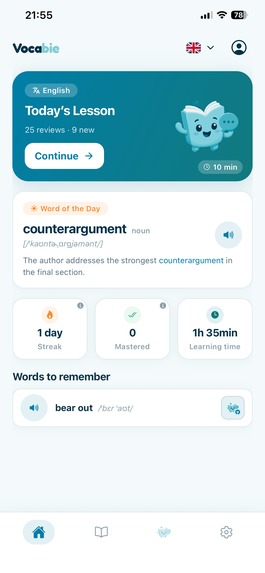
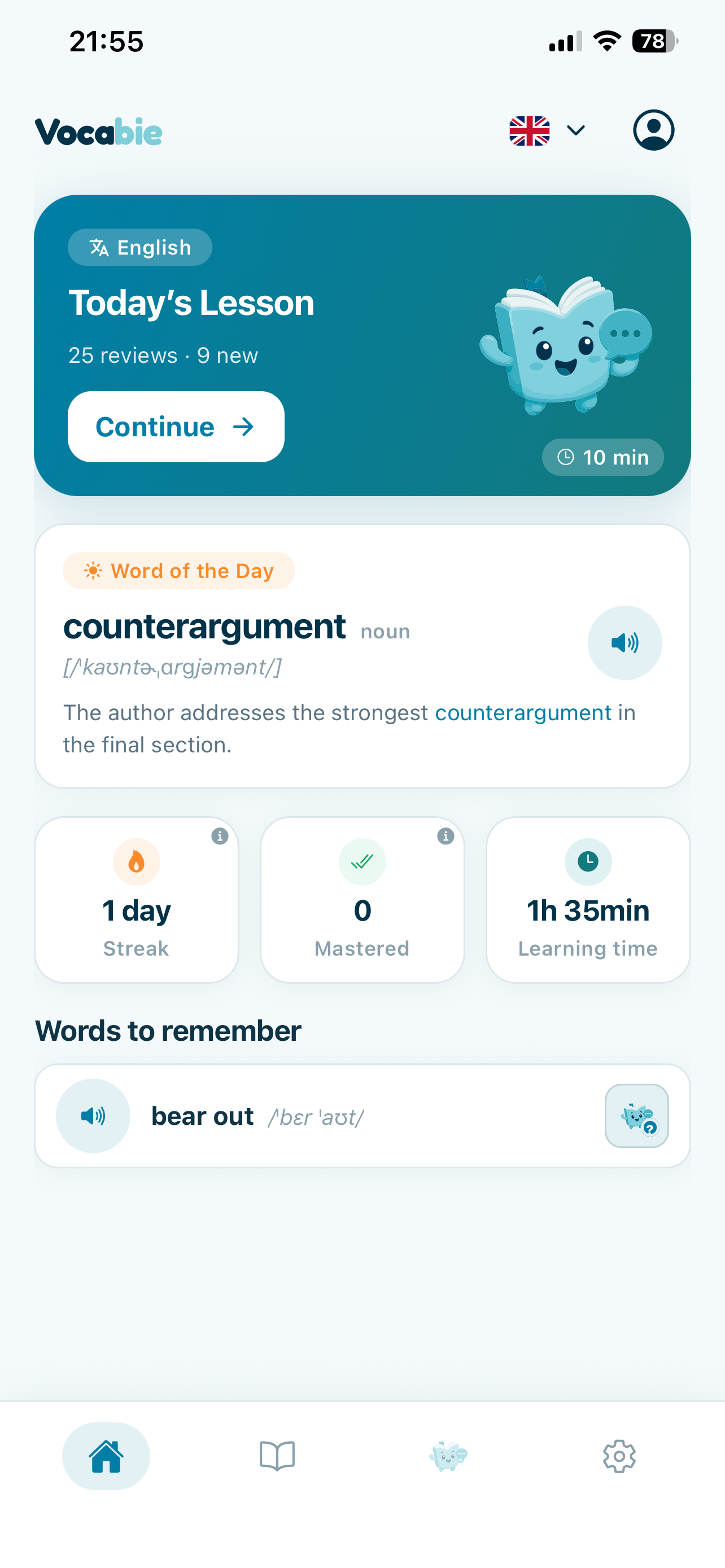
Home brings together the personalized daily lesson, Word of the Day, progress, and words that need more practice.
-
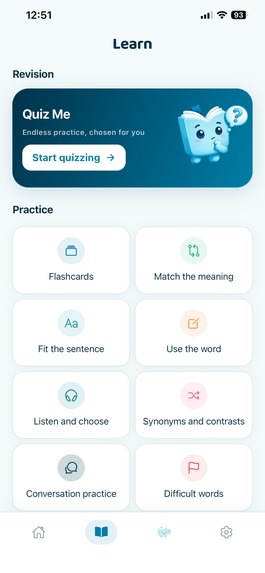
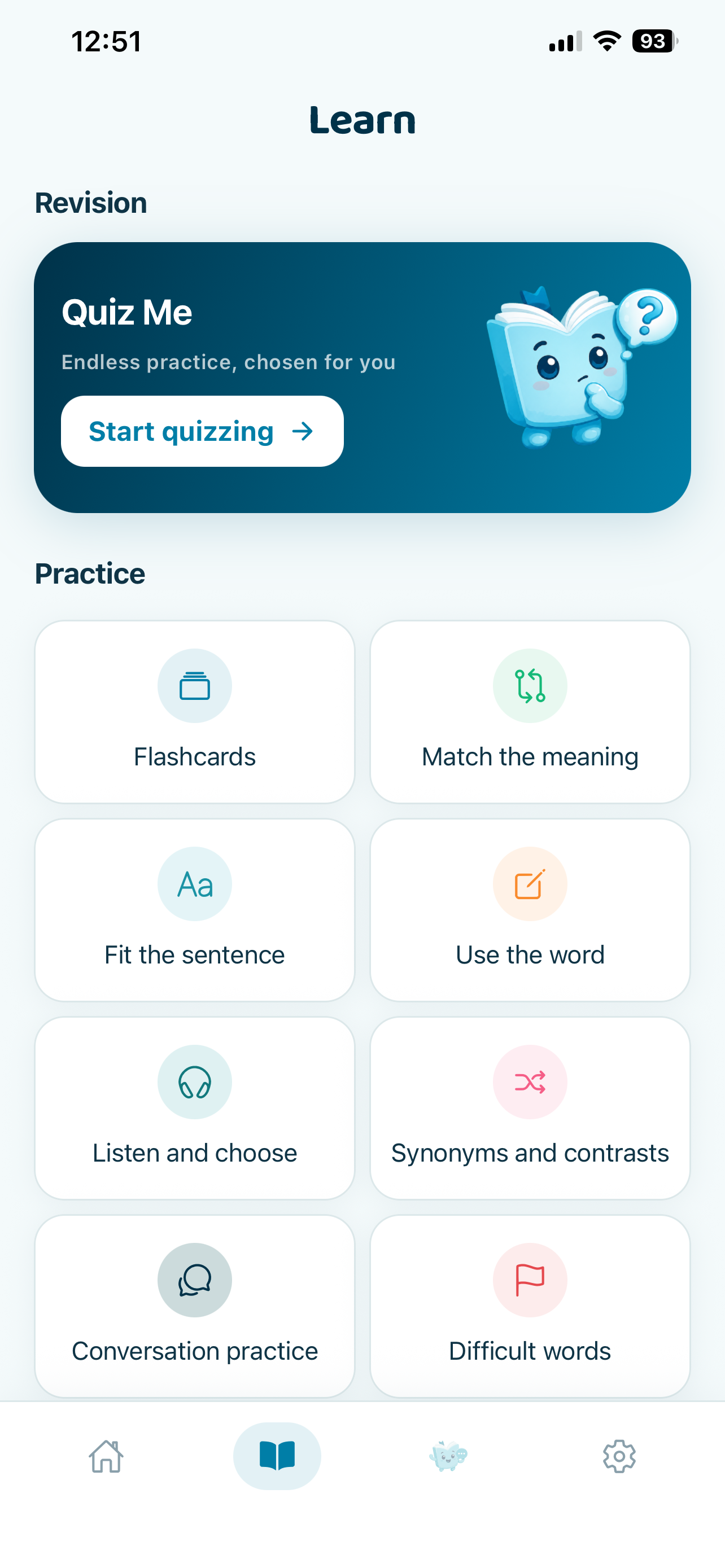
Eight focused practice modes train vocabulary through recognition, context, listening, contrasts, writing, and recall.
-
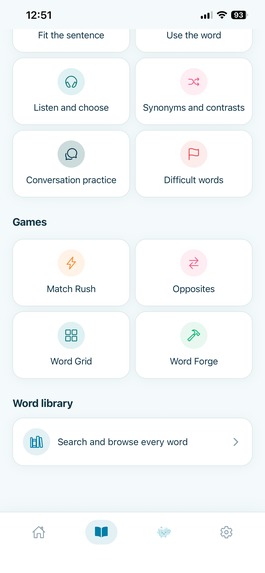
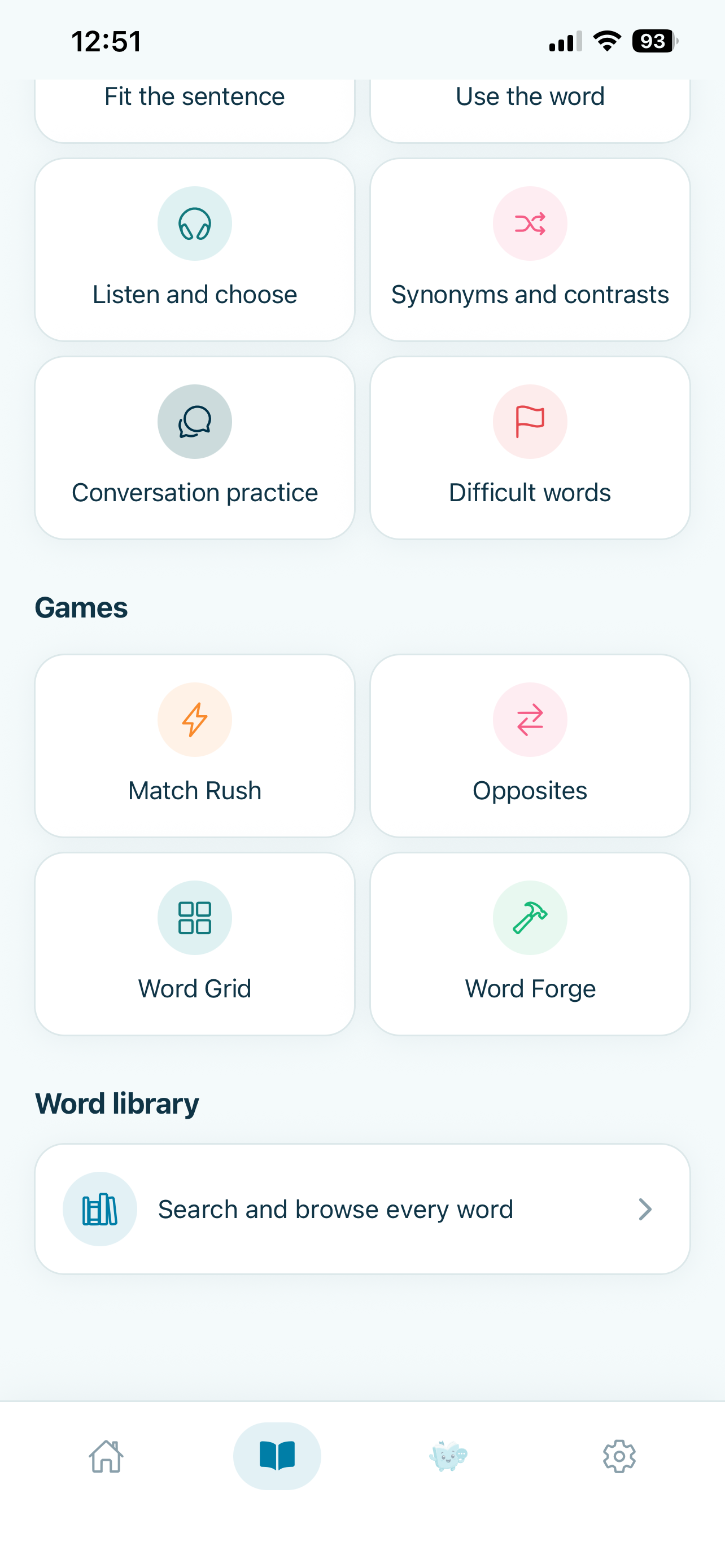
Games and the searchable Word Library extend practice beyond structured exercises while keeping everything in one hub.
-
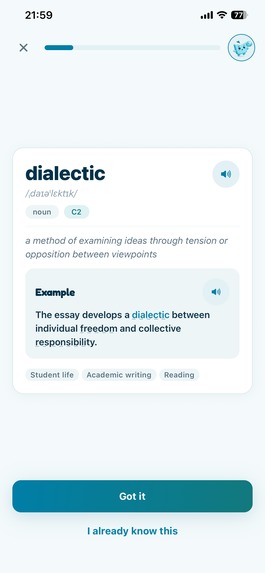
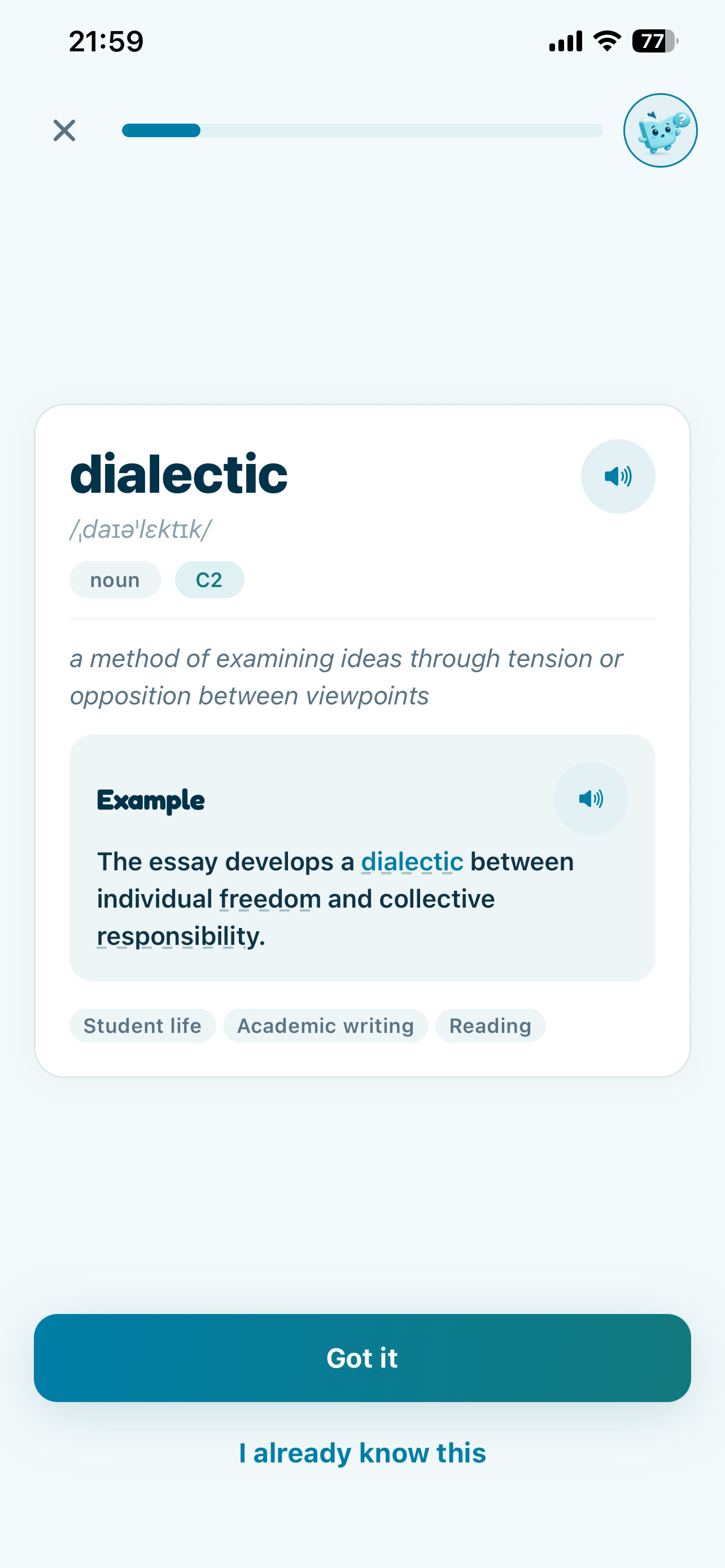
Every word includes pronunciation, level, meaning, contextual examples, audio, and topics relevant to the learner.
-
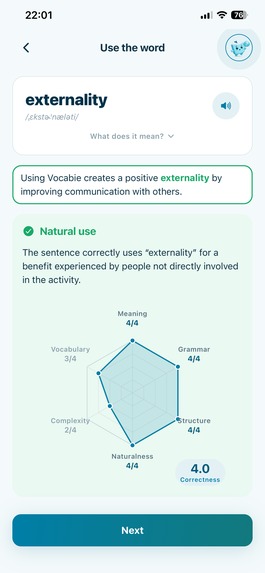
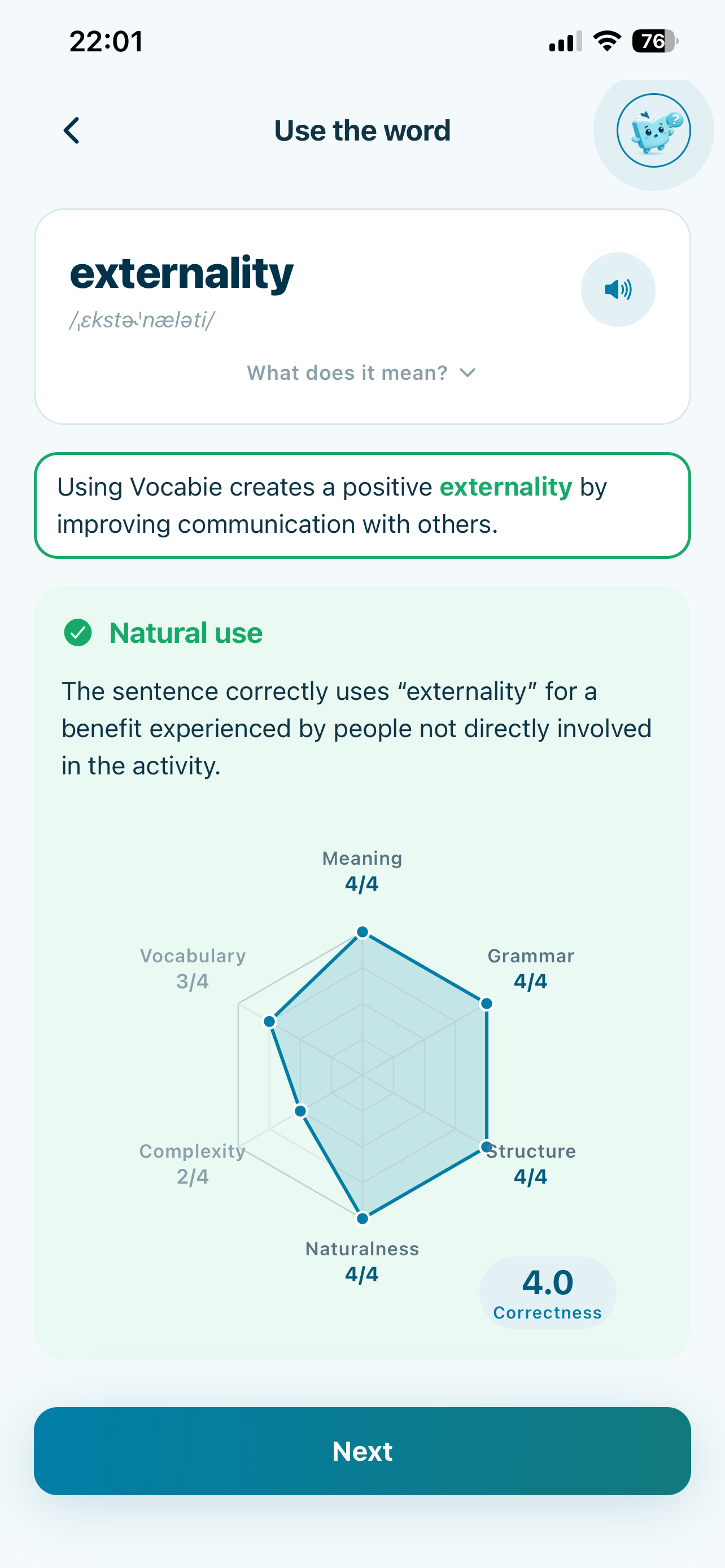
AI evaluates a learner-created sentence across meaning, grammar, structure, naturalness, vocabulary, and complexity.
-
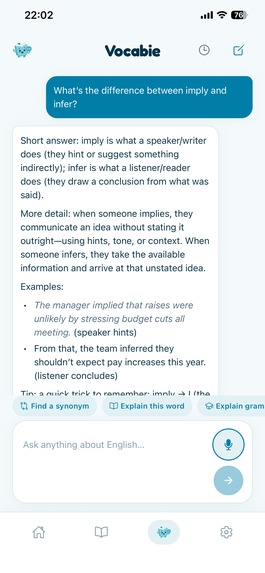
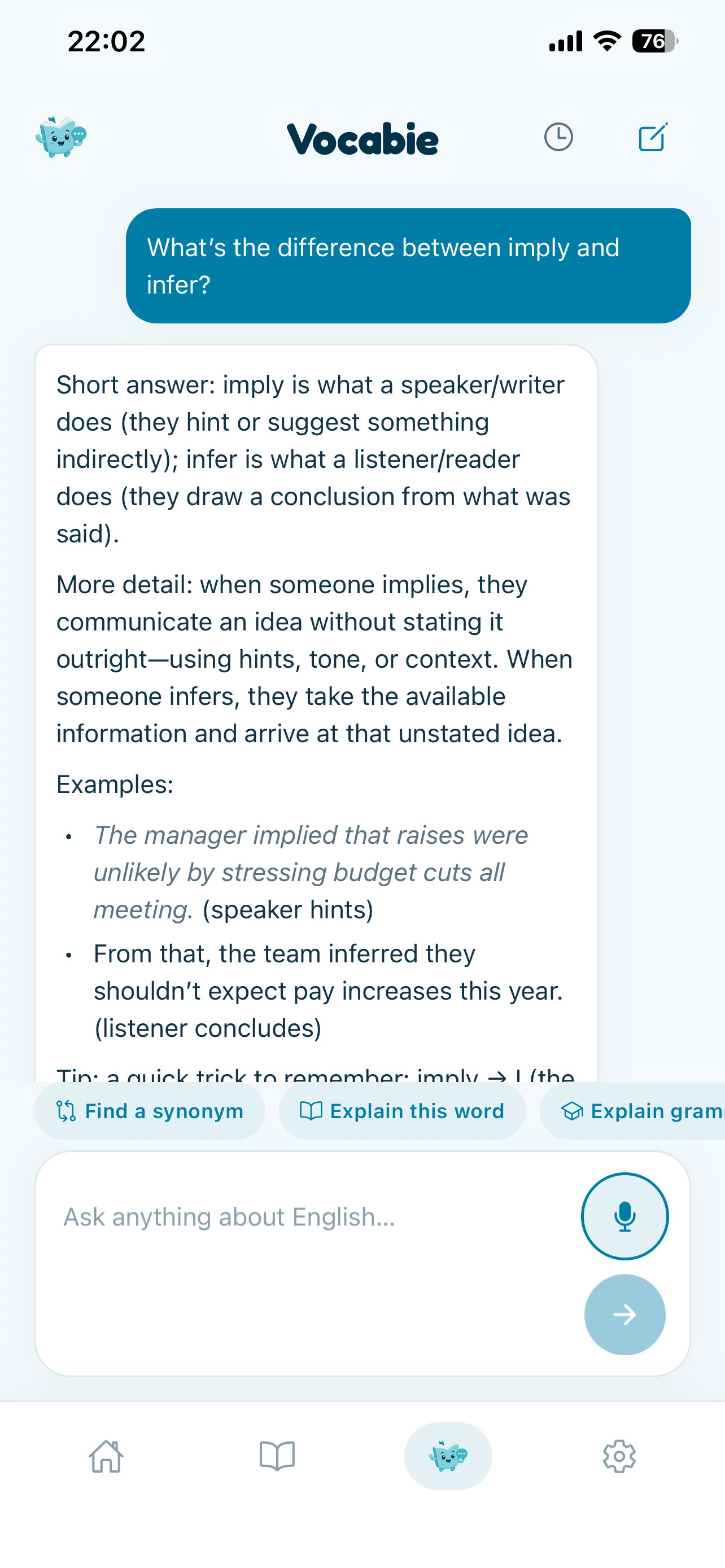
Vocabie AI explains vocabulary, grammar, word choice, and subtle differences with guided follow-up actions.
-
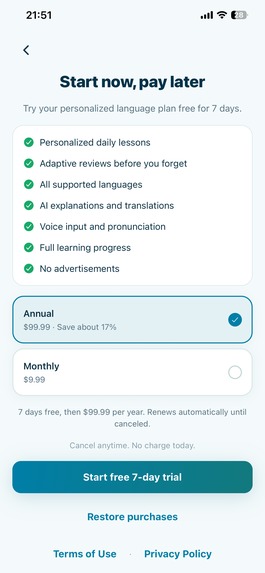
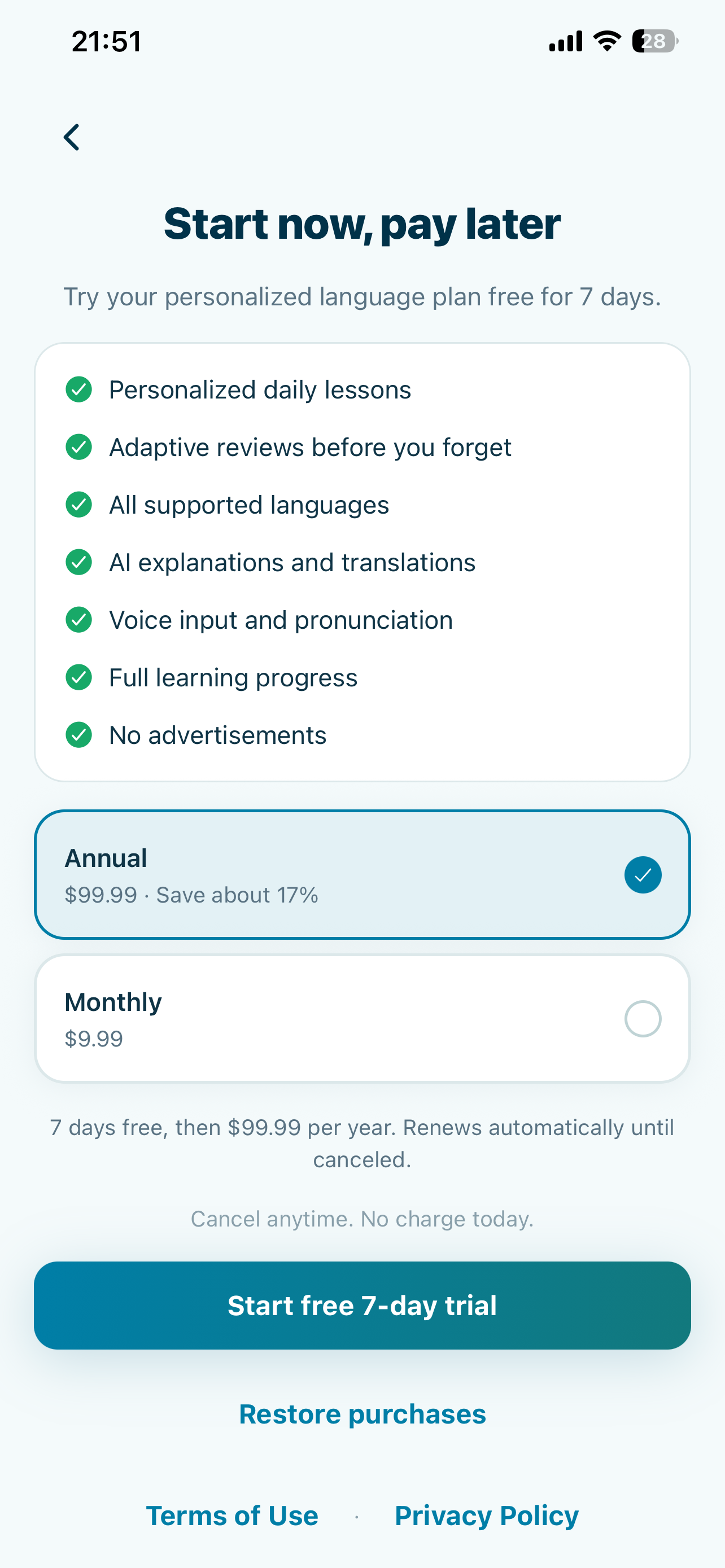
A focused RevenueCat-powered paywall with one Premium tier, monthly or annual billing, and a 7-day free trial.
-
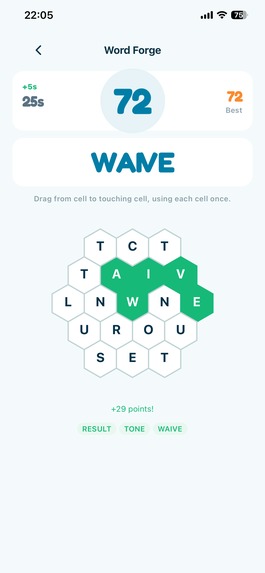
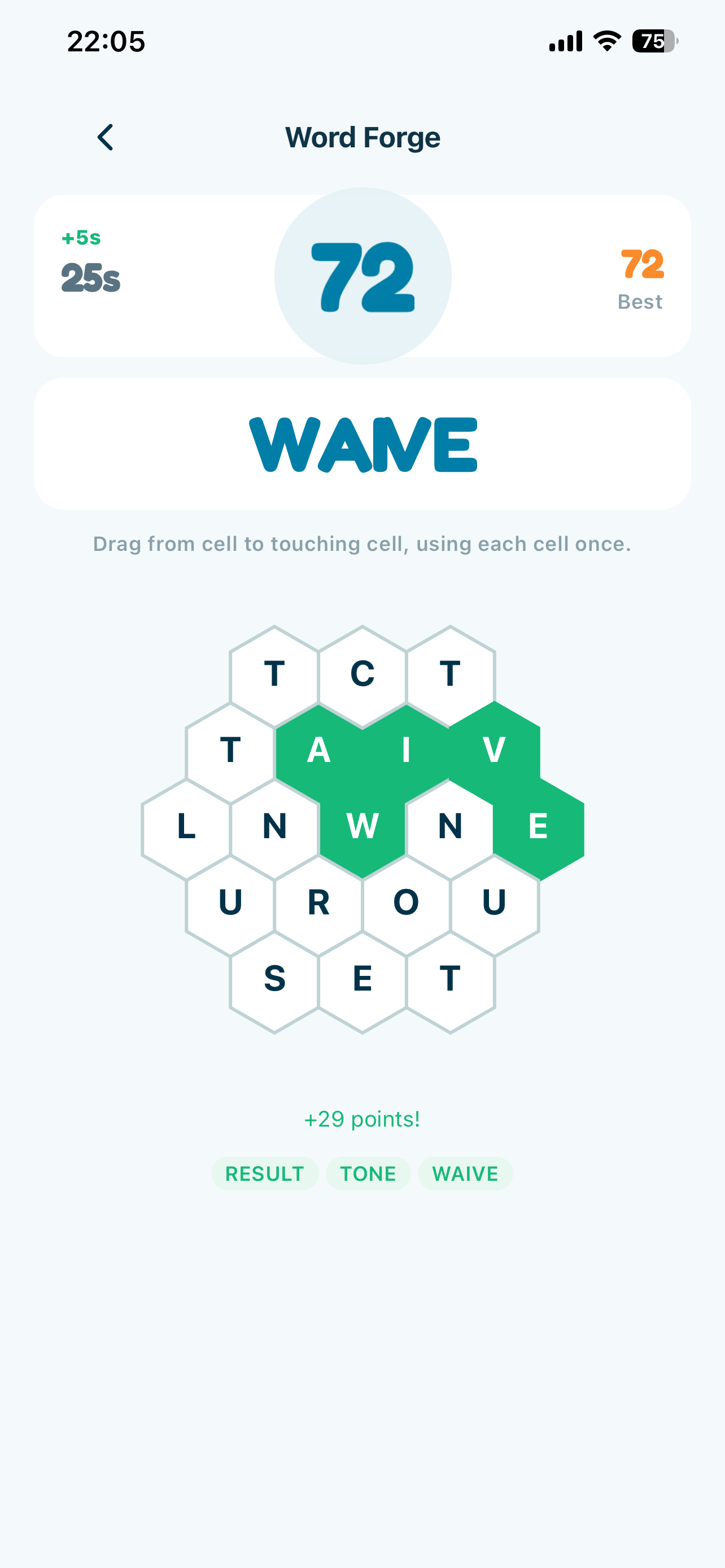
Word Forge turns vocabulary recall into a timed word-building game while reinforcing related vocabulary.
-
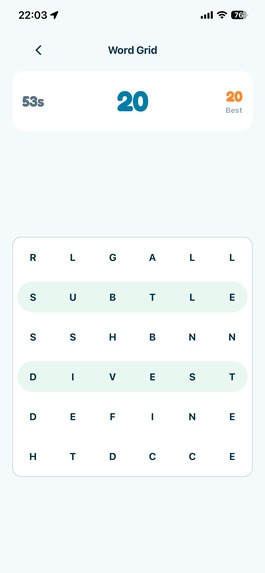
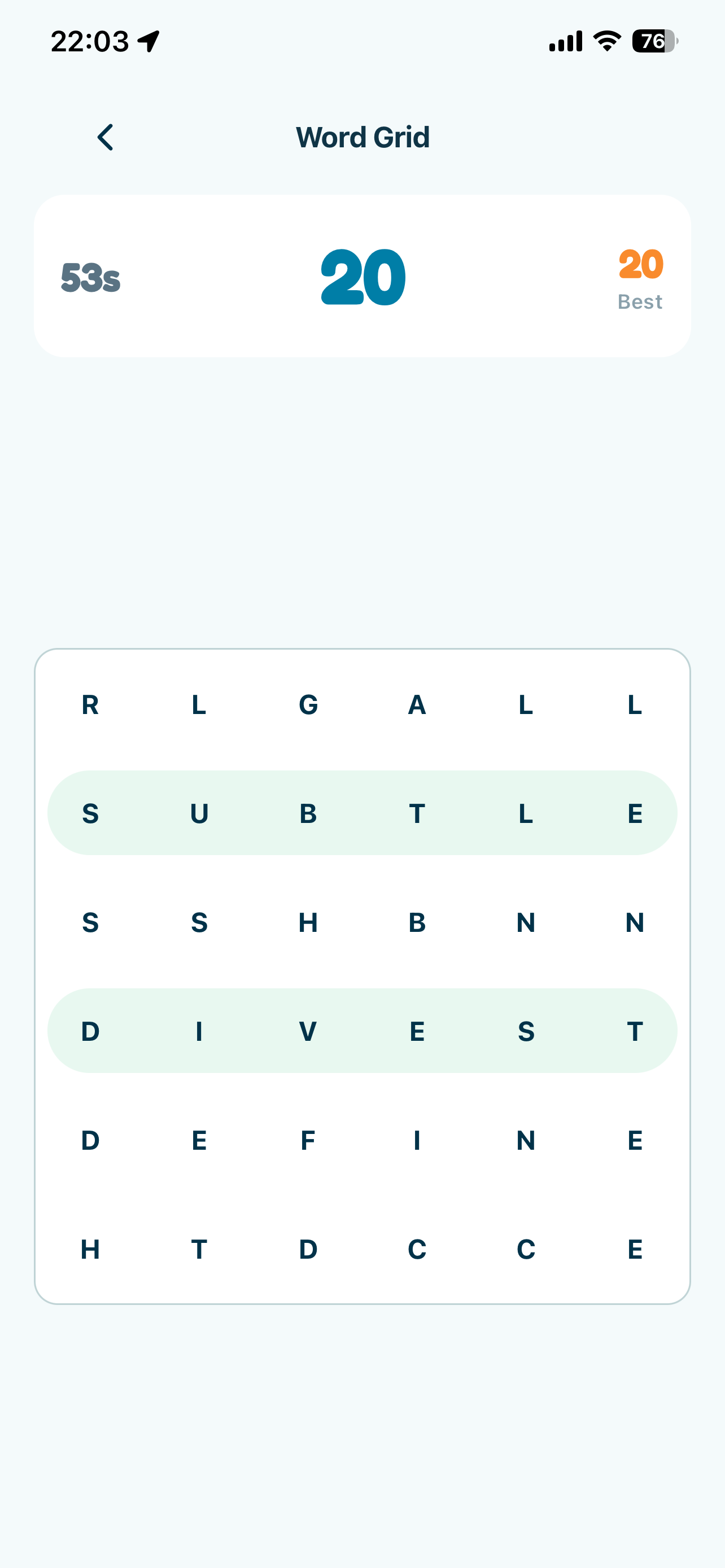
Word Grid reinforces visual scanning and vocabulary recognition by challenging learners to find hidden words against the clock.
-
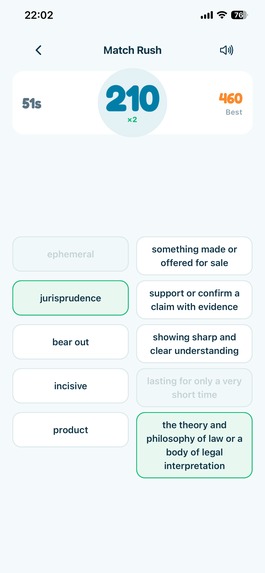
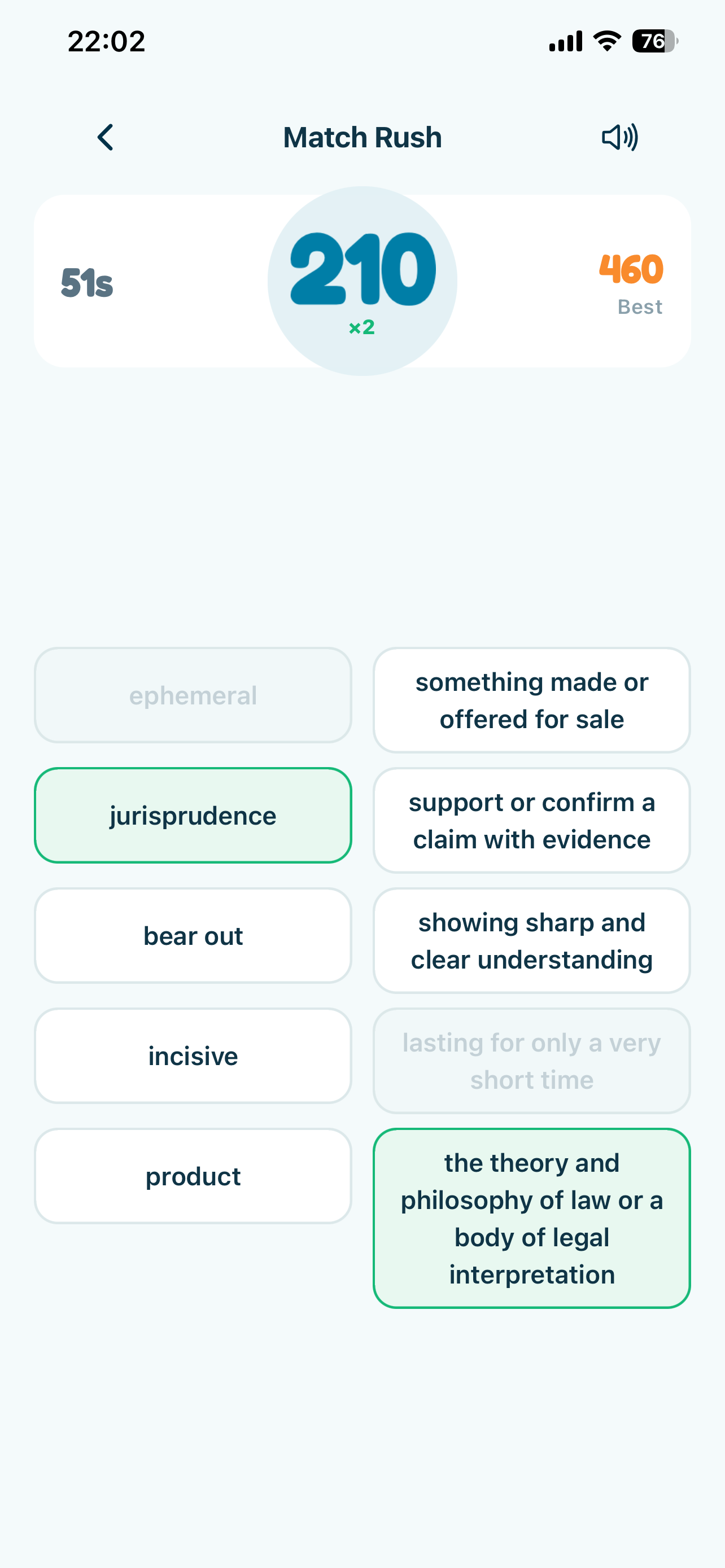
Match Rush reinforces word meanings through fast matching, scoring, and repeated retrieval under light time pressure.
-
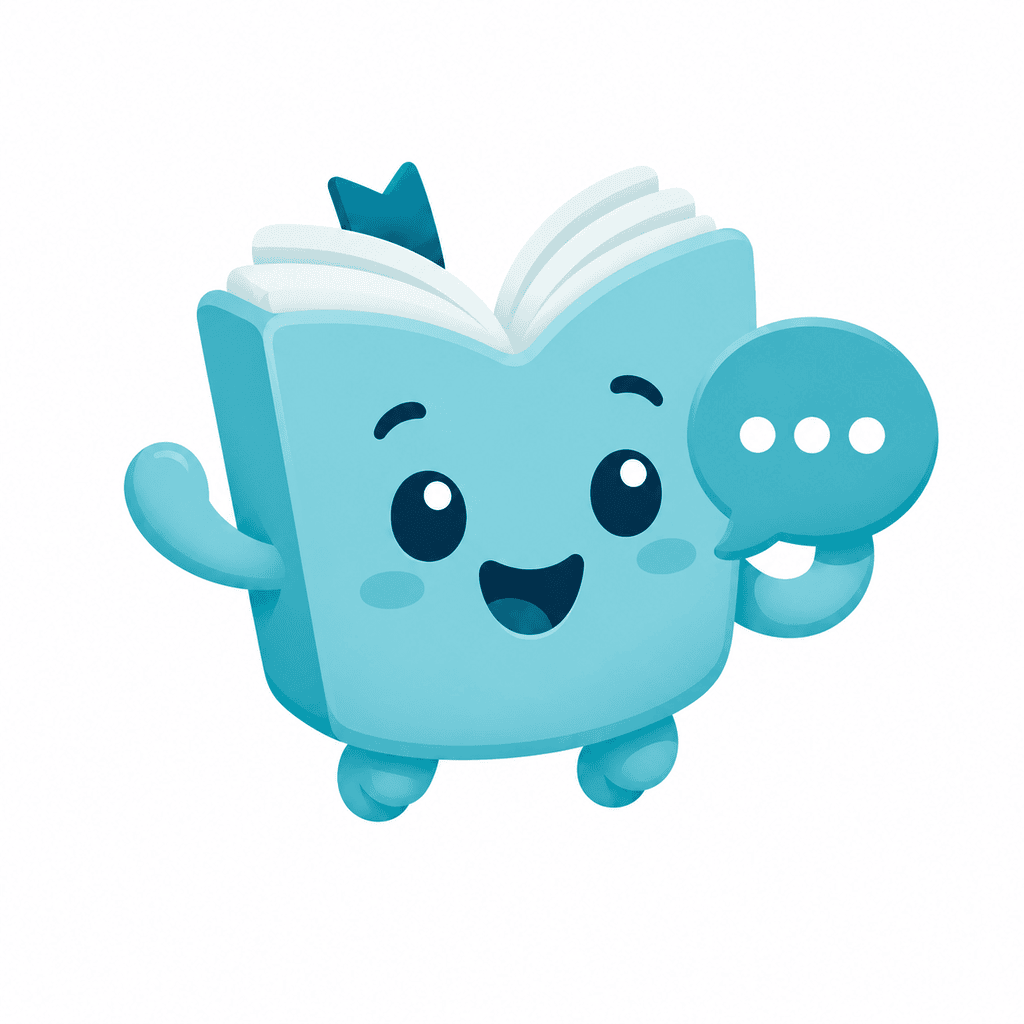
Vocabie’s app icon features its book-shaped mascot and speech bubble, representing vocabulary learning and guided language support.
Vocabie
What is Vocabie?
Vocabie is a vocabulary-learning app built for the gap between knowing a language and being able to use its vocabulary confidently.
Many people reach a point where they can understand grammar, hold conversations, and read in a language, but still struggle to find the precise word they want. They recognize advanced vocabulary when they see it, yet cannot recall or use it naturally when speaking or writing.
Vocabie is designed specifically for that stage.
Instead of teaching a language from zero, Vocabie helps learners expand, practice, and actively master vocabulary they can actually use. It can be used to improve a second language, such as English → French, but also to improve vocabulary within a language someone already speaks, such as English → English.
The goal is simple:
Turn words you recognize into words you can understand, recall, and use.
Personalized vocabulary, not a fixed course
Vocabie does not give every learner the same list of words.
During onboarding, users choose their language pair, interests, current comfort level, learning goals, and daily commitment. They then complete a short placement process that helps Vocabie estimate their current vocabulary level and prepare a personalized learning plan.
The personalization system considers proficiency, interests, previous learning performance, words already practiced, areas that need reinforcement, and vocabulary appropriate to the learner's level.
Interests influence the learning plan without narrowing it too much. Someone interested in business vocabulary, for example, will still encounter useful words from literature, culture, technology, everyday communication, and other areas.
This keeps learning relevant while still introducing new vocabulary outside the learner's usual comfort zone.
The onboarding is designed to reveal this personalization gradually rather than presenting one large configuration form. Each step has one clear purpose, and the information collected directly affects what the learner receives later.
Recognition is not mastery
One of the principles behind Vocabie is that answering one multiple-choice question correctly does not mean that a word has been learned.
A learner might recognize a definition but still be unable to distinguish the word from a similar one, understand it in a different sentence, recognize it when hearing it, recall it without help, or use it naturally when writing.
Vocabie therefore practices vocabulary through different forms of understanding and production, including:
- meanings and synonyms
- sentence context
- listening and recognition
- fill-in-the-blank recall
- contrasts between similar words
- writing
- active usage
Progress is measured across repeated attempts and different learning skills.
A word becomes mastered only after the learner demonstrates consistent understanding rather than simply answering one question correctly.
The objective is to measure usable vocabulary, not short-term memorization.
AI that explains when you need it
Vocabie AI is designed to help learners understand language rather than simply mark answers as correct or incorrect.
The Vocabie AI Coach is a dedicated language assistant where users can ask questions about vocabulary, grammar, meaning, tone, word choice, or usage.
For example:
- Why does this word sound unnatural here?
- What is the difference between these two words?
- When would I use this expression?
- How could I say this more professionally?
AI is also integrated directly into exercises through Ask Vocabie.
If a learner is confused, they do not need to leave the practice session, open a separate chatbot, remember the original question, and explain the entire situation again.
Vocabie already understands the context of the exercise, including the word being practiced, the sentence, the correct answer, the learner's answer, and the available alternatives.
The learner can immediately ask a custom question or select contextual prompts such as:
- Why was my answer wrong?
- What's the difference between these options?
This turns a mistake into an opportunity to understand why something is wrong instead of simply moving on.
For open-ended writing exercises, AI can also evaluate how the learner used a word in context and provide feedback beyond simple exact-answer matching.
Learning in different ways
Vocabulary requires repetition, but repetition does not always have to mean repeating the same type of quiz.
Vocabie combines structured exercises with small vocabulary games that reinforce recall, recognition, and word relationships through different interactions.
The games are intentionally supplementary. The goal is not to turn the entire application into a heavily gamified experience, but to give learners another way to work with vocabulary while keeping the main learning system focused.
Designed to stay out of the learner's way
Vocabie's design is built around one principle:
Learning vocabulary already requires concentration. The interface should not compete for that concentration.
The visual system is intentionally minimal. Screens use clear hierarchy, restrained text, generous spacing, focused actions, and consistent components rather than filling the interface with secondary controls.
Most screens are designed around one primary task.
Important information appears when it is needed, while secondary functionality stays contextual. Ask Vocabie is an example of this approach: advanced help is available immediately, but it does not permanently occupy the learning interface.
The same visual language is used across onboarding, exercises, progress, AI, games, and Premium. Different exercise types require different interactions, but they are designed to feel like parts of one product rather than separate tools.
Transitions, feedback states, and progress indicators are kept responsive and clear without becoming distracting.
The goal is not to create the interface with the most visible effects.
It is to create one where the learner notices the vocabulary before noticing the interface.
Five languages, deliberately
Vocabie currently supports:
- English
- French
- Spanish
- Czech
- Thai
The number is deliberately limited.
These are languages that I, my family, or people close to me can understand and evaluate, which makes it possible to pay closer attention to vocabulary selection, meanings, examples, translations, and real usage.
Rather than automatically claiming support for dozens of languages, I wanted to prioritize quality and linguistic confidence.
The supported languages can also be used in different ways. A learner can study from one language into another, such as English → French, or improve vocabulary within the same language, such as English → English.
This makes Vocabie useful not only for traditional language learning, but also for people who already speak a language and want to become more precise, professional, or expressive.
Built around better communication
Vocabie is not intended to replace teachers, schools, books, or complete language courses.
It is designed to address a narrower problem that appears after someone already understands the foundations of a language.
That can include people who want to:
- understand more of what they read
- improve academic vocabulary
- communicate more professionally
- become more precise when writing
- recognize advanced vocabulary more easily
- express ideas they already understand but cannot yet phrase well
The positive impact I want Vocabie to create is straightforward:
Help people express what they already know, think, and understand more precisely.
A subscription built around recurring value
Vocabie's monetization model is intentionally simple.
There are no advertisements, virtual currencies, or consumable purchases.
Vocabie Premium is offered through:
- Monthly: $9.99
- Yearly: $99.99
- 7-day free trial
The yearly option costs roughly the equivalent of ten monthly payments, giving subscribers about two months free compared with paying monthly for a full year.
I chose a subscription model because Vocabie provides recurring value rather than a one-time feature unlock. The product continuously provides personalized learning, mastery tracking, AI-powered explanations, contextual AI assistance, ongoing review, and cloud-based progress.
The subscription flow is also designed to demonstrate value before asking for payment.
A new user first selects their language, interests, level, and daily commitment, then completes placement exercises and receives a personalized learning plan.
Only after Vocabie understands enough about the learner to show what their experience will look like does the product move into account creation and Premium.
The idea is simple:
Show the user what Vocabie will do for them before asking them to subscribe to it.
The paywall follows the same minimal design principles as the rest of the app. It focuses on the Premium value, pricing, free trial, and one clear decision between monthly and yearly billing.
There is only one Premium tier, so users do not need to work out which features belong to which package.
RevenueCat manages the Premium entitlement, monthly and annual products, free trial, purchase state, restoration, and subscription lifecycle.
This keeps subscription logic centralized and gives Vocabie a sustainable foundation without introducing advertising into the learning experience.
What I am most proud of
What I am most proud of is not one individual feature, but how the different systems work together.
The personalization decides what should be learned.
The exercises test vocabulary in different ways.
The mastery system identifies what still needs work.
The AI explains confusion when it happens.
The games provide another way to reinforce vocabulary.
The interface tries to stay out of the learner's way.
RevenueCat supports the recurring infrastructure behind the product without forcing the experience to depend on advertising.
All of these pieces support the same idea:
Knowing what a word means is only the beginning. The goal is being able to use it when you need it.
Built With
- ai
- apple
- eas
- expo.io
- openai
- postgresql
- react
- revenuecat
- supabase
- typescript


Log in or sign up for Devpost to join the conversation.