-
-
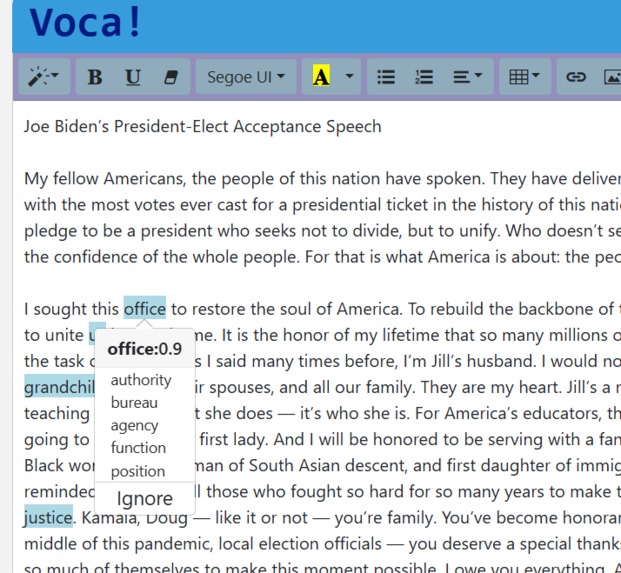
Demonstration of hover functionality!
What it does
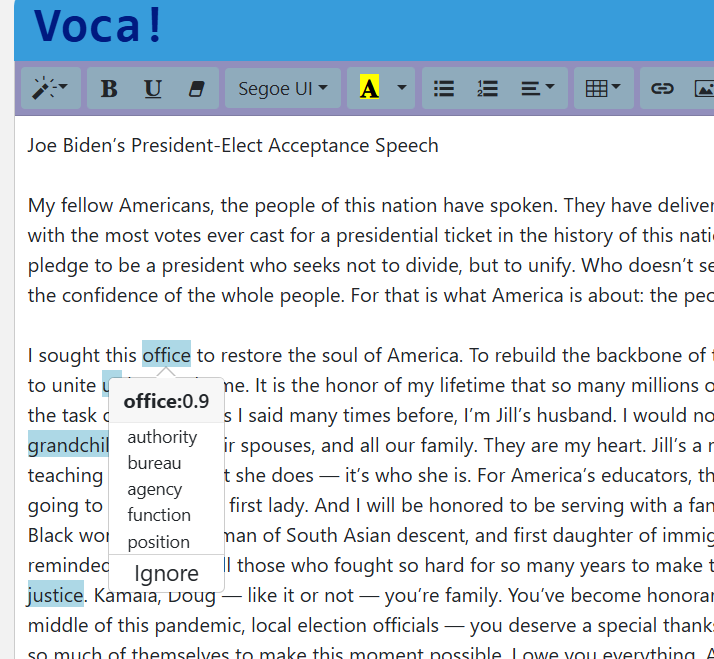
Voca is a powerful web-based text editor designed to combine the familiar functionality of popular writing tools with innovative machine-learning technology aimed at assisting individuals who stutter. Like traditional word processors, Voca offers a complete range of formatting features, allowing users to adjust fonts, colors, and styles, making it suitable for all types of writing tasks, from professional reports to creative projects. However, what sets Voca apart is its unique focus on speech fluency. For individuals who stammer, certain words or sounds can be difficult to pronounce, causing interruptions in speech. A common way people compensate for this is by trying to swap words that you have difficulty saying. Voca tackles this challenge by integrating machine learning algorithms that identify words in a user's text that may be harder to say based on common speech patterns. The app analyzes the text and highlights potentially difficult words, offering users alternative phrases or synonyms that could help them avoid stuttering. The app goes beyond just word prediction. It actively engages with users by asking them directly if specific words are difficult to say. These words can be used to make more informed decisions regarding the words to be highlighted. This personalized interaction allows the app to learn about each user's unique speech patterns and preferences, further refining its suggestions over time to provide even more tailored recommendations. Through this adaptive learning process, Voca becomes increasingly efficient at helping users craft their text in a way that ensures smoother, more confident verbal communication. Voca tries to empower people who stammer by making speech more accessible and fluid. It enables users to express themselves with greater ease by offering alternatives to potentially troublesome words and phrases. With a user-friendly interface, the app blends text editing with specialized speech assistance technology, helping users not only write effectively but also prepare for smoother verbal communication in any context. Voca represents accessibility and writing technology, making it an invaluable tool for individuals who stammer.
Inspiration
As someone who has stuttered since childhood, I’ve spent years navigating the challenges that come with struggling to say certain words. Growing up, I quickly realized that some words were consistently harder for me to articulate than others. This led me to develop a habit of substituting difficult words with simpler or easier ones that I could say fluently. Over time, I became quite adept at mentally scanning my vocabulary for alternatives whenever I felt a block coming on, but it was always a time-consuming and sometimes stressful process, especially in conversations or presentations where quick thinking was required.
In my search for a better way to manage stuttering, I began to do research. I looked into speech therapy techniques and linguistic studies, trying to understand the mechanics behind stuttering and why certain words are more difficult to say. What I found was that many people who stammer have triggers—specific letters, sounds, or word patterns that cause them to trip up. For me, the challenge wasn’t just saying the words but preparing to speak, knowing that some words might cause hesitation. However, despite various therapy methods and tools out there, I realized that few, if any, tech solutions addressed this issue directly—especially in writing and preparation for speech.
That’s when the idea for Voca came to me. I thought about a tool that could predict which words might be difficult for someone who stammers to say and offer alternatives. This could make the process of speaking more fluid and reduce anxiety for people like me. With a passion for improving accessibility, Voca was a way to bridge that gap.
Voca is not just a regular text editor but a tool that could learn from users, identifying words that are often challenging for them and suggesting replacements. It’s a way of providing real-time assistance to individuals preparing to speak, helping them structure their words to make verbal communication smoother and less stressful.
Challenges Voca ran into
Researching the best practices in speech therapy and ensuring Voca would truly be useful for people who stutter was vital but time-consuming. The project was about balancing technology with deeply personalized human needs, which demanded a thoughtful and technical approach at every step.
One of the biggest hurdles was gathering appropriate data to train the machine-learning model. Since stuttering patterns are unique to each individual and influenced by factors like specific sounds, word structures, and even emotional states, finding a comprehensive dataset that could accurately predict difficult words was tricky. Research to identify patterns in speech disfluency is scarce, but pulling from public speech data to fine-tune the model proved to be useful. However, stuttering is highly variable, so creating a model flexible enough to adapt to different users is an ongoing challenge.
On the frontend side, ensuring that Voca was intuitive and user-friendly was crucial. I wanted the tool to feel like a familiar word processor while integrating its unique features seamlessly. Balancing a clean, simple interface with complex machine-learning processes in the background was a juggling act.
Building and modifying machine learning systems also posed difficulties. The model needed to not only identify potentially challenging words but also suggest meaningful alternatives that preserved the context and intent of the original text. Training it to balance fluency with semantic accuracy required testing. Algorithms had to be refined so that they wouldn’t just swap out words randomly but offer thoughtful and contextually relevant replacements.
What's next for Voca
For Voca 2.0, the vision is to create a more powerful, interactive, and community-driven platform that not only assists with writing but also significantly improves speech fluency and contributes to advancing stuttering research. A major focus will be building a community where users can access curated speech therapy resources, share experiences, and offer support to one another. This community aspect will provide a valuable space for individuals who stammer to connect, learn, and grow together. Additionally, Voca 2.0 will integrate voice input functionality, allowing users to speak directly into the app and receive real-time feedback on difficult words or sounds. This will enhance the app’s ability to offer personalized word suggestions based on both written and spoken input, making the tool more versatile and effective for speech practice. The machine learning model will also be significantly upgraded, utilizing faster algorithms and more comprehensive, labeled data focused on stuttering patterns. This will enable the app to provide more accurate and contextually relevant word replacements while processing user inputs quickly and efficiently. The front end will see major improvements to ensure a smoother, more intuitive user experience, with a cleaner interface and faster navigation. The app will also expand its functionality by contributing to stuttering research, with anonymized user data (gathered with consent) being analyzed to identify deeper patterns in speech disfluency. By supporting research in this way, Voca 2.0 can help push the boundaries of understanding stuttering triggers and interventions. Ultimately, the next version of Voca will be much more than a text editor—it will be a full-fledged platform where users can practice, prepare, and gain confidence in their speech, with the backing of an engaged community and machine-learning technology. Voca 2.0 will aim to empower individuals who stammer by giving them the tools and support needed to communicate more fluidly, both in writing and speech, while also advancing the science behind speech disorders.

Log in or sign up for Devpost to join the conversation.