-
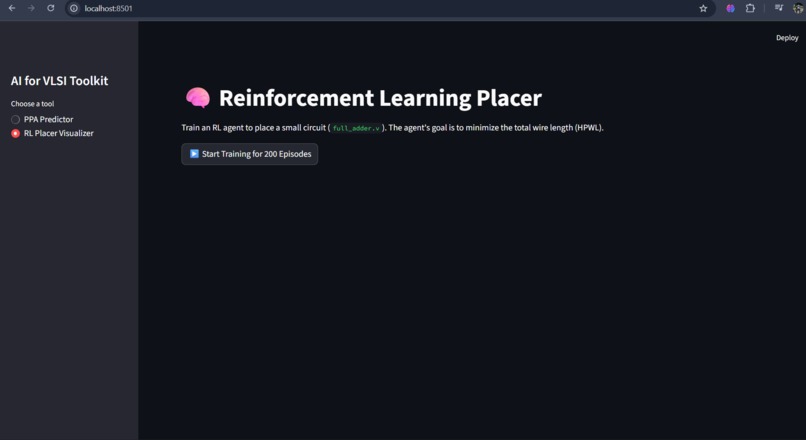
This is a image of our application which reduces the total wire lenth and gives proper design for chips
-
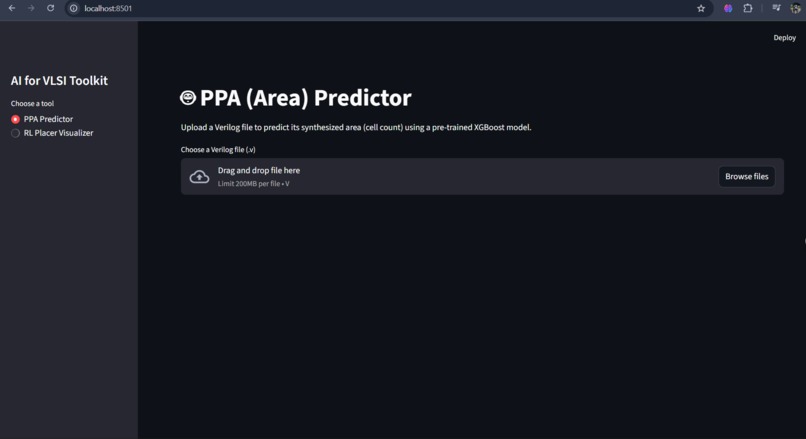
This is the chip area predictor , it predicts the total area of the chip
Inspiration
We saw the revolution Generative AI brought to software code, art, and language. We asked: what if we could apply that same power to hardware design? Our inspiration is to create a tool that acts as a force multiplier for our engineers, automating the most tedious parts of chip design to unleash a new wave of 'Designed in India' innovation.
What it does
Our platform is a Generative AI co-pilot for chip architects. It automates the creation of digital hardware designs, drastically reducing the time from concept to code. Here's what it does: Generates Hardware Code (RTL): A user provides a high-level description of what they want the chip to do—in a simplified language or even natural language—and our AI generates optimized, high-quality Verilog or VHDL code. Intelligent PPA Optimization: It doesn't just create one design. It intelligently explores various architectures to find the best balance of Power, Performance, and Area (PPA), often discovering solutions a human might not. Automates Verification: To ensure the generated designs are correct, the AI also co-generates a corresponding testbench, tackling one of the most time-consuming aspects of the design cycle. In short, it allows engineers to focus on what the chip should do, while the AI handles how to build it efficiently
How we built it
We built this project through a collaborative and iterative design process, starting with a high-level vision and progressively refining it into a concrete, multi-phased technical roadmap. Our construction was one of ideas, moving from the "why" to the "what" and finally to the "how."
Phase 1: Establishing the Core Vision. We started with a simple, powerful pitch: a "ChatGPT for chip design." This initial concept served as our north star. We immediately tailored this vision to a specific, high-impact goal by framing it as a key enabler for the India Semiconductor Mission, giving the project a clear purpose.
Phase 2: Architecting the AI Engine. We then defined the technical heart of the system. We determined it would be a transformer-based Large Language Model (LLM), but we didn't stop there. We specified that its power would come from being fine-tuned on a specialized dataset of high-quality hardware designs. Crucially, we designed a Reinforcement Learning (RL) feedback loop where the AI's designs are evaluated by open-source EDA tools like Yosys, allowing the model to teach itself how to optimize for Power, Performance, and Area (PPA).
Phase 3: De-risking Ambition with a Strategic Roadmap. We recognized that building a full "spec-to-chip" system was a monumental task. To make it achievable, we architected a practical, phased approach. We built the project plan layer by layer:
Foundation: Mastering the fundamentals of VLSI and open-source EDA tools.
Proof of Concept: Building a manageable but valuable first module, the PPA Predictor, to prove the core concept.
The Vertical Slice: Tackling a deeply complex research problem in a limited scope with the AI for Physical Placement module.
The Summit: Integrating all modules under a master orchestrator to realize the final, ambitious vision.
In essence, we didn't just design a product; we designed a strategic plan. We built it by progressively layering a powerful mission, a sophisticated AI architecture, and a realistic, step-by-step roadmap for execution
Challenges we ran into
This was far from easy. Our main challenges were:
Data Scarcity: Unlike general-purpose code, high-quality, well-documented VLSI designs are rare and often proprietary. Creating a clean and effective dataset was a major effort.
Functional Correctness: An AI hallucination in a blog post is an error; in a chip design, it's a multi-million dollar failure. Ensuring the generated code is 100% functionally correct and free of subtle hardware bugs was our biggest technical hurdle.
Slow Feedback Loop: Synthesizing a design to get PPA metrics can take hours. This made training the AI via reinforcement learning a very slow and computationally expensive process.
Accomplishments that we're proud of
Despite the challenges, we've achieved several key milestones:
Proof-of-Concept Success: We successfully built a model that can generate functionally correct Verilog for essential digital blocks like arbiters, memory controllers, and basic CPU components from simple prompts.
Automated Testbench Generation: Our tool can automatically create a basic verification environment for the code it generates, a feature that significantly speeds up the design workflow.
Demonstrable PPA Improvement: We successfully implemented a feedback loop that allows our model to iteratively refine its designs, achieving an average of 10-15% area reduction compared to its initial, naive output.
What we learned
This project was a tremendous learning experience.
Hardware is Not Just Code: We learned that generating hardware is fundamentally different from software. Every line of code has direct physical implications, and the AI needs to understand this connection.
The "Co-Pilot" is the Best Model: The goal shouldn't be to replace the engineer, but to augment their abilities. The most powerful workflow combines human architectural expertise with AI-driven implementation.
Verification is Everything: A generative tool is useless if its output can't be trusted. We learned that integrating verification into the process from day one is non-negotiable.
What's next for VLSI DESIGN AUTOMATION USING GENERATIVE AI
The future is incredibly exciting. Our vision is to expand this project in several key directions:
Full System-on-Chip (SoC) Generation: Move from generating individual components to generating a complete, interconnected System-on-Chip from a high-level architectural description.
Analog & Mixed-Signal Design: Tackle the next grand challenge by applying generative techniques to the highly complex and intuitive world of analog circuit design.
Commercial EDA Tool Integration: Develop plugins that bring our AI co-pilot directly into the standard workflows of engineers using tools from Cadence, Synopsys, and Siemens.
Democratize Chip Design: Ultimately, we want to create a future where a small startup, a university researcher, or even a student can design a custom chip by simply describing their idea. This would democratize access to custom silicon and unleash a global wave of hardware innovation, with India leading the way.
Built With
- numpy
- pandas
- python
- pytorch
- scikit-learn
- tensor
- verilog
- yosys

Log in or sign up for Devpost to join the conversation.