-
-
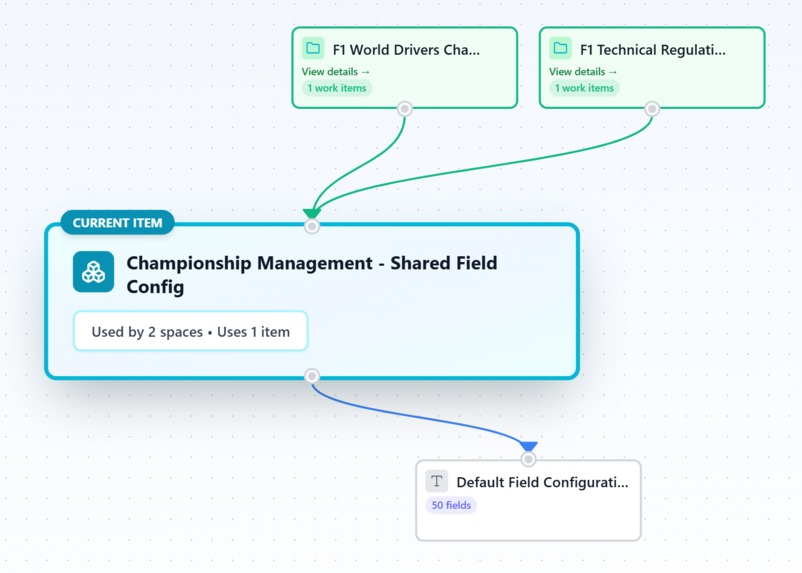
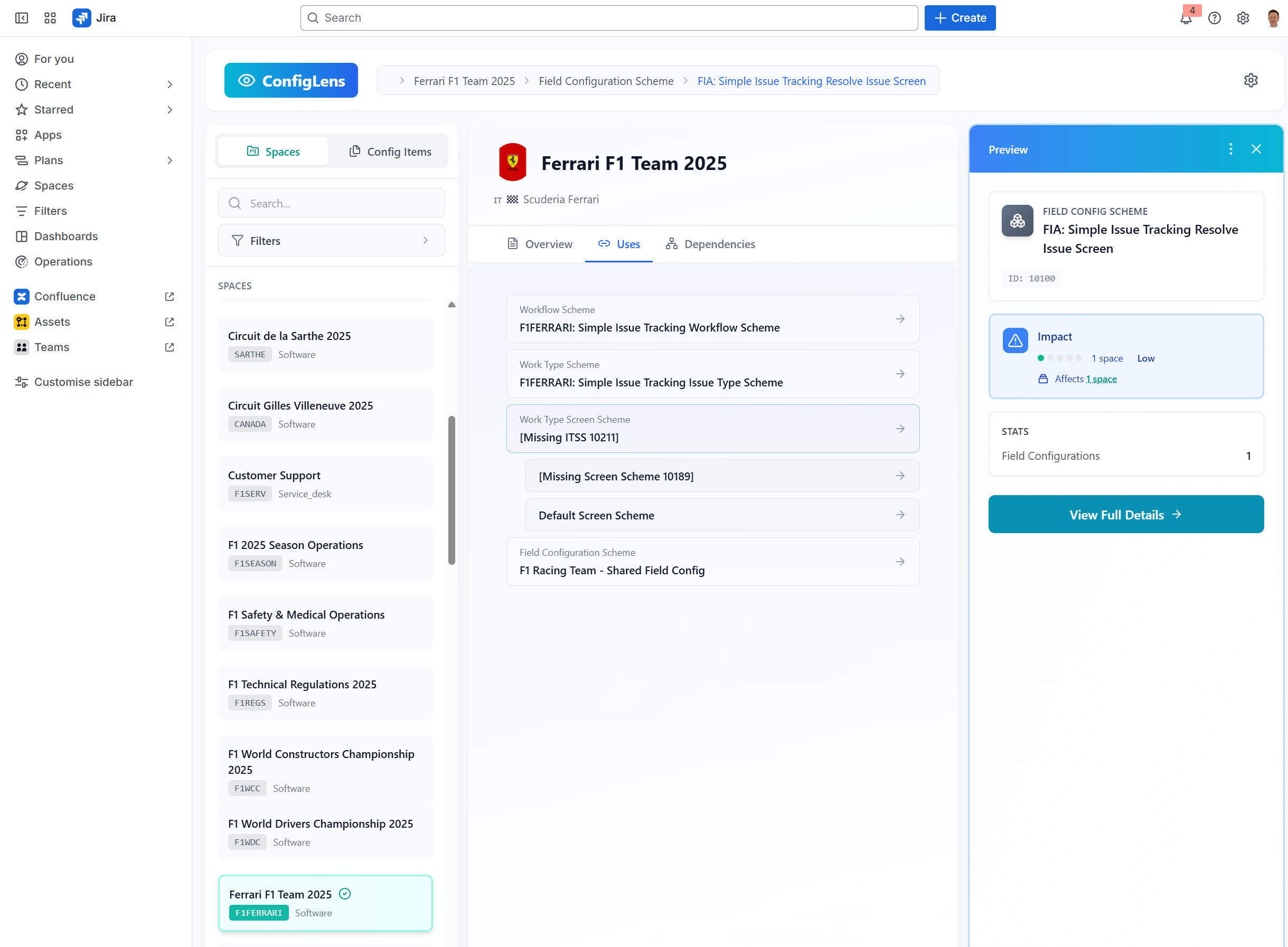
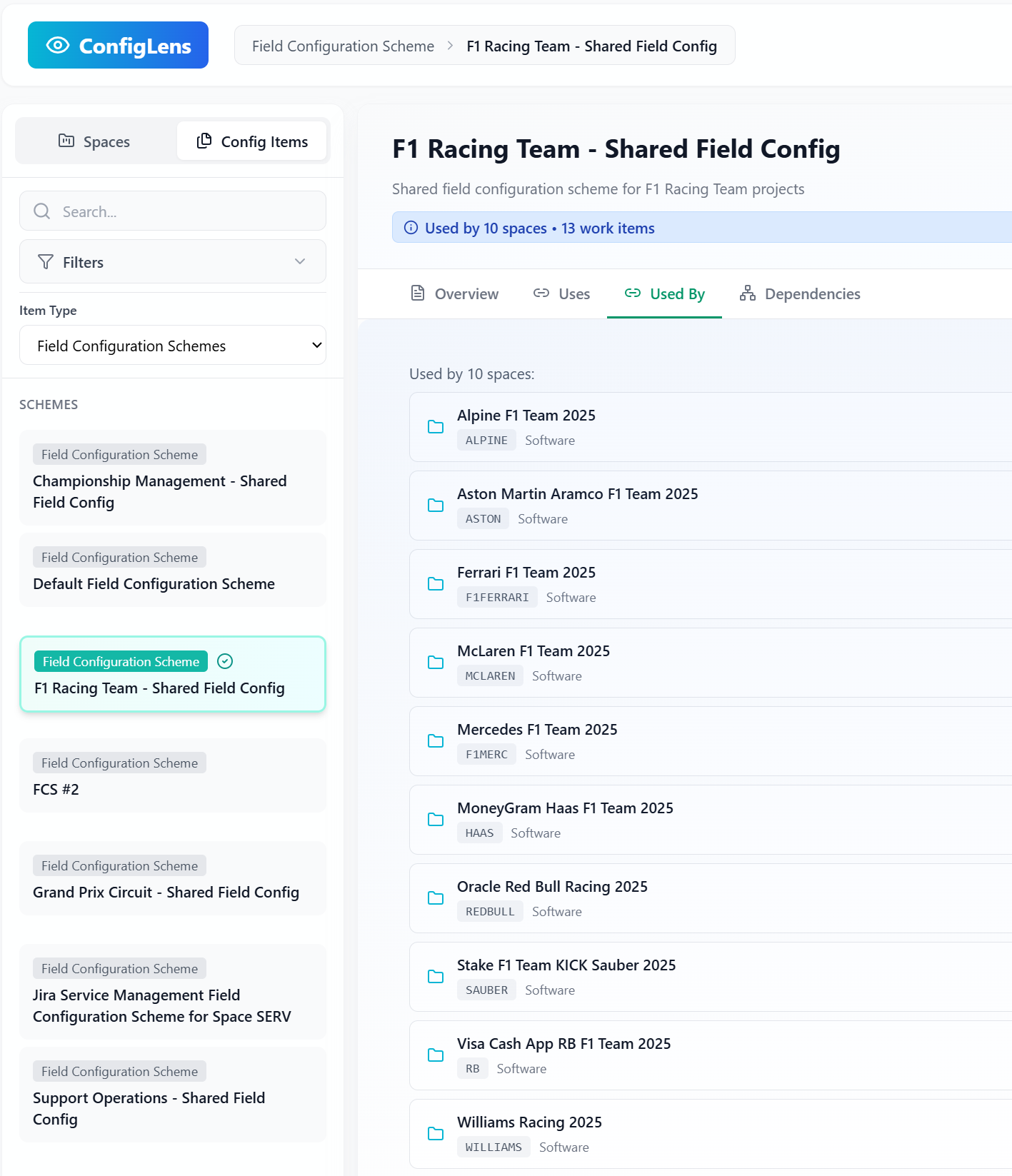
ConfigLens simplifies Jira Administration.
-
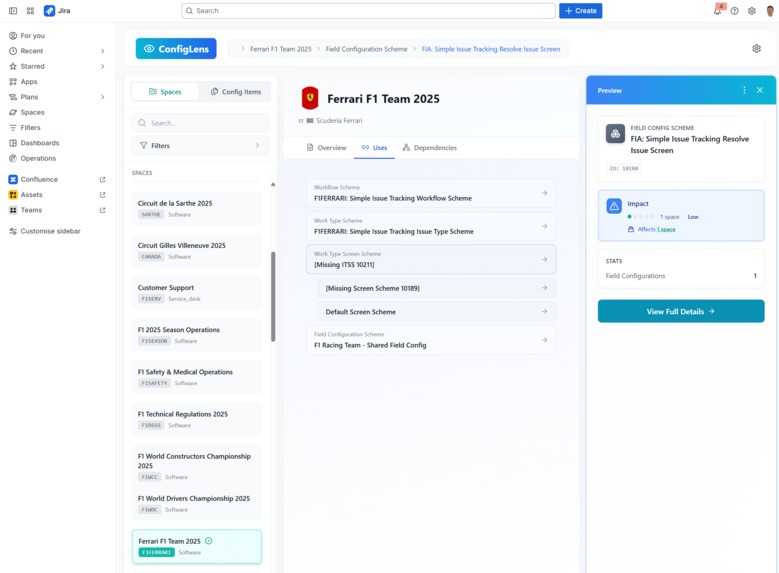
Fully integrated into Jira.
-
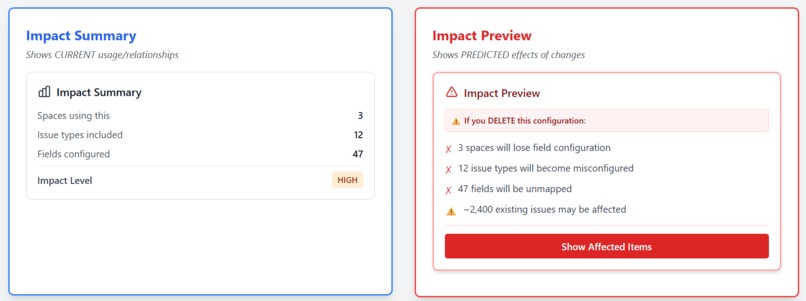
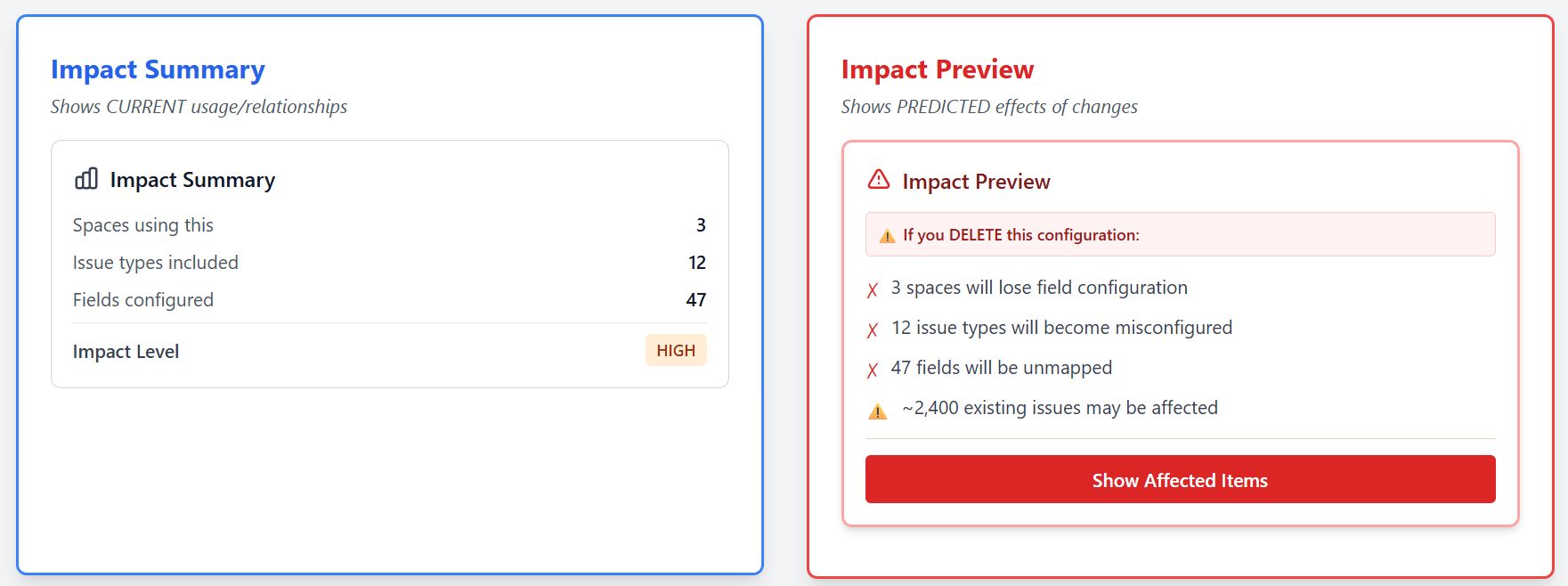
Assess the impact BEFORE you make a change
-
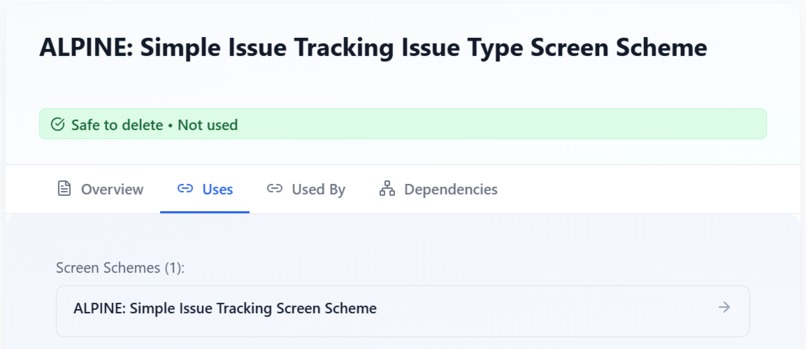
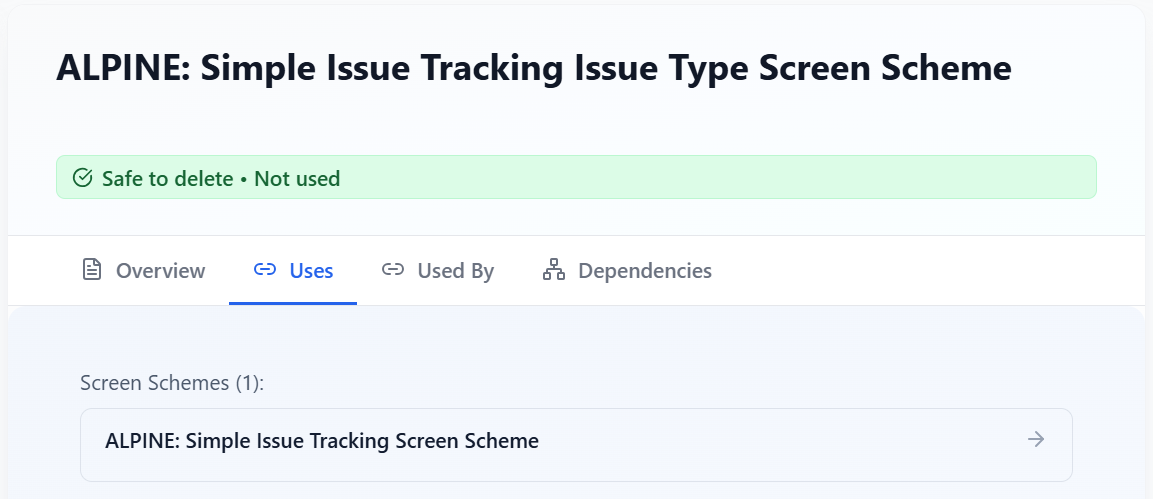
Delete with confidence.
-
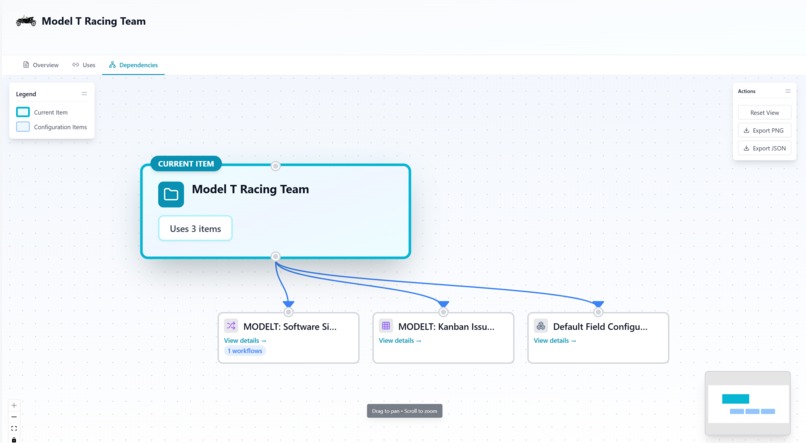
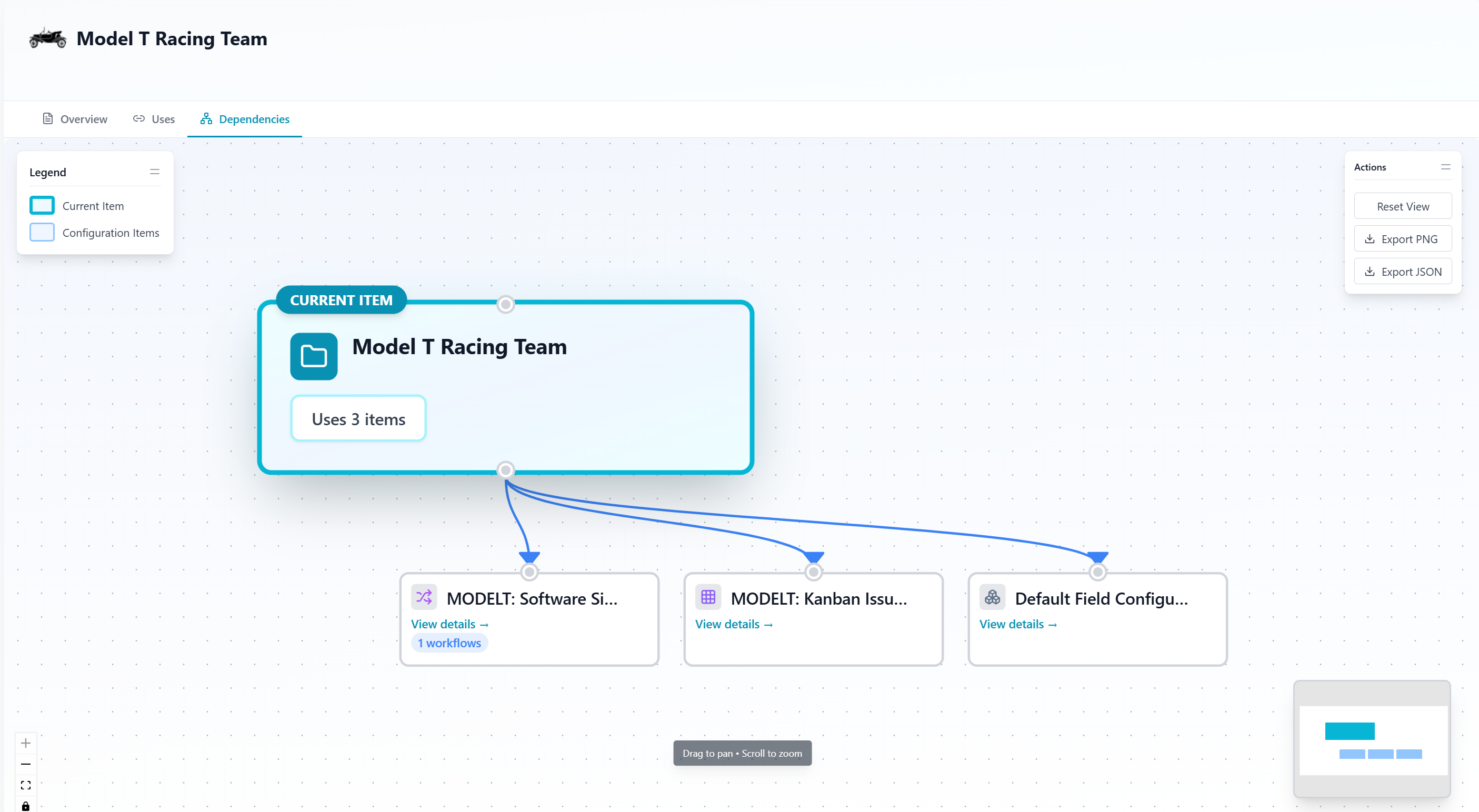
Visualise Space configuration
-
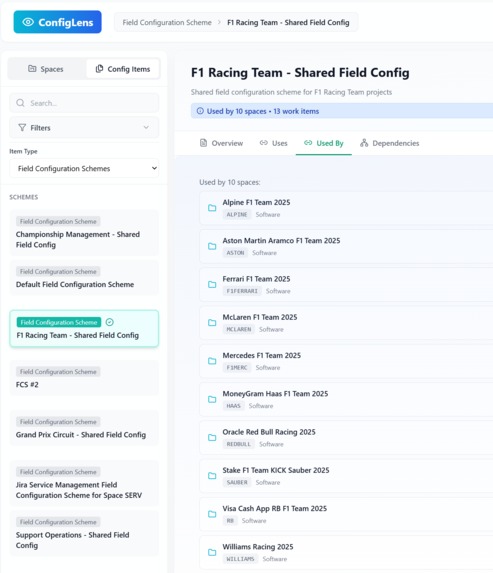
Jira configuration presented with style.
-
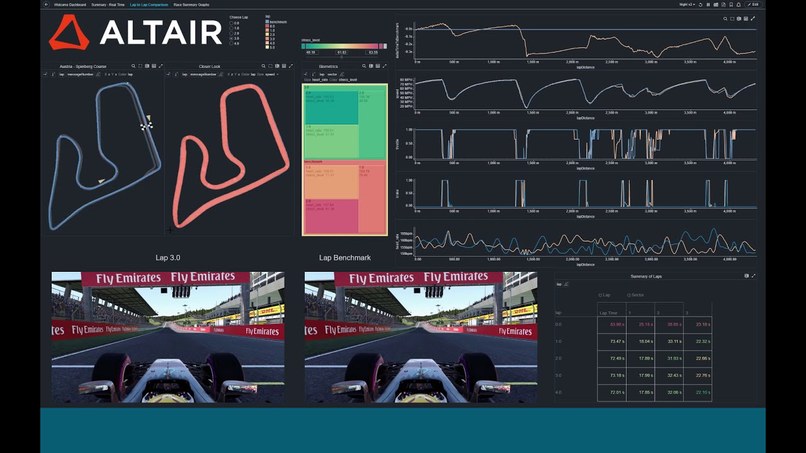
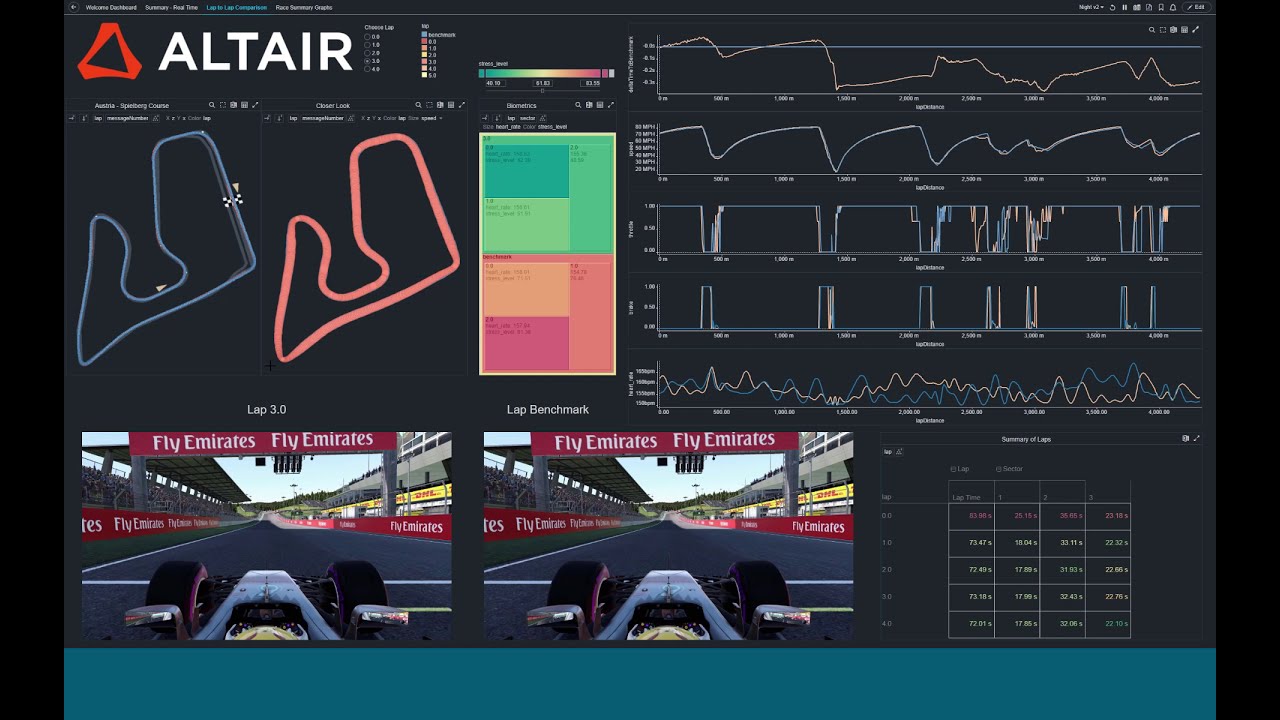
F1 telemetry for Jira.
Inspiration: From Frustration to High-Performance Vision
As a long-time Jira administrator managing complex instances for software teams, I've spent countless hours troubleshooting configuration changes gone wrong. Deleting a custom field or modifying a workflow seemed simple—until it broke screens, issue types, or workflows across projects, causing outages and frantic rollbacks. Teams operate under immense pressure, much like a Formula 1 pit crew where one wrong move can cost the race.
Codegeist 2025's Williams Racing theme struck a chord: software teams need to perform like elite racing crews—fast, precise, and coordinated. I was inspired to build ConfigLens, a Forge app that acts as "race control" for your Jira engine, visualizing configuration relationships and predicting the "blast radius" of changes to enable confident, high-speed administration.
The Problem: Navigating Jira's Hidden Complexity
Jira configurations form a tangled web: custom fields link to screens, workflows, issue types, and more. Admins often guess the impact of changes, leading to:
- Prolonged troubleshooting (often 30+ minutes per issue)
- Unintended disruptions during migrations or cleanups
- Hesitation to optimize, leaving bloated instances
ConfigLens solves this by providing telemetry-like insights, helping teams accelerate without crashing.
How I Built It: Leveraging Forge for Speed and Precision
Built entirely on Atlassian's Forge platform, ConfigLens integrates deeply with Jira:
- Custom UI modules for intuitive graph visualizations of dependencies
- Resolver functions to fetch and analyze configuration data via Jira's REST APIs
- Impact analysis engine that maps relationships and computes impact scores based on the breadth and criticality of affected elements
The graph visualization uses a force-directed layout where critical dependencies glow red, allowing admins to instantly see danger zones. For example, when a user hovers over deleting Custom Field X, ConfigLens instantly shows it would break 3 active workflows across 12 projects—information that would take 45 minutes to gather manually.
Key features:
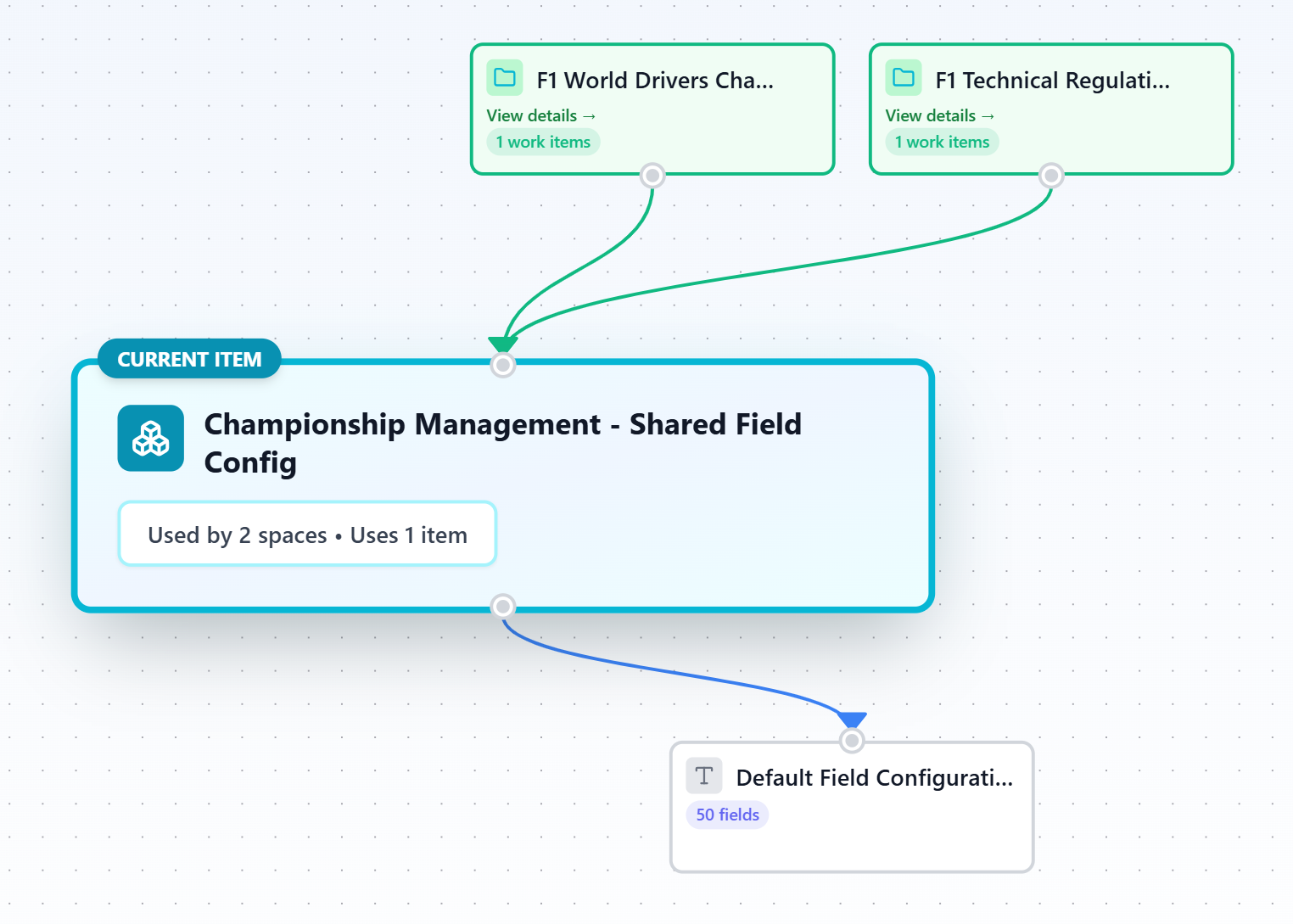
- Graph views showing connections (e.g., a field's links to 50+ screens)
- Blast radius prediction: Quantify how many projects/workflows would break
- Impact scoring to prioritize changes by potential disruption
I drew on Forge's serverless strengths for scalability, ensuring it handles large instances without performance lags—like a finely tuned F1 car.
Challenges Faced: Pit Stops and Pivots
The biggest hurdle was accurately modeling Jira's intricate configuration dependencies. Early prototypes missed edge cases (e.g., indirect links via notification schemes), leading to incomplete graphs.
I overcame this by:
- Iteratively refining API queries and data parsing
- Testing on real-world-like instances with thousands of configs
- Balancing visualization clarity—avoiding overwhelming graphs while showing depth
Time constraints pushed me to prioritize core features: visualization and impact prediction over polish. Late nights debugging Forge deployments felt like high-pressure qualifying laps, but the Williams Racing spirit kept me accelerating.
I validated the concept with several fellow Jira admins who confirmed the pain point and praised the instant visibility ConfigLens provides—one called it "the X-ray vision I've always needed."
What I Learned: Precision Under Pressure Wins Races
This project deepened my mastery of Forge and Jira's configuration APIs. I learned that great apps stem from real pain points—mine and many admins'. Embracing the racing theme taught me to focus on precision and speed: reduce change impact assessment from minutes to seconds.
ConfigLens isn't just a tool; it's a mindset shift for safer, faster Jira administration. I'm excited for its potential in the Atlassian Marketplace, helping software teams race ahead confidently.
ConfigLens transforms Jira administration from a minefield into a precision operation—because software teams deserve to move at racing speed, safely.
Thank you, Codegeist 2025, for the push to turn frustration into innovation. Start your engines! 🏎️
Built With
- atlassian-forge
- custom-ui
- graph-visualization
- javascript
- jira-cloud
- node.js
- react
- rest-api
- rovo-dev
- serverless
- typescript

Log in or sign up for Devpost to join the conversation.