VividLaunch: The Automated Growth Engine for the Vibe Coding Era
Inspiration
Building apps has never been easier. We live in the era of "vibe coding," where anyone can turn a spark of an idea into a functional product in days. But while building is solved, distribution is still broken.
Most brilliant apps don’t fail because they are bad; they fail because they are ghosts. They live in a vacuum. Modern marketing demands a relentless stream of content: high-impact videos for TikTok/Reels, thought-leadership blogs, and a constant pulse on X and LinkedIn. For indie hackers and small teams, this content treadmill is overwhelming. It steals time away from the one thing that actually matters: building a product users love.
I built VividLaunch to fix this. It’s the "Creative Director" that every founder needs but can't yet afford.
What it does
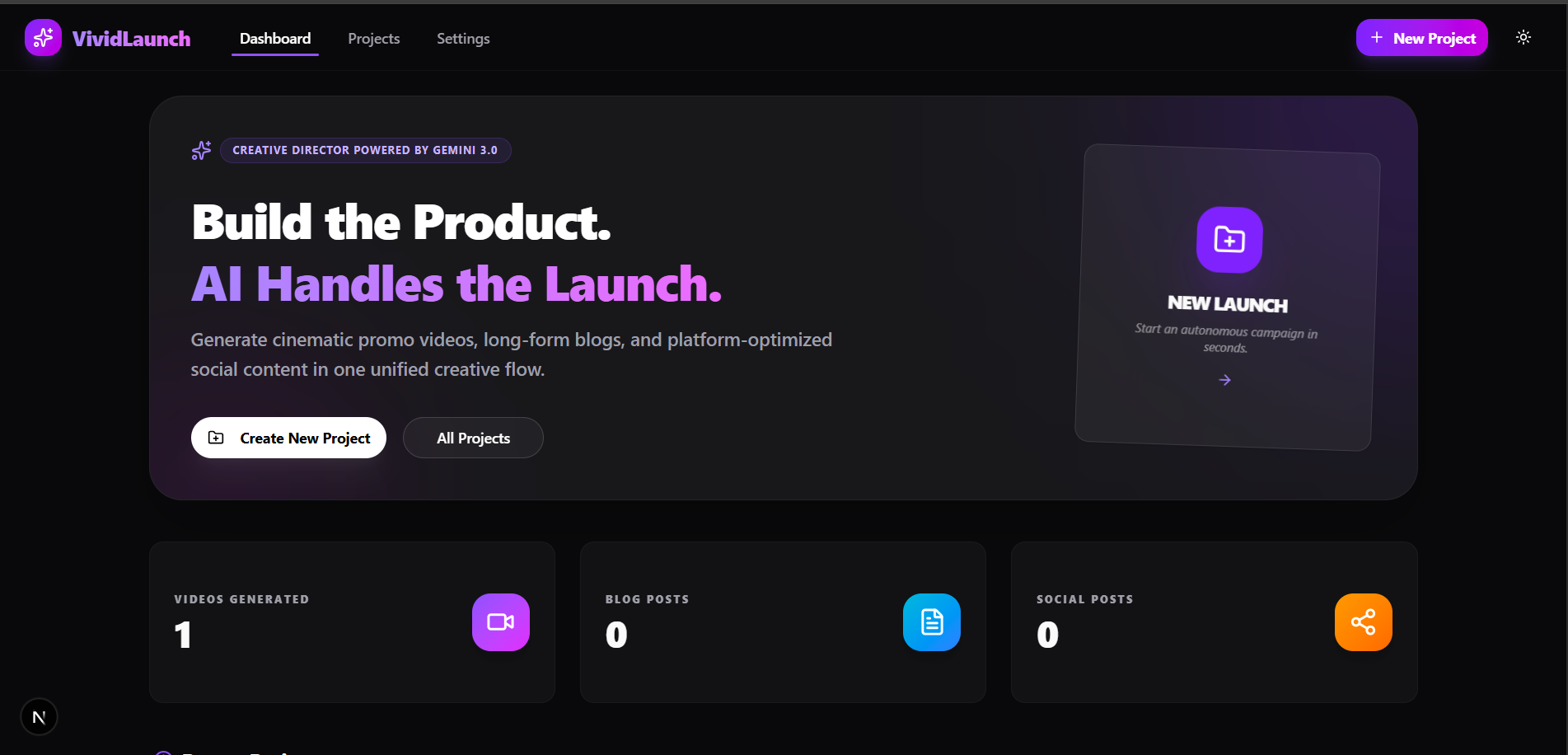
VividLaunch is an autonomous orchestration platform that handles the entire lifecycle of a product launch.
- Unified Product Knowledge (VividSource): VividLaunch doesn't just scrape; it "understands." It connects to your existing ecosystem—Medium blogs, YouTube channels, landing pages, and even raw PDF documentation—to build a unified context window for every campaign.
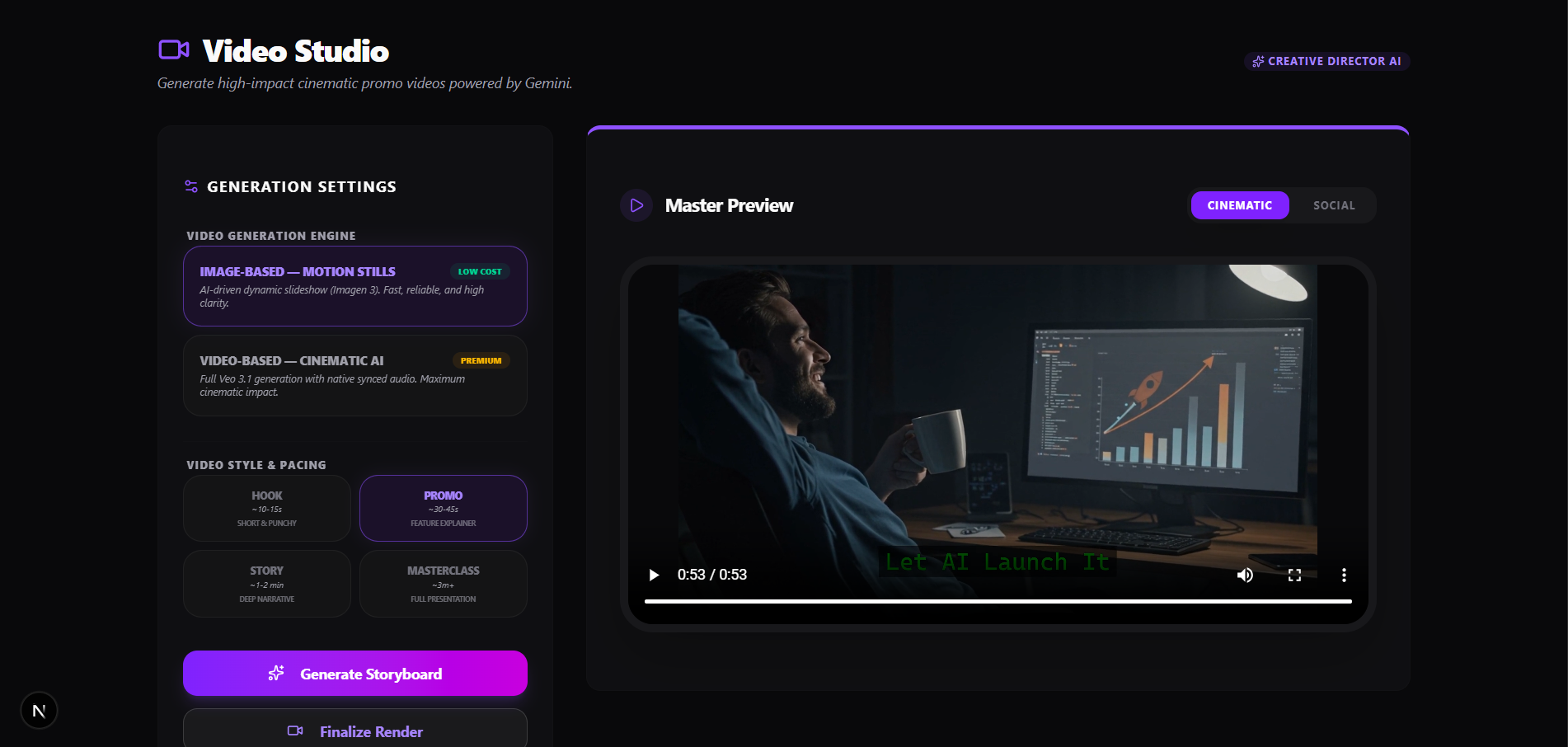
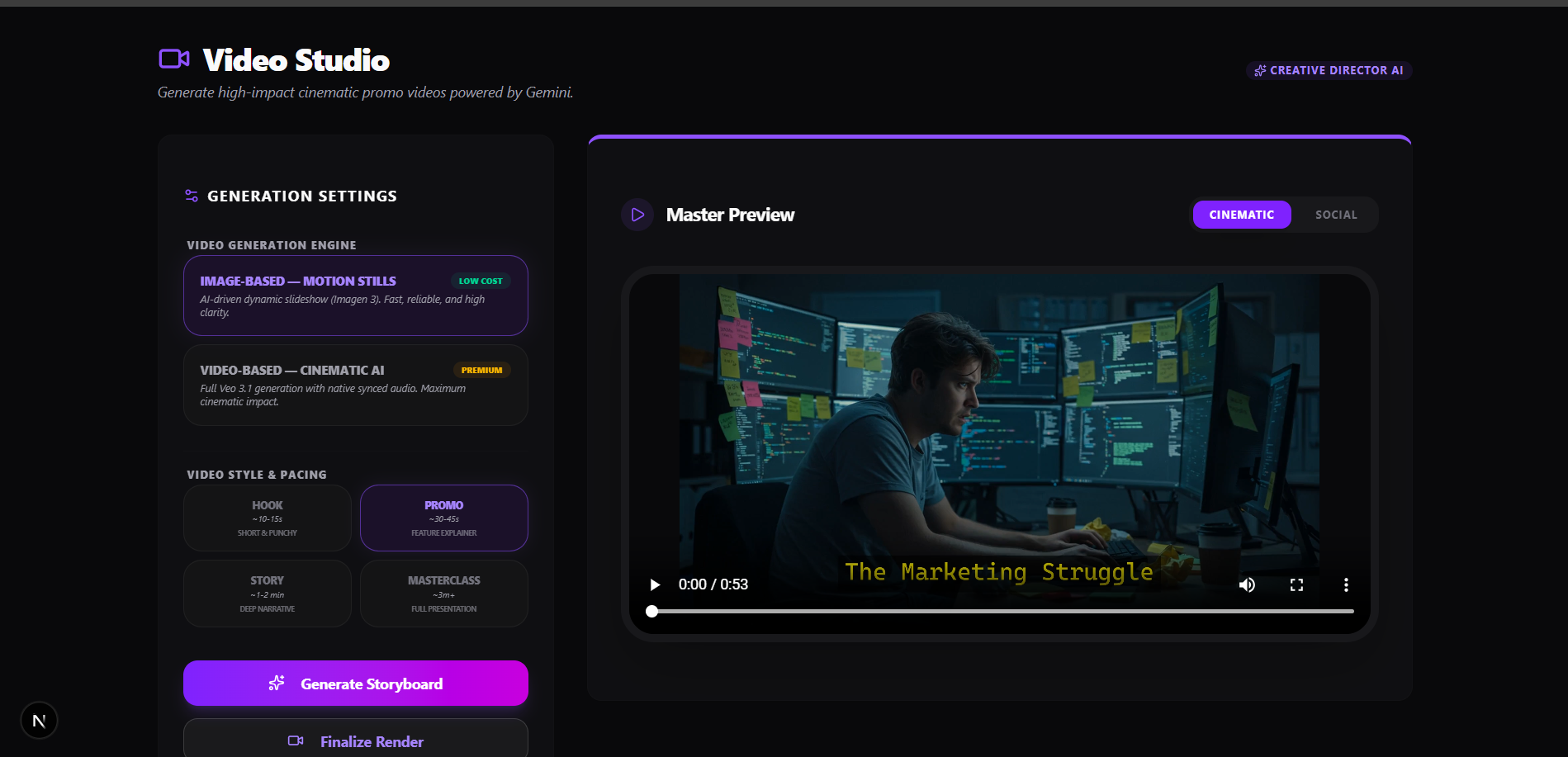
- Video Studio: Gemini acts as a Creative Director with a 3-Tier Generation Engine. Users can choose between Classic (Imagen 3), Hybrid (Images + Veo 2), or Cinematic (Veo 3.1 Only). It orchestrates cinematic promo videos (up to 4K resolution) for YouTube and Reels/TikTok by syncing narration, visuals, and kinetic typography.
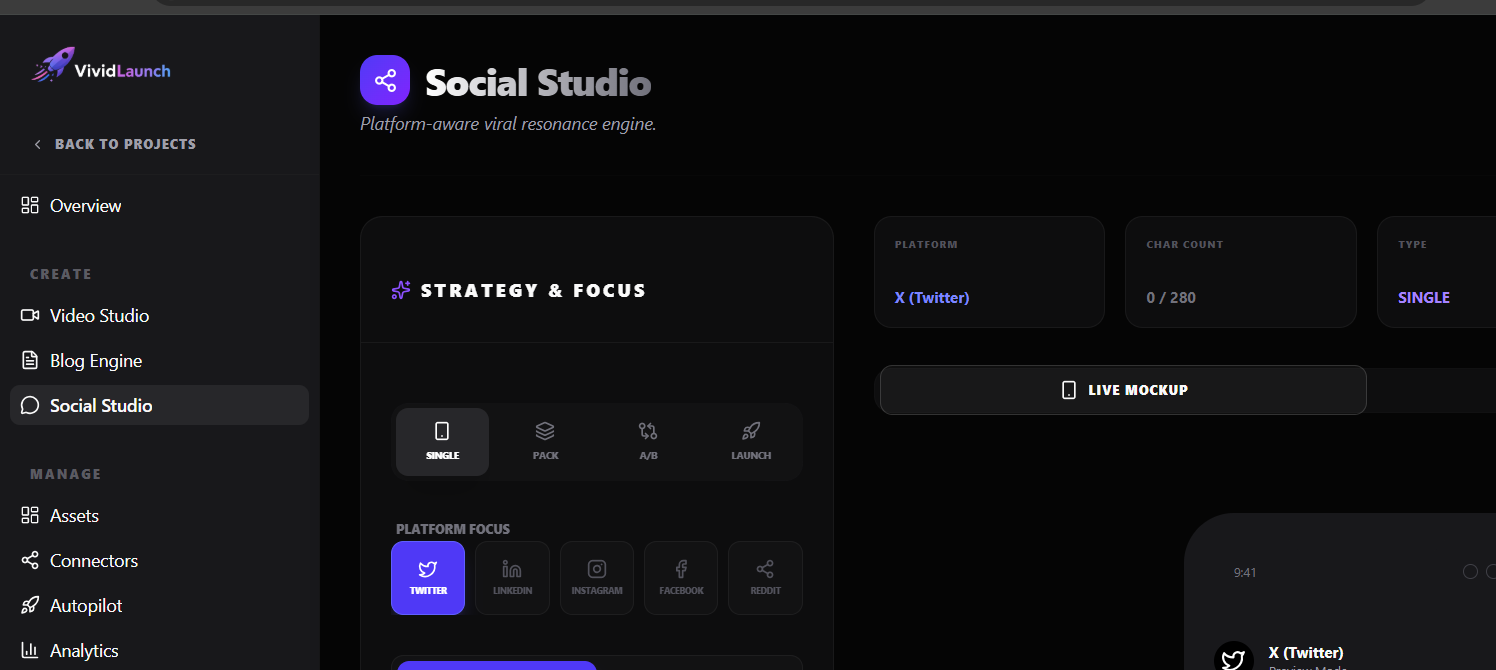
- Multi-Channel Social Studio: A split-screen mission control to generate content for X (Twitter), LinkedIn, Instagram, TikTok, and Facebook. Each post is tailored to the specific platform's "DNA"—from hashtag strategies to live platform mockups.
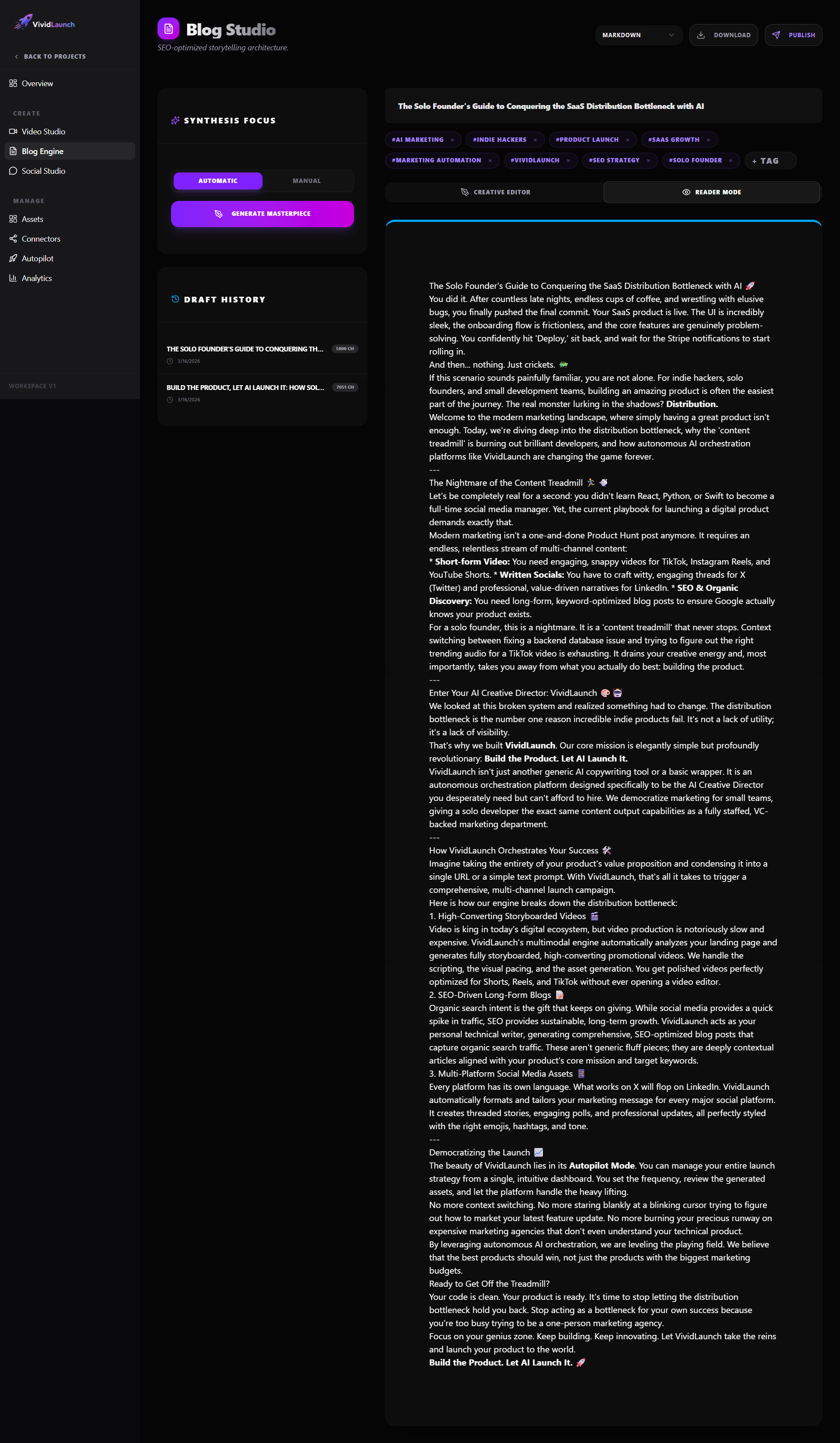
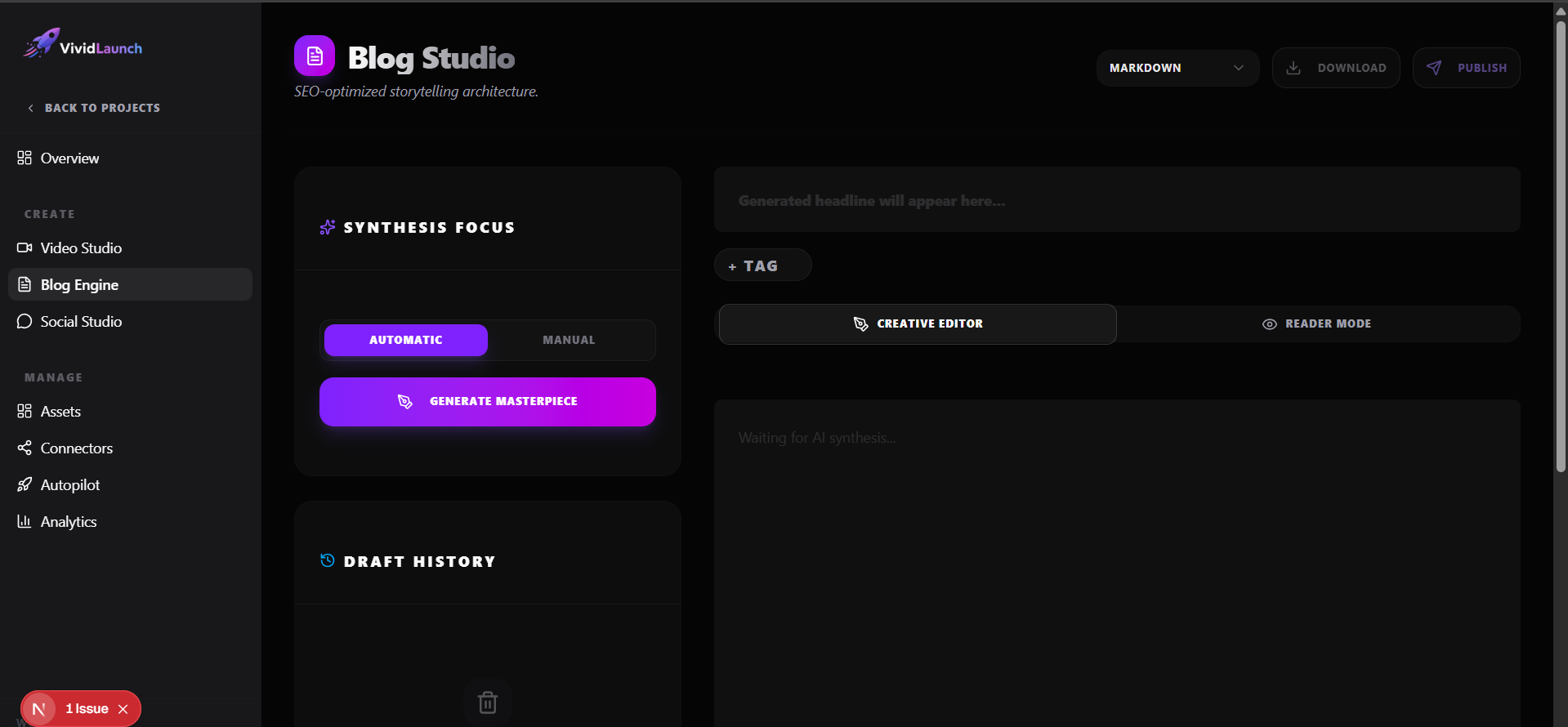
- Direct-to-Blog Studio: Generate high-authority thought leadership pieces for Medium and Substack based on your project context, complete with AI-generated featured images.
- Autopilot (VividAuto): A set-and-forget orchestrator. Define your "Automation Pulse" and let our agents handle the distribution across all connected platforms while you sleep.
How I built it
I built VividLaunch using a cutting-edge Google-native stack:
- Orchestration: Built with the Google GenAI SDK (ADK). I use a multi-agent loop where a "Researcher Agent" (Context Analyzer) autonomously gathers project context from disparate sources (Medium blogs, landing pages, manual descriptions) which is then passed to a "Cinematographer Agent" to build the multimodal storyboard.
- Model Hierarchy:
- Gemini 2.0 Flash (Experimental): Powers the Researcher Agent and Context Analysis (scraping websites/blogs), selected for its industry-leading stability in complex tool-calling loops.
- Gemini 3 Flash (Preview): Acts as the Creative Director (Social Studio and Video Variants), leveraged for its state-of-the-art multimodal generative capabilities and "vibe-aware" creative logic.
- Visuals & Audio: I leverage Vertex AI Imagen 3 for high-fidelity background synthesis and Google Cloud Text-to-Speech for professional-grade voiceovers.
- Infrastructure: Google Cloud Firestore manages our complex identity and asset registry, while Google Cloud Storage handles the high-volume media ingestion.
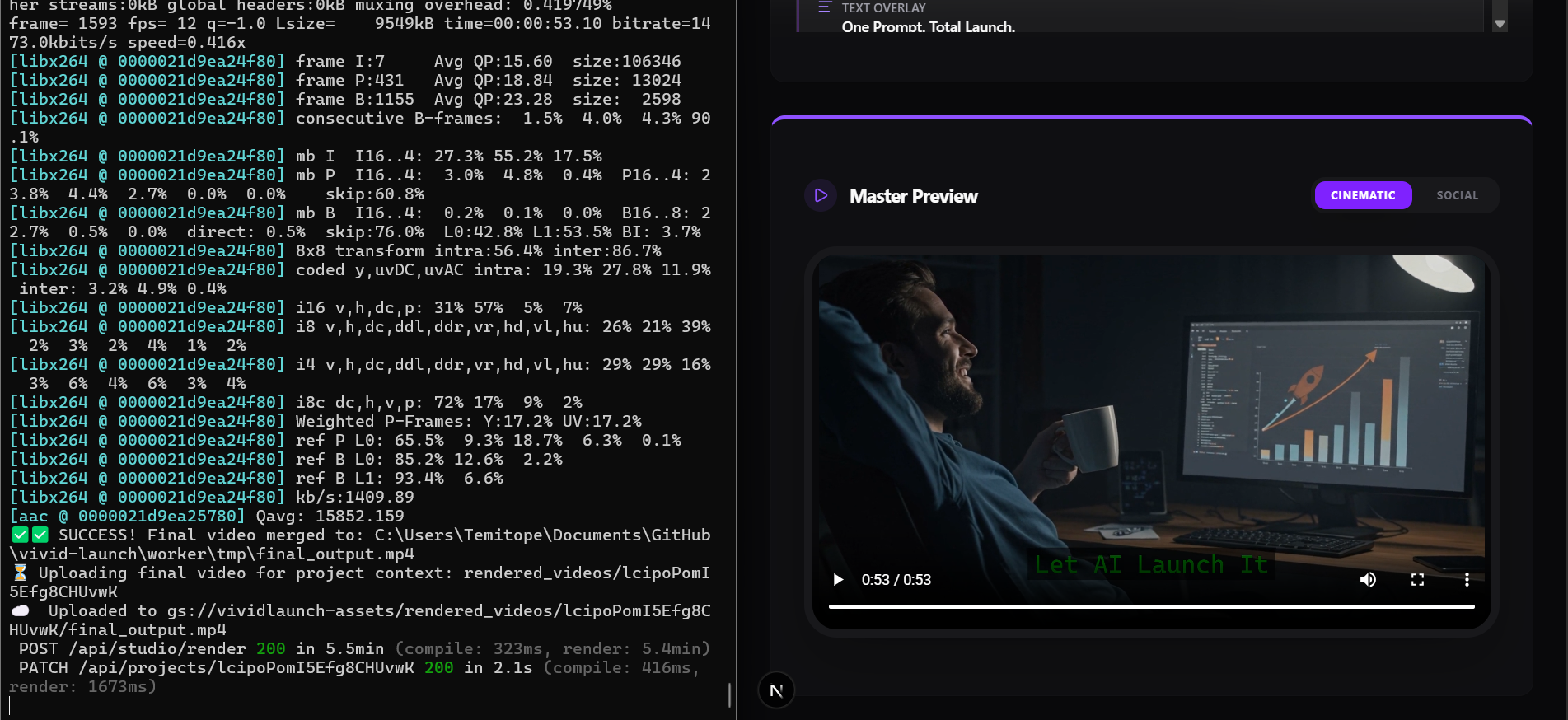
- Media Engine: A custom FFmpeg-based worker that interprets Gemini's structured JSON output to composite the final video assets.
Challenges I ran into
1. The "Breathless Narrator" Timing Gap
When syncing Google Cloud Text-to-Speech with the video scenes, I found that the AI-generated audio was often "too efficient." The narrator would finish a sentence faster than the visual scene could play out, leading to awkward silences.
The Solution: I implemented SSML (Speech Synthesis Markup Language) dynamically. I taught Gemini to insert <break time="500ms"/> tags between key sentences. I then built a calculation engine that measures the duration of the resulting .mp3 and automatically stretches or trims the visual scene duration in FFmpeg to match the audio length perfectly.
2. The "Ken Burns" Effect Calculation
I wanted to implement slow zooming/panning to make static Imagen 3 photos feel like cinematic video. However, calculating raw X/Y coordinates in FFmpeg based on a "vibe" description from Gemini was unstable—the model would often provide coordinates that resulted in shaky footage.
The Solution: I created a Motion Preset Library. Gemini now selects a "Motion Intent" (e.g., ZOOM_IN_SLOW, PAN_RIGHT). My media worker then maps these intents to pre-tested, mathematically smooth FFmpeg filter strings.
3. The Multimodal "Identity Crisis"
A major issue was maintaining the Narrator's Tone. Sometimes the background music would drown out the narration because the model didn't understand "Audio Ducking." The Solution: I built an Audio Mixer into the FFmpeg pipeline. It uses a "Ducking" filter that automatically lowers the volume of the background track by 15dB whenever the Narrator's audio stream is active.
4. Subtitle Sync & Overflow
Gemini would generate long sentences that looked great in a blog but overflowed the video frame when rendered as kinetic typography. The Solution: I developed a Text-Wrapping Logic within the media worker. Before rendering, the system checks the character count. If it exceeds the safe zone for a TikTok-style frame, it automatically breaks the text into multiple "cards" and syncs them to the specific timestamps of the TTS audio.
Accomplishments that I'm proud of
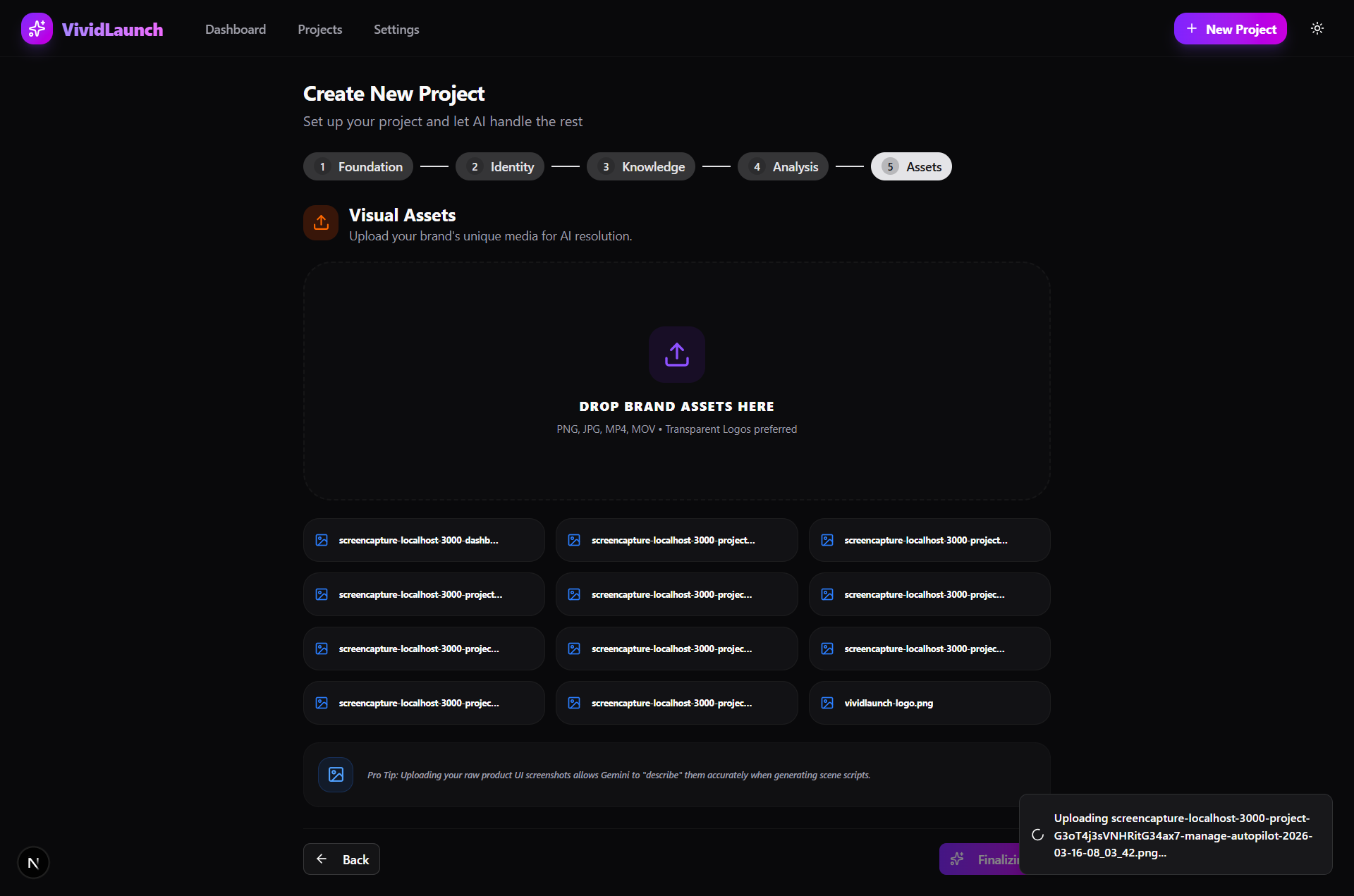
- Unified Onboarding & DNA Extraction: Moving beyond a simple website field. The new 5-step wizard can ingest a Medium blog or a single Notion page and "learn" exactly who the product is for.
- Autonomous Context Gathering: I’m proud of the ADK implementation. The agent "surfs" your site, learns your brand voice, and checks your asset library without any manual hand-holding.
- The Video Preview UX: Seeing a "Live Stream" of JSON blocks from Gemini turn into a playable video with subtitles and motion graphics in under 60 seconds still feels like magic.
What I learned
This project was a masterclass in Agentic Multi-Step Workflows. I learned that moving beyond simple "chat" into a world of tool-calling is the true threshold of AI utility.
- The Stability vs. Creativity Tradeoff: I learned how to architect a "Dual-Tier Agency." By using Gemini 2.0 Flash for deterministic researcher tasks (where tool reliability is paramount) and Gemini 3 Flash for the "Creative Director" roles (where nuance and "vibe" matter), I achieved a balance between high-quality creative output and rock-solid backend reliability.
- Latency as a Design Constraint: Managing the "Live Stream" of JSON blocks from
streamObjecttaught me how to build perceived-instant UIs. Even though video rendering takes time, showing the user the AI's "thought process" block-by-block makes the experience feel immediate and transparent. - The Nuances of Interleaved Output: I spent a lot of time learning how to make Gemini think about transitions, camera motion, and typography as part of a single creative thought. Getting an LLM to understand temporal relationships—how a visual pan should end exactly when a specific narrator's word is spoken—required a deep dive into structured prompting and defensive parsing.
- Context Management at Scale: I learned how to "ground" agents by building tools like getProjectContext and scrapeWebsite. This taught me how to manage the "context-to-generation" ratio to prevent the model from getting lost in the noise of its own past outputs.
- Unified Identity Orchestration: Building the Global Connectors system taught me how to manage authentication and cross-project permissions in a way that feels seamless for the user but secure on the backend.
What's next for VividLaunch
- Deep Social Integration: Plugging in full OAuth flows for direct-to-platform publishing (one-click "Launch" button).
- VividAnalytics: An agent that scans your engagement metrics and suggests "Regenerations" to optimize your content performance.
- Collaborative Storyboarding: A multi-user "War Room" where teams can tweak Gemini's creative decisions in real-time.
Build the product. VividLaunch handles the launch.
Built With
- cherio
- ffmpeg
- gemini
- google-cloud-firestore
- google-cloud-secret-manager
- google-cloud-tasks
- google-cloud-text-to-speech
- google-gen-ai-sdk
- javascript
- next.js
- react
- shadcn
- typescript

Log in or sign up for Devpost to join the conversation.