-
-

Homepage
-
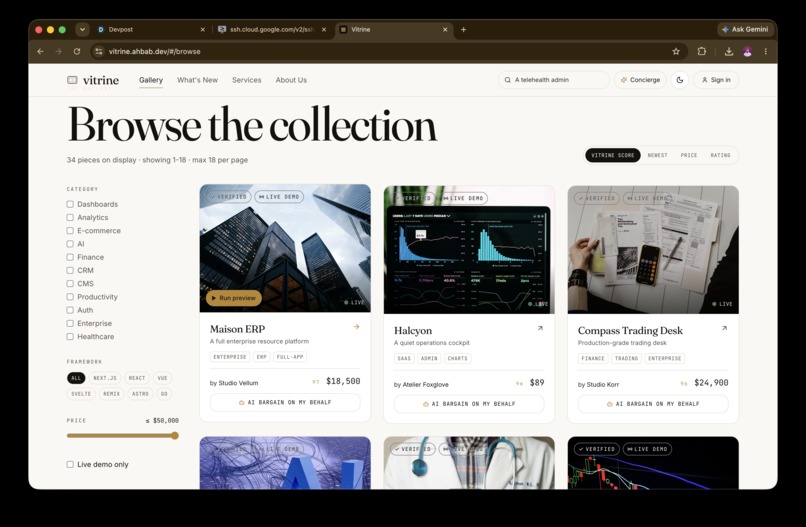
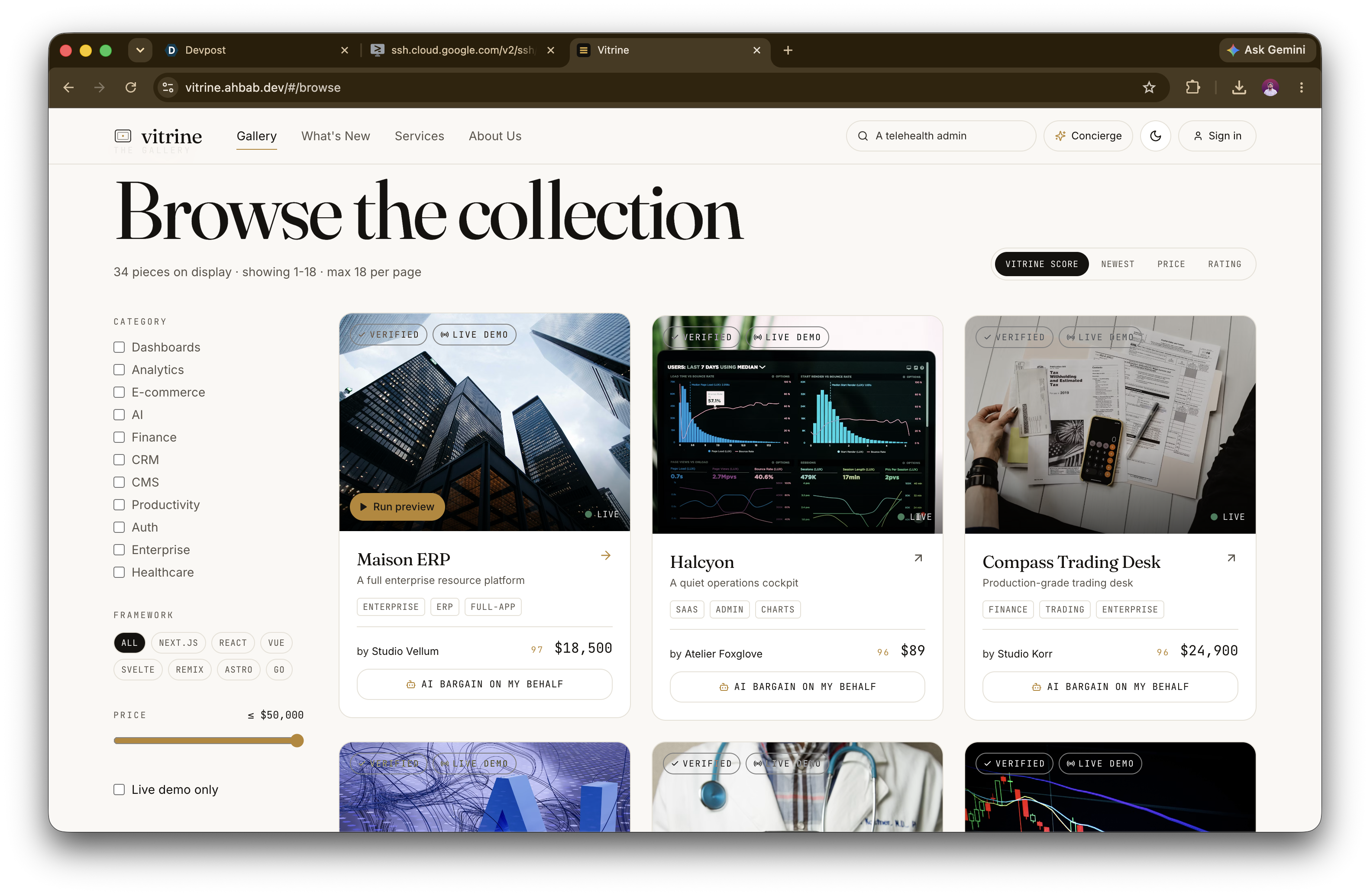
Gallery
-
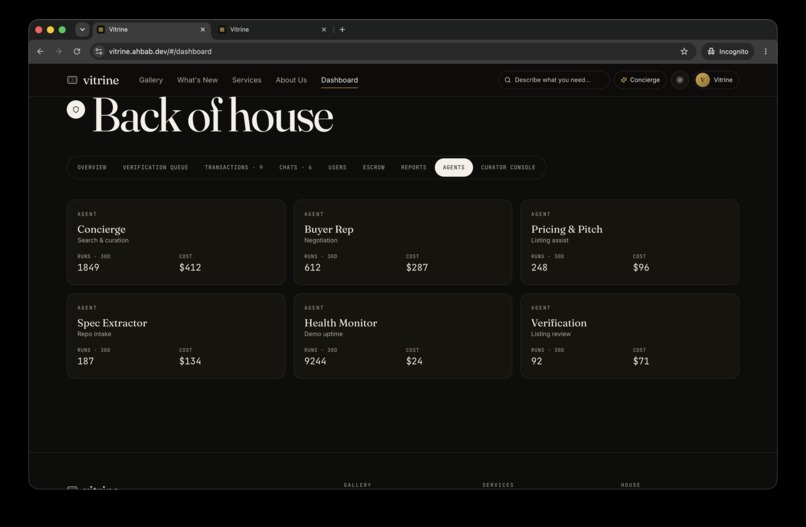
Agents
-
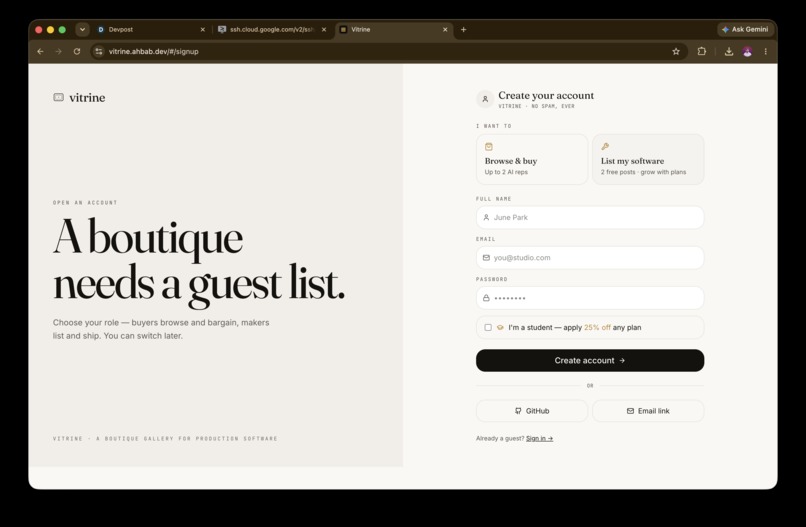
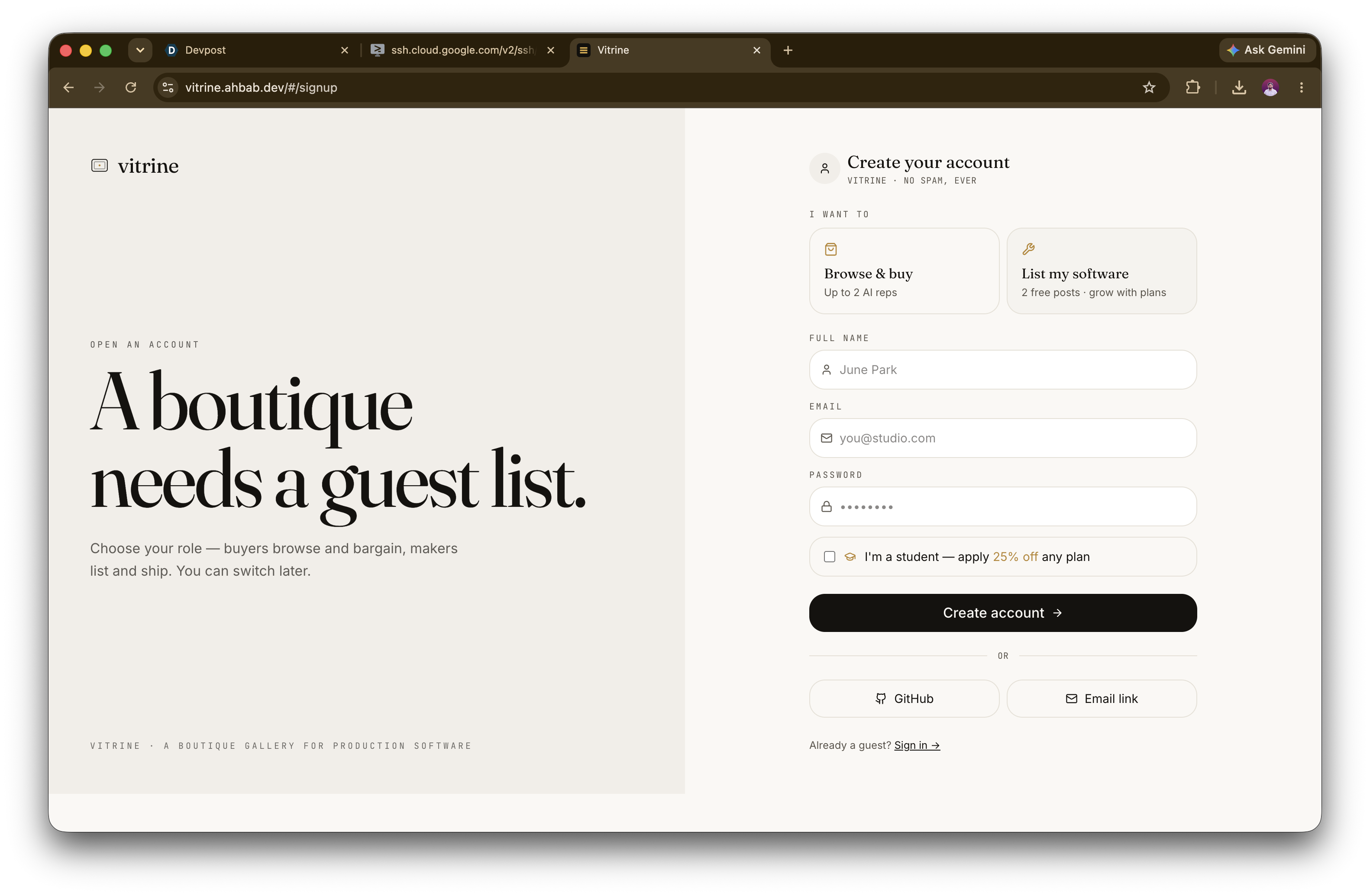
Auth
-
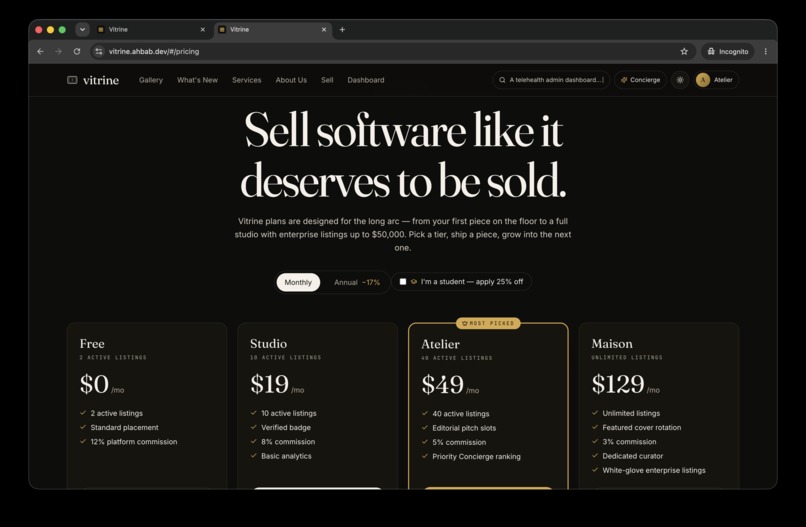
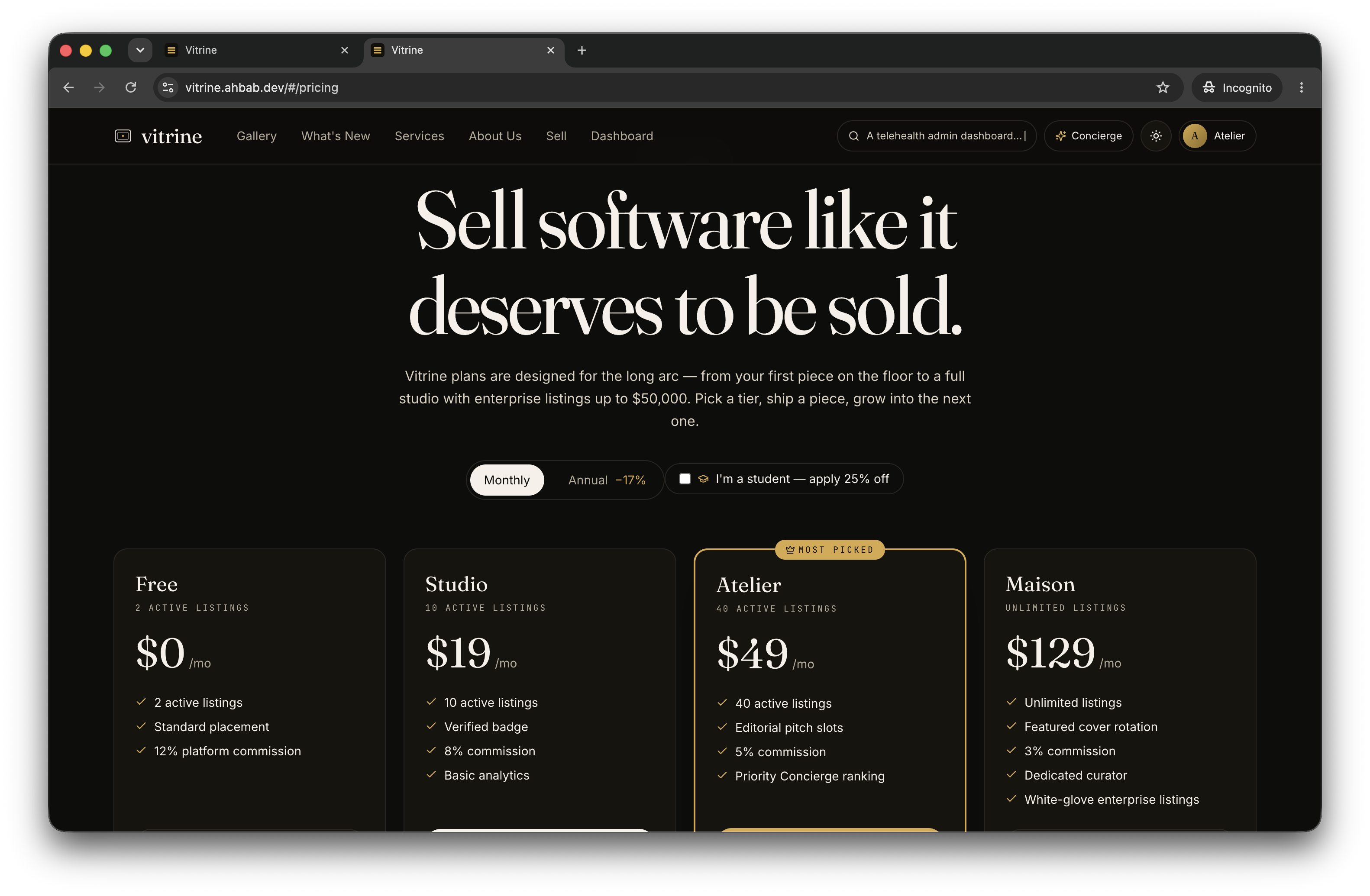
Subscriptions
-
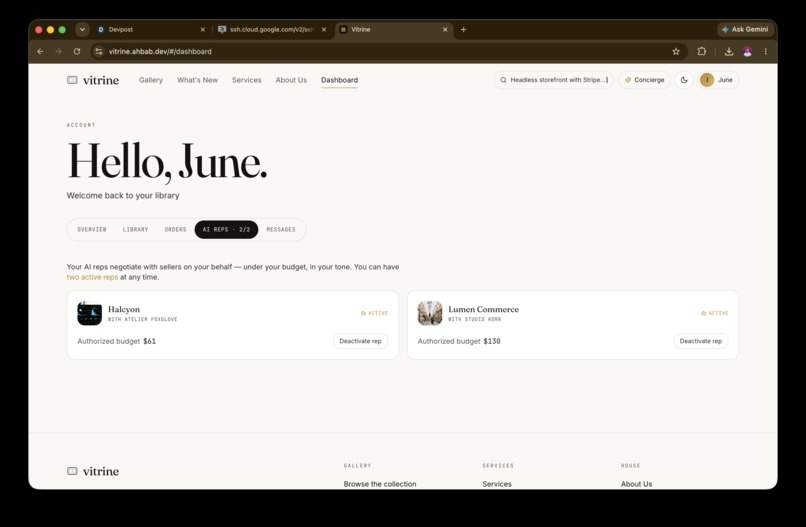
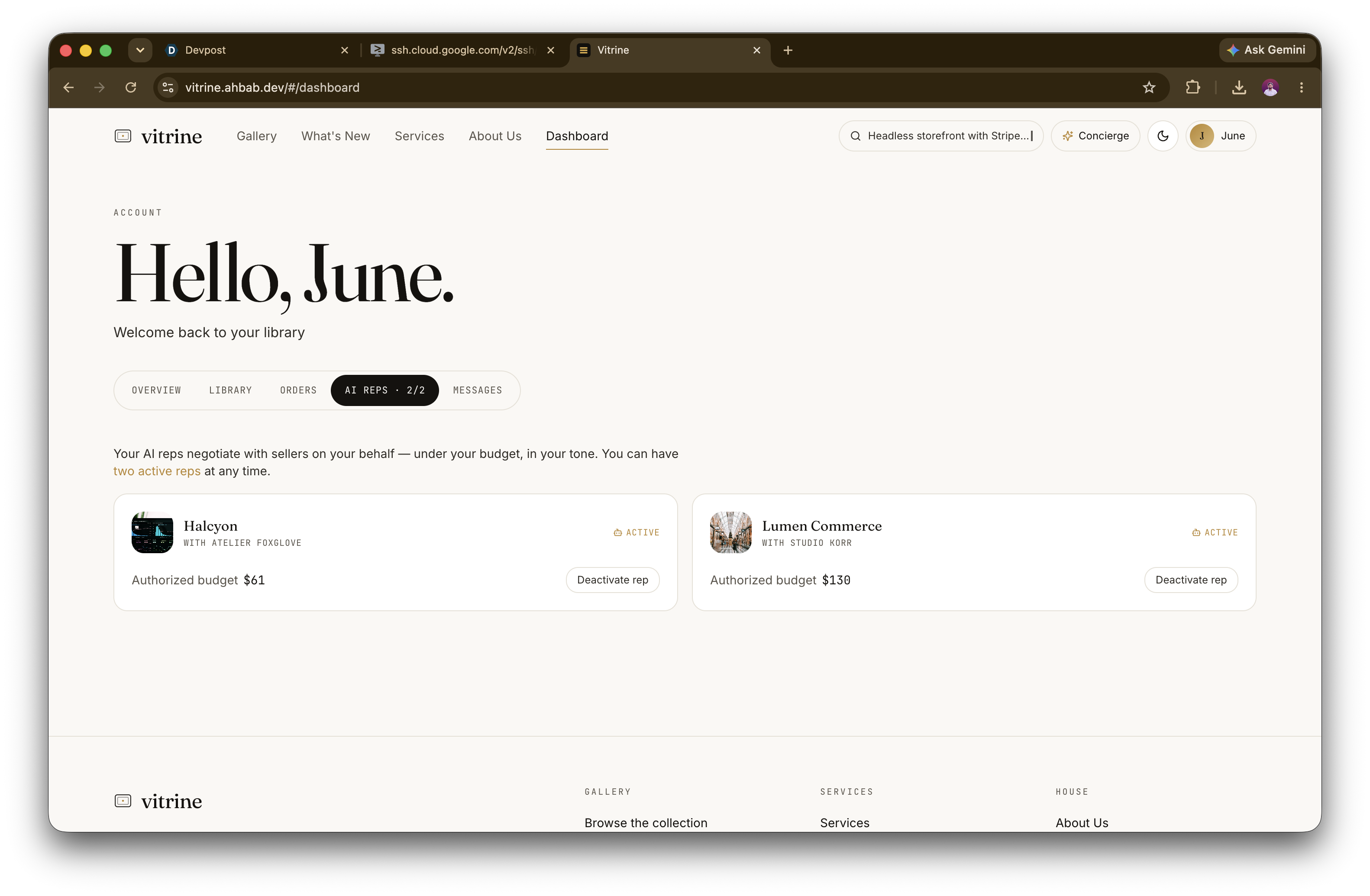
Ai Agent representatives
-
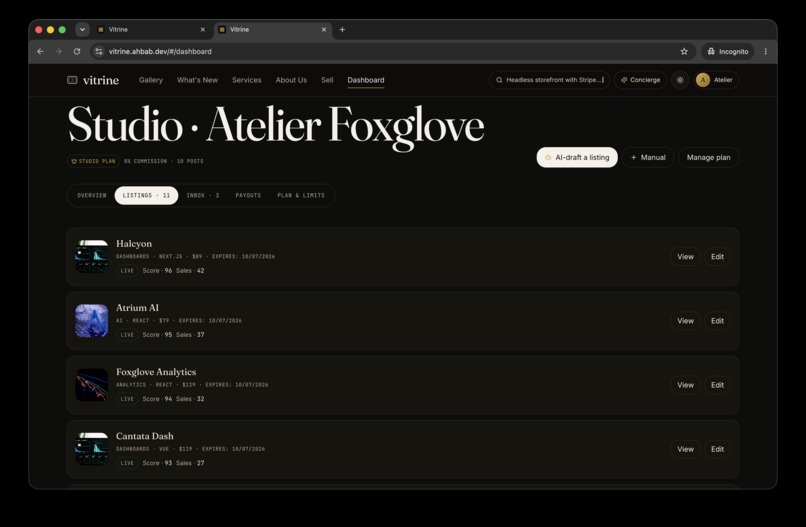
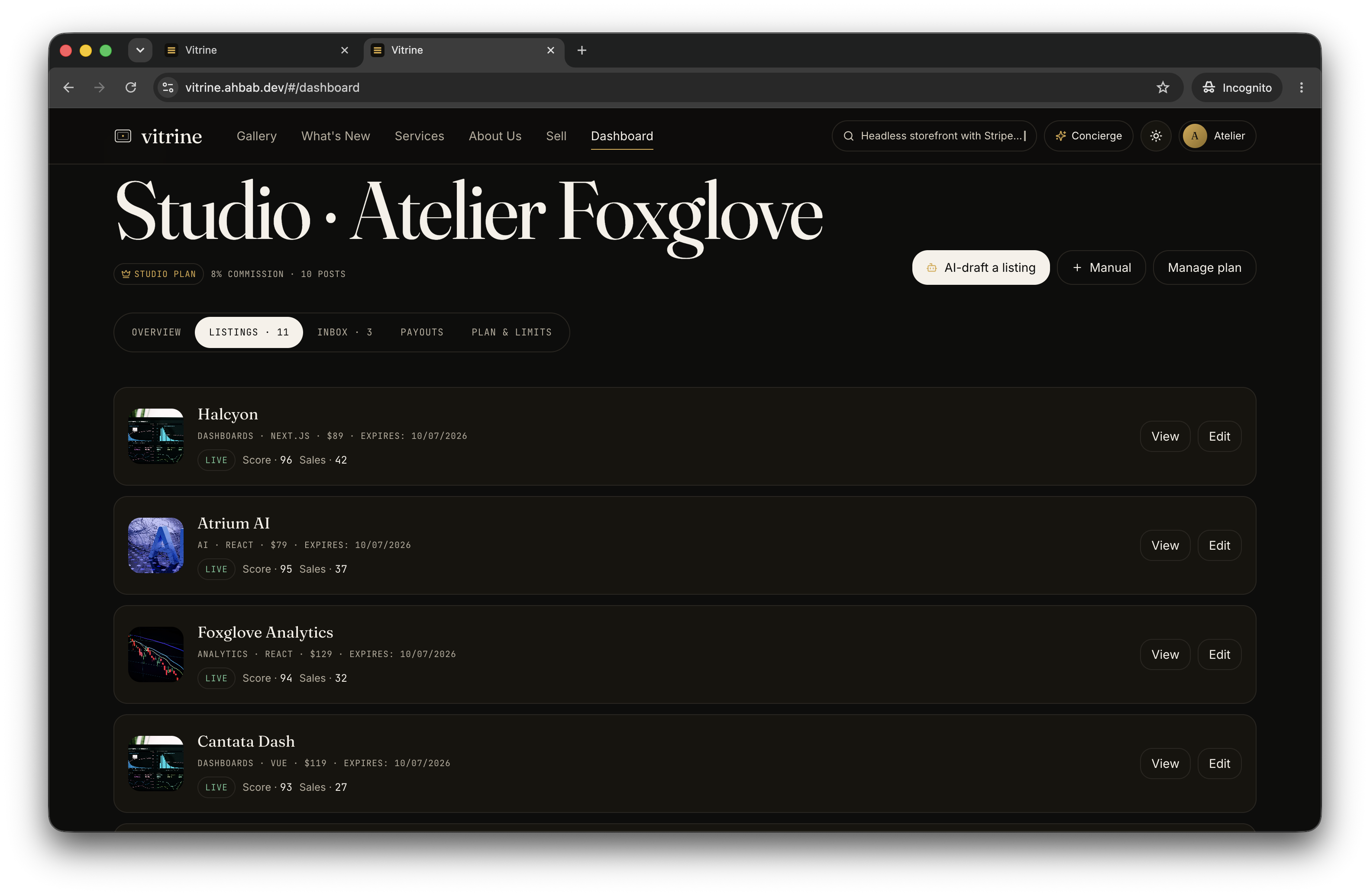
Listings
-
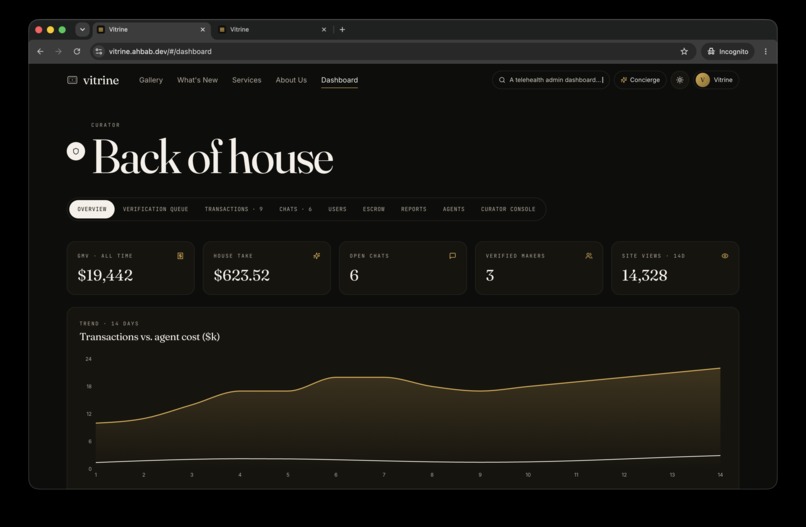
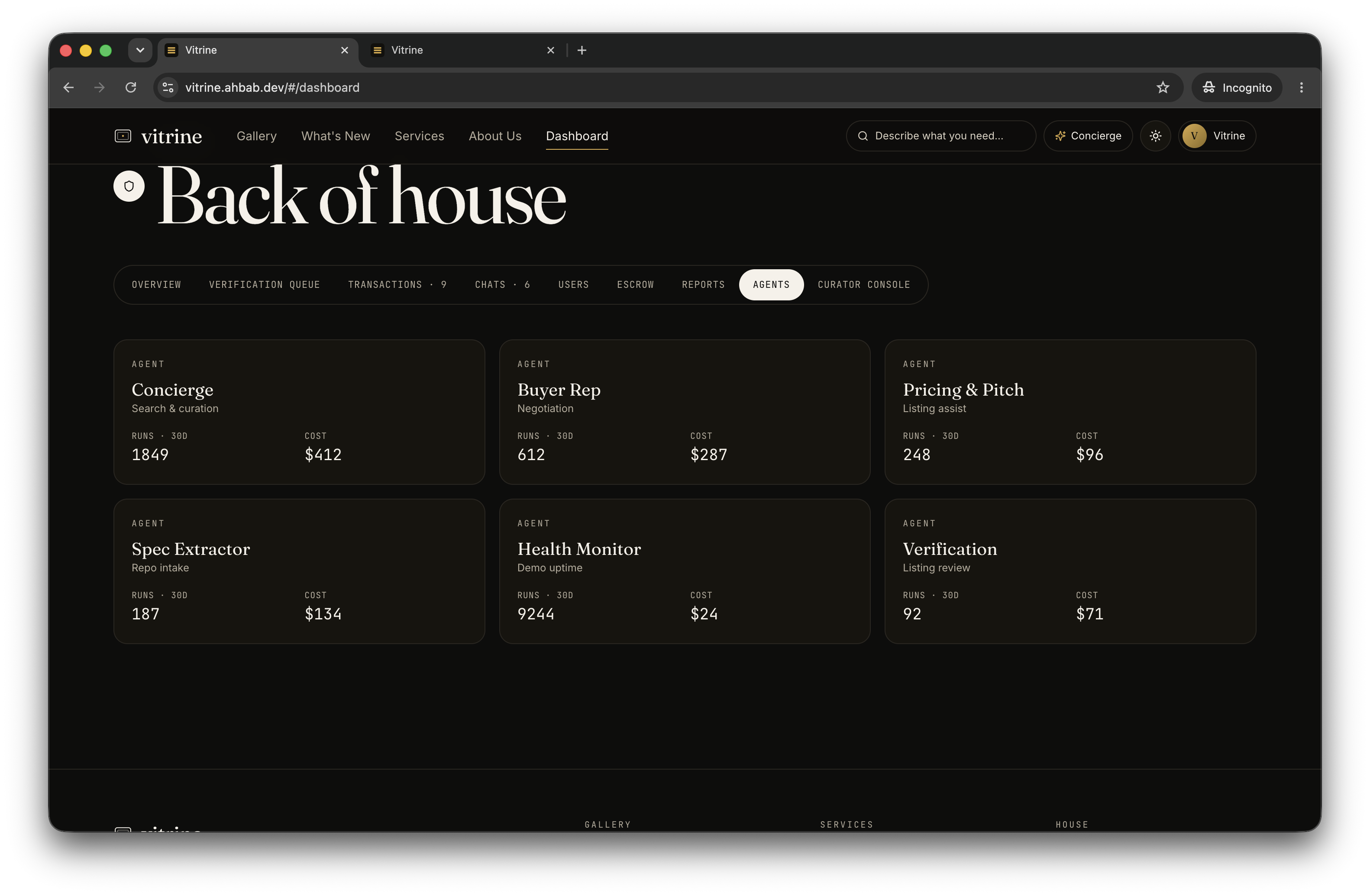
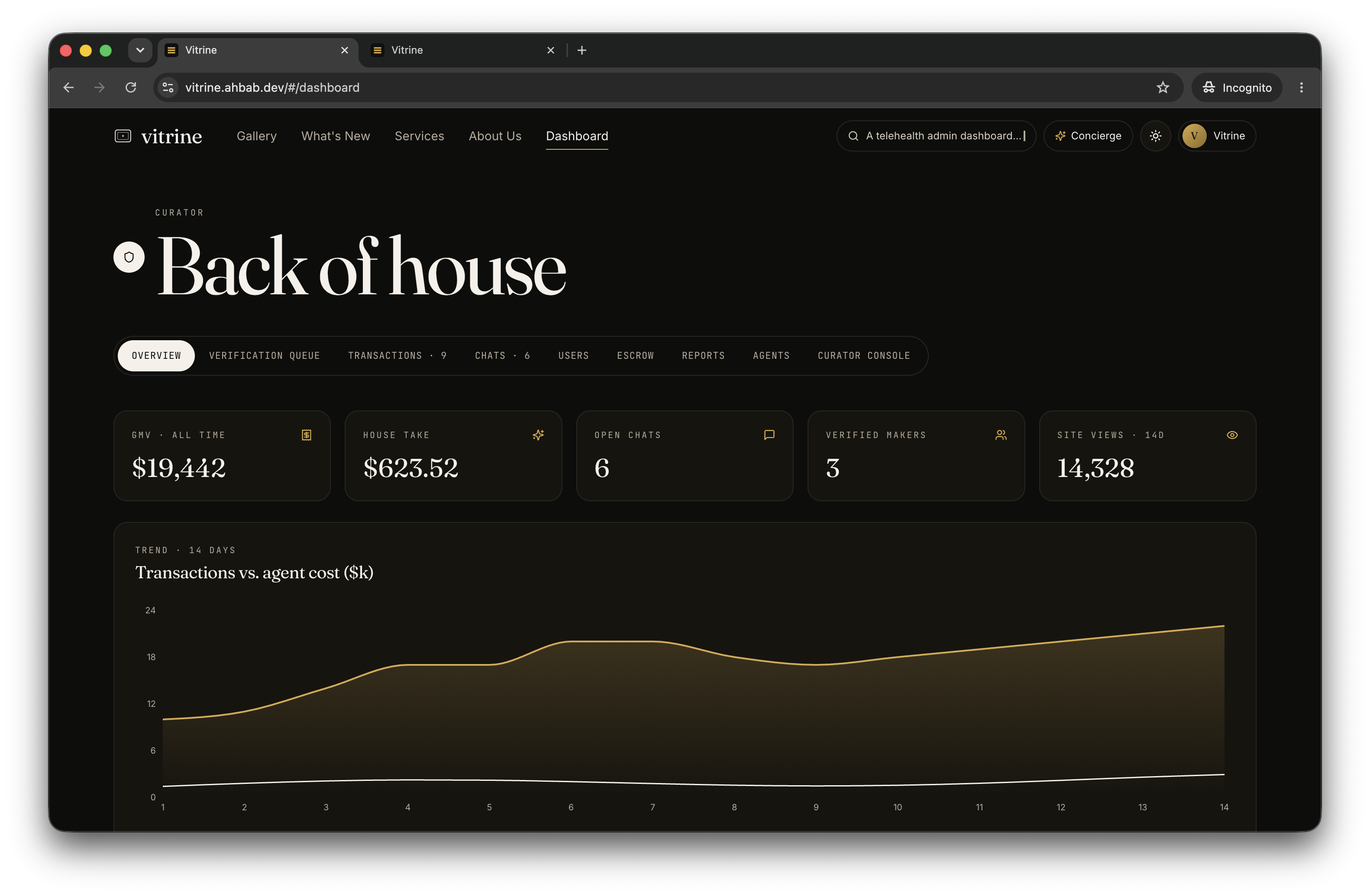
Admin Dashboard

Inspiration
Today’s software marketplace is highly bifurcated. On one end, we have bloated SaaS platforms charging recurring fees for simple utilities. On the other end, we have fragmented GitHub repositories—millions of lines of open-source code gathering dust because they lack distribution, polished UI, or developer support.
We asked ourselves:
Why can't software be bought like editorial art? Why can't there be a boutique storefront for curated, production-ready, beautiful codebases?
This inspired Vitrine — a boutique marketplace for live, runnable software templates.
We wanted to build a platform that elevates code to craftsmanship. By combining rich web design with a fleet of autonomous AI agents, we created an environment where creators can present their codebases with the detail of an architectural spec sheet, while buyers can browse, test, and negotiate custom extensions with ease.
What It Does
Vitrine is a boutique gallery for high-quality software codebases. Instead of browsing simple README files, buyers see a comprehensive design and engineering specification.
Core Features
The Gallery
A premium storefront that dynamically sorts listings using the Vitrine Score, a multi-dimensional ranking algorithm balancing:
- Visual craftsmanship
- Repository completeness
- Test coverage
- Demo health
- User engagement
AI Repo-Intake
Sellers paste a GitHub repository URL, and Vitrine automatically:
- Parses manifests and project metadata
- Detects frameworks, packages, and CI configurations
- Uses LLM enrichment to generate a structured specification sheet
Buyer Concierge
A conversational discovery interface powered by hybrid vector search:
pgvectorin production- Optimized SQLite brute-force search in development
Buyers can search by:
- Budget
- Framework
- Utility
- Visual style
- Technology stack
Interactive Negotiation (Buyer Representatives)
Buyers can dispatch autonomous AI agents to negotiate with sellers.
These agents operate using:
- Budget constraints
- Timeline goals
- Historical transaction context
- Product specification awareness
Feature Cost Estimator
Buyers describe a desired feature, and an estimator agent analyzes:
- Programming languages
- Database systems
- Project architecture
- Complexity estimates
The system then generates:
- Recommended pricing
- Milestone breakdowns
- Delivery projections
Curator Moderation Console
An administrative suite for:
- Human review workflows
- Verification log screening
- Copycat detection
- Listing approval pipelines
How We Built It
Frontend
The frontend is a high-performance single-page application built using:
- React
- TypeScript
- Vite
Design System
The visual system uses custom Vanilla CSS tokens to create a premium editorial aesthetic featuring:
- Restrained typography
- Dark mode transitions
- Glassmorphism
- Responsive card layouts
State Management
Global state synchronization is powered by:
- Zustand
Backend
The backend consists of modular microservices implemented with:
- FastAPI (Python 3.11)
- SQLAlchemy 2.0
- Aiosqlite
Database Architecture
- SQLite in development
- PostgreSQL migration path for production
Event Orchestration
Services communicate asynchronously using:
- Redis Streams
AI Orchestrator
Vitrine uses a custom OpenAI tool-calling coordinator managing a fleet of seven autonomous agents.
Agent Fleet
| Agent | Responsibility |
|---|---|
| Repo-Intake Agent | Repository structure analysis |
| Verification Agent | License validation and preview checks |
| Curation Agent | Visual scoring and ranking |
| Buyer Concierge | Conversational discovery |
| Buyer Representative | Autonomous negotiation |
| Feature Cost Estimator | Quote generation |
| Pricing & Pitch Agent | Seller pricing optimization |
The Mathematics of Curation: The Vitrine Score
Rather than relying on chronological ordering, listings are ranked using the Vitrine Score.
Formula
$$ S_v = w_c \cdot C + w_u \cdot U + w_d \cdot D + w_r \cdot R + w_t \cdot T + w_e \cdot E $$
Where:
| Variable | Description |
|---|---|
| $C \in [0,100]$ | Completeness index representing specification coverage |
| $U \in [0,100]$ | UI Craft score generated via visual LLM analysis |
| $D \in [0,100]$ | Demo health based on uptime and latency |
| $R \in [1,5]$ | Bayesian review score |
| $T \in [0,1]$ | Recency decay factor |
| $E \in [0,100]$ | User engagement metrics |
Bayesian Rating Rollup
To avoid low-volume review manipulation, ratings use Bayesian averaging:
$$ R = \frac{v \cdot r + m \cdot C_{\text{avg}}}{v + m} $$
Where:
- $v$ = number of reviews
- $r$ = average review score
- $m = 10$ = prior weight
- $C_{\text{avg}}$ = global average platform rating
Recency Decay
Repository freshness is modeled using exponential decay:
$$ T = e^{-\lambda t} $$
Where:
- $t$ = elapsed days since the last update
- $\lambda$ = decay coefficient
Challenges We Ran Into
Dynamic Multi-Turn Agent Tool-Calling
One of the largest challenges was building a secure framework where autonomous agents could:
- Inspect database models
- Compare pricing data
- Generate negotiations
- Write structured outputs safely
Solution
We implemented:
- Strict Pydantic validation schemas
- Restricted write operations
- Controlled tool exposure boundaries
Context-Aware Bargaining
The Buyer Representative needed to:
- Understand the buyer’s true maximum budget
- Negotiate effectively
- Avoid exposing internal constraints
Solution
We introduced:
- Prompt guardrails
- State verification loops
- Counter-offer constraint systems
Synchronizing Mock and Live Modes
The frontend supports:
- Fully client-side mock execution
- Real-time backend synchronization
Reconciling both execution paths required a conditional API connector inside the Zustand store that switches seamlessly using:
VITE_USE_MOCKS
Accomplishments We’re Proud Of
High-Fidelity Aesthetics
We built a storefront experience that feels closer to a design publication than a traditional software marketplace.
Highlights include:
- Inter & Outfit typography pairing
- Glassmorphism interfaces
- Editorial spacing systems
- Seamless dark mode transitions
Robust Agent Fleet
A single repository link triggers an asynchronous orchestration pipeline involving:
- Repository inspection
- Stack detection
- Visual scoring
- Demo verification
- Score computation
- Final curation
Deterministic Embedding Fallback
We designed a custom hashing-based embedding fallback system allowing semantic search to function offline during development without requiring external API credentials.
What We Learned
Heuristics First, LLMs Last
LLMs are powerful but computationally expensive.
We significantly reduced inference costs by:
- Parsing structured manifests deterministically
- Using regex-based extraction first
- Passing only ambiguous or unstructured content to LLMs
Examples include:
package.jsonpyproject.toml- CI configuration files
Zustand Is Powerful for Hybrid States
Separating networking logic from UI components dramatically simplified frontend architecture.
Transparent API fallback behavior inside Zustand actions allowed components to remain entirely presentation-focused.
What’s Next for Vitrine
Stripe Connect Integration
Direct seller payouts and marketplace revenue routing.
Live Sandbox Hosting
Secure WASM-based in-browser execution environments for live codebase testing before purchase.
it
| Agent | Screen to open | The one line to say |
|---|---|---|
| Repo-Intake | Sell → New Listing → paste repo | "Detects the stack deterministically, then one LLM call fills the judgment fields — with confidence scores." |
| Pricing & Pitch | Sell → "Help me price" | "Anchors price on real comps, proposes tiers and copy — advisory, never auto-applied." |
| Verification | Admin → verification queue | "Pings the live demo, cross-checks claims, can flag but never hard-reject." |
| Curation & Ranking | Product / Admin → Vitrine Score | "Mostly deterministic signals + a once-cached vision score → the Vitrine Score." |
| Buyer Concierge | Concierge panel | "Plain English → filters → hybrid RAG search, streamed, grounded in real rows." |
| Buyer Representative | Product → Ask AI to Bargain | "Negotiates for the buyer, capped at their max budget, discloses it's an AI." |
| Feature Cost Estimator | Product → custom feature | "Reads the real tech spec, estimates hours + milestones, flags impossible asks." |
GitHub Webhook Sync
Automatic re-indexing and score recalculation whenever repository updates are pushed.
This includes:
- Test suite refreshes
- Metadata synchronization
- Demo validation
- Vitrine Score recomputation
Built With
- ai-tools
- fastapi
- openai
- rag
- react
- redis
- typescript
- vite
- zustand

Log in or sign up for Devpost to join the conversation.