Inspiration
The inspiration for our project stems from the severe healthcare disparities faced by ethnic minority pregnant women in the mountainous and remote areas of Dong Nai province. Statistics from the Ministry of Health indicate that maternal mortality rates in mountainous regions are 3.5 times higher than in the lowlands, and in certain ethnic groups, this figure is 7 to 8 times higher. Due to long geographical distances, lack of local medical equipment, and language barriers, these women rarely have access to proper prenatal care or early risk detection. Additionally, early marriage and childbirth common in these communities further increase pregnancy complications. Witnessing these urgent issues motivated us to create a practical technology platform to assist local medical staff and protect the health of minority mothers.
What it does
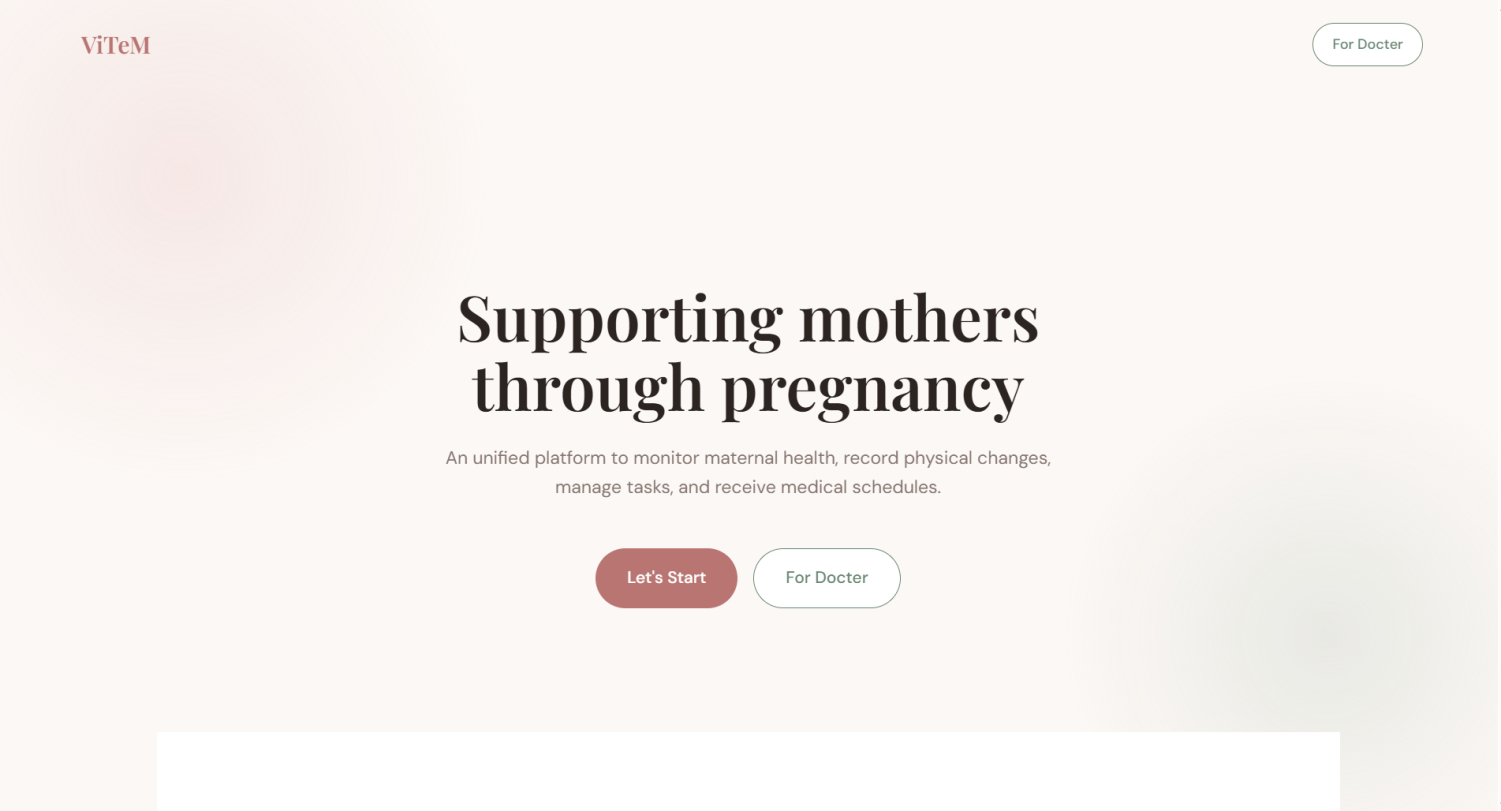
ViTeM is an intelligent health management and monitoring web application designed specifically for ethnic minority pregnant women and grassroots healthcare workers. For pregnant women, the platform offers a straightforward interface to track basic health indicators, including weekly weight, blood pressure, and fetal movement. It also integrates an automated Zalo notification system to remind mothers of important prenatal checkups and incorporates an AI assistant to offer emotional support and basic maternal health guidance. For local healthcare personnel, the system offers a dedicated Doctor Dashboard, where they can enter unique patient identification codes to access medical histories, track visual health charts, and send direct audio or text medical recommendations.
How we built it
We developed ViTeM as a Progressive Web App (PWA) to ensure it runs efficiently on low-configuration mobile devices common in rural areas. The frontend of the application was constructed using popular web frameworks like React/Vue, paired with a clean, soft pink UI/UX design optimized for users with limited technological literacy. For the backend database and real-time data storage, we utilized Firebase, while deploying the overall architecture on free hosting platforms like Vercel or Netlify. To power the psychological counseling and basic medical advisory feature, we integrated Google's large language model API to act as the MamaAI assistant.
Challenges we ran into
During the development process, our biggest hurdle was gathering accurate local data and designing a user interface that could overcome the strict language and cultural barriers of ethnic minority groups. Because medical literacy varies significantly among the target population in remote districts of Dong Nai, translating standard medical workflows into highly simplified, icon-driven visual modules was a tedious process. We had to undergo multiple data restructuring cycles to ensure our underlying database could logically organize maternal health metrics while remaining respectful of local cultural habits. Stripping away complex technical and medical jargon to create an accessible user interface required continuous adjustments based on direct feedback.
Accomplishments that we're expecting
Through this initiative, we aim to gain valuable experience for future project development while directly empowering ethnic minority communities with better access to technology and healthcare support. Ultimately, our vision is to advance this technology to assist a wider range of vulnerable groups and scale our social impact globally.
What we learned
This project provided a vast amount of knowledge that extended far beyond regular classroom learning. On a technical level, we gained practical experience in UI/UX design, technical problem-solving, logical database management, and building functional web systems. More importantly, the fieldwork taught us that implementing technology in real life requires deep empathy and social responsibility. We learned how to analyze actual public health problems, interact with community stakeholders, and understand the necessity of cultural inclusivity when deploying technology for vulnerable populations.
What's next for ViTeM - Intelligent Maternal Care for Ethnic Minorities
Moving forward, we want to expand the role of Artificial Intelligence in ViTeM to turn it into a system that can actually anticipate health risks rather than just storing data. Our first goal is to add a basic scanning feature where mothers or local midwives can simply take a photo of paper prescriptions or ultrasound results. The system will use image recognition to pull out the key numbers and automatically fill in the digital charts, saving time for everyone. We also plan to train simple machine learning models on basic health trends like sudden weight changes or blood pressure spikes to flag early signs of dangerous conditions like pre-eclampsia before they become emergencies. Lastly, we hope to build a data-mapping tool for the doctor dashboard that highlights which remote villages have the highest density of high-risk pregnancies, making it easier for local health stations to plan their mobile medical trips.
Built With
- css
- google-cloud
- javascript
- llm
- pdf2text
- python
- rag
- react
- ssml-speech-to-text
- supabase
- vercel


Log in or sign up for Devpost to join the conversation.