Please note that this was built for the Google Solution Challenge 2026 (where the judging is still in progress)
Inspiration
I originally wanted to build something for general supply chain tracking. But as I was brainstorming for the 2026 Google Solution Challenge, I realized this tech could do so much more than track packages—it could actually save lives. I decided to pivot entirely to healthcare. Seeing the terrifying gaps in how fast critical resources like oxygen, blood, and organs get delivered made me want to build a system where saving a few seconds could literally mean saving a life.
What it does
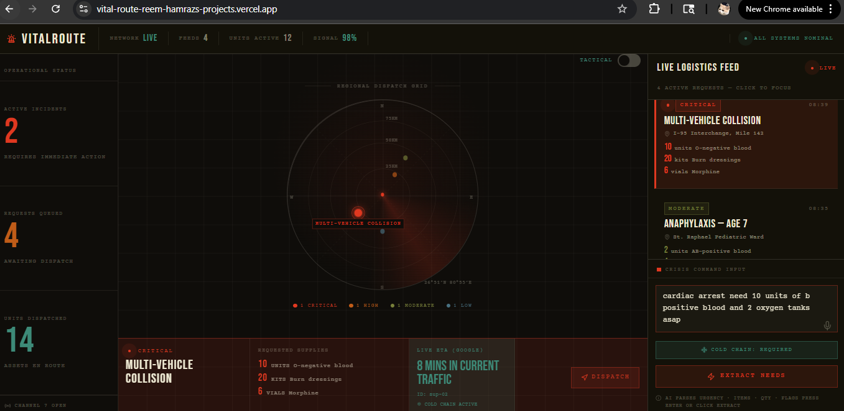
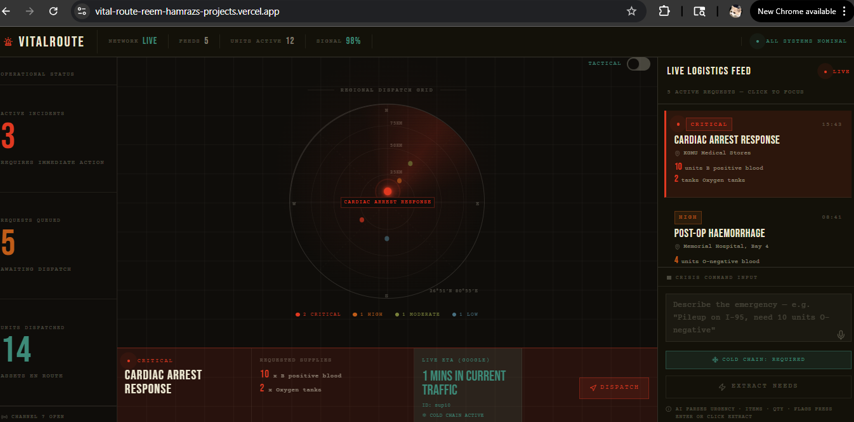
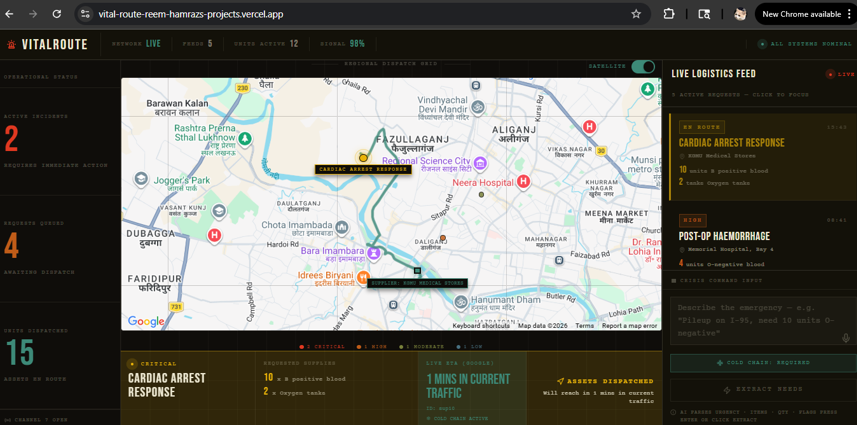
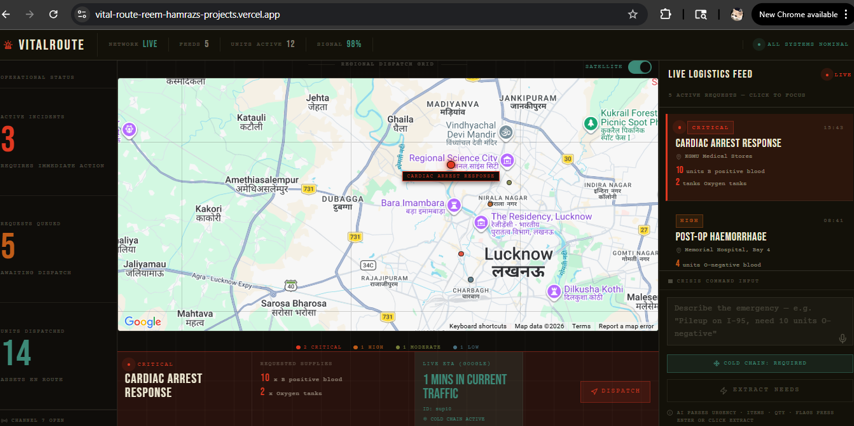
Think of VitalRoute as the central nervous system for a hospital's emergency supply chain. It's a real-time dashboard and dispatch platform that completely automates how critical medical supplies are triaged and routed. It uses an AI engine to instantly understand what an emergency needs, and then pairs that with a mapping system to figure out the absolute fastest way to get those supplies exactly where they need to go.
How I built it
I built the frontend dashboard with React and hooked it up to a Node.js and Firebase backend. For the "brains" of the operation, I brought in Gemini 2.5 Flash to quickly read and understand emergency requests, and tied it to Google Maps APIs to handle the actual routing. One of the coolest (and most important) parts under the hood is the atomic inventory locking, basically, a safeguard I built to ensure that in the chaos of an emergency, the system never accidentally promises the same medical supplies to two different places at the exact same time.
Challenges I ran into
When you're dealing with healthcare, there's absolutely zero room for error. One of the biggest headaches was getting that atomic inventory locking right. I had to be 100% sure that concurrent emergency requests wouldn't make the database glitch out and create "phantom" inventory. On top of that, getting the Gemini AI to accurately read high-stress, messy emergency requests without hallucinating or making mistakes took a ton of rigorous prompt engineering and late-night testing.
Limitations
as of now, this web app has hospitals native to my city "Lucknow" and it's a small scale app built specifically with my city in mind. However with the right resources and time I plan to scale this to much greater heights, namely all over the world and include sea, air and road links.
Accomplishments that I'm proud of
Honestly, I'm just incredibly proud that I pulled off the pivot from a basic supply chain idea to a tool that could have a real humanitarian impact. Technically speaking, getting an AI to talk seamlessly with a real-time routing system, and making it all look clean and easy to use in a high-stress situation, feels like a massive win.
What I learned
I leveled up a ton in managing real-time databases, especially wrapping my head around concurrency and state management in Firebase. But the biggest learning curve was figuring out how to put strict guardrails on a Large Language Model for a time-critical medical setting, and then translating what the AI understood into actual, actionable coordinates on a map.
What's next for VitalRoute: An AI-driven logistics Command Center
The dream is to scale this up so it can handle logistics across an entire network of hospitals, not just one. Next up, I want to pull in live traffic and weather data to make the routing even smarter. I'm also planning to build predictive AI models that can spot a resource shortage before it even happens, and I'm really excited to explore API integrations for dispatching automated drones in extreme emergencies.


Log in or sign up for Devpost to join the conversation.