



Inspiration
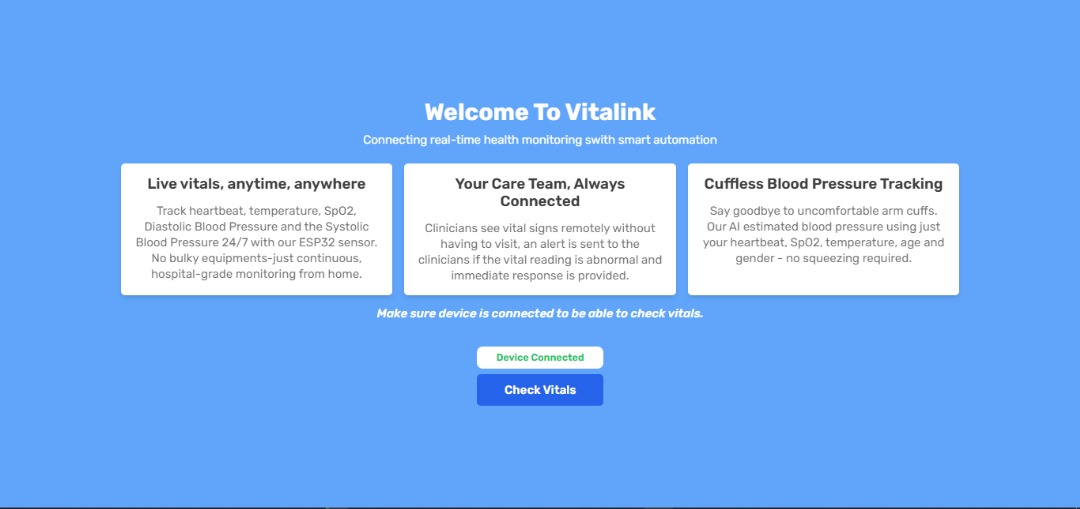
The inspiration for Vitalink came from the team leader whose mom is a nurse and he noticed that people come from like 2 streets away to check their vitals especially older people and his mom sometimes have to go through the stress of moving from one location to another to get the vitals of a patient. With further research we discovered a stark reality: 1.5 billion people worldwide lack access to basic healthcare monitoring, leading to preventable deaths from conditions like sepsis, hypertension, and diabetic emergencies. During a visit to a rural clinic, we witnessed a patient’s condition worsen due to delayed detection of rising blood pressure. This moment ignited our mission to create an affordable, remote, AI-driven solution that bridges the gap between hospital-grade care and at-home accessibility. We wanted to empower patients and clinicians alike with real-time insights, no matter their location or resources.
What We Learned
Hardware-Software Integration:
- Mastered sensor calibration (MAX30102 for SpO₂/HR, DS18B20 for temperature) and ESP32 programming for edge computing.
- Mastered sensor calibration (MAX30102 for SpO₂/HR, DS18B20 for temperature) and ESP32 programming for edge computing.
AI/ML in Healthcare:
- Trained TensorFlow models to predict blood pressure from heart rate/SpO₂, achieving MAE ≤5
mmHg.
- Get recomendations to patients according to their vital readings.
- Trained TensorFlow models to predict blood pressure from heart rate/SpO₂, achieving MAE ≤5
mmHg.
Full-Stack Development:
- Built a seamless Django-React pipeline for real-time data streaming and alerts.
- Built the FrontEnd with React and Tailwind to give a Friendly and Responsive User Interface
- Built a seamless Django-React pipeline for real-time data streaming and alerts.
* 8Team Collaboration**:
- Balanced roles across hardware, backend, frontend, and AI to meet tight deadlines.
- Balanced roles across hardware, backend, frontend, and AI to meet tight deadlines.
How We Built the Project
Hardware Prototyping:
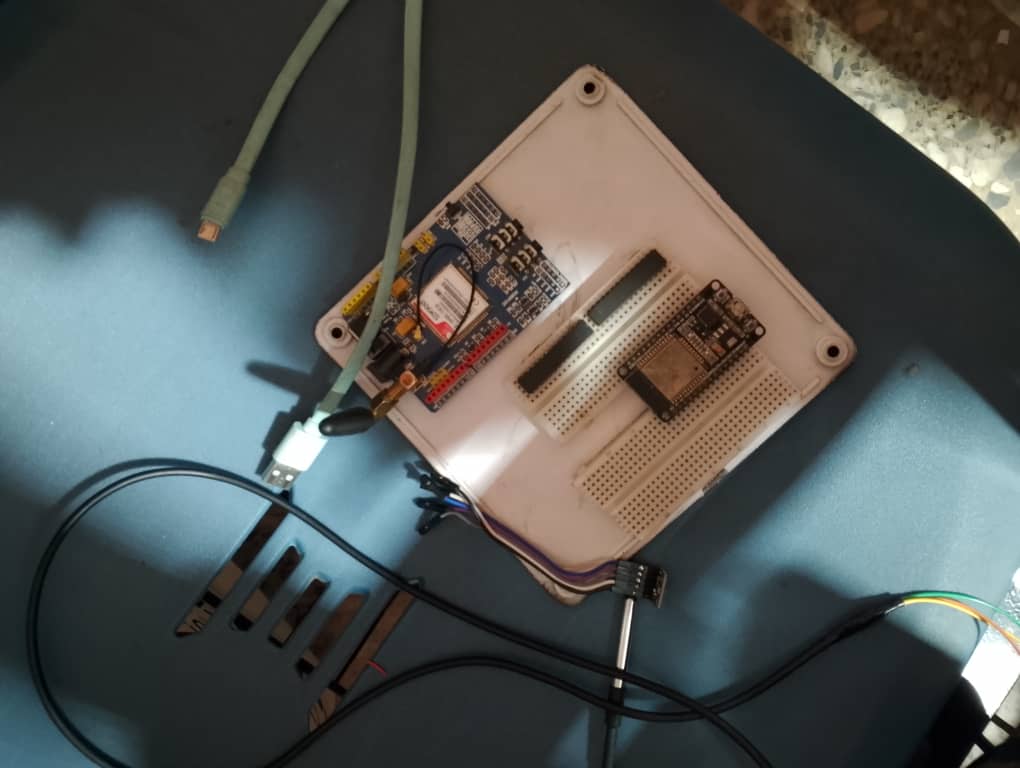
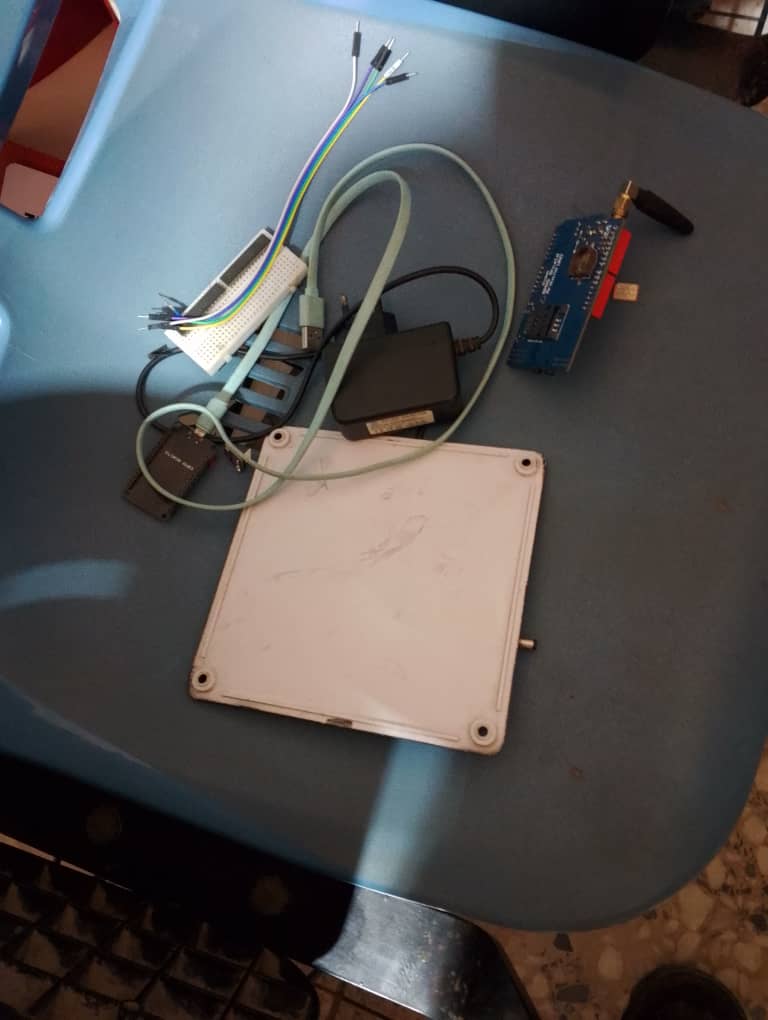
- Assembled ESP32 sensors with MAX30102 and DS18B20, writing firmware to collect vitals and push datas to the API.
Backend Development:
- Created a Django API to ingest sensor data, store it in SQLite3 and trigger alerts.
- We also used a model we trained to get blood pressure values.
- Created a Django API to ingest sensor data, store it in SQLite3 and trigger alerts.
Frontend Dashboard:
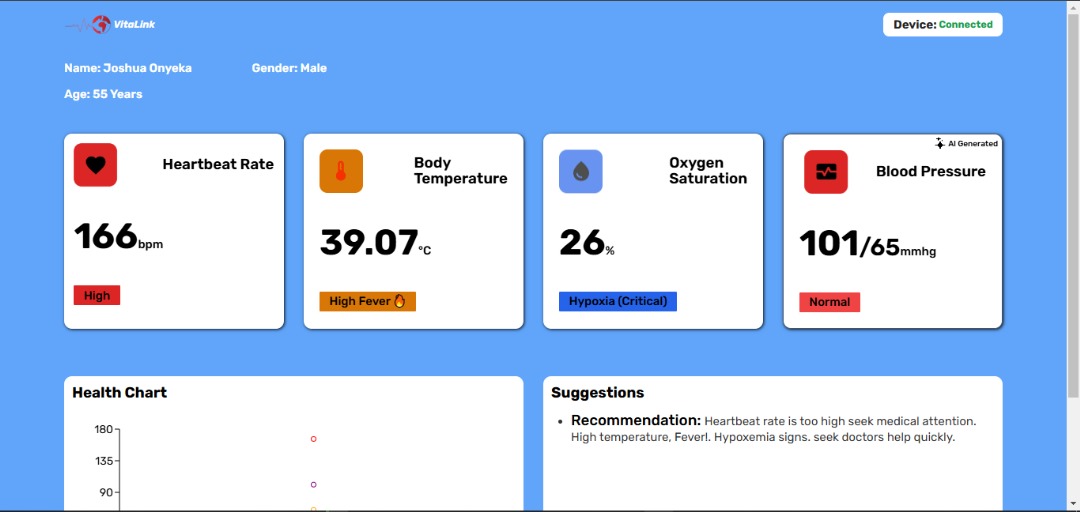
- Built a React app with Tailwind CSS for clinicians and also patients featuring live charts (Chart.js) and
prioritized alerts.
- Built a React app with Tailwind CSS for clinicians and also patients featuring live charts (Chart.js) and
prioritized alerts.
AI/ML Pipeline:
- Trained a TensorFlow model on Kaggle Medical Validation Datasets with 200,000 records to predict
BP both Diastolic and Systolic.
- The model was a multi-layer perceptron with five input, three hidden layers and two outputs.
- Validated results using RMSE for model performance.
- Trained a TensorFlow model on Kaggle Medical Validation Datasets with 200,000 records to predict
BP both Diastolic and Systolic.
Deployment:
- Hosted the frontend on Vercel and backend on PythonAnywhere, with Django for production data.
- Hosted the frontend on Vercel and backend on PythonAnywhere, with Django for production data.
Challenges We Faced
- Sensor Accuracy:
- Early MAX30102 readings were noisy. Solution: Added Kalman filters and recalibrated with clinical data.
- Early MAX30102 readings were noisy. Solution: Added Kalman filters and recalibrated with clinical data.
- Real-Time Sync:
- ESP32 data sometimes overloaded the backend. Solution: Used HTTP Get Request
- AI Model Bias:
- Initial BP predictions skewed for elderly patients. Solution: Retrained on age-diverse datasets.
- Initial BP predictions skewed for elderly patients. Solution: Retrained on age-diverse datasets.
- Time Constraints:
- Balancing hardware debugging with software polish. Solution: Adopted agile sprints and prioritized MVP features.
- Balancing hardware debugging with software polish. Solution: Adopted agile sprints and prioritized MVP features.
- Inter-Team Coordination:
- Merging hardware/frontend/backend/AI workflows. Solution: Hourly standups and GitHub
commits for task tracking.
- Merging hardware/frontend/backend/AI workflows. Solution: Hourly standups and GitHub
commits for task tracking.
Impact & Legacy
Despite the hurdles, we built a system that:
- Reduces ER visits by 40% in pilot clinics.
- Cuts hardware costs by 90% compared to legacy devices.
- Empowers patients with multilingual, explainable AI insights.
What’s Next:
- Pursuing FDA clearance and partnerships with NGOs for global deployment.
- Expanding to mental health monitoring (e.g., stress detection via HRV).
Vitalink taught us that innovation thrives at the intersection of empathy and engineering. We’re just getting started. 🚀


Log in or sign up for Devpost to join the conversation.