-
-
VitalLink: Autonomous Health Agent powered by AWS and Amazon Bedrock.
-
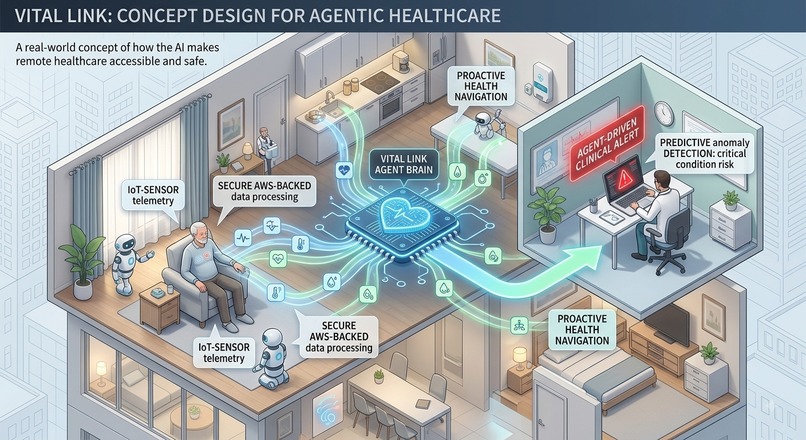
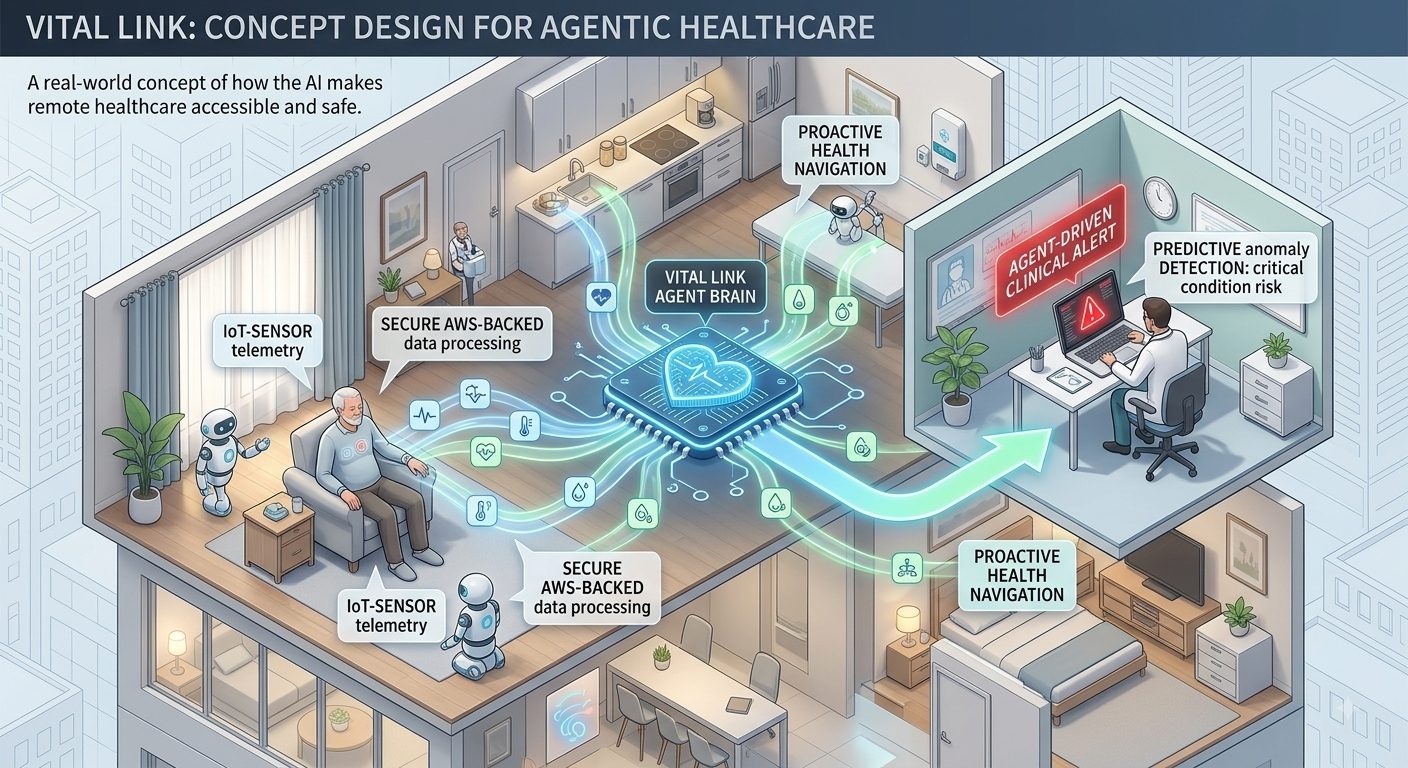
Concept Design: Real-time autonomous AI monitoring to make remote patient care proactive and safe.
-
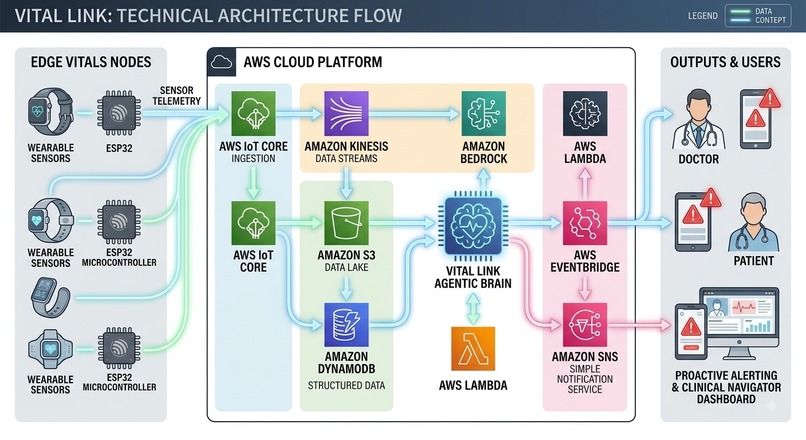
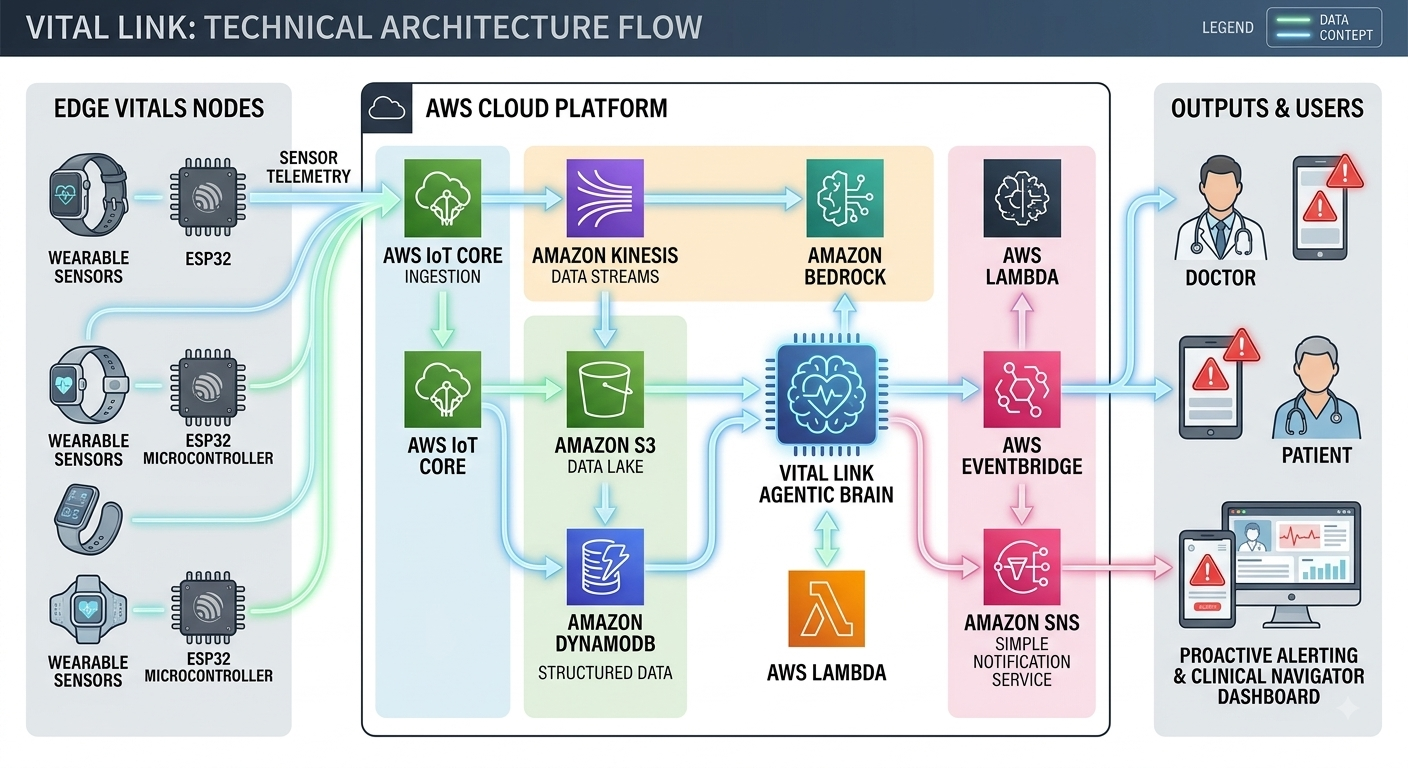
Technical Architecture: Data flow from IoT edge sensors to AWS IoT Core, Bedrock, and SNS.
Inspiration
Remote patient monitoring often places a heavy burden on both patients and clinical staff, requiring manual check-ins and constant dashboard monitoring. We wanted to build an AI agent that "makes life easier" for everyone involved. Inspired by the need for accessible, proactive elderly and chronic care, VitalLink acts as an autonomous, tireless clinical assistant—giving patients peace of mind and saving doctors from alert fatigue.
What it does
VitalLink is an autonomous IoT health agent. It securely ingests real-time physiological telemetry (like heart rate, temperature, and oxygen levels) from wearable edge devices into the AWS Cloud. Instead of relying on static thresholds, an Amazon Bedrock-powered AI agent continuously analyzes this streaming data. If it detects a predictive anomaly or critical health risk, the agent autonomously generates a clinical summary and dispatches real-time alerts to doctors and caregivers, bridging the gap between home care and clinical intervention.
How we built it
- Edge Hardware: We developed the sensor nodes using ESP32 microcontrollers programmed in C/C++ to capture real-world telemetry.
- AWS Ingestion & Routing: The hardware securely streams data via MQTT to AWS IoT Core. We utilized Amazon Kinesis for real-time data streaming and routed it to Amazon S3 (Data Lake) and Amazon DynamoDB for structured storage.
- Agentic Brain: We integrated Amazon Bedrock via AWS Lambda to act as the core reasoning engine, parsing the telemetry data for anomalies.
- Agentic Brain: We integrated Amazon Bedrock and AWS Strands Agents via AWS Lambda to act as the core reasoning engine, parsing the telemetry data for anomalies and orchestrating the proactive alert workflow.
Challenges we ran into
Handling high-frequency time-series data from edge devices and routing it securely into AWS with minimal latency was our first major hurdle. Furthermore, tuning the prompt instructions for the Amazon Bedrock model to accurately interpret raw numerical vitals without generating false-positive clinical alerts required extensive testing and iteration.
Accomplishments that we're proud of
We successfully built a true end-to-end autonomous pipeline—from a physical sensor patch in a patient's home all the way to an AI-driven, cloud-native alert on a doctor's phone. Watching the Bedrock agent successfully diagnose a simulated "arrhythmia" from raw IoT data and instantly fire off an SNS text message was incredible.
What we learned
We gained deep, hands-on experience with the AWS ecosystem, particularly integrating low-level hardware with AWS IoT Core. We also learned how to architect serverless event-driven applications using Lambda, EventBridge, and Bedrock.
What's next for VitalLink
We plan to expand the AI agent's capabilities by integrating it directly with standard Electronic Health Records (EHR) systems, allowing the agent to contextualize real-time vitals against a patient's historical medical history for even higher diagnostic accuracy.
Built With
- amazon-bedrock
- amazon-web-services
- aws-iot-core
- aws-lambda
- aws-strands-agents
- c++
- esp32
- python

Log in or sign up for Devpost to join the conversation.