-
-
Title
-
Info
-
The App

Inspiration
More than inspiration, I made Vitality out of anger. Why you may ask? If I get personal for a minute, one of my close relatives died due to a heart attack last year. Why? Late diagnosis of pulmonary artery disease. To be fair, doctors are not robots and it's not possible for them to care for everyone. But we are in the 21st century, with Machine Learning algorithms everywhere. Thus, I wanted to make heart disease diagnosis faster and easier for doctors using the K-NN Algorithm with python.
What it does
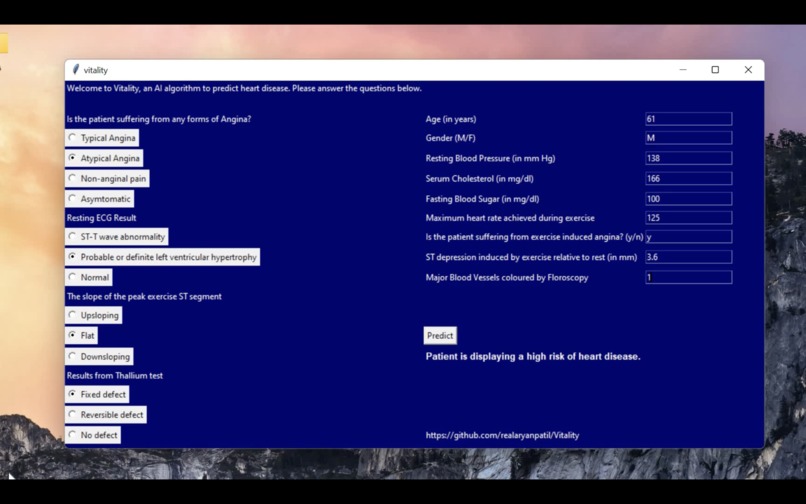
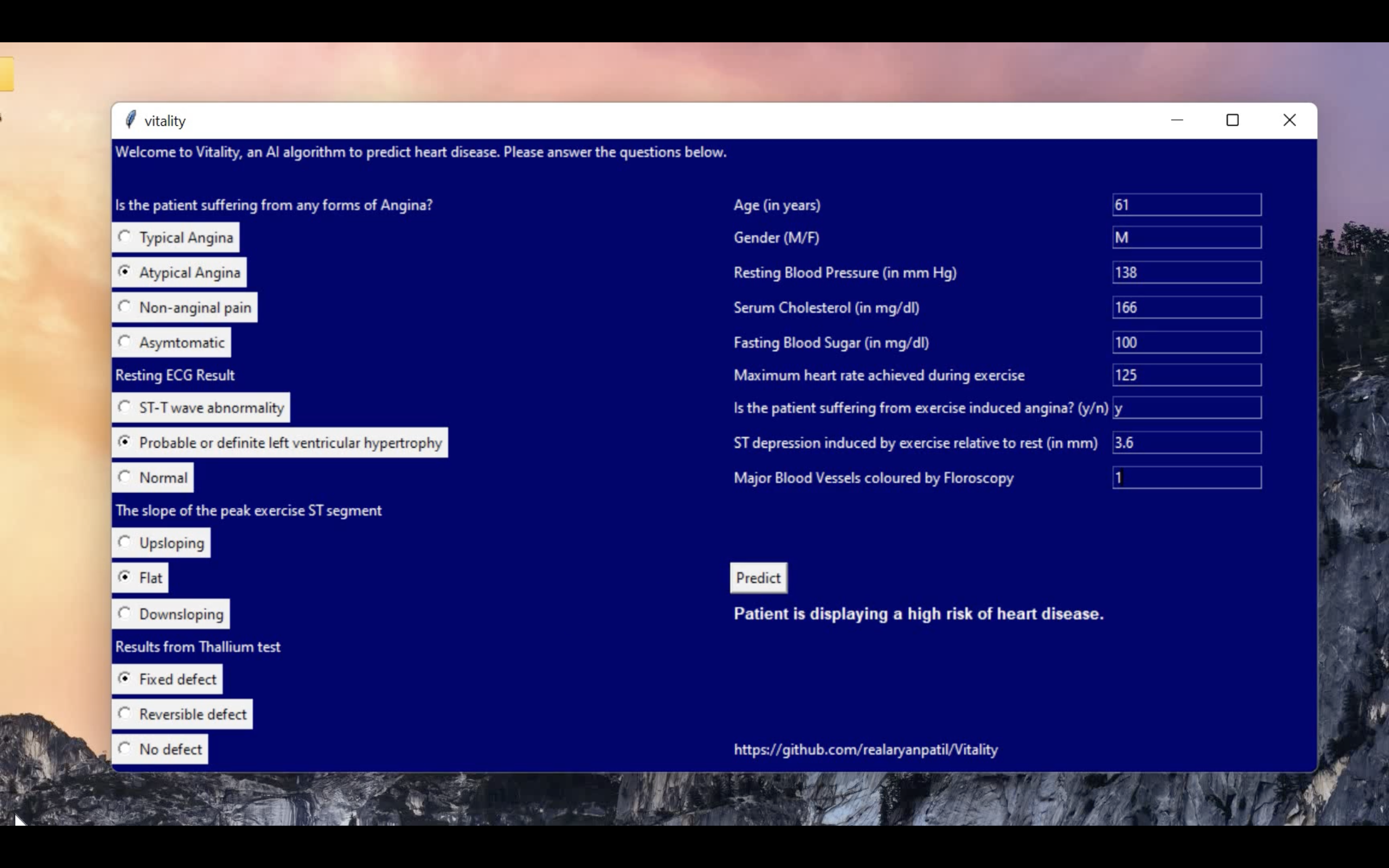
It takes in user values like blood pressure, blood glucose and 11 such values and calculates the risk of having heart disease.
How I built it
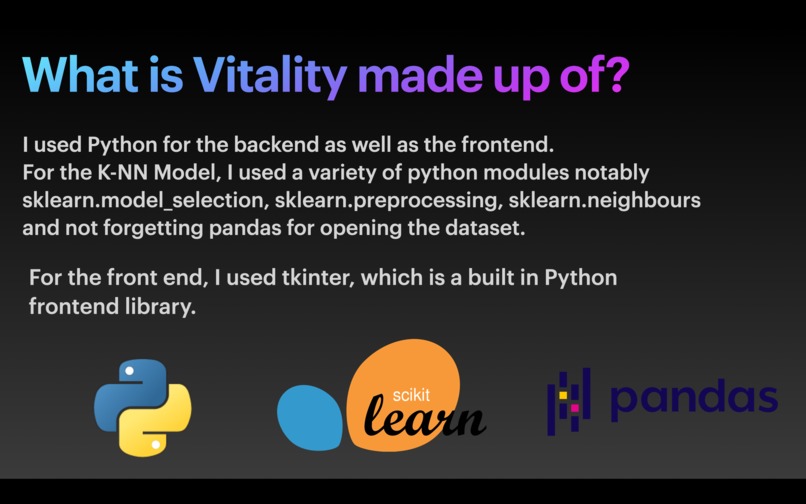
I used python for both the backend and frontend, with tkinter, sklearn and pandas being the notable modules.
If you don't know what a K-NN algorithm is, the K-nearest neighbors (KNN) algorithm is a simple, supervised machine learning algorithm that can be used to solve both classification and regression problems.
Challenges I ran into
Obtaining the dataset was a tough and challenging process, but I managed to get a very good dataset in the end.
Accomplishments that I am proud of
I was able to put my ideas down in code and make a working project.
What I learned
Challenges can be overcome . All you need is the dedication and the will to succeed.
What's next for Vitality
I want to implement Deep Learning algorithms in Vitality to make the predicts more accurate. I also want to make a web based frontend using Django to make it more accessible to everyone.
Side Note
I would like to thank Robert Detrano, M.D., Ph.D. from V.A. Medical Center, Long Beach and Cleveland Clinic Foundation for making his dataset on heart disease open source. It makes projects like these possible.


Log in or sign up for Devpost to join the conversation.