-
-
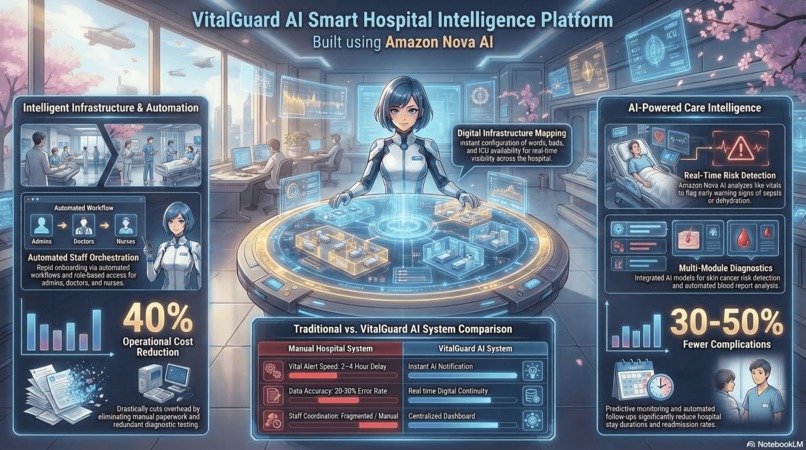
VitalGuard AI dashboard interface enabling hospital administrators and doctors to monitor patients, manage infrastructure,

** VitalGuard AI – Smart Hospital Intelligence System**
Inspiration
The idea for VitalGuard AI started from a personal experience. About four months ago, I was admitted to a hospital for treatment. During my stay, I observed that every day doctors and nurses added new paper records containing vitals, reports, and medical observations to my file. However, once the patient is discharged, many of these papers are no longer actively used. This made me realize how much natural resources are consumed in hospital documentation for information that is only temporarily useful. It inspired me to think about how hospitals could manage this data more intelligently using digital systems and artificial intelligence.
Another inspiration came from observing global healthcare challenges during the COVID-19 pandemic. Hospitals were overwhelmed with emergency cases and often struggled with patient prioritization, bed allocation, and resource management. This highlighted the need for smarter hospital systems that can support doctors with faster insights and better decision-making during critical situations.
I also considered the growing health challenges related to cancer. Treatments for diseases such as blood cancer and skin cancer are extremely expensive and often detected at later stages. This led me to think about the principle that prevention is better than cure. If artificial intelligence could analyze blood reports or skin patterns earlier, it might help identify potential risks sooner and reduce future mortality rates.
Environmental factors also influenced this idea. Due to increasing population and environmental changes, global temperatures are rising, which indirectly affects the ozone layer and increases exposure to harmful ultraviolet radiation. In the coming years, this could significantly increase the risk of skin-related diseases. This motivated the idea of developing AI-assisted tools that can analyze skin patches or early indicators to support preventive healthcare.
Another concept connected to this vision is the idea of maintaining the body's internal balance through thermal-based dietary recommendations. Example: In winter, the cold is high, so we have to eat something that keeps our body warm by generating heat during digestion, like ice, which looks cold but it creates heat during digestion. As temperatures increase globally, maintaining a balance between internal body heat and external environmental conditions becomes important for health. A system that understands both environmental conditions and body signals could eventually guide individuals toward healthier lifestyles and diet decisions.
My personal background also shaped this perspective. My mother works as a farmer on other people's farms, where physical work in extreme weather conditions is common. Observing such real-life struggles made me realize that innovations should not only solve technological problems but also improve everyday life for ordinary people.
These experiences and observations came together to form the idea behind VitalGuard AI — a system designed to combine intelligent healthcare management, early disease detection, and preventive health awareness to benefit both hospitals and society.
What It Does
VitalGuard AI is an intelligent hospital infrastructure platform designed to assist hospitals with AI-powered decision support.
The system helps manage hospital resources and patient care through:
- AI-generated patient summaries
- Smart bed allocation recommendations
- Patient vitals monitoring and trend tracking
- AI-assisted analysis of blood reports
- Skin patch image analysis for potential cancer risk indicators
- Risk monitoring to help doctors prioritize patients
By combining hospital infrastructure management with artificial intelligence, the platform aims to help healthcare professionals make faster, data-driven decisions.
How We Built It
VitalGuard AI was developed as a cloud-based intelligent healthcare platform.
The frontend interface was built using React, providing dashboards for hospital administrators and doctors to manage patient admissions, view hospital infrastructure, and monitor patient data.
The backend integrates several cloud technologies:
- Amazon Bedrock to access Amazon Nova AI models
- AWS Lambda for serverless backend processing
- Amazon API Gateway to connect the frontend with AI services
- Firebase for authentication and database storage
When a patient is admitted, the system sends symptoms and patient information to the AI service. The AI model processes this data and generates a patient summary and recommendations that can help doctors understand the situation quickly.
Additional modules allow doctors to upload blood reports or skin images for AI-assisted analysis and preliminary insights.
Challenges We Ran Into
Building the project involved several technical and integration challenges.
One of the biggest challenges was connecting multiple technologies such as React, cloud services, APIs, and AI models into a single cohesive system. Ensuring that the frontend could correctly communicate with the backend AI services required careful configuration.
Another challenge was handling the flow of AI responses so that the generated summaries and insights could be properly displayed in the interface.
Managing deployment, organizing the project structure, and debugging integration issues were also difficult during development. These challenges required significant troubleshooting and experimentation.
Accomplishments That We Are Proud Of
One of the biggest accomplishments of this project is successfully creating a working prototype that combines hospital management with AI-powered medical insights.
We were able to:
- Integrate AI-powered patient analysis using Amazon Nova models
- Design a hospital dashboard for managing infrastructure and patient data
- Implement features for patient admission, vitals tracking, and AI recommendations
- Demonstrate how AI can assist doctors in real healthcare scenarios
Transforming a real-world healthcare problem into a functioning AI-assisted system is something we are proud of.
What We Learned
Working on this project taught us several valuable lessons.
First, we learned how artificial intelligence can be integrated into real-world systems to support professionals rather than replace them. In healthcare, AI should act as a decision-support tool for doctors.
Second, we gained experience with cloud architecture and serverless computing. Using AWS services such as Lambda and API Gateway helped us understand how scalable AI-powered applications can be built.
Finally, we learned the importance of system design and workflow thinking when building technology for critical environments like hospitals.
What's Next for VitalGuard AI
VitalGuard AI is currently a prototype, but the long-term vision is much broader.
Future improvements may include:
- Real-time patient monitoring using wearable devices
- Advanced disease prediction models
- Multilingual AI assistance for healthcare workers
- Predictive hospital resource management
- Integration with digital health record systems
- Continuation of follow-up even after the discharge of patients
- national connection of all hospitals, which shows the comparison of the efficient treatment rate of hospitals in an area.
The ultimate goal is to create a smarter healthcare ecosystem where AI helps doctors make better decisions, improves hospital efficiency, and ultimately saves lives.
Built With
- amazon-api-gateway
- amazon-bedrock
- amazon-bedrock-api
- amazon-nova
- amazon-web-services
- aws-lambda
- css
- firebase-firestore
- github
- html
- javascript
- python
- react
- rest-api
- vercel
- vite
- webapplication


Log in or sign up for Devpost to join the conversation.