-
-
Icon
-
Architecture
Inspiration
The inspiration behind HealthConnect came from the pressing need for continuous healthcare
monitoring in today's world.
As healthcare systems face growing demands, we wanted to create a solution that empowers healthcare providers to monitor patients remotely in real-time, especially those with chronic conditions.
Leveraging Microsoft Fabric and Azure's powerful AI capabilities, we aimed to build a scalable, efficient, and user-friendly platform that bridges the gap between patients and healthcare providers.
What it does
Smart Healthcare Monitoring System
Category: Microsoft Fabric + AI Innovation
Description: Develop a system that uses real-time patient data to provide predictive healthcare insights.
Key Features:
- Leverage RTI to stream health data (e.g., vitals from wearables) into Microsoft Fabric.
- Use Azure OpenAI to analyze patient data for early diagnosis of conditions.
- Create a dashboard for healthcare professionals to monitor patient health in real-time.
How we built it
The project was developed in several key phases:
Data Streaming & IoT Integration:
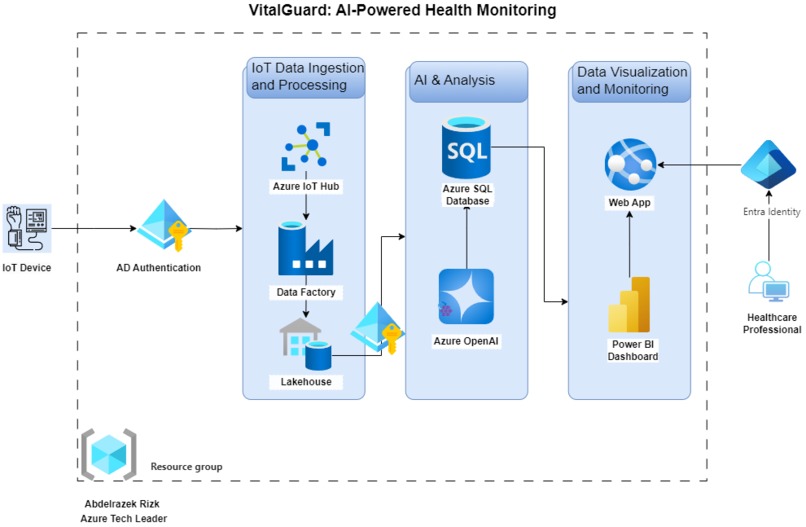
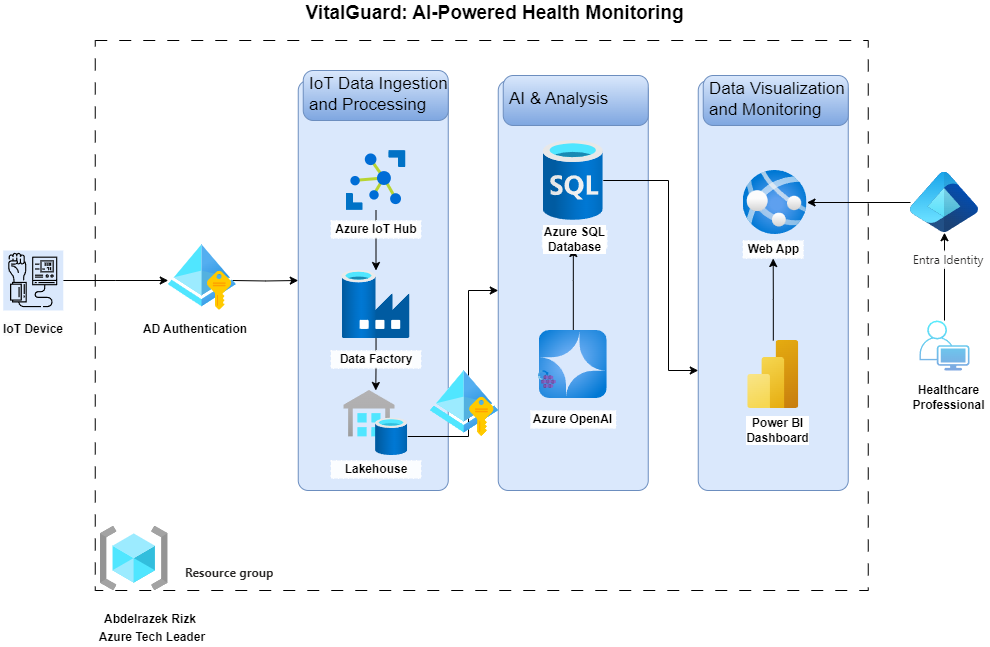
- Set up Azure-IoT-Hub to stream live health data (e.g., heart rate, oxygen levels) from patient monitoring devices.
- Configured Azure Stream Analytics to process data in real-time and send alerts for abnormal readings.
Data Storage & Management: - Utilized Azure-SQL-Database for storing patient historical data, allowing for trend analysis over time.
- Integrated Microsoft-Fabric to centralize data from IoT Hub and SQL Database for comprehensive analysis.
AI Model Development: - Developed predictive models using Azure-Machine-Learning to forecast potential health issues based on historical data patterns.
- Implemented real-time anomaly detection using Azure-OpenAI to trigger alerts for healthcare professionals.
Frontend Dashboard: - Integrated Power BI reports into the dashboard, providing healthcare providers with real-time monitoring capabilities.
Challenges we ran into
Building HealthConnect was a rewarding journey, but not without its challenges:
Data Latency:no open-source data
Accomplishments that we're proud of
- Set up Azure services
- Create Microsoft Fabric workspace
What we learned
throughout the journey, we gained invaluable experience in multiple areas:
Azure Services: We deep-dived into using Azure IoT Hub for real-time data ingestion, Azure SQL Database for storing historical data, and Microsoft Fabric for data integration and analytics.
AI & Machine Learning: Implemented Azure OpenAI models for predictive analysis, learning how to fine-tune models for accurate health predictions.
Data Visualization: Leveraged Power BI for creating real-time dashboards, giving healthcare
professionals actionable insights at their fingertips.
What's next for VitalGuard
Telemedicine Integration: Incorporate video consultations to provide a holistic remote healthcare platform.
AI-Driven Personalized Health Recommendations: Use AI to offer personalized health tips based on patient data.
Mobile App Version: Expand the solution to include a mobile app for patients to monitor their health metrics on the go.
Built With
- azure
- azure-iot-hub
- azure-openai
- azure-sql-database
- microsoft-fabric

Log in or sign up for Devpost to join the conversation.