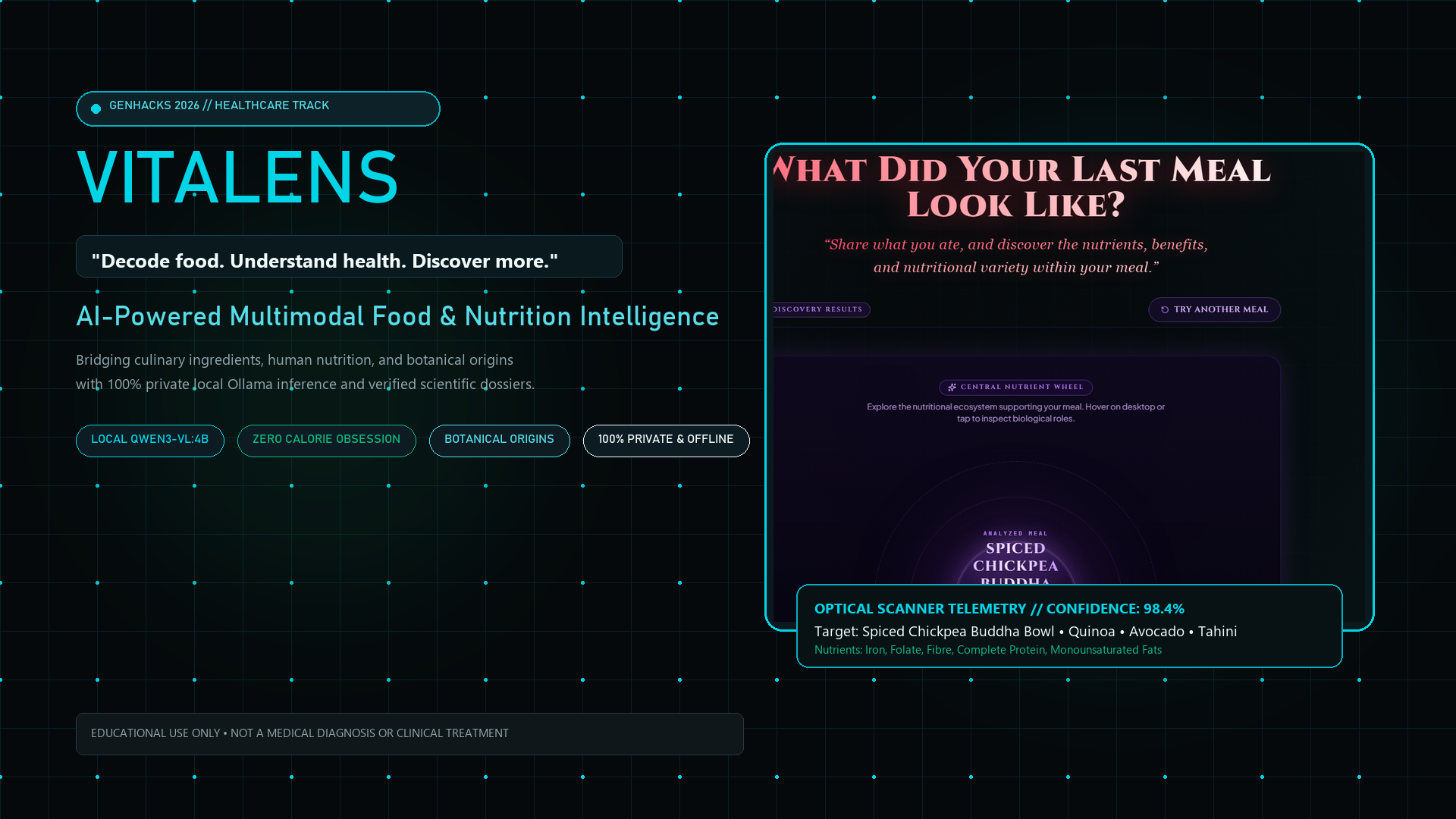
VITALENS
Decode food. Understand health. Discover more.
About the Project
VITALENS is an AI-powered food, nutrition, and health intelligence platform that connects food discovery, nutritional understanding, and interactive learning.
I wanted to explore how AI could help people understand the relationship between what they eat, the ingredients behind it, and the natural world that produces it.
Instead of treating food identification, nutrition information, and educational content as separate experiences, I envisioned a connected platform that brings them together.
The Inspiration
Food is one of the most familiar parts of everyday life, yet understanding it involves much more than recognizing what is on a plate.
Behind every food item are ingredients, plants, origins, nutritional properties, and connections to the environment.
I found this relationship interesting because food can become a starting point for learning about nutrition and nature.
However, information about these topics is often scattered across different platforms, and understanding it can require considerable effort.
I wanted to explore how AI could make this discovery process more accessible and interactive.
That idea became VITALENS.
The Solution
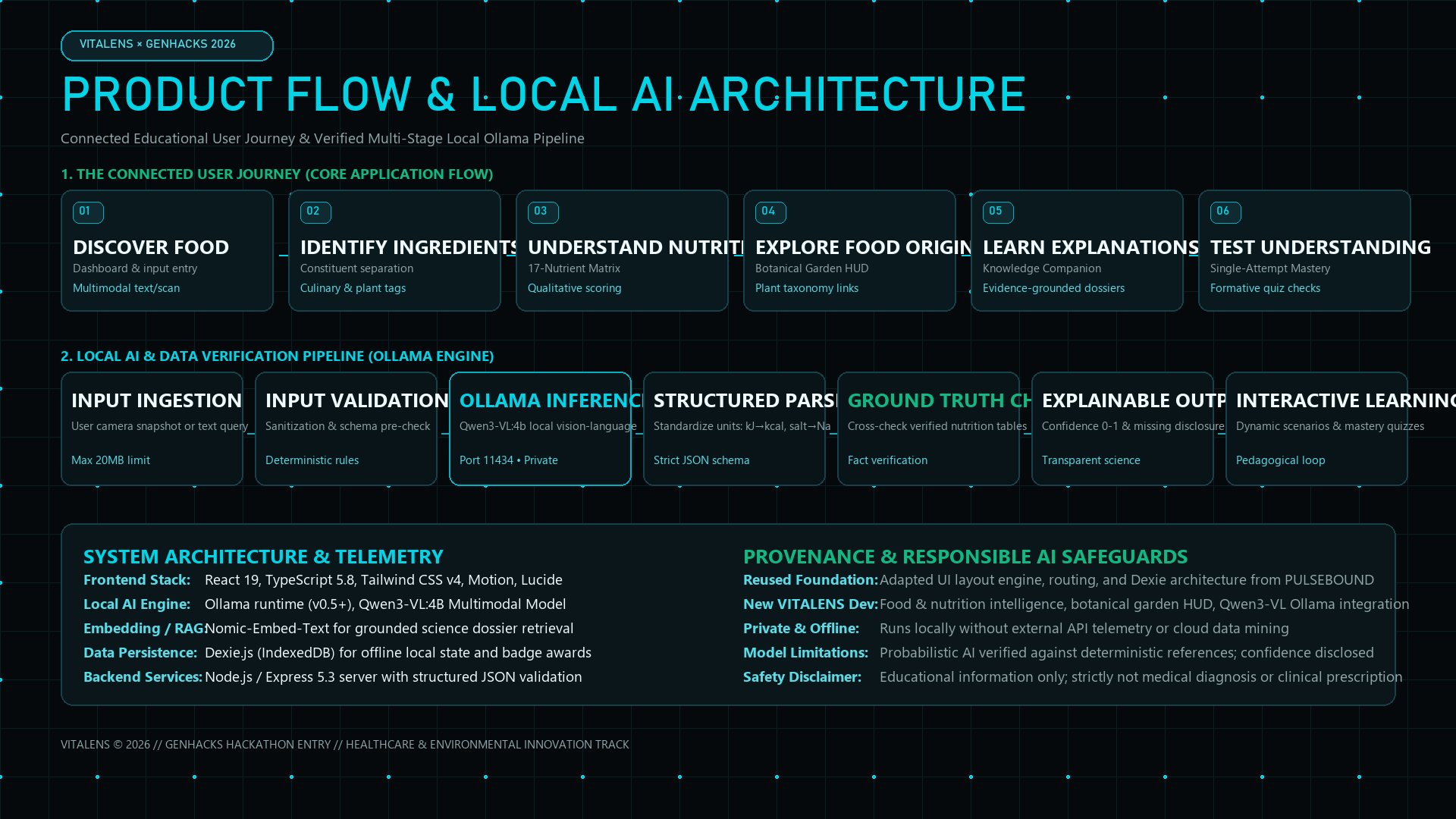
VITALENS is designed around a simple journey:
Discover → Identify → Understand → Explore → Learn
The platform brings together several connected experiences.
AI Food Scan
An AI-assisted experience for interpreting food-related images and inputs, helping users explore candidate food items and related information.
Nutrition Intelligence
A way to organize and explore nutritional information, including available energy, protein, carbohydrates, sugars, fibre, fats, and other nutritional fields.
Food and Nature Discovery
An educational experience connecting foods with ingredients, plants, origins, and related nutritional concepts.
Health Knowledge Companion
An AI-assisted educational experience designed to explain relevant food and nutrition concepts in understandable language.
Learning Companion
An interactive learning journey where users can explore concepts, understand explanations, and reinforce their knowledge through quizzes and progress-based activities.
How I Use AI
I chose Ollama as the primary local AI inference technology.
My goal was to make AI part of the actual product experience rather than using it only as a conversational interface.
The intended processing flow is:
User Input → Validation → Ollama Inference → Structured Information → Trusted Data Verification → Explainable Response
This approach separates AI-assisted interpretation from factual nutritional information.
It is especially important because recognizing a food item does not automatically provide an exact measurement of its nutritional composition.
I want VITALENS to communicate what is known, what is estimated, and what remains uncertain.
What Makes VITALENS Meaningful
I see food as a natural connection between health awareness, education, and environmental understanding.
A single food item can lead to questions about its ingredients, where they come from, what nutrients they contain, and how they relate to the wider natural world.
VITALENS explores this connection through AI-assisted discovery and learning.
Rather than giving users an isolated answer, I want the platform to encourage them to explore the information behind it.
What I Learned
Developing this concept helped me understand that building an AI-powered application requires more than model integration.
I explored how AI inference, backend processing, structured information, and reliable data sources need to work together.
I also learned that local AI introduces practical considerations such as model availability, hardware requirements, inference performance, and deployment constraints.
Most importantly, I learned that health-related information needs careful handling. An AI-generated explanation should not be presented as a verified medical fact without appropriate support.
Challenges I Faced
One challenge was connecting food identification, nutrition information, and learning into a coherent user experience.
Another was determining which responsibilities should belong to AI and which should remain with conventional application logic and trusted information sources.
I also had to consider the limitations of image-based food identification, uncertain nutritional estimates, and incomplete information.
These challenges shaped my approach toward a more structured and transparent AI-powered experience.
Responsible Use
VITALENS is intended for food, nutrition, and health education.
It is not designed to diagnose medical conditions, prescribe treatment, or replace professional medical advice.
I believe that making information more accessible also means communicating uncertainty and avoiding unsupported health claims.
Project Development and Attribution
VITALENS is being developed by transforming an existing PULSEBOUND codebase.
I am distinguishing the pre-existing project foundation and reused components from the new VITALENS identity, AI-focused direction, and newly developed functionality.
I will not represent reused code as entirely new work or claim that the complete project originated during GenHacks.
The Vision
With VITALENS, I want to explore a more connected way of understanding food: one where AI helps people move beyond simply seeing what they consume and toward discovering the information, knowledge, and natural connections behind it.
VITALENS — Decode food. Understand health. Discover more.
Built With
- ai
- ai-powered
- api
- artificial
- discovery
- environmental
- food
- generative
- health
- healthcare
- intelligence
- interactive
- learning
- nature
- node.js
- nutrition
- ollama
- react
- rest
- technology
- typescript
- vite

