Inspiration
Nurses shouldn't have to leave the bedside to find the right information.
VitalLens started in our NTU design and systems thinking course (DR5004) in June and July 2026. We didn't start with glasses. We started with a problem: why are so many healthcare workers burning out? Our causal loop kept pointing to the same cycle. Staff shortages lead to more work per person, which leads to people leaving, which makes the shortage worse.
Then we spoke to a frontline ward nurse, and our assumption flipped. We thought it was mostly about staffing ratios. What she described again and again was the admin around the care: handovers, typing the same data in again, and walking back to a workstation to check something. Glasses only came in at the ideation stage.
I also interned at NUH, so I'd seen how busy a ward gets and how much depends on the right information reaching the right person at the bedside. That's the moment we wanted to design for.
What it does
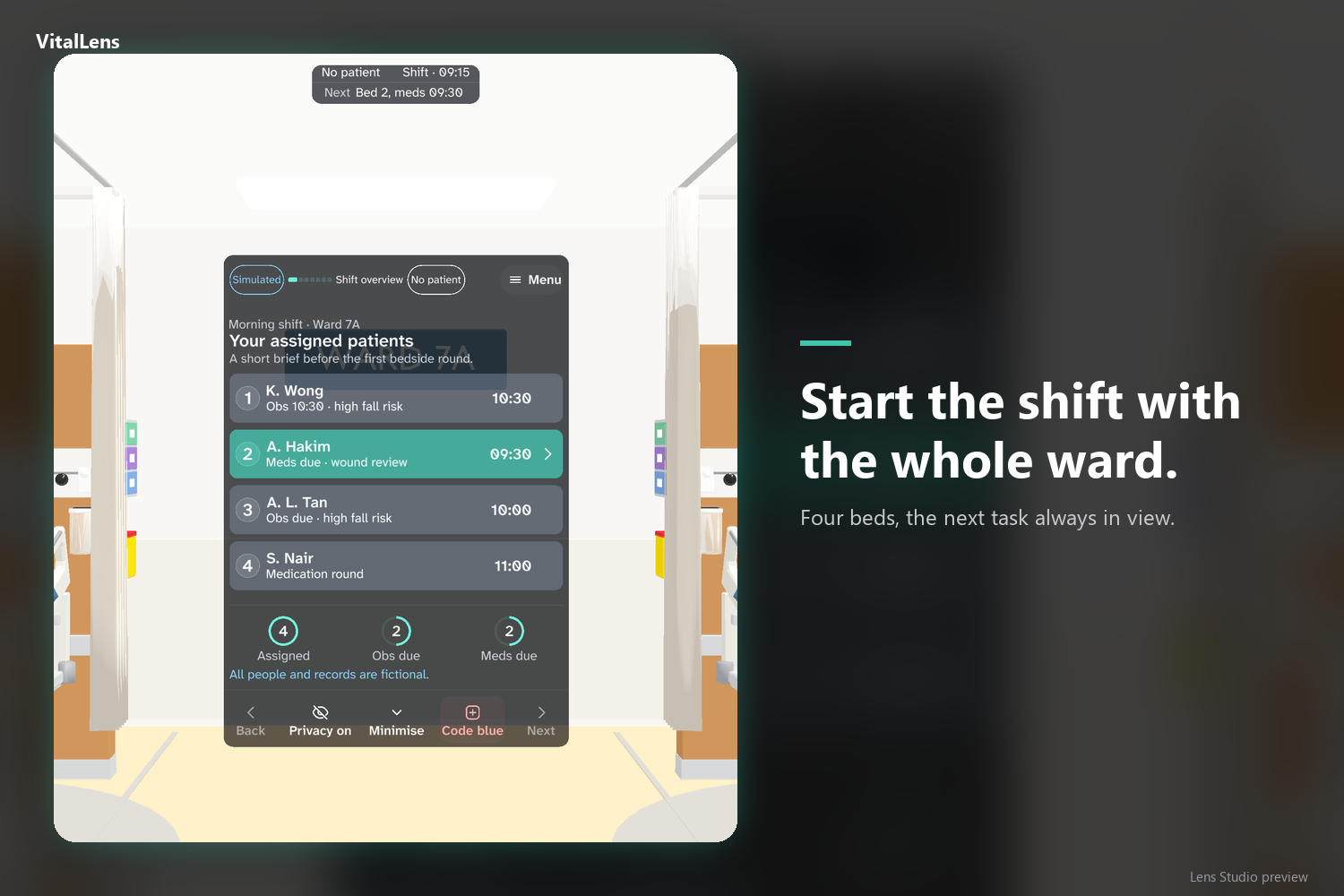
VitalLens is a SPECS Lens for one fictional ward round:
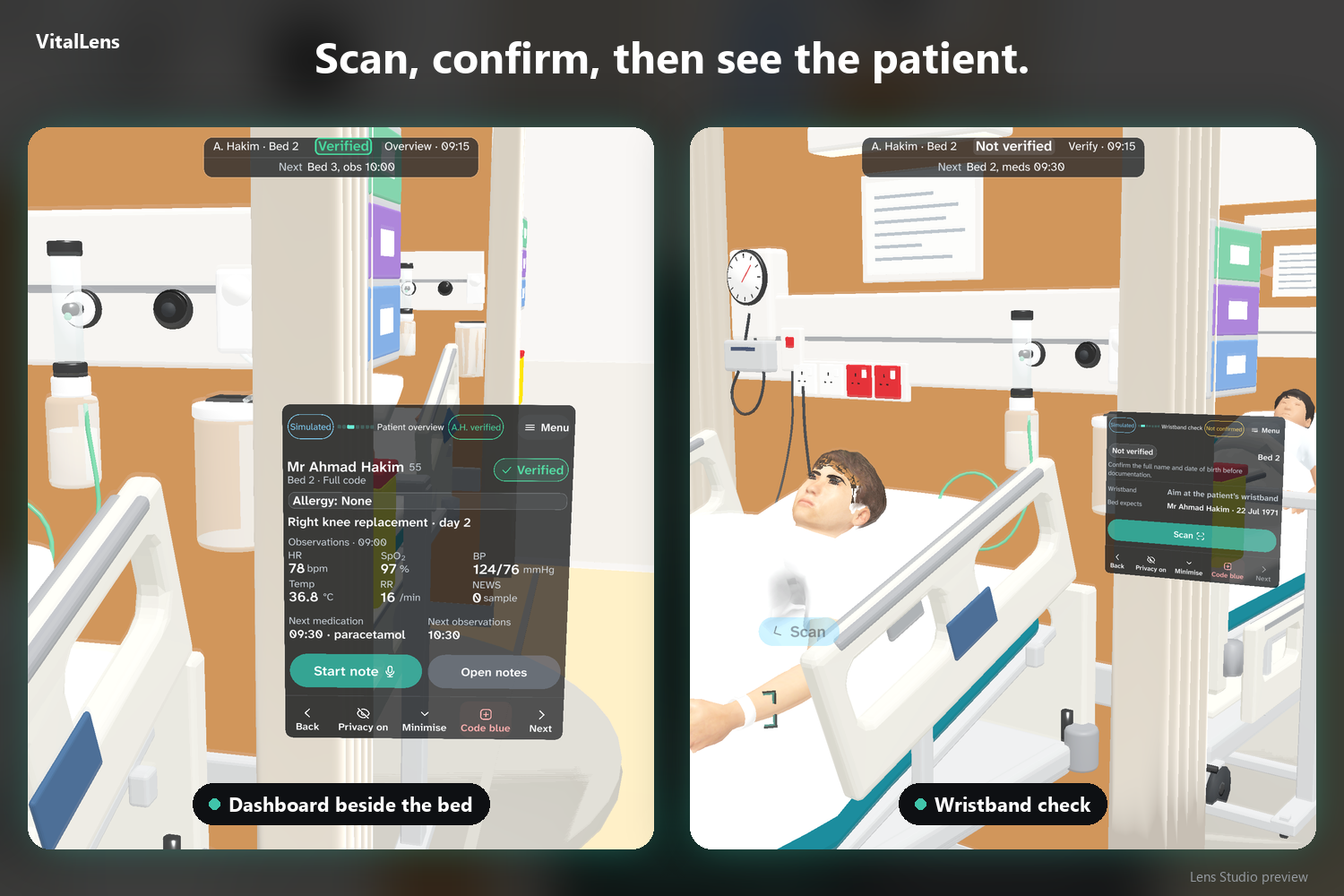
- The nurse scans the patient's wristband to confirm the right patient before anything patient-specific opens. There's no face recognition.
- A short patient overview appears beside the bed, not floating in front of the nurse.
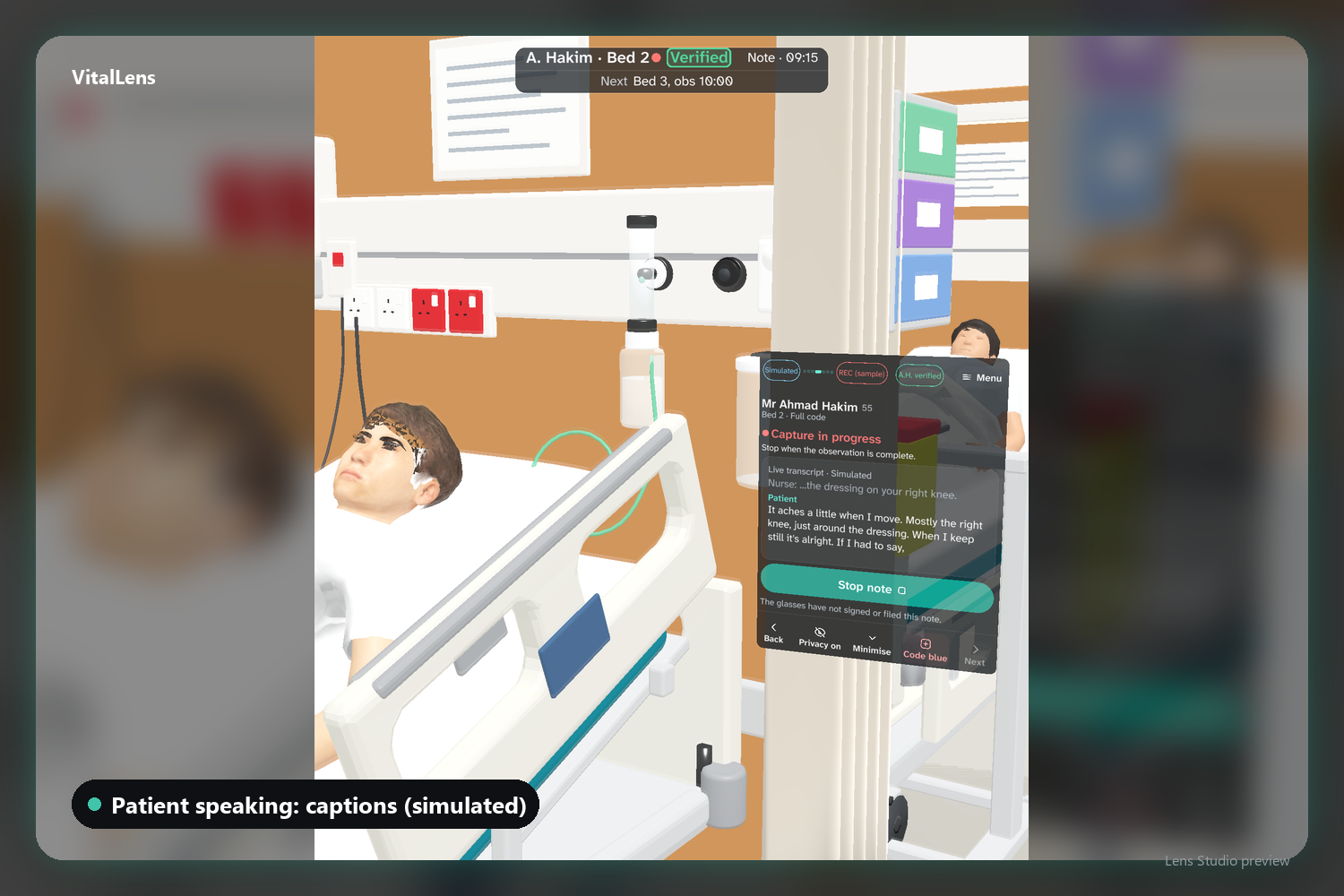
- The nurse dictates a note (a sample transcript), reviews a simulated AI draft and deliberately saves it for review. Nothing is approved by navigation or a timer.
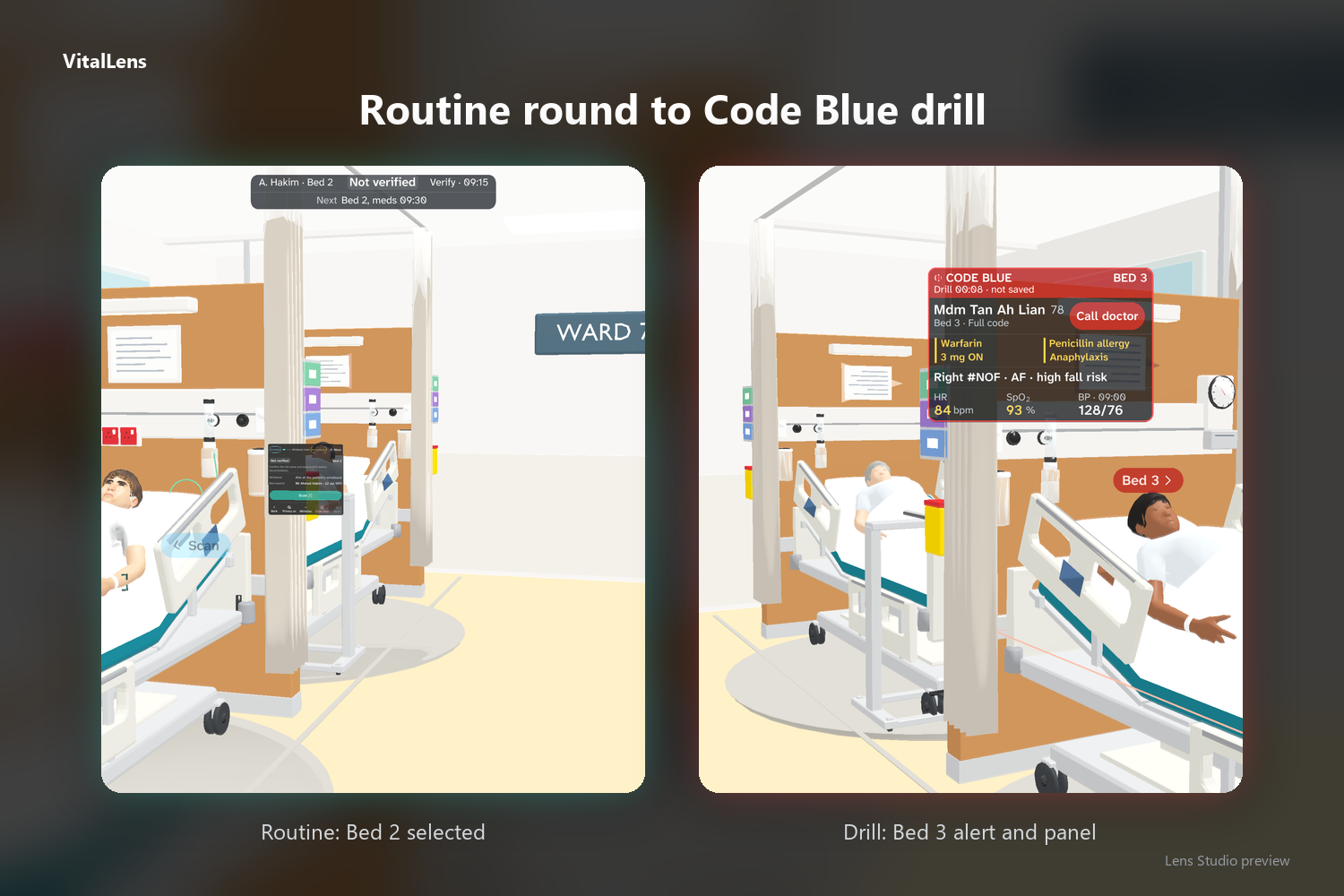
- A simulated Code Blue drill at another bed shows a compact travel HUD, then a bedside board.
- A handover summary is built only from saved notes, and the nurse reviews it.
All patients and data are fictional. Every simulated part is labelled. It isn't a medical device.
Why glasses, not a phone
A nurse's hands are busy and their eyes need to stay on the patient. Glasses can put the right record beside the right bed after a wristband check, without picking up a device or walking to a workstation. Whether that beats a phone or a ward computer is exactly what we want to test with nurses.
How we built it
- Lens Studio 5.24 on the SPECS Base Template, with the SPECS Interaction Kit and UI Kit.
- Coding agents (Kiro and Claude Code) working through CLAD and the Lens Studio MCP. They built scenes, screens and materials, ran the preview and read the logs.
- Planning: we used the official plan-lens skill pack's design-brief template. We didn't run its live interview; our coding agent wrote the brief from our written decisions and HTML storyboards (1 to 2 November), and a public version is in the repo's
devpost/folder. - One shared state model for verification, capture, drafts, saving and handover, with 160 logic tests in Node (all passing), plus LEAF scenarios for the core flow in the Lens Studio preview.
- A 3D ward with four beds, built by script from CC0 MakeHuman patients, so the preview feels like a real bay.
- Preview-only sound: a sample bedside conversation with live captions (ElevenLabs voices) and interface sounds.
Challenges we ran into
- Designing for glasses, not a screen. Our first storyboards were basically a dashboard floating in the air. We had to cut text, anchor panels to the bed, use a few big pinch targets and keep the walking view clear.
- The preview isn't the glasses. The display is additive, so black is see-through, and the preview dims everything outside the display frame. We spent a long time measuring brightness before accepting that the dim edges are a preview artefact, not what a nurse would see.
- No camera or reliable voice in the preview. So wristband scanning uses a "scan" stand-in, and every voice action also has a button.
- Safety rules in the logic. Draft vs saved vs approved, edits that invalidate a summary, and unknown facts staying unknown were harder to get right than the visuals. That's why most of our tests are about state.
- Three people, one scene file. We split ownership by file and used branches and a team board to avoid overwriting each other.
What we learned
- On glasses, less is better: show information only when it's needed, and put it where the nurse is already looking.
- The hardest part of AI help at the bedside is the review step, not the AI.
- A coding agent with the Lens Studio MCP is fast. You still have to check everything in the preview yourself and not trust "done".
What's next
We want to test the flow with nurses and see whether it actually helps before claiming anything.
Built With
- blender
- clad
- claude-code
- elevenlabs
- kiro
- leaf
- lens-studio
- lens-studio-mcp
- python
- specs
- specs-ui-kit
- spectacles-interaction-kit
- typescript
