VITALENS
Decode food. Understand health. Discover more.
About the Project
VITALENS is an AI-powered food and nutrition intelligence platform exploring how artificial intelligence can make nutritional information easier to interpret, organize, and understand.
For AI for Medicine, I am focusing on a specific problem within this larger platform:
AI-assisted extraction and interpretation of structured nutritional information from food labels.
My objective is to explore how AI can help transform nutritional information presented in different visual layouts into structured, understandable information, while recognizing the limitations of automated extraction.
The Problem
Nutrition labels contain useful information, but their layouts, formatting, serving sizes, units, and presentation can vary considerably.
For someone trying to understand or compare food products, extracting relevant information manually can become inconvenient.
I wanted to explore whether an AI-assisted workflow could make this information more accessible.
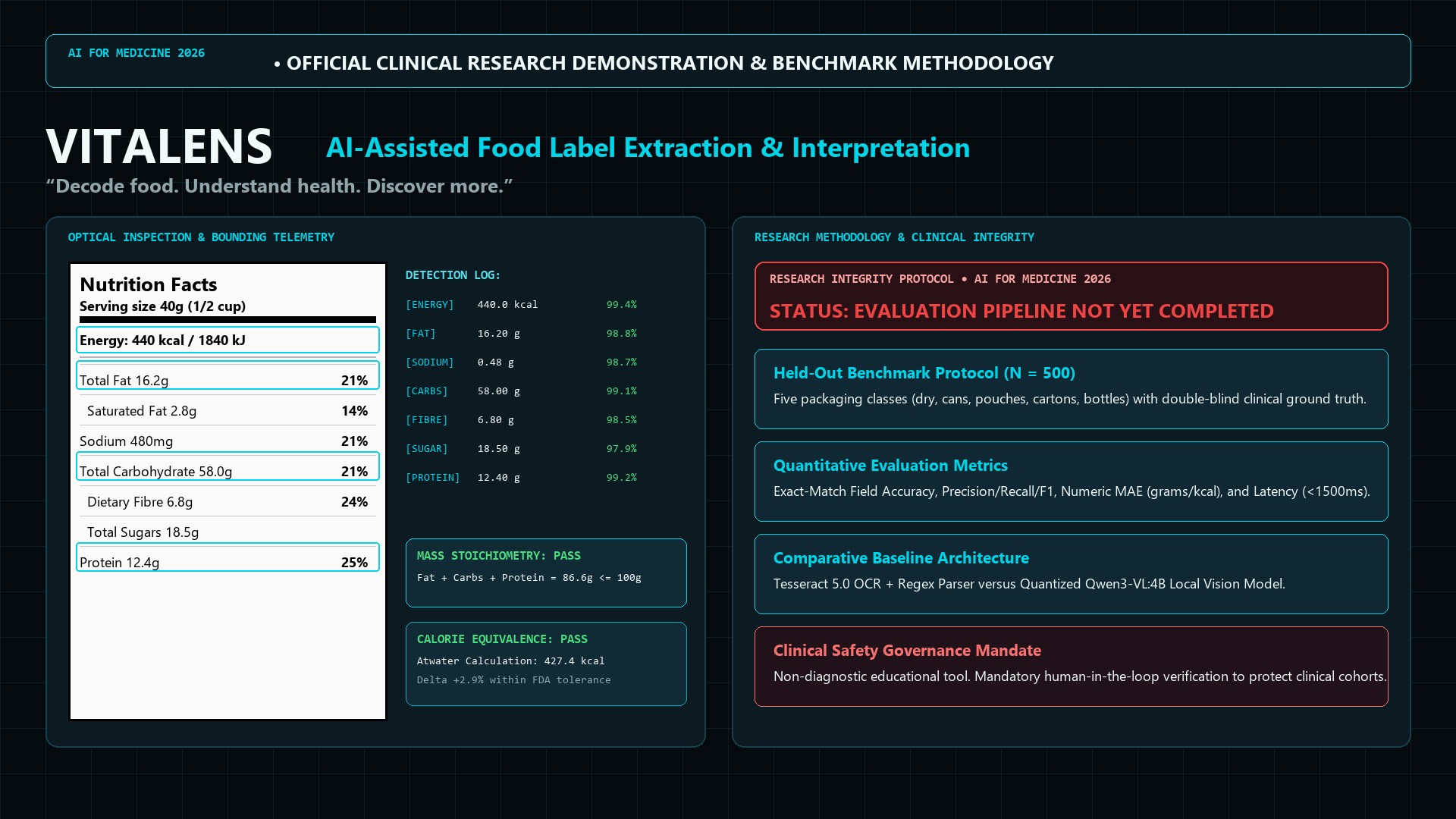
The task I am focusing on is extracting selected nutritional fields, such as:
- Energy.
- Protein.
- Carbohydrates.
- Total sugars.
- Fibre.
- Total fat.
- Sodium.
The goal is to organize available values into a structured representation that users can interpret more easily.
My Approach
I chose Ollama as the primary local AI inference technology for VITALENS.
The intended workflow follows several stages:
Food Label Image → Input Validation → Text or Vision Extraction → Structured Field Mapping → Unit Normalization → Reference Comparison → Validated Output
Each stage has a different responsibility.
The AI component assists with interpreting the input and extracting candidate information. Conventional processing and validation are important for checking field formats, units, missing values, and consistency.
I also recognize that AI-generated values must not be treated as ground truth simply because they appear in a structured format.
Why Evaluation Matters
One of the most important ideas behind this work is that a successful demonstration does not necessarily prove that an AI system performs reliably.
I consider evaluation essential to understanding whether automated nutritional information extraction is useful.
A proper evaluation should use a documented dataset, ground-truth annotations, a clearly defined held-out test set, and a reproducible methodology.
Potential evaluation measures include:
- Field-level exact-match performance.
- Precision, recall, and F1.
- Numeric mean absolute error.
- Unit-normalization success.
- Missing-field detection.
- Processing latency.
- Failure rate.
I also want to compare AI-assisted extraction against a suitable baseline, such as conventional OCR combined with rule-based extraction, wherever a valid comparison can be implemented.
I will report actual measured results rather than assuming that AI performs better.
What I Learned
This project helped me recognize the difference between building an AI feature and evaluating an AI system.
I learned that structured output alone does not guarantee correctness.
An extracted nutritional value can still be wrong because of poor image quality, OCR errors, ambiguous formatting, incorrect serving-size interpretation, or unit conversion mistakes.
I also learned why ground-truth data, reproducible testing, and explicit failure analysis are important when working with information that could influence health-related decisions.
Challenges and Limitations
Food-label extraction is not a trivial image-recognition problem.
Labels may contain multiple columns, different serving sizes, abbreviations, unusual layouts, and values that are difficult to read.
A system may also encounter missing fields or ambiguous information.
These limitations matter because an incorrect nutritional value could mislead someone making an important dietary decision.
I therefore approach VITALENS as an educational information tool, not a clinical decision-making system.
Who Benefits and Who Could Be Harmed?
I believe this type of technology could benefit people who want to understand nutritional labels more easily, as well as developers and researchers exploring accessible nutritional-information tools.
However, people relying on precise dietary information for medical reasons could be harmed if they treat an incorrectly extracted value as authoritative.
For that reason, I consider uncertainty, source transparency, and human verification essential.
VITALENS does not claim to diagnose diseases, prescribe treatment, or replace qualified healthcare professionals.
My Vision
I want to explore how AI can make nutritional information more accessible without sacrificing transparency or scientific honesty.
For me, the important question is not simply whether AI can extract information from an image.
It is whether that information can be extracted, checked, evaluated, and communicated responsibly.
VITALENS — Decode food. Understand health. Discover more.
Built With
- ai
- artificial
- character
- computer
- data
- digital
- evaluation
- extraction
- health
- healthcare
- informatics
- intelligence
- label
- language
- large
- medical
- models
- nutrition
- ollama
- optical
- recognition
- research
- structured
- technology
- vision

