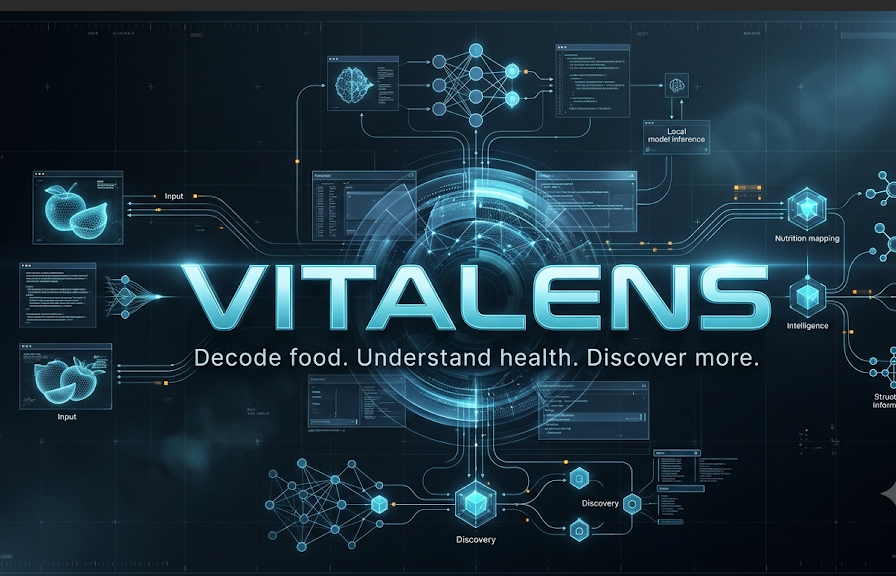
VITALENS
Decode food. Understand health. Discover more.
About the Project
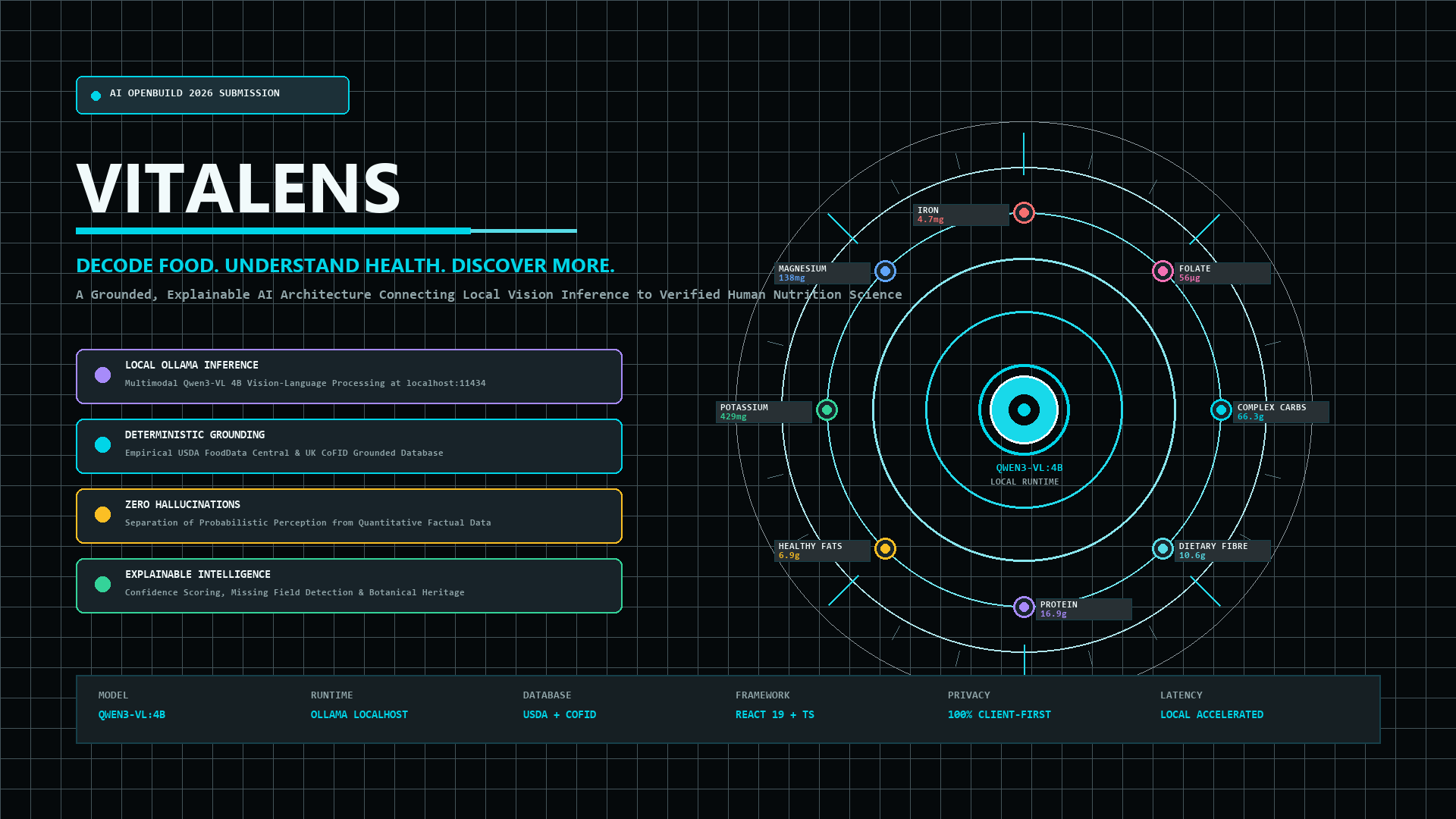
VITALENS is an AI-powered food and nutrition intelligence platform that explores how local AI inference, structured information extraction, and trusted data retrieval can work together to make food-related knowledge more understandable.
I created VITALENS around a technical question:
How can I build an AI application where the model does more than generate text, and where its outputs become part of a structured, explainable user experience?
The Problem I Wanted to Explore
Food-related information is available in many forms: images, nutrition labels, ingredient descriptions, and educational resources.
However, interpreting these different inputs often requires users to move between multiple tools and information sources.
I wanted to investigate how AI could help connect these interactions while maintaining a distinction between model-generated interpretations and verified factual information.
This became the foundation of VITALENS.
My Approach to AI
I chose Ollama as the primary local AI inference technology.
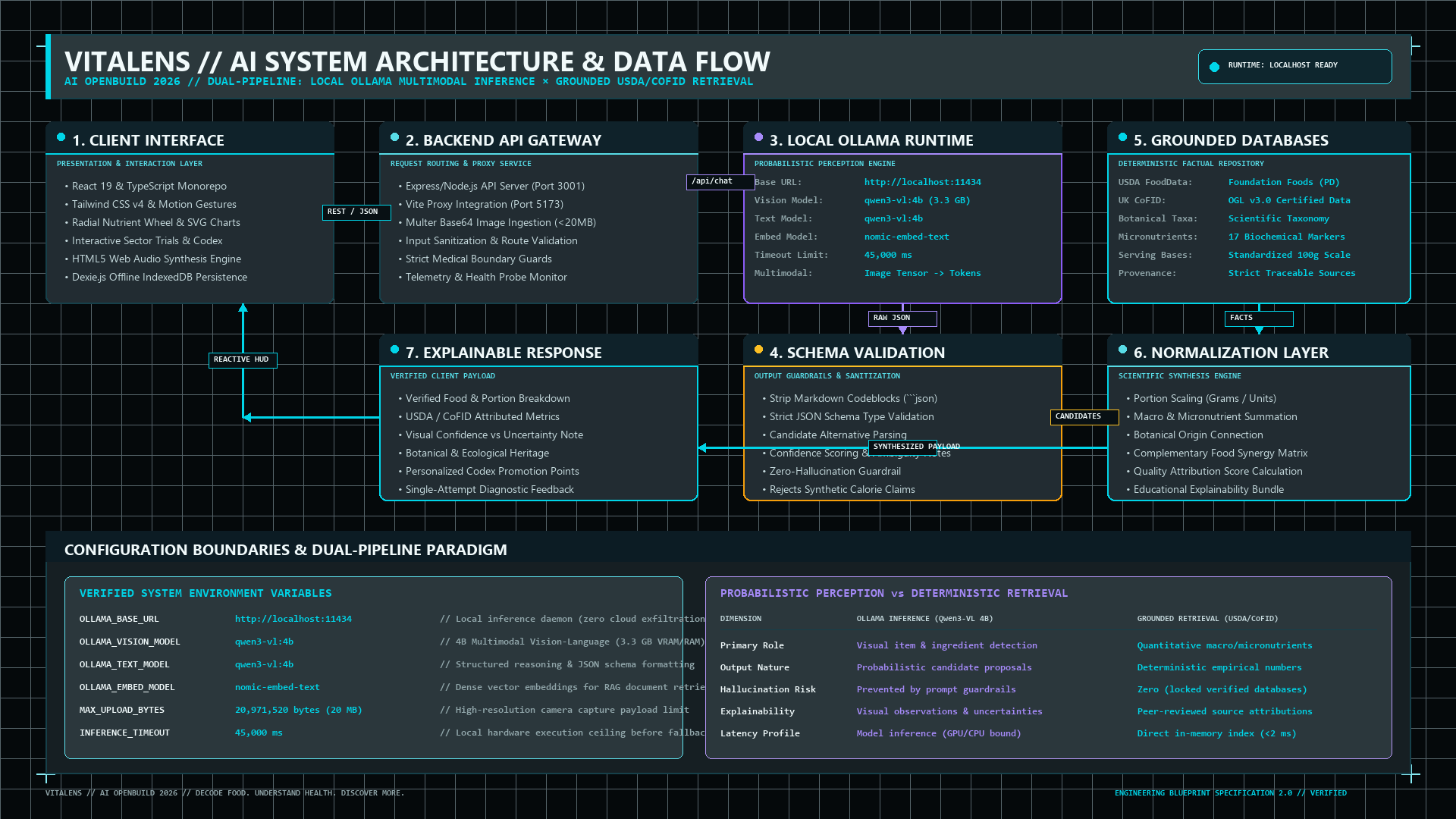
Rather than treating AI as an isolated chat interface, I designed the application around a processing pipeline:
User Input → Validation → AI Inference → Structured Extraction → Data Verification → Explainable Output
The intention is to give each part of the system a clearly defined responsibility.
- The frontend handles user interaction and presentation.
- The backend manages requests and processing.
- Ollama handles configured local model inference.
- Structured extraction organizes model outputs.
- Trusted data retrieval provides factual nutritional information.
- Validation helps identify incomplete or uncertain outputs.
This architecture helps separate what the model predicts from what the application can actually verify.
How VITALENS Works
The product brings together several related experiences:
AI Food Scan
Users can provide food-related inputs for AI-assisted interpretation. The goal is to identify candidate food items and make the resulting information easier to understand.
Nutrition Intelligence
Nutritional information is organized into understandable fields, allowing users to explore and compare available information.
Food and Nature Discovery
Food becomes an entry point for exploring ingredients, plants, origins, and related nutritional concepts.
Health Knowledge Companion
The platform is designed to provide context-aware educational explanations using AI and relevant information sources.
Learning Companion
Users can move from discovery to explanation and interactive learning rather than stopping at a single AI-generated answer.
Why Local AI?
I chose Ollama because local inference provides an opportunity to experiment with AI processing without making every interaction dependent on an external hosted model API.
It also introduces important engineering challenges that I wanted to understand.
Model selection, vision capabilities, hardware requirements, response latency, structured outputs, and service availability all affect how a local AI application behaves.
I therefore treat model configuration and system health as important parts of the overall architecture, rather than assuming that an AI model will always be available.
What I Learned
This project helped me understand that AI integration is not simply about connecting an application to a model endpoint.
A useful AI product needs a complete workflow around the model.
I explored why model outputs should be validated, why nutritional facts should be grounded in reliable sources, and why uncertainty must be communicated instead of hidden.
I also learned to distinguish local inference from public deployment. A model running on my own machine is not automatically accessible to users visiting a remotely hosted application.
Engineering Challenges
One major challenge was designing a product that combines different types of input and information without creating an overly complicated architecture.
Another was determining which tasks should use AI and which should rely on conventional application logic or external reference data.
For example, AI can assist with food identification and explanation, but it should not invent precise nutritional values when reliable measurements or reference information are unavailable.
I also had to consider incomplete inputs, unavailable models, invalid responses, and the practical limitations of local hardware.
Responsible AI
VITALENS is intended for educational food and nutrition understanding, not medical diagnosis or treatment.
I do not consider an AI-generated response automatically correct. The system needs appropriate validation, source awareness, and transparent limitations.
My goal is to create an application where AI contributes meaningful functionality while the surrounding engineering makes its behavior more understandable and reliable.
Looking Forward
I see VITALENS as an exploration of practical AI engineering: connecting local inference, structured information, data retrieval, and user-centered experiences into one coherent system.
VITALENS — Decode food. Understand health. Discover more.
Built With
- ai
- artificial
- computer
- data
- engineering
- extraction
- generative
- inference
- integration
- intelligence
- language
- large
- local
- models
- natural
- ollama
- processing
- prompt
- react
- structured
- typescript
- vision

