Inspiration
The night shift runs on fewer staff, less rotation between patients, and longer gaps between check-ins. Nurses can’t always revisit every patient every 15 minutes — even when vitals may be changing in between.
What we wanted to break was this gap in coverage.
VitaLens was inspired by a simple idea — that patient monitoring shouldn’t depend on constant physical check-ins alone. Instead, it should quietly track changes in the background and bring attention to the patients who need it most.
What it does
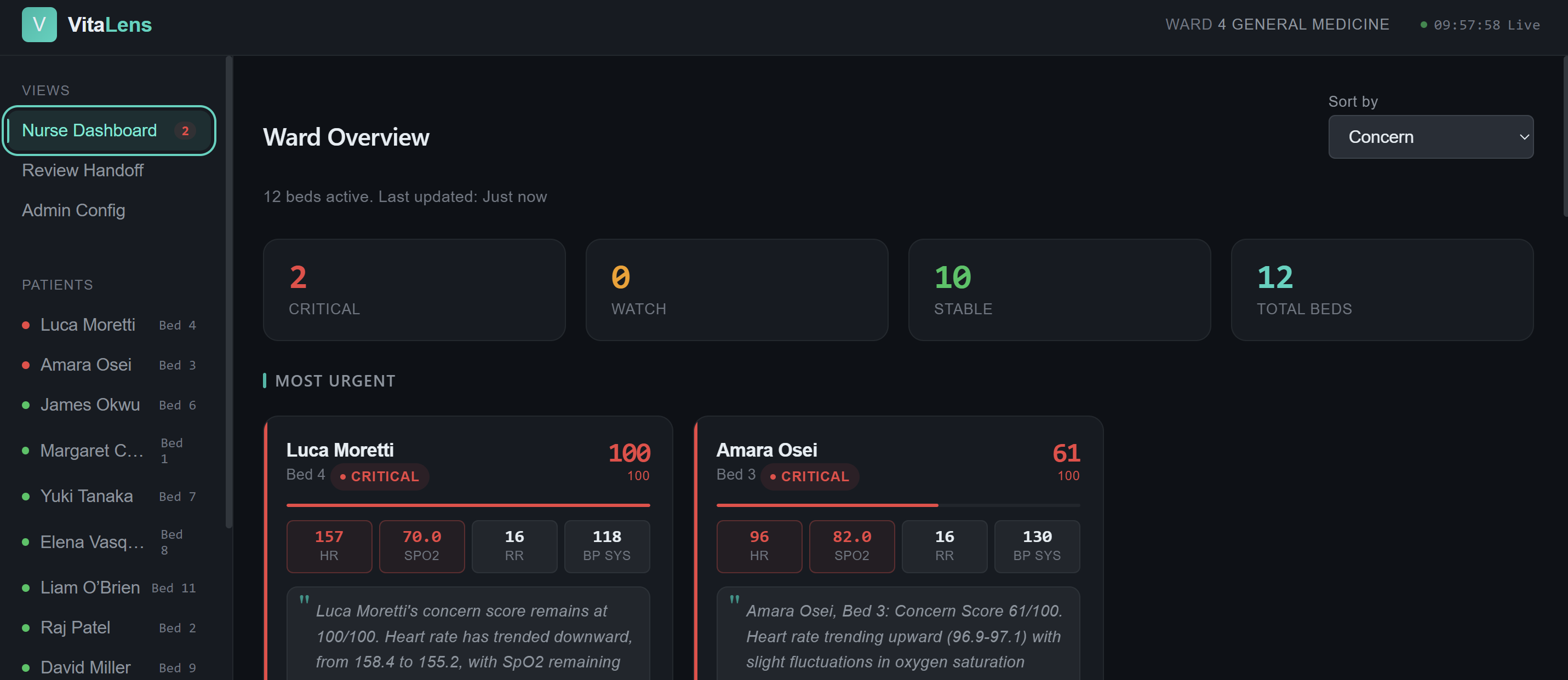
VitaLens is a clinical AI monitoring dashboard built for the night shift. It monitors a 12-patient ward, checks each patient’s vitals against accepted clinical thresholds, scores how far each patient has drifted from normal, and ranks the ward by urgency 🚨
Each patient card updates every 15 minutes and is color-coded by concern level, making it easy to understand the state of the ward at a glance.
For patients that need attention, Snowflake Cortex generates a calm, plain-English explanation of what changed and why it matters. ElevenLabs then turns the highest-priority case into a short spoken brief 🔊 — so nurses can quickly know where to focus without manually checking every patient.
How we built it
We built VitaLens using:
- Snowflake → data + intelligence layer
- Node.js + Express → backend
- React → dashboard interface
Within Snowflake, we:
- Store patient data
- Run threshold checks
- Perform deviation scoring across:
- Heart rate
- Respiratory rate
- SpO2
- Systolic blood pressure
- Heart rate
Snowflake Cortex:
- Transforms raw deviations into clear clinical summaries
ElevenLabs:
- Converts top-priority concerns into natural speech 🎙️
➡️ The result feels less like a dashboard, and more like a support system during long shifts.
Challenges we ran into
One of the biggest challenges was resisting the default dashboard mindset. It would have been easy to build another grid of numbers or alerts, but that wouldn’t solve the real issue — limited time and attention during night shifts.
We also had to ensure the AI stayed calm, specific, and genuinely useful. Another challenge was connecting scoring, ranking, narration, and audio into a single flow that still felt simple in a hackathon build.
Accomplishments that we're proud of
We’re proud that VitaLens focuses on a real gap in care: helping nurses prioritize when they can’t be everywhere at once.
Instead of adding more work, it guides attention, explains why something matters, and delivers that information in a way that feels clear and supportive. The entire system — from dashboard to spoken brief — works together to reduce mental load during long shifts.
What we learned
We learned that innovation isn’t always about adding more, but about designing around real constraints — in this case, limited time, staffing, and attention.
We also learned how much clarity matters in healthcare. The way information is presented directly affects how quickly it’s understood and acted on.
What's next for VitaLens
Next, we want to improve trend detection, add richer patient context, and make the ranking logic more adaptive over time.
We also plan to expand handoff and escalation workflows so the system fits more naturally into real clinical routines.
Conclusion 🎉
Thank you for checking out VitaLens!
We built this because the night shift deserves better support — especially when staffing is limited and attention is stretched. VitaLens helps teams stay aware, prioritize faster, and act sooner.
**Built with 💛 at BearHacks · 2026** Tasnia · Insha · Hiba⚠️ VitaLens is a prototype built for demonstration purposes. It is not a certified medical device and should not be used for real clinical decision-making.


Log in or sign up for Devpost to join the conversation.