Inspiration
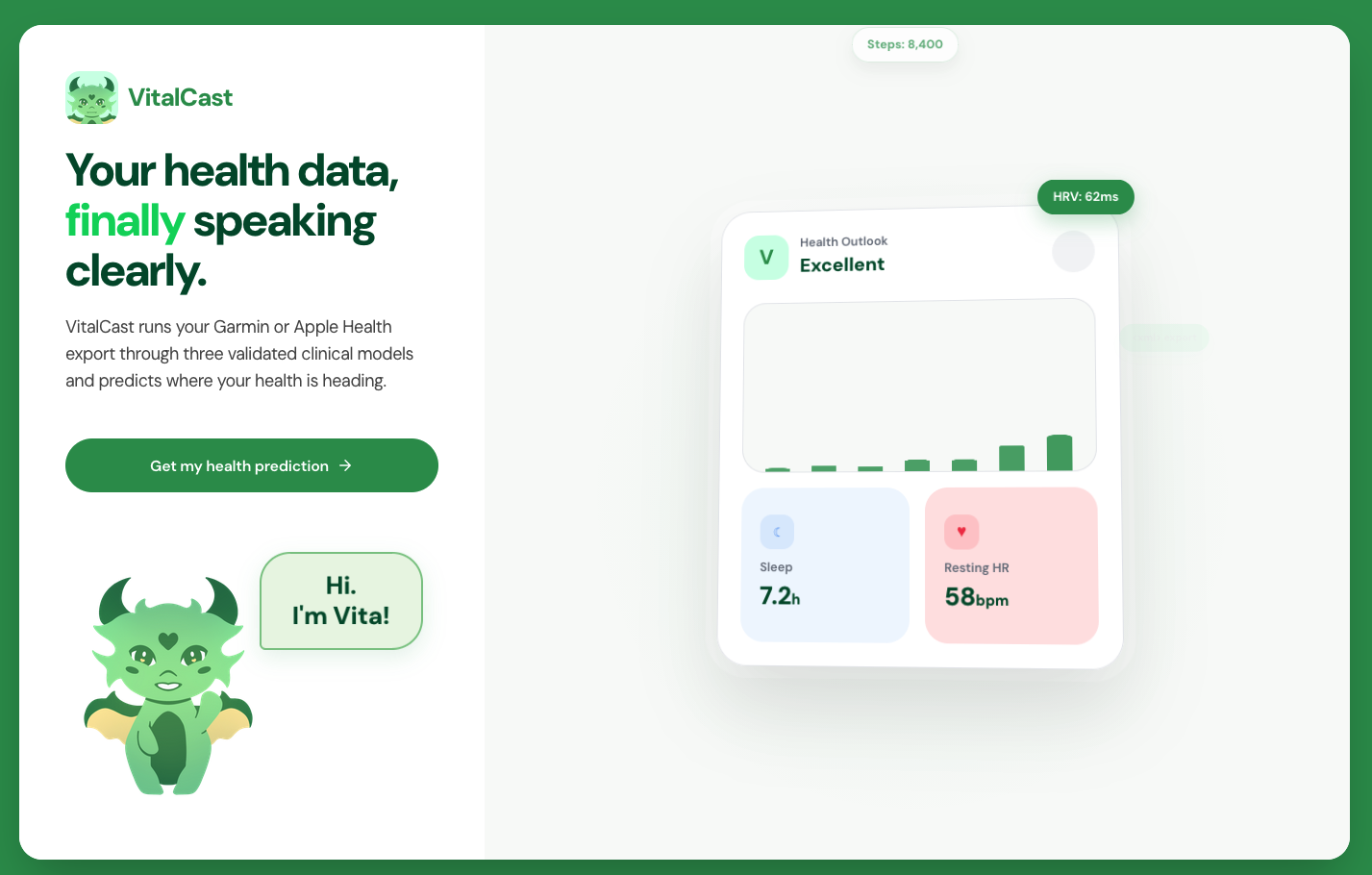
Like most people, we’ve become obsessed with tracking our health. Whether we’re closing rings on Apple Fitness, checking our resting heart rate, or monitoring our sleep stages, we love seeing our data in real time. But we realized a major gap: most health apps show you the "rearview mirror" of what happened, not the "windshield" of where you’re heading. We wanted to turn that passive tracking into proactive forecasting, so we built VitalCast—a clinical health companion that uses real medical models to predict your future health trajectory.
What it does
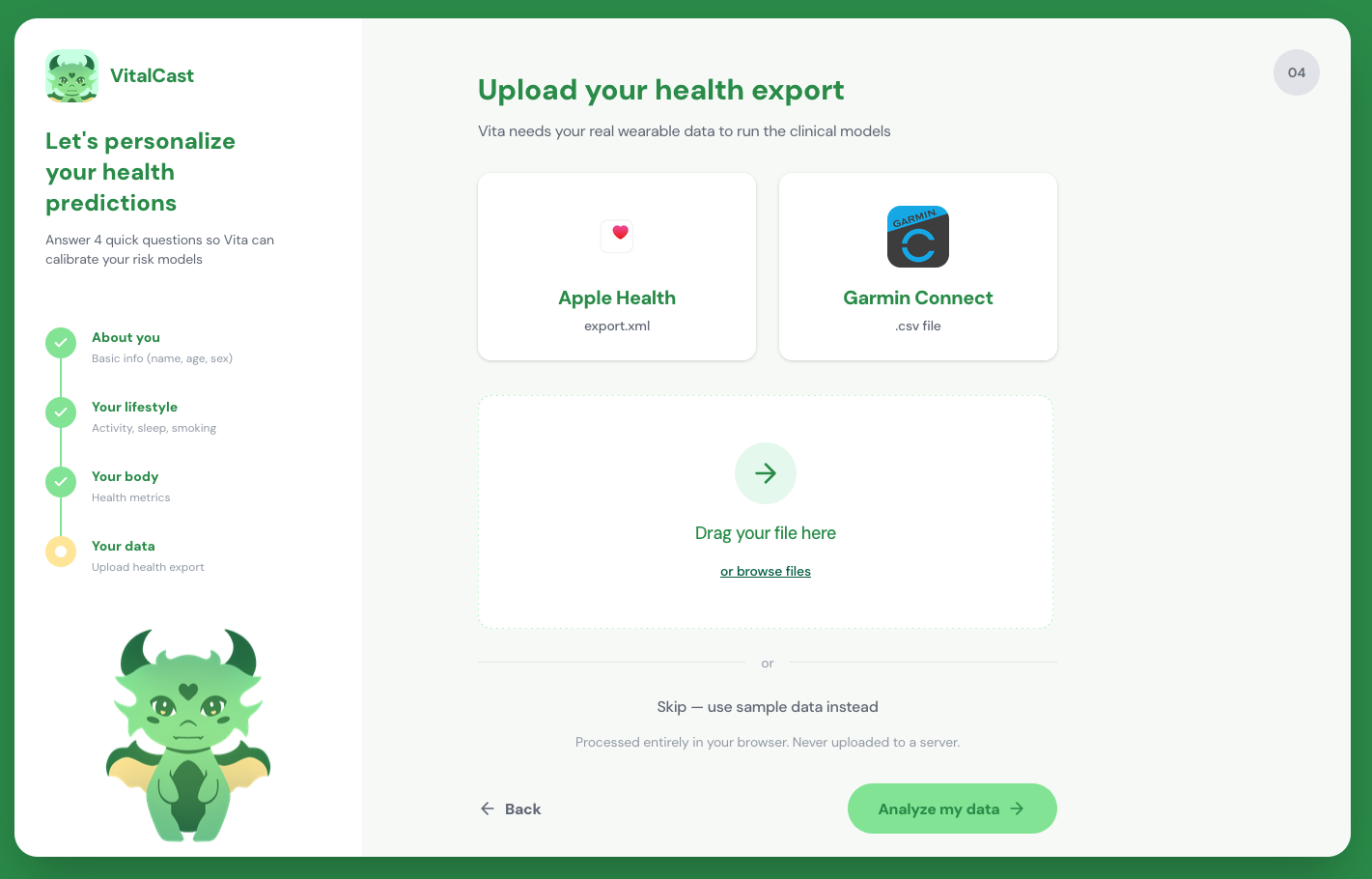
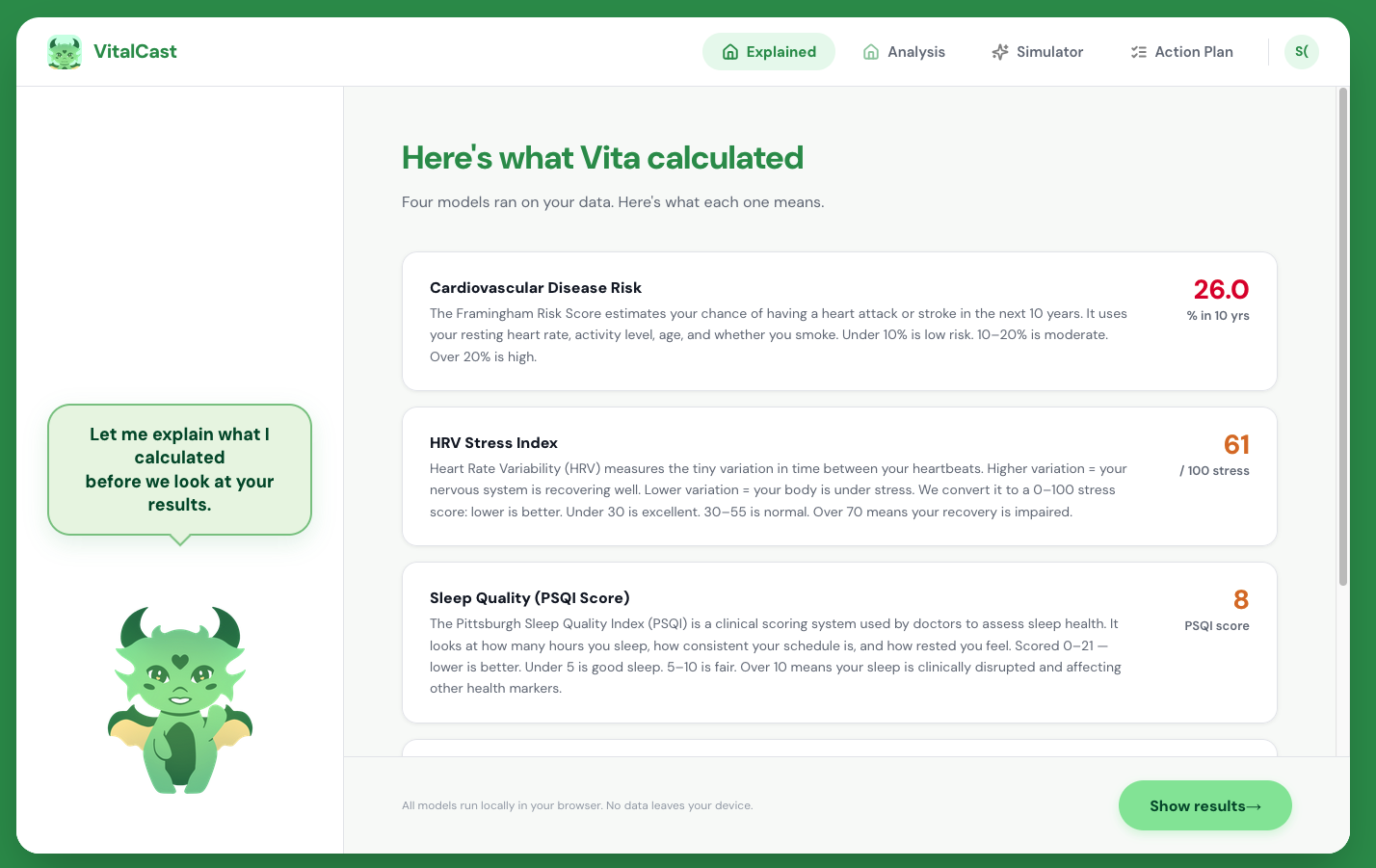
VitalCast is a clinical forecasting platform that transforms years of wearable data into a personalized 30-day health windshield. By analyzing Apple Health and Garmin data, it runs three validated clinical models—Framingham CVD Risk, PSQI Sleep Scoring, and HRV Stress Indexing—to identify high-priority health risks. The core of the experience is our "What If" Simulator, where users can live-adjust their lifestyle habits (like smoking, activity, or sleep) and see exactly how those changes extend their predicted lifespan. It’s about moving beyond simple tracking and giving users the steering wheel to their own longevity.
How we built it
We engineered VitalCast as a high-performance React application using Vite for a lightning-fast development experience. The technical backbone is a custom Regex-based XML stream parser we built from scratch to process 800MB+ Apple Health exports locally in the browser in under 30ms—bypassing the performance bottlenecks of standard DOM parsers. We utilized Web Workers to offload heavy clinical calculations and string manipulation to background threads, ensuring the mascot-driven UI remains buttery smooth. Our architecture is 100% client-side, ensuring total data privacy while delivering deterministic, clinically-backed results.
Challenges we ran into
Our biggest hurdle was browser performance. Handling gigabyte-scale XML files without locking up the main thread or crashing the browser required us to rethink standard data ingestion and move toward high-speed regex scanning. Balancing clinical complexity with approachable UX was also a challenge; we had to ensure that while the math was medically valid (like the Framingham equation), the output felt human and motivating. Fine-tuning the predictive linear projections to account for data gaps in a user's health history required significant logic refinement in our model engine.
Accomplishments that we're proud of
We’re incredibly proud of building a functional, clinical-grade prototype that can handle massive amounts of real-world health data entirely in the browser. Seeing the "What If" simulator come to life—where a simple toggle can show a user exactly how many "Days of Active Life" they can gain—has been incredibly rewarding. We built a technical pipeline that isn't just a wrapper for an LLM; it's a deterministic machine that delivers life-altering insights based on real clinical standards.
What we learned
Throughout this project, we learned the importance of "translational design"—how to take complex medical percentages and turn them into emotional, actionable metrics that people actually care about. We gained deep hands-on experience in high-performance browser engineering, specifically in optimized string parsing and multi-threaded JavaScript. We also saw firsthand how important trust is in health-tech: users and judges engage more when you pull back the curtain and show them the actual clinical logic powering the predictions.
What's next for VitalCast
Our next big step is moving from manual exports to HealthKit Live Sync, bringing real-time data streaming into the forecasting engine. We’re also planning direct EMR (Electronic Medical Record) integration, allowing users to push their simulator results directly to their primary care physician's portal. We are looking to expand our model library to include metabolic forecasting for Type 2 Diabetes (HbA1c) prediction and deeper stress/burnout analytics. VitalCast is just getting started, and we're excited to turn every wearable into a true predictive windshield.
Built With
- css3
- html5
- javascript
- jspdf
- react
- vite

Log in or sign up for Devpost to join the conversation.