-
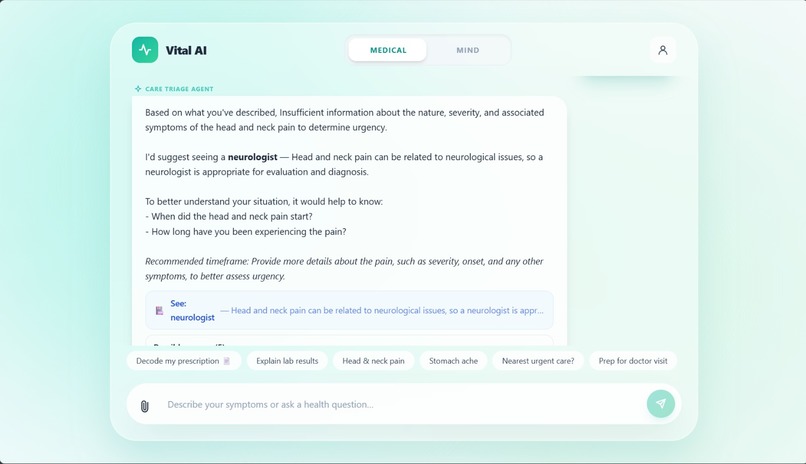
Medical Query
-
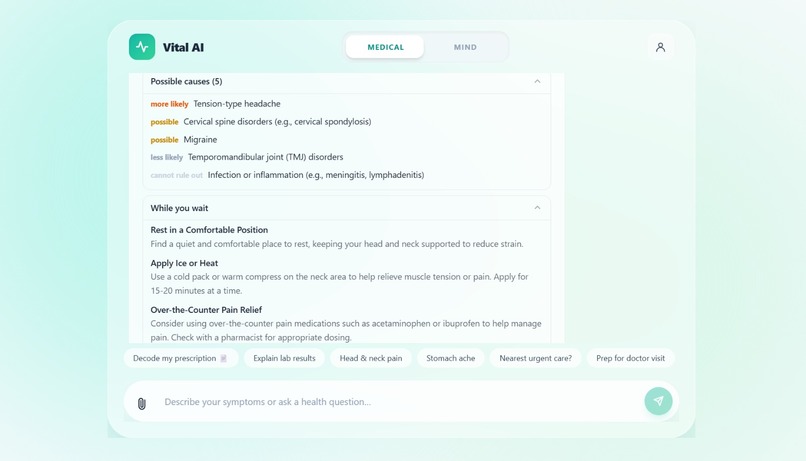
Query Classification
-
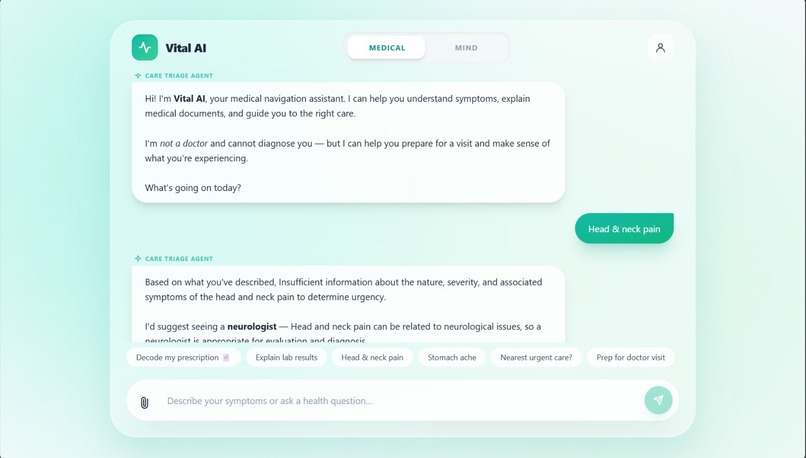
Response
-
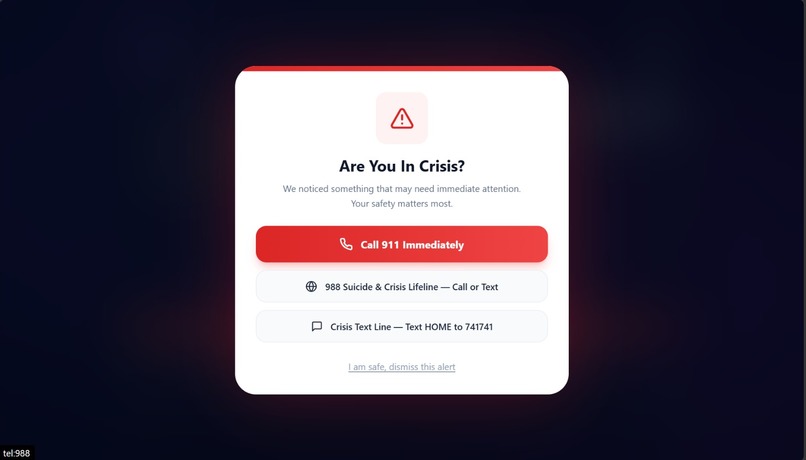
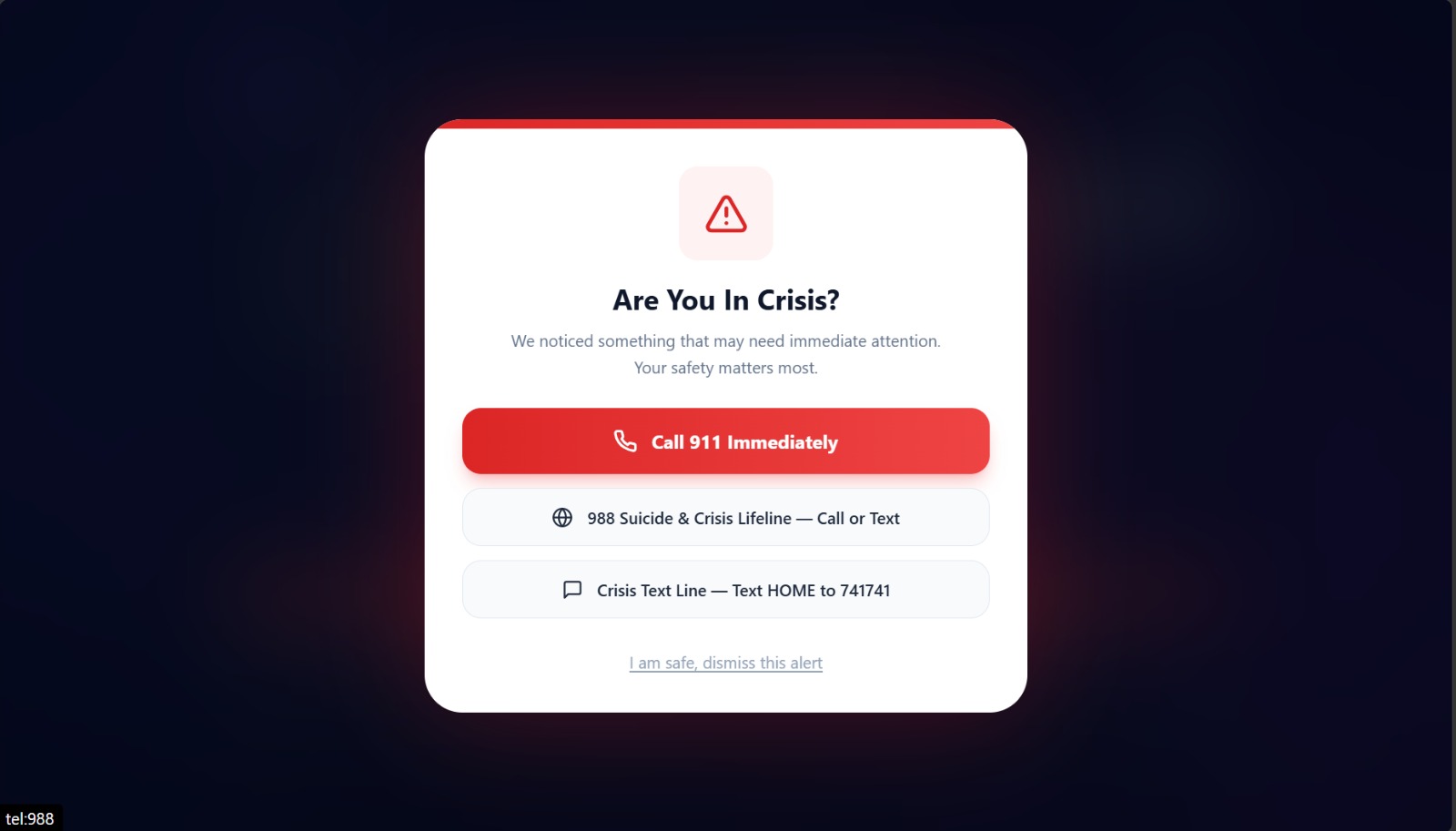
Crisis PopUp
-
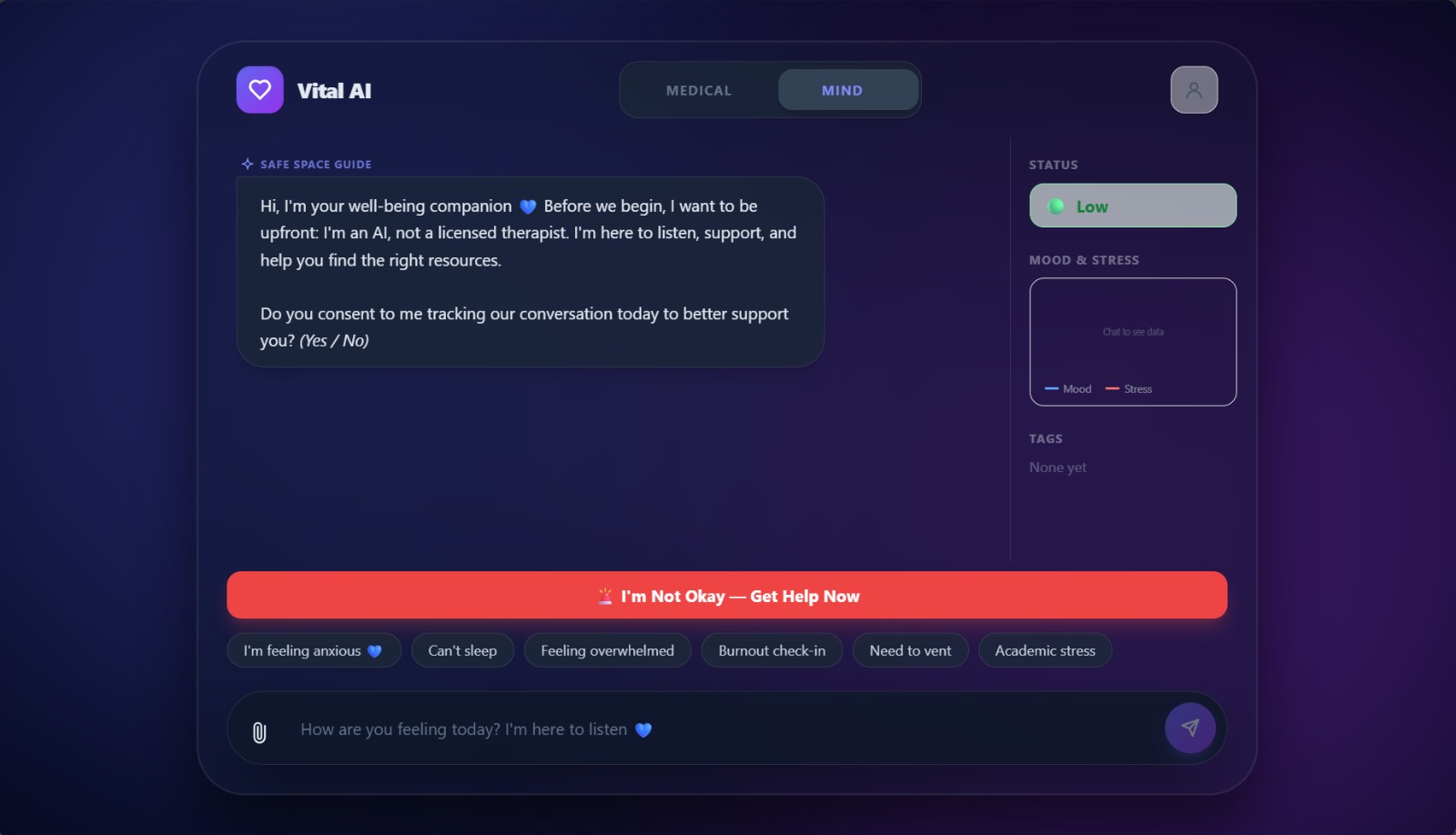
Mental Health
Inspiration
Students skip the doctor not because they don't care about their health — but because the system is terrifying to navigate alone. Decoding a lab result, figuring out if a symptom is serious, understanding what your insurance actually covers, finding a doctor nearby — every one of those steps is a barrier. For first-generation students especially, there's no family playbook for this. We built Vital AI because every student deserves the knowledgeable friend that most of them never had.
What it does
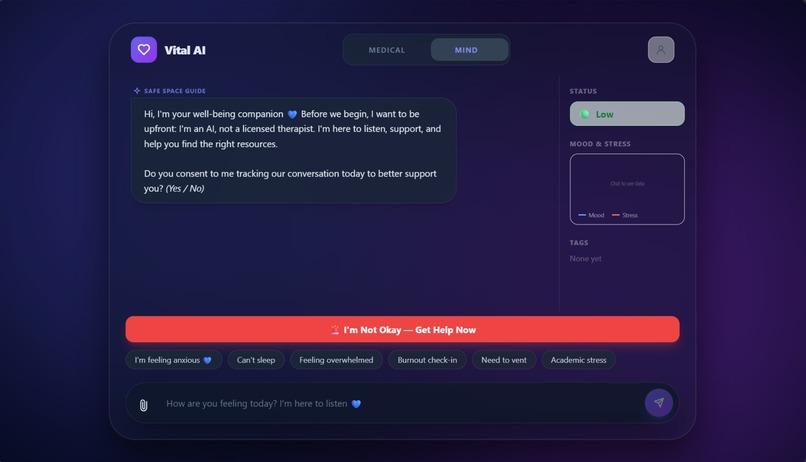
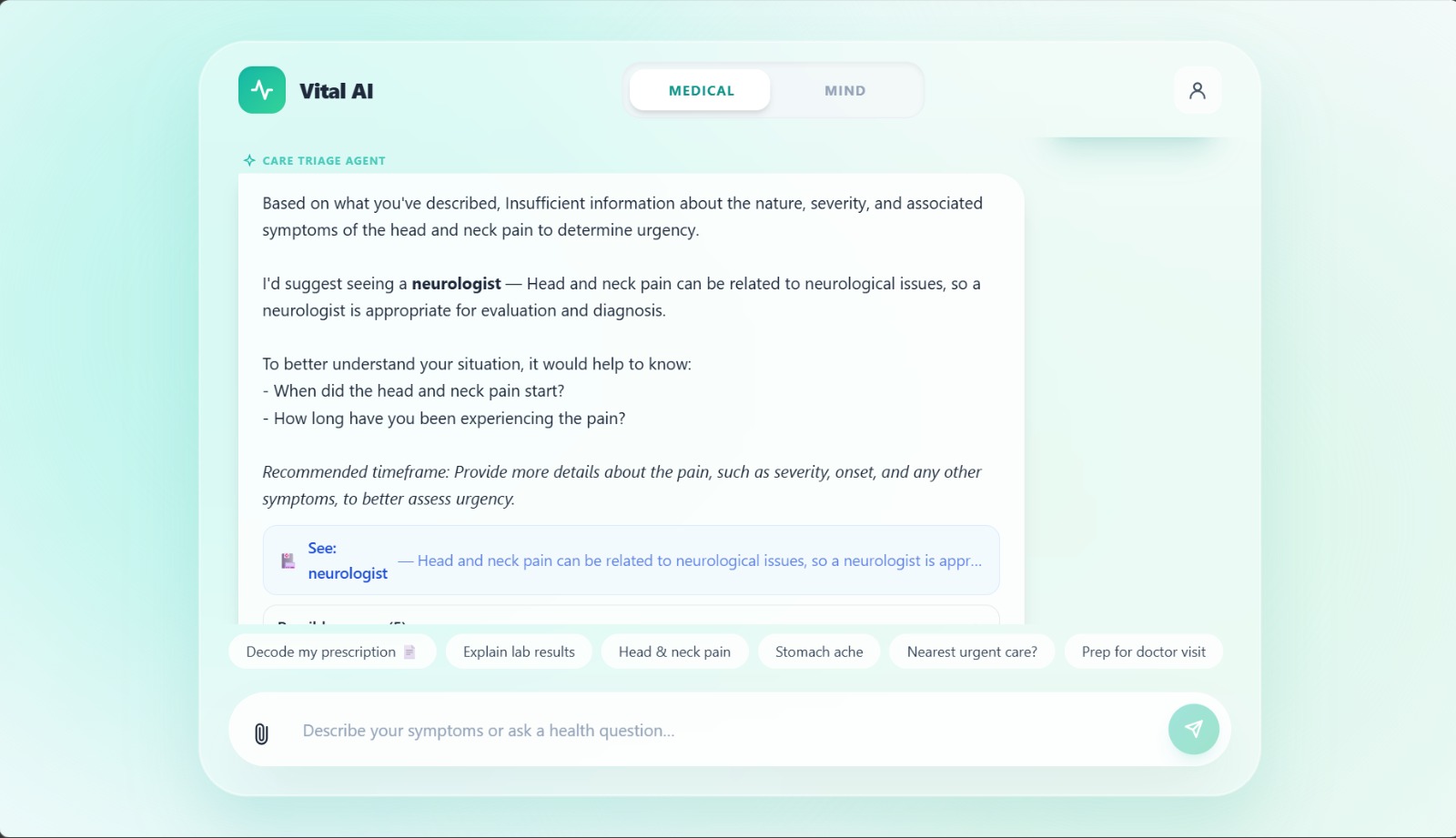
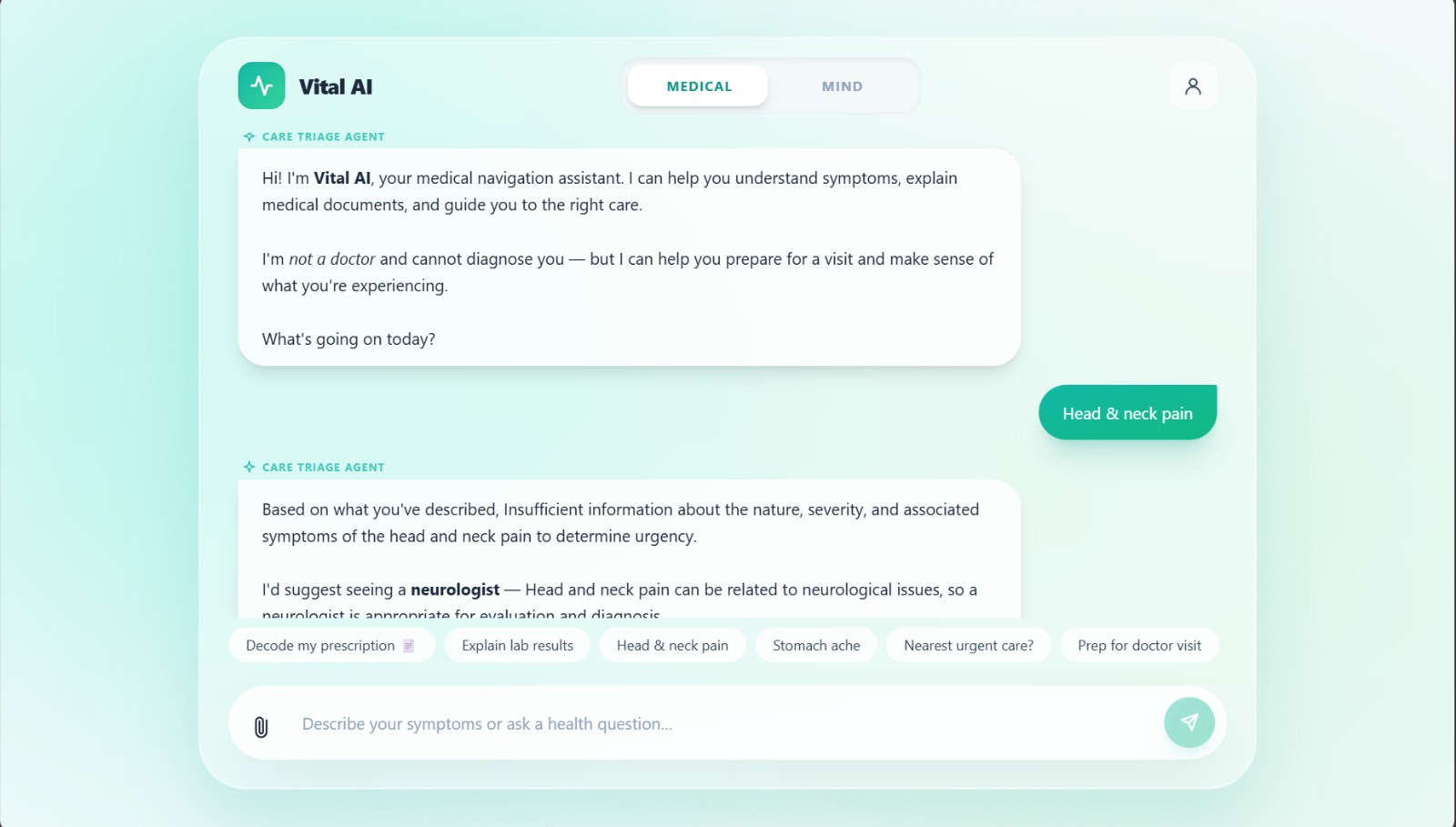
Vital AI is a dual-agent AI health companion built for college students. The Diagnosis Agent takes your symptoms, uploaded prescriptions, or confusing lab results and turns them into something actionable — it classifies urgency, explains medical jargon in plain English, suggests what type of doctor to see, finds covered providers near you, and generates a ready-to-hand doctor visit summary so you walk in prepared. The Wellbeing Agent tracks your emotional health across sessions, detects burnout and crisis signals early, and when things get serious, both agents work together — surfacing a 1-page PDF summary and the nearest mental health providers covered under your insurance in a single tap.
How we built it
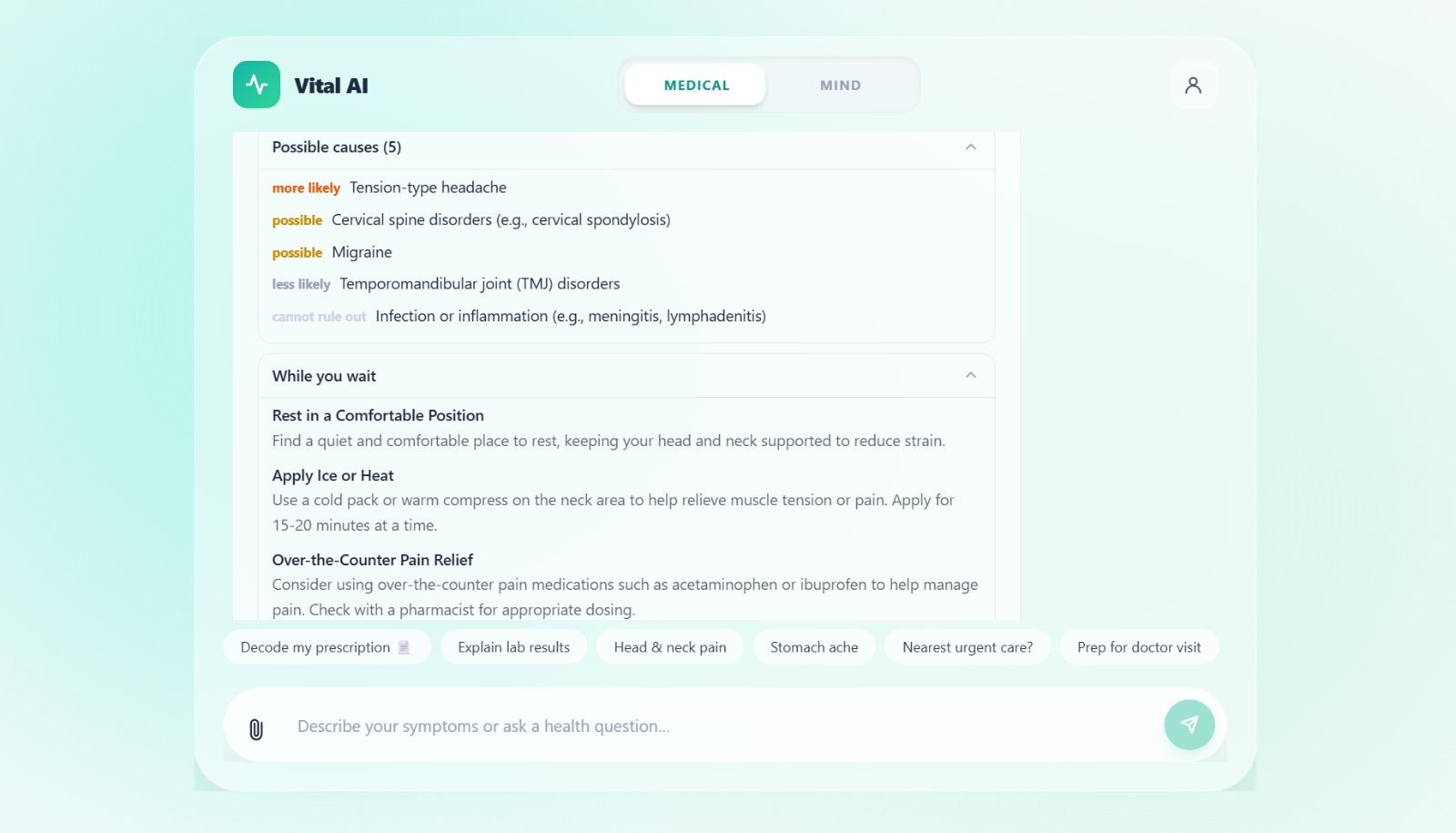
We built a Python + FastAPI backend using a skill-based agent architecture — one central DiagnosisChatAgent that dynamically loads only the skills it needs based on detected user intent. Skills include symptom consultation, urgency classification, possible causes (with likelihood tiers, never diagnoses), temporary mitigation, provider type recommendation, care locator, and doctor visit prep. Medical safety guardrails run on every response before it reaches the user. Documents are parsed via pdfplumber and pytesseract, with ChromaDB/FAISS powering RAG over trusted medical sources like MedlinePlus, CDC, and NIH. The frontend features a live mood graph, severity badge, and smart tag panel all driven by structured JSON the agents return on every message.
Challenges we ran into
The hardest problem was drawing the line between being genuinely helpful and being dangerously overconfident. Healthcare AI fails when it sounds too certain — so we spent significant time designing a response schema that uses likelihood tiers (more_likely, possible, less_likely, cannot_rule_out) instead of diagnoses, and building safety guardrails that override any response when emergency red flags are detected. Getting the cross-agent escalation handoff to work cleanly — passing a structured session summary from the Wellbeing Agent to the Diagnosis Agent to find real covered providers — was the other major technical challenge we had to solve under time pressure.
Accomplishments that we're proud of
The safety guardrail system is something we're genuinely proud of — it's not bolted on, it's baked into the core response pipeline. We're also proud of the cross-agent escalation flow: the moment a student hits the "I'm Not Okay" button, the system generates a human-readable 1-page PDF of their session, finds nearby covered providers, and stays present in the conversation — it never just abandons the user after a crisis trigger. Building a full skill-based agentic backend with 9 modular skills, proper Pydantic schemas, database models, and test coverage in under 45 minutes felt impossible until it wasn't.
What we learned
We learned that the hardest part of building health tech isn't the AI — it's the responsibility. Every design decision had an ethical dimension: what language do we use, when do we escalate, what do we never claim? We also learned that a skill-based architecture is dramatically more maintainable than monolithic agents — being able to isolate, test, and swap individual skills without touching the core agent made iteration fast and safe. And we learned that the most impactful feature isn't always the most complex one — the panic button that hands a student a PDF and a phone number might be the simplest thing we built and the most important.
What's next for Vital AI
Real insurance plan integration — so provider recommendations are genuinely filtered by what a student's plan covers, not just proximity. A fully implemented Wellbeing Agent with persistent cross-session memory so it actually knows your history. Native campus integration with UMD's TimelyCare, Counseling Center, and CARE Team APIs. Expansion to other universities with localized resource banks. And eventually, a HIPAA-aligned data layer so students can optionally build a longitudinal health record they own and control — and bring to every doctor they ever see.

Log in or sign up for Devpost to join the conversation.