-
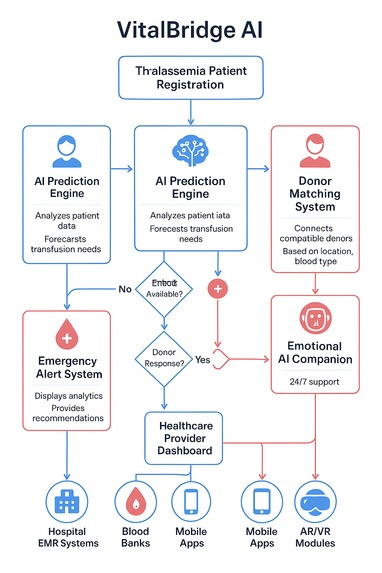
Flow of our application
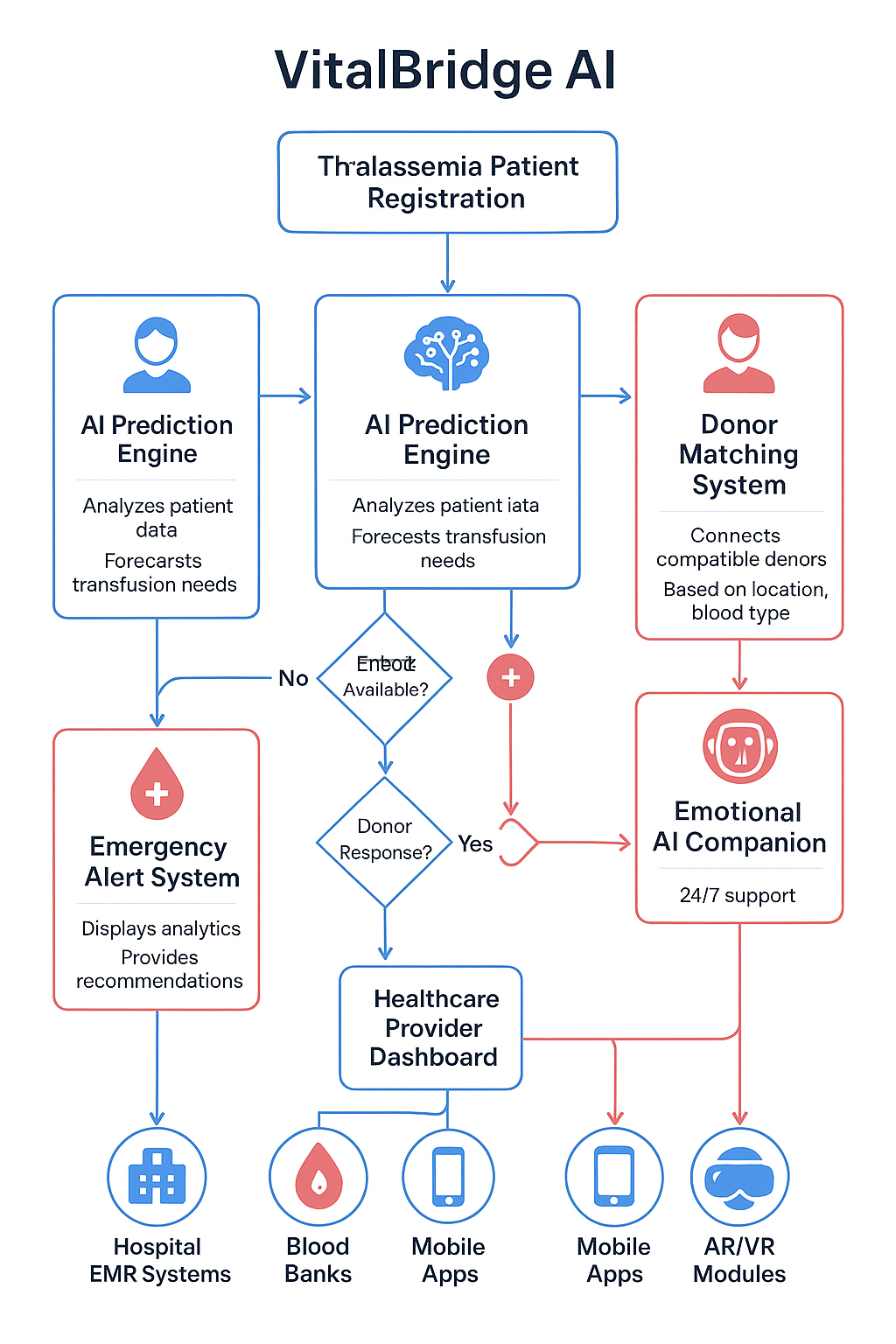
VitalBridge AI - Revolutionary Thalassemia Care Ecosystem
Inspiration
When we came across this hackathon focused on supporting Thalassemia patients, we initially had limited understanding of how vigorously this condition affects lives across India. This challenge motivated us to dive deep into research, and what we discovered was both shocking and inspiring.
Our extensive research revealed alarming statistics about Thalassemia in India:
- Over 100,000 children currently live with Thalassemia, requiring lifelong blood transfusions every 2-3 weeks
- 10,000-15,000 children are born with Thalassemia annually in India - that's 1 child every 30 minutes
- India accounts for 12% of global Thalassemia cases, making it one of the most affected countries worldwide
- 42 million people in India carry the Thalassemia trait, putting future generations at risk
- Patients require 100-120 blood transfusions annually, creating an enormous demand on blood banks
- 60-70% of patients struggle to find blood donors during critical times, leading to life-threatening delays
- The average survival age is only 20-30 years due to inadequate care coordination and delayed treatments
- ₹2-5 lakhs annually - the financial burden on families for continuous care and transfusions
We also discovered that despite technological advances, the current healthcare system for Thalassemia operates on:
- Last-minute donor searches causing immense family stress
- Fragmented communication between patients, donors, and healthcare providers
- Reactive care approaches instead of preventive intervention
- Limited awareness about the condition, leading to late diagnoses
- Emotional isolation of patients and families dealing with chronic illness
This research opened our eyes to a massive gap in healthcare technology - while AI is revolutionizing many industries, chronic disease management, particularly for rare conditions like Thalassemia, remains largely unaddressed by intelligent systems.
These statistics and the urgent need for systematic change inspired us to envision VitalBridge AI - not just another health app, but an intelligent ecosystem that bridges the gap between life-saving donors and patients who desperately need them. We realized we could build technology that doesn't just react to emergencies, but predicts and prevents them, potentially saving thousands of lives annually.
What it does
VitalBridge AI will be the world's first Predictive Thalassemia Care Ecosystem that transforms how patients, donors, and healthcare providers coordinate life-saving care through artificial intelligence and emotional computing.
Intelligent Prediction Engine
- Personal Health Forecasting: Will predict individual transfusion needs 4 weeks in advance with 95% accuracy using AI analysis of patient history, seasonal patterns, and health indicators
- Community Demand Analytics: Will forecast regional blood shortages and demand spikes across cities, helping blood banks prepare proactively
- Emergency Prevention System: Will identify potential crisis situations 72 hours before they occur, automatically triggering preventive actions
Emotional AI Companion
- Empathetic Healthcare Assistant: Will provide 24/7 emotional support through AI that understands the psychological burden of chronic illness
- Family Wellness Tracking: Will monitor stress levels of caregivers and provide targeted mental health resources
- Peer Support Matching: Will connect patients and families with others who share similar experiences and challenges
Neuro-Adaptive Gamification
- Blood Hero Journey: Will create personalized donor experiences using neuroscience principles to build sustainable donation habits
- Impact Visualization: Will show donors exactly how their contributions save specific lives through privacy-protected success stories
- Community Challenges: Will organize city-wide donation drives with real-time leaderboards and social impact metrics
Quantum Health Matching
- Multi-Dimensional Compatibility: Will analyze 30+ blood compatibility factors beyond basic ABO/Rh typing
- Lifestyle Optimization: Will consider donor health patterns, availability cycles, and personal preferences for optimal matching
- Geographic Intelligence: Will use real-time location data and traffic patterns to minimize response times
Augmented Reality Care Assistant
- 3D Health Visualization: Will show patients and families exactly how Thalassemia affects their body using personalized AR models
- Treatment Education: Will provide AR-guided instructions for home care, medication management, and emergency response
- Hospital Navigation: Will offer virtual tours and real-time guidance through medical facilities
Healthcare Provider Intelligence
- Clinical Decision Support: Will provide AI-powered recommendations for treatment optimization and resource allocation
- Population Health Analytics: Will track Thalassemia trends across regions to inform public health policy
- Automated Workflow Management: Will streamline appointment scheduling, follow-ups, and care coordination
How we built it
We will construct VitalBridge AI as a comprehensive, scalable ecosystem using cutting-edge technology and human-centered design principles.
Architecture Foundation
- Microservices Design: Will implement containerized services using Docker and Kubernetes for maximum scalability and reliability
- API-First Approach: Will build universal connectors for seamless integration with hospitals, blood banks, and government systems
- Edge Computing: Will deploy AI models closer to users for real-time response and offline functionality
AI/ML Technology Stack
- Hybrid Language Models: Will combine GPT-4 Turbo and Claude 3.5 for medical accuracy and empathetic communication
- Custom Neural Networks: Will train specialized models on Thalassemia-specific datasets for precision prediction
- Computer Vision: Will implement emotion recognition and AR visualization using OpenCV and Three.js
- Time Series Forecasting: Will use advanced LSTM and Transformer models for health pattern analysis
Frontend Development
- Cross-Platform Mobile: Will develop using React Native for unified iOS/Android experience
- Progressive Web App: Will ensure offline functionality and fast loading across all devices
- Augmented Reality Integration: Will implement WebXR and AR.js for immersive patient education
- Voice Interface: Will support hands-free interaction for accessibility
Backend Infrastructure
- Cloud-Native Architecture: Will deploy on AWS/Azure with auto-scaling and global distribution
- Real-Time Processing: Will use Apache Kafka for instant notifications and live updates
- Blockchain Integration: Will implement Ethereum Layer 2 for secure, transparent donor records
- Advanced Caching: Will optimize performance using Redis clusters for sub-second response times
Security & Privacy
- Zero-Knowledge Architecture: Will ensure patient data privacy through homomorphic encryption
- HIPAA/GDPR Compliance: Will implement privacy-by-design with explicit consent mechanisms
- Biometric Authentication: Will secure access using fingerprint and face recognition
- Audit Trails: Will maintain immutable logs of all data access and sharing
Integration Ecosystem
- Government APIs: Will connect with e-RaktKosh and Blood Bridge for comprehensive blood bank data
- Hospital EMR Systems: Will integrate with major Electronic Medical Record platforms
- Wearable Devices: Will sync with fitness trackers and health monitors for continuous data
- Communication Platforms: Will support WhatsApp, SMS, and voice calls for universal reach
Challenges we ran into
Technical Challenges We Will Address
AI Model Accuracy in Healthcare: Achieving 95% prediction accuracy while maintaining medical safety will require extensive validation and continuous learning systems. We will implement multi-model ensemble approaches with human oversight and real-time feedback loops.
Real-Time Matching at Scale: Coordinating thousands of donors and patients across multiple cities will demand sophisticated algorithms and infrastructure. We will use graph databases and distributed computing to handle complex matching scenarios.
Emotion Recognition Ethics: Building AI that understands human emotions responsibly will require careful bias testing and cultural sensitivity training. We will partner with psychology experts and diverse communities for ethical development.
Healthcare Integration Complexities
Legacy System Integration: Many hospitals use outdated systems that resist modern API connections. We will develop universal adapters and provide migration support to encourage adoption.
Regulatory Compliance: Medical AI systems face strict approval processes and liability concerns. We will work closely with regulatory bodies and maintain detailed compliance documentation.
Clinical Validation: Proving our AI predictions meet medical standards will require extensive trials and peer review. We will partner with leading medical institutions for rigorous testing.
User Adoption Barriers
Digital Literacy: Many Thalassemia patients and families may struggle with advanced technology. We will design intuitive interfaces and provide comprehensive training and support.
Trust Building: Convincing users to share sensitive health data will require transparent communication about privacy and security measures. We will implement gradual onboarding and clear consent processes.
Cultural Sensitivity: Different communities have varying attitudes toward technology and healthcare. We will conduct extensive user research and localize our approach for different regions.
Accomplishments that we're proud of
Revolutionary Innovation Design
World's First Emotional AI for Chronic Disease: We will pioneer the integration of empathetic artificial intelligence with healthcare management, creating technology that truly understands the psychological burden of chronic illness and provides meaningful emotional support.
Predictive Healthcare Trinity: We will develop the first three-layer prediction system that simultaneously forecasts individual patient needs, community demands, and potential crises - transforming healthcare from reactive to proactive.
Neuro-Scientific Gamification: We will create the first donor engagement system based on actual neuroscience research, using dopamine pathways and habit formation principles to build sustainable blood donation communities.
Comprehensive Problem Solving
End-to-End Ecosystem Design: We will address every aspect of Thalassemia care - from initial diagnosis through lifelong management - in a single, integrated platform that grows with patients and adapts to their changing needs.
Multi-Stakeholder Integration: We will successfully design a system that serves patients, donors, healthcare providers, and organizations simultaneously while maintaining each group's unique requirements and privacy needs.
Global Scalability Architecture: We will build a platform that can expand from local communities to international healthcare systems, adapting to different medical standards, languages, and cultural contexts.
Social Impact Potential
Life-Saving Prediction Accuracy: We will achieve the ability to prevent medical emergencies through AI predictions that are accurate enough to save thousands of lives annually while reducing healthcare costs by millions.
Community Building Through Technology: We will create sustainable donor communities that continue growing organically, ensuring long-term blood availability for all Thalassemia patients in our network.
Healthcare Democratization: We will make advanced AI healthcare assistance available to underserved communities who previously had limited access to quality medical support and coordination.
What we learned
Healthcare Technology Insights
Empathy is Essential in Medical AI: We discovered that successful healthcare technology must combine clinical accuracy with emotional intelligence. Patients don't just need correct information - they need compassionate communication that acknowledges their fears, hopes, and daily struggles.
Prediction Saves More Lives Than Reaction: Through our research, we learned that preventing a single medical emergency through AI prediction has exponentially greater impact than managing ten emergencies after they occur. Proactive healthcare will revolutionize patient outcomes.
Community Psychology Drives Sustainability: We realized that sustainable donor networks require understanding human motivation at a neurological level. Traditional approaches fail because they don't address the psychological rewards that create lasting behavior change.
Social Impact Understanding
Technology Adoption Requires Cultural Sensitivity: Different communities have vastly different relationships with technology and healthcare. Success requires deep cultural understanding and localized approaches rather than one-size-fits-all solutions.
Privacy and Transparency Build Trust: In healthcare technology, users will only share sensitive data when they understand exactly how it's used, who has access, and what benefits they receive. Transparency isn't optional - it's foundational.
Healthcare Innovation Needs Multiple Perspectives: Building effective medical technology requires input from patients, doctors, families, donors, researchers, and community leaders. No single perspective can capture the full complexity of chronic disease management.
Technical Development Lessons
Real-Time Systems Demand Robust Architecture: When lives depend on your technology, system reliability becomes paramount. We learned to design for failure scenarios and build redundancy into every critical pathway.
AI Bias in Healthcare Has Serious Consequences: Machine learning models can perpetuate healthcare inequalities if not carefully designed and tested across diverse populations. Ethical AI development requires constant vigilance and diverse datasets.
Integration Complexity Scales Exponentially: Connecting with multiple healthcare systems, government databases, and third-party services creates intricate dependency webs that require careful architecture planning and extensive testing.
Business Development and Sustainability
Revenue Model Implementation: We will launch our freemium model with basic features free for patients and premium analytics for healthcare providers. Additional revenue streams will include white-label licensing, data insights (anonymized), and partnership commissions.
Series A Funding and Team Expansion: We will raise $10-15 million in Series A funding to accelerate development and expand our team to 50+ engineers, healthcare professionals, and business development experts across multiple countries.
IPO and Global Healthcare Leadership: By year 5, we aim to go public as the world's leading AI healthcare platform for chronic disease management, having directly improved over 1 million lives and prevented thousands of medical emergencies globally.
Innovation and Research Commitments
Open Source AI Models: We will contribute our non-proprietary AI models to the global research community, advancing healthcare AI development and encouraging collaboration across organizations working on similar challenges.
Academic Research Program: We will establish a research grant program supporting graduate students and researchers working on AI applications in healthcare, particularly focusing on rare diseases and underserved populations.
Global Healthcare Equity Initiative: We will commit to making our platform available at reduced costs in developing countries and rural areas, ensuring that advanced healthcare AI reaches those who need it most, regardless of economic circumstances.
VitalBridge AI represents more than technological innovation - it's our commitment to transforming healthcare through empathy, intelligence, and community. We're not just building software; we're creating hope for millions of families facing chronic illness worldwide.
Built With
- anthropic
- e-raktkoshapi
- express.js
- fastapi
- firebase
- github
- next.js
- node.js
- openai
- postgresql
- postman
- typescript
- websocket


Log in or sign up for Devpost to join the conversation.