Inspiration
Access to timely healthcare remains a global challenge. Many people delay seeking medical attention due to lack of access, cost, or uncertainty about symptoms.
We asked a simple question:
What if anyone could get instant health insights using just their phone?
Vital Scan was inspired by the need to bridge the gap between symptom awareness and medical action, aligning with UN SDG 3: Good Health and Well-being.
What it does
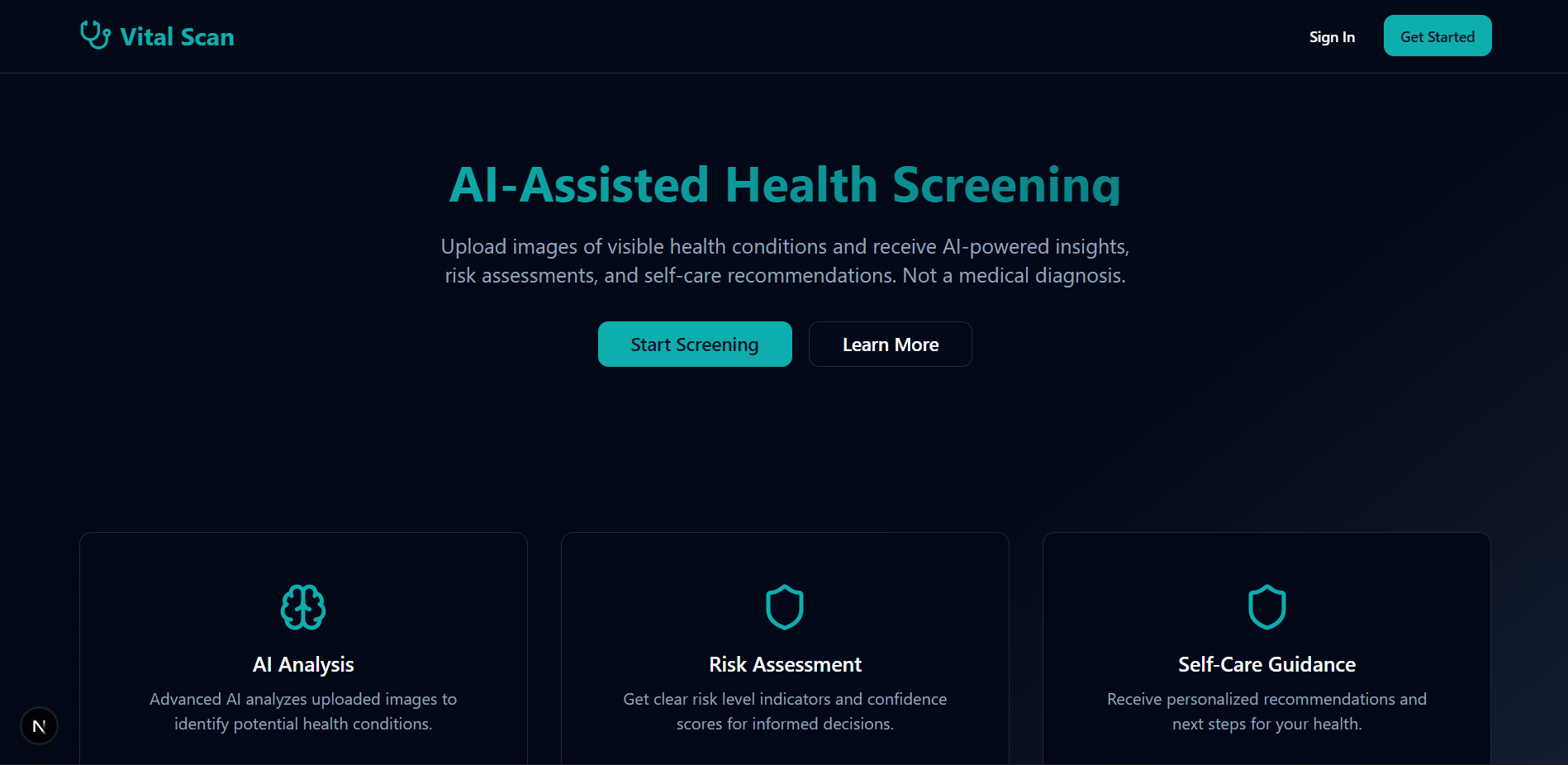
Vital Scan is an AI-powered health screening and assistant platform that enables users to:
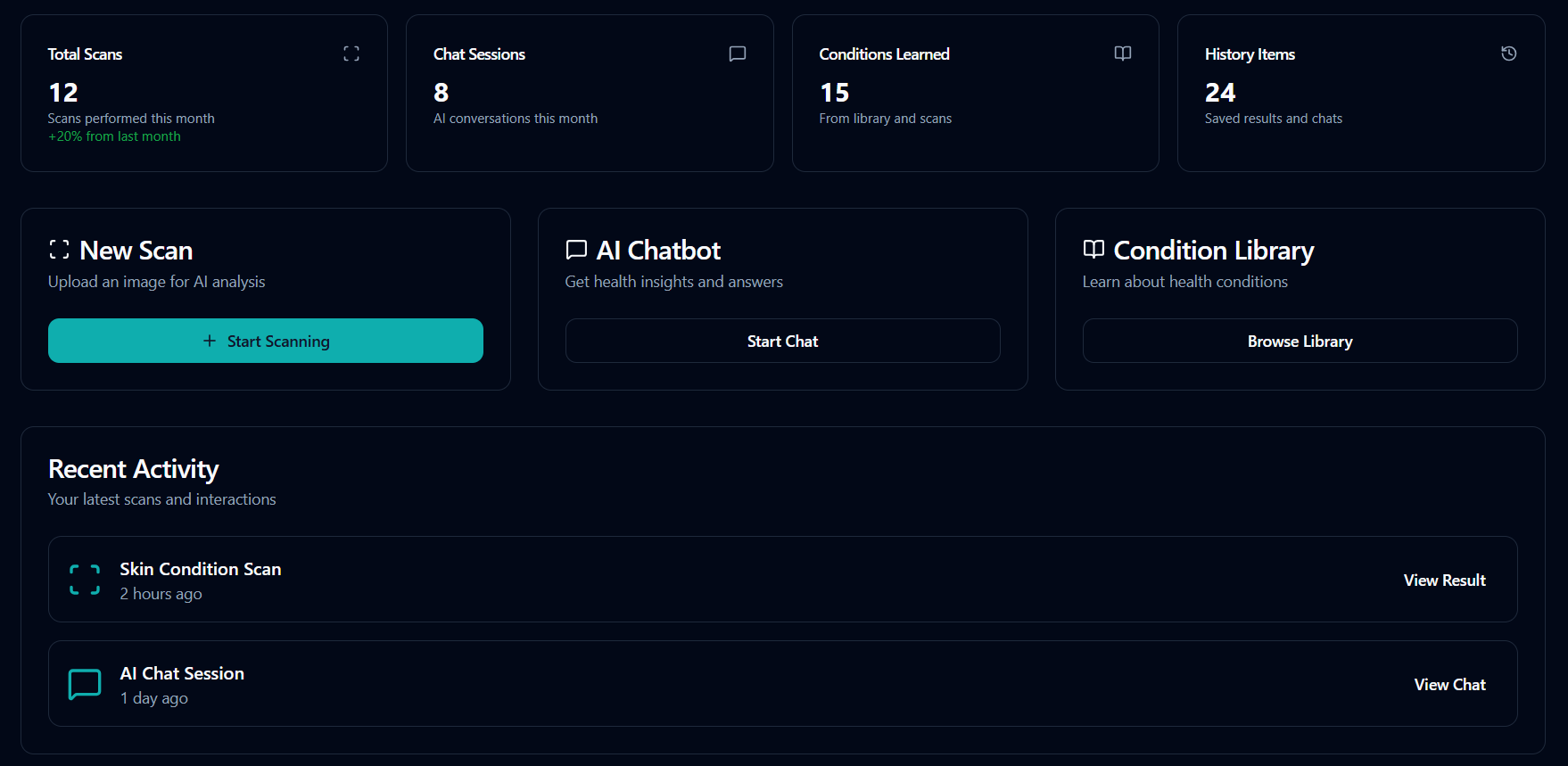
- Capture or upload images of visible health concerns
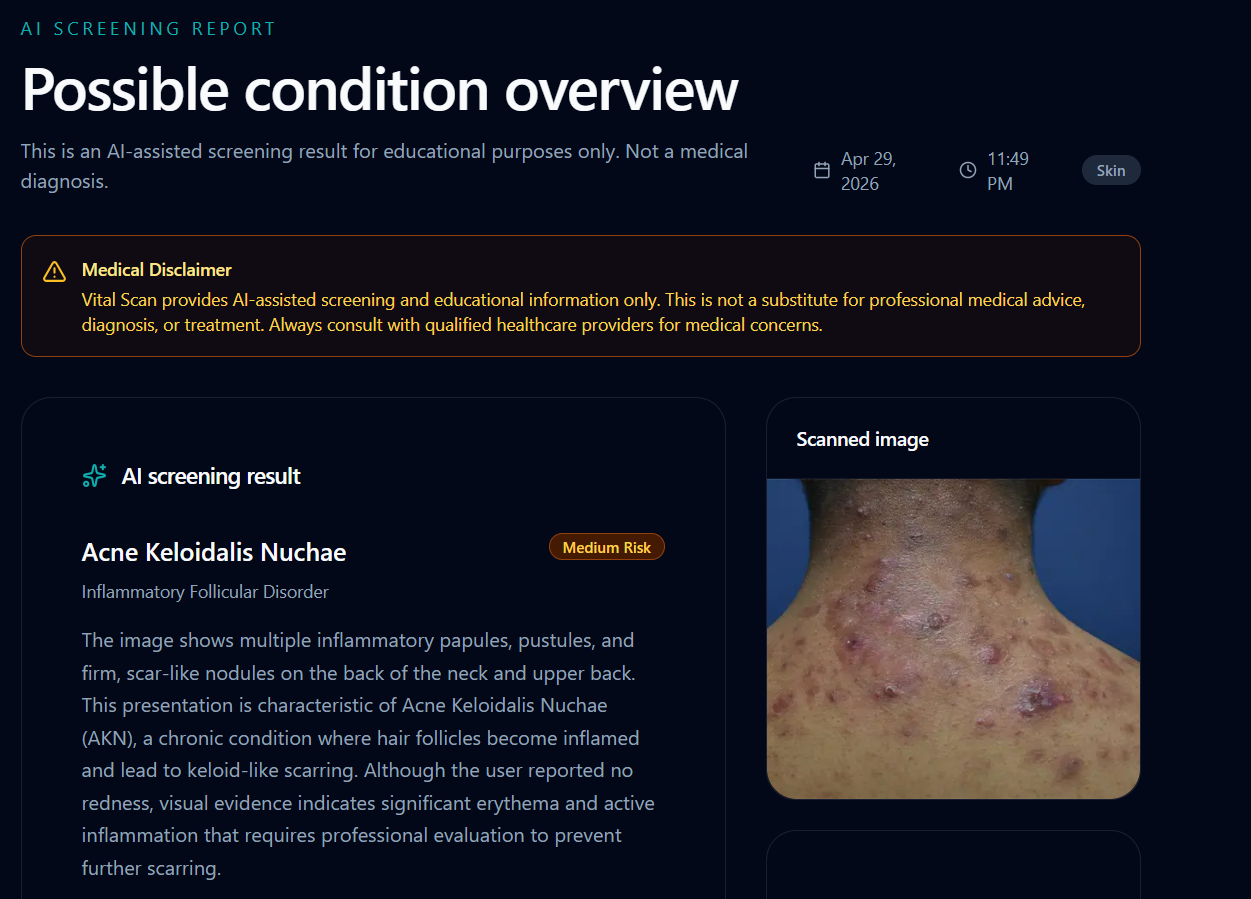
- Receive instant AI-powered analysis
- View structured insights including condition, confidence, and risk level
- Get recommended next steps and self-care guidance
- Ask follow-up questions through an AI chatbot
- Use voice input (speech-to-text) and listen to responses (text-to-speech)
- Access personal screening history
The system combines multiple AI outputs to improve reliability:
$$ \hat{y} = \arg\max_c (\alpha \cdot P_{model}(c|x) + (1 - \alpha) \cdot P_{fallback}(c|x)) $$
How we built it
We built Vital Scan using a modern full-stack architecture:
- Frontend: Next.js (App Router), TypeScript, Tailwind CSS
- Backend: Supabase (PostgreSQL, Auth, Storage, Edge Functions)
- AI: Google Gemini API (Vision + Chat)
- Client AI fallback: ONNX Runtime Web
- State Management: Zustand
- Voice Features: Web Speech API
- Deployment: Vercel
Workflow
- User uploads or captures an image
- Image is stored securely in cloud storage
- AI analyzes the image and returns structured data
- Results are validated and saved in the database
- UI displays insights and enables further interaction via chatbot
Challenges we ran into
- Handling inconsistent AI responses that were not always valid JSON
- Managing API reliability issues and implementing fallback logic
- Designing database schemas that enforce strict validation
- Keeping UI state synchronized across scans, chatbot, and history
- Implementing speech features without causing performance issues
Accomplishments that we're proud of
- Built a complete AI-powered health scanning system
- Successfully integrated image analysis, chatbot, and voice interaction
- Designed a scalable and structured backend system
- Achieved real-time result processing and display
- Created an intuitive and accessible user experience
What we learned
- How to handle and validate unpredictable AI outputs
- The importance of strong database constraints and schema design
- Building resilient systems with fallback mechanisms
- Designing user-friendly interfaces for complex AI systems
- Applying AI to real-world health challenges with meaningful impact
What's next for Vital Scan
- Add multilingual support for global accessibility
- Integrate wearable health data for deeper insights
- Expand to more medical conditions and use cases
- Connect with telemedicine platforms
- Introduce predictive analytics for early risk detection
Our long-term goal is to evolve Vital Scan into a continuous health intelligence platform.
Built With
- auth
- edge-functions)
- google-gemini-api
- next.js
- onnx-runtime-web
- recharts
- redux
- storage
- supabase-(postgresql
- tailwind-css
- typescript
- vercel
- web-speech-api
- zustand


Log in or sign up for Devpost to join the conversation.