-
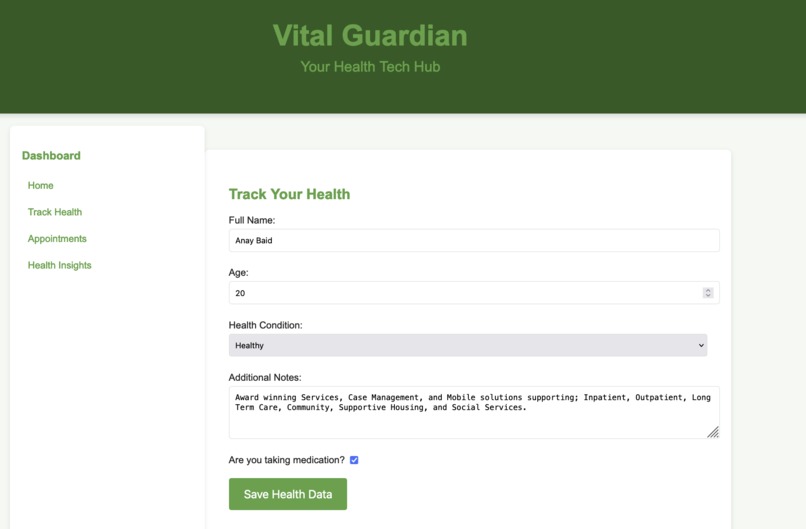
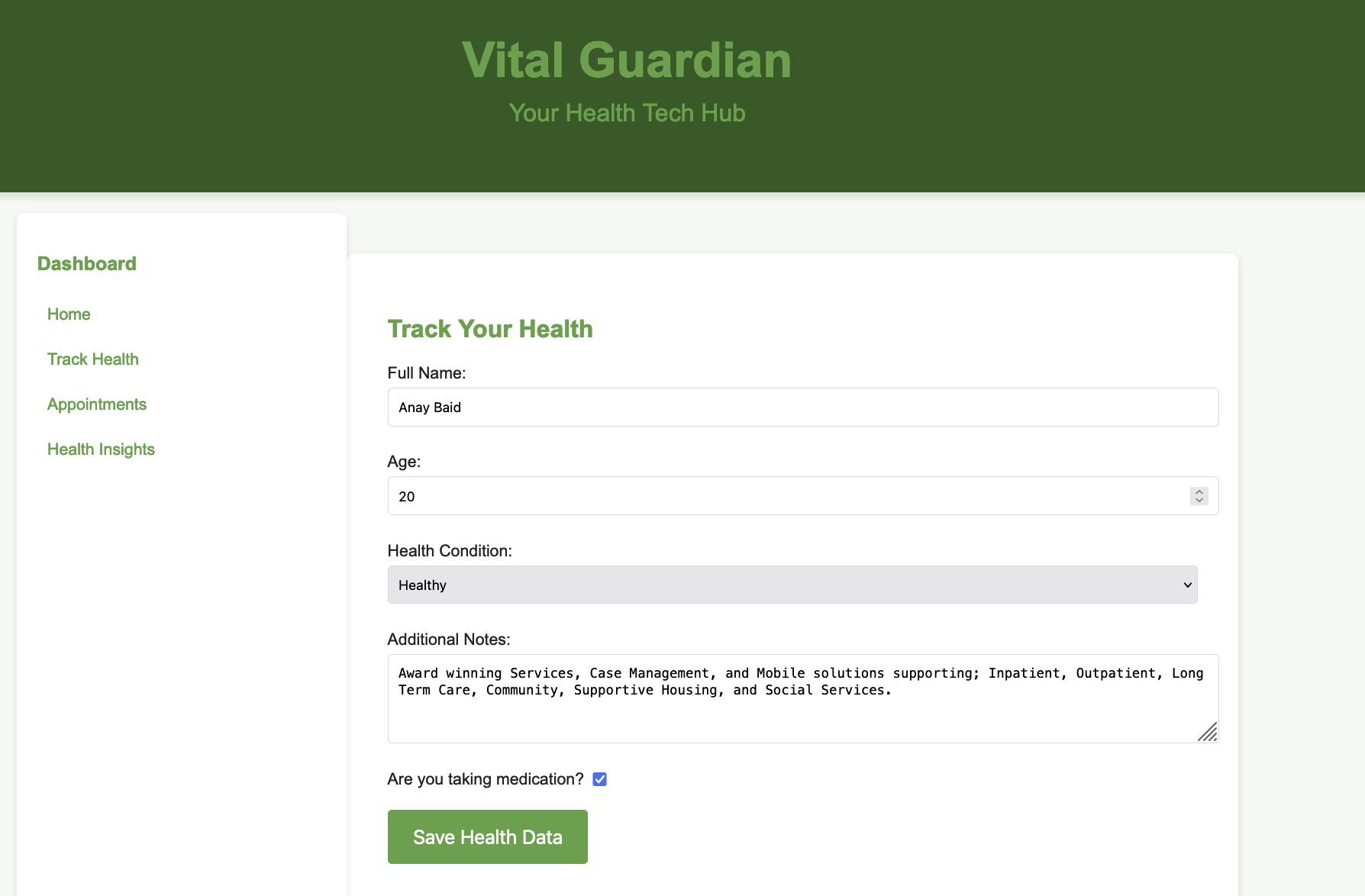
Effortlessly track your health, monitor progress, and manage appointments with Vital Guardian’s all-in-one dashboard.
-
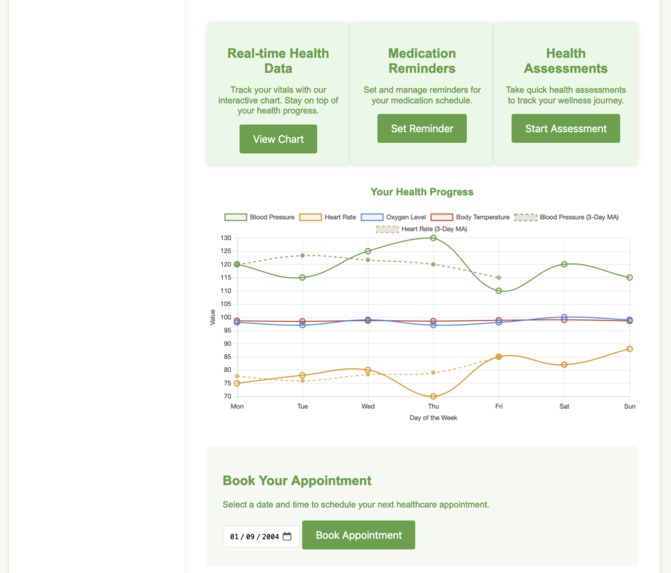
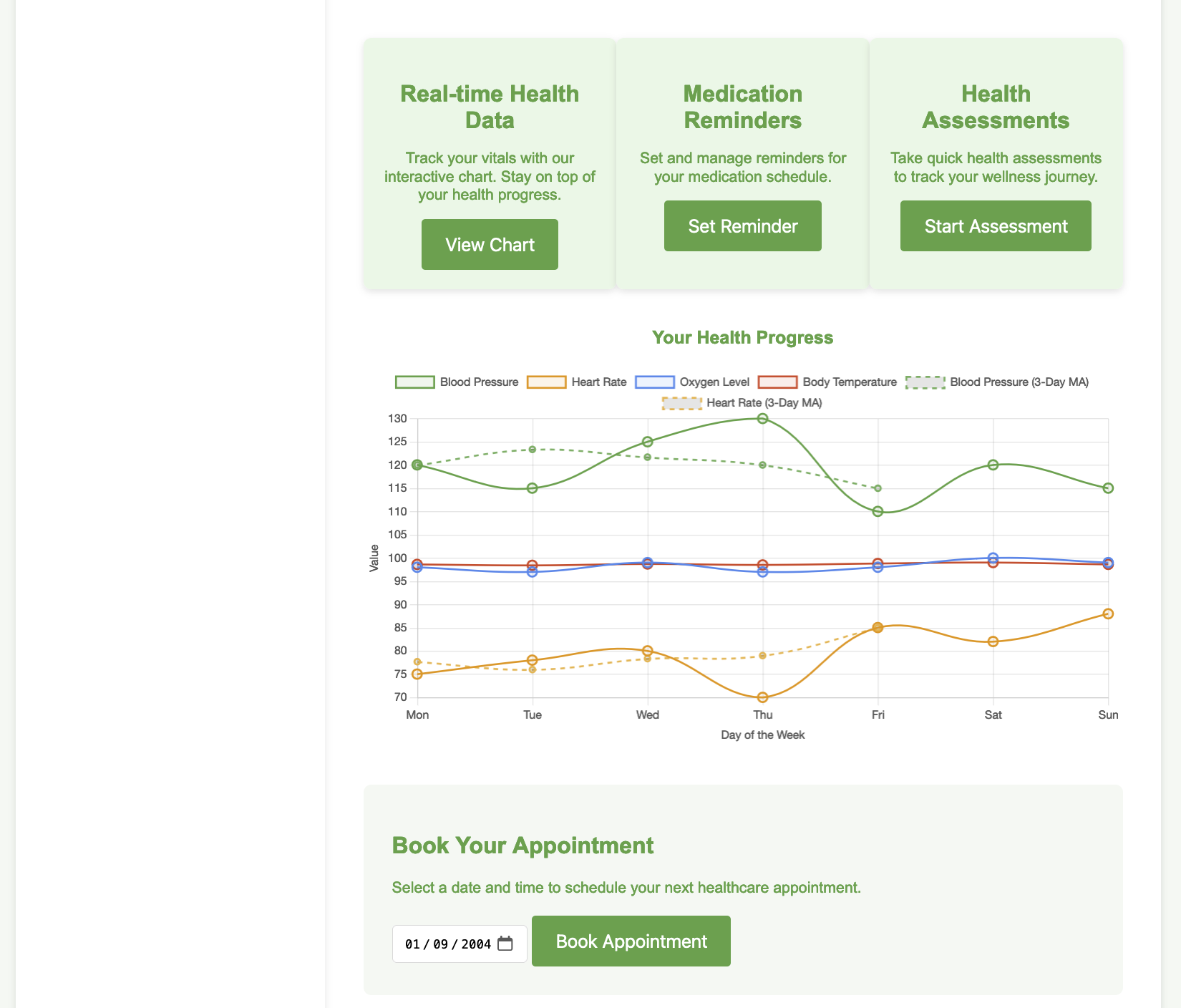
Stay on top of your health with Vital Guardian. Easily track key metrics, view your progress, and manage appointments all in one place.
Inspiration
As healthcare systems around the world continue to evolve, many remote and underserved communities still face challenges in accessing timely medical care. In these areas, health conditions like respiratory diseases, waterborne infections, and other preventable illnesses are common, yet often undetected until it's too late. The need for a scalable and accessible solution inspired Vital Guardian, an AI-powered health monitoring system designed to provide early health insights and proactive alerts through low-cost wearable sensors. This project aims to bridge the healthcare gap by empowering individuals in remote villages with predictive health technology.
What it does
Vital Guardian is a predictive health assistant that leverages machine learning algorithms and wearable sensor data to monitor vital signs like heart rate, blood pressure, and temperature. The system analyzes this data to predict potential health risks, such as respiratory distress, dehydration, or signs of waterborne diseases. If an anomaly is detected, the app sends a real-time alert via SMS, ensuring that individuals are aware of potential health risks even if they don't have internet access.
This system not only alerts users to potential health concerns but also helps prioritize care by predicting health issues before they become critical, enabling earlier intervention and better health outcomes.
How we built it
To build Vital Guardian, we integrated affordable, low-power IoT sensors (e.g., heart rate, temperature, and blood oxygen) with an ESP32 microcontroller to collect real-time health data. The data is transmitted to a central AWS-hosted cloud server, where we preprocess it using Python for cleaning and structuring before passing it to a machine learning model built with TensorFlow. This model, optimized with TensorFlow Lite, predicts potential health risks (e.g., respiratory distress or dehydration) using decision trees and neural networks for classification and anomaly detection. In areas with limited internet connectivity, we use Twilio's SMS API to send real-time alerts to users and healthcare workers. A mobile app developed in Flutter allows users to track their health, receive alerts, and view historical data, with functionality for both online and offline use. The cloud infrastructure ensures scalability, efficient updates, and enables remote monitoring by healthcare providers.
Challenges we ran into
We faced several challenges while developing Vital Guardian. Ensuring sensor calibration and data accuracy was crucial, so we spent considerable time fine-tuning the wearable sensors to match health standards and ensure reliable measurements. In low-connectivity regions, where internet access was limited, we had to design an SMS-based alert system using Twilio, as internet-dependent push notifications were not feasible. Additionally, safeguarding sensitive health data required implementing strong encryption protocols for secure transmission, and ensuring compliance with health data security standards. Optimizing the machine learning model for mobile deployment also posed a challenge due to the limited processing power of mobile devices, necessitating the use of TensorFlow Lite to deploy a lightweight, performance-optimized version of the model for real-time predictions.
Accomplishments that we're proud of
We are proud to have made significant progress on Vital Guardian, though we're still refining and improving the system. We've managed to build a real-time alerting system that works in low-connectivity areas, sending SMS notifications to users about potential health risks, even when internet access is limited. We've also successfully integrated machine learning to predict health risks using data collected from wearable sensors, bringing us closer to proactive healthcare for remote communities. The mobile app, built with Flutter, provides users with an intuitive interface to monitor their health and receive alerts, though we're continually working to enhance the user experience. Lastly, we've been able to work with low-cost, low-power sensors to make the solution affordable and accessible, but there's still work to be done to improve sensor accuracy and integration.
What we learned
Through the development of Vital Guardian, we gained valuable interdisciplinary skills, particularly in integrating hardware with software, building mobile applications, and implementing machine learning models for predictive health analytics. Designing mobile-first solutions for low-connectivity environments emphasized the importance of creating resilient systems that can operate offline, ensuring reliability in remote areas. We also learned the powerful role AI can play in making healthcare more proactive and accessible, especially in underserved communities, demonstrating the potential of technology to address global health challenges.
What's next for Vital Guardian: AI-Powered Predictive Healthcare
The next steps for Vital Guardian involve scaling the system by integrating additional low-cost sensors and expanding the machine learning model to cover a broader range of health issues, such as malnutrition and chronic diseases, enhancing predictive capabilities. To ensure widespread adoption, we plan to collaborate with healthcare NGOs and government organizations for device distribution and awareness campaigns. Additionally, we aim to integrate the system with remote healthcare platforms, enabling healthcare providers to remotely monitor patient data, triggering timely interventions when needed. We also plan to refine the mobile app's user interface, focusing on enhancing usability for individuals with varying levels of digital literacy, ensuring effective deployment in target communities.

Log in or sign up for Devpost to join the conversation.