The drawer is the real record
Ask anyone to name every medicine in their mother's drawer, with strengths. Almost nobody can. I couldn't.
The drawer is the record that actually governs what somebody swallows, and it is a mess: a brand and its generic side by side because the hospital sent her home on one and the GP repeated the other, something a cardiologist stopped last spring that nobody threw away, a box from a batch that was recalled four months ago and never came up because nobody was looking.
Every formal record of that same drawer is a photograph of a moment, presented as though it were current. A GP's list is what was true in March. Neither says so — and that unmarked confidence is the hazard, not the staleness. A clinician who knows a list is six months old asks a question. One handed the same list with no date acts on it.
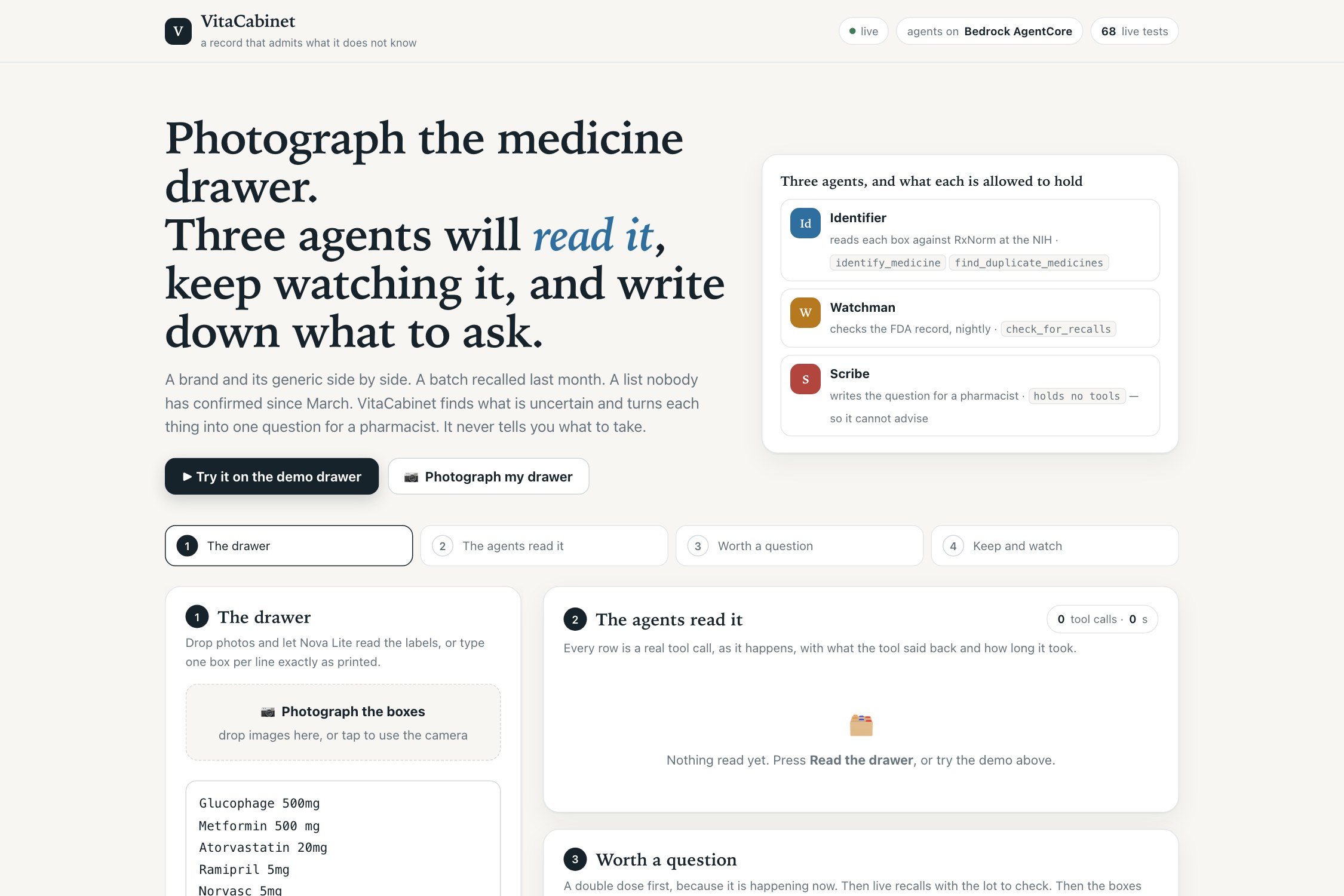
VitaCabinet is a record that admits what it does not know, and three agents that keep reducing what it is unsure about — in the background, for as long as the drawer exists.
Live: https://b5emjsgbi1.execute-api.eu-north-1.amazonaws.com — no install, no sign-up.
What it does, in the order you see it
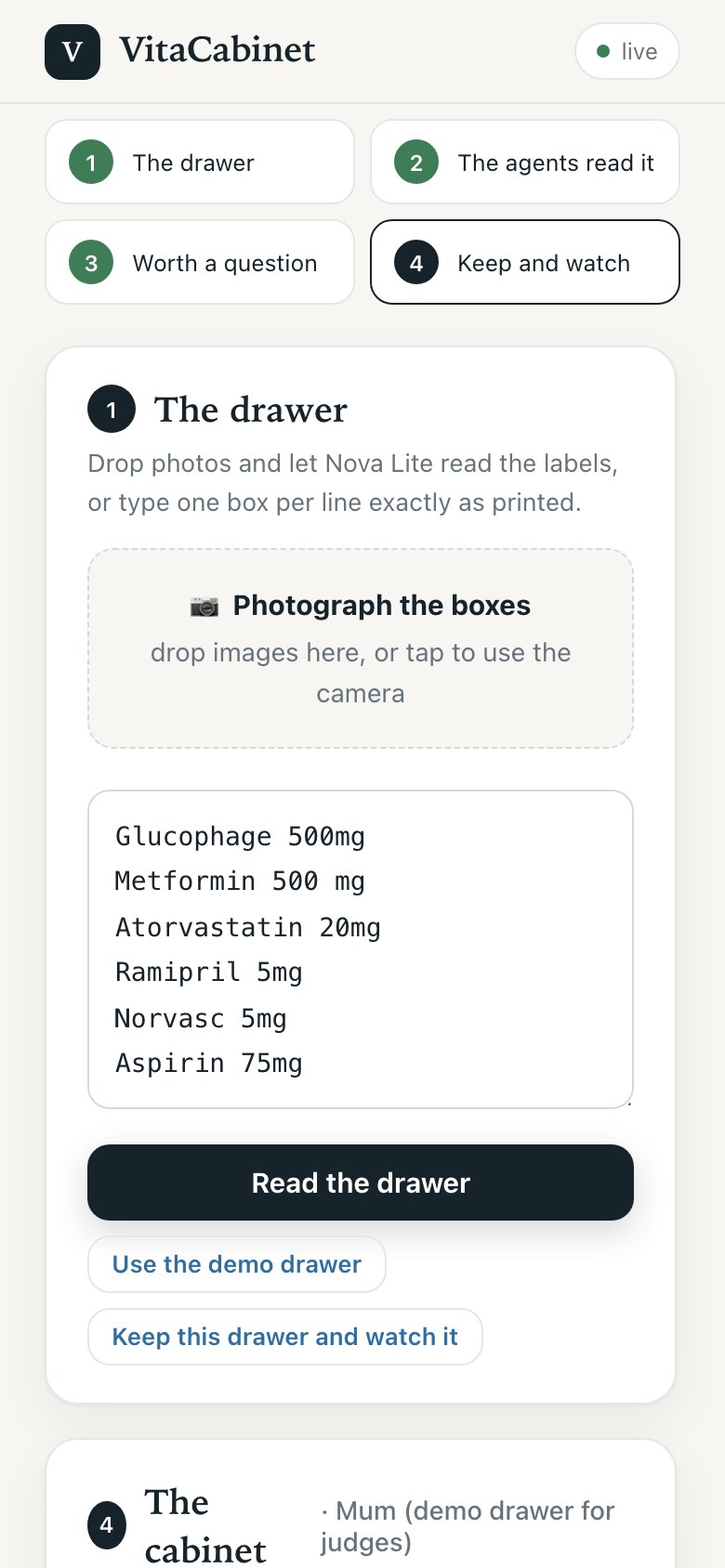
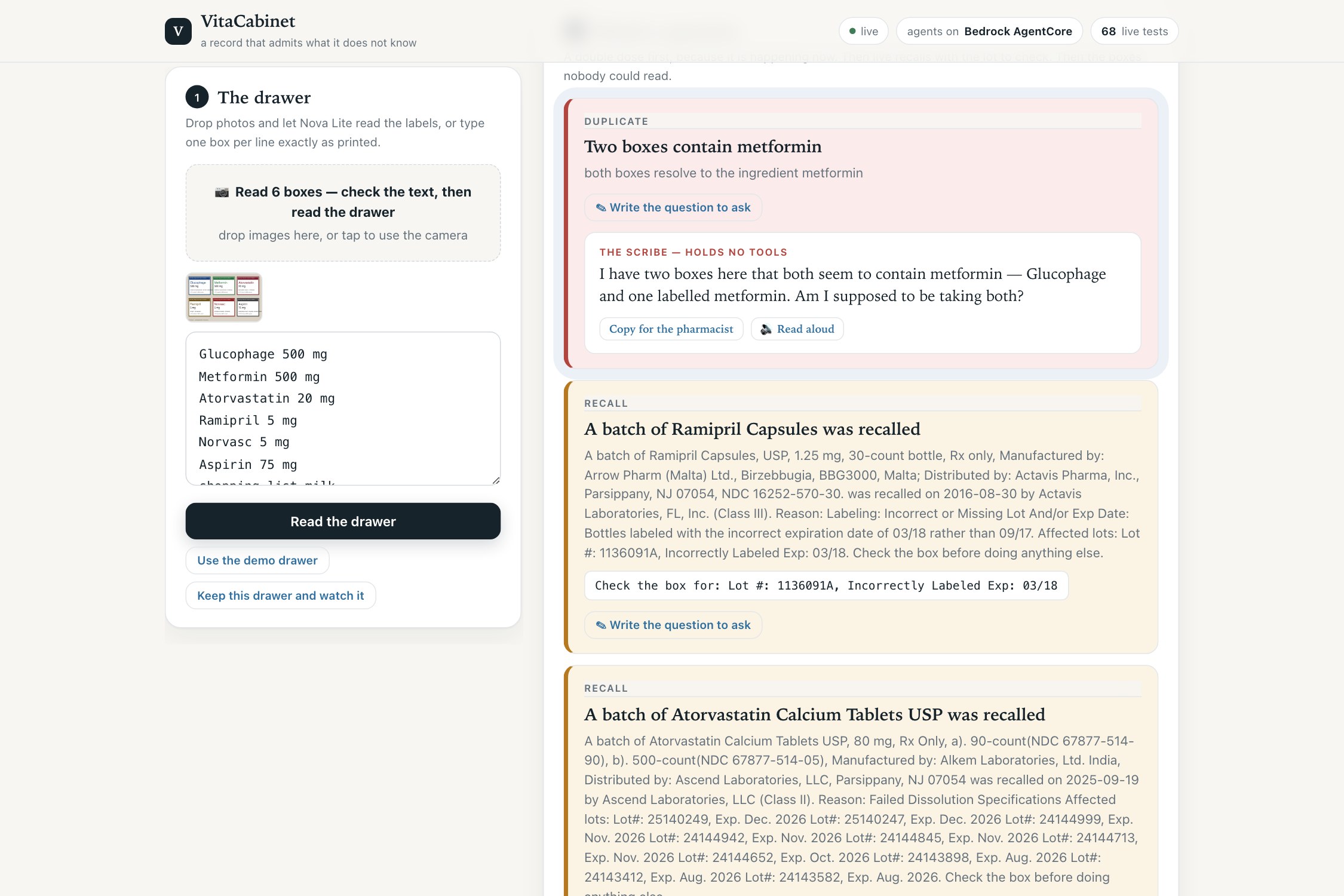
- Photograph the boxes. Amazon Nova Lite reads the printed name and strength off each one. It reads; it does not identify.
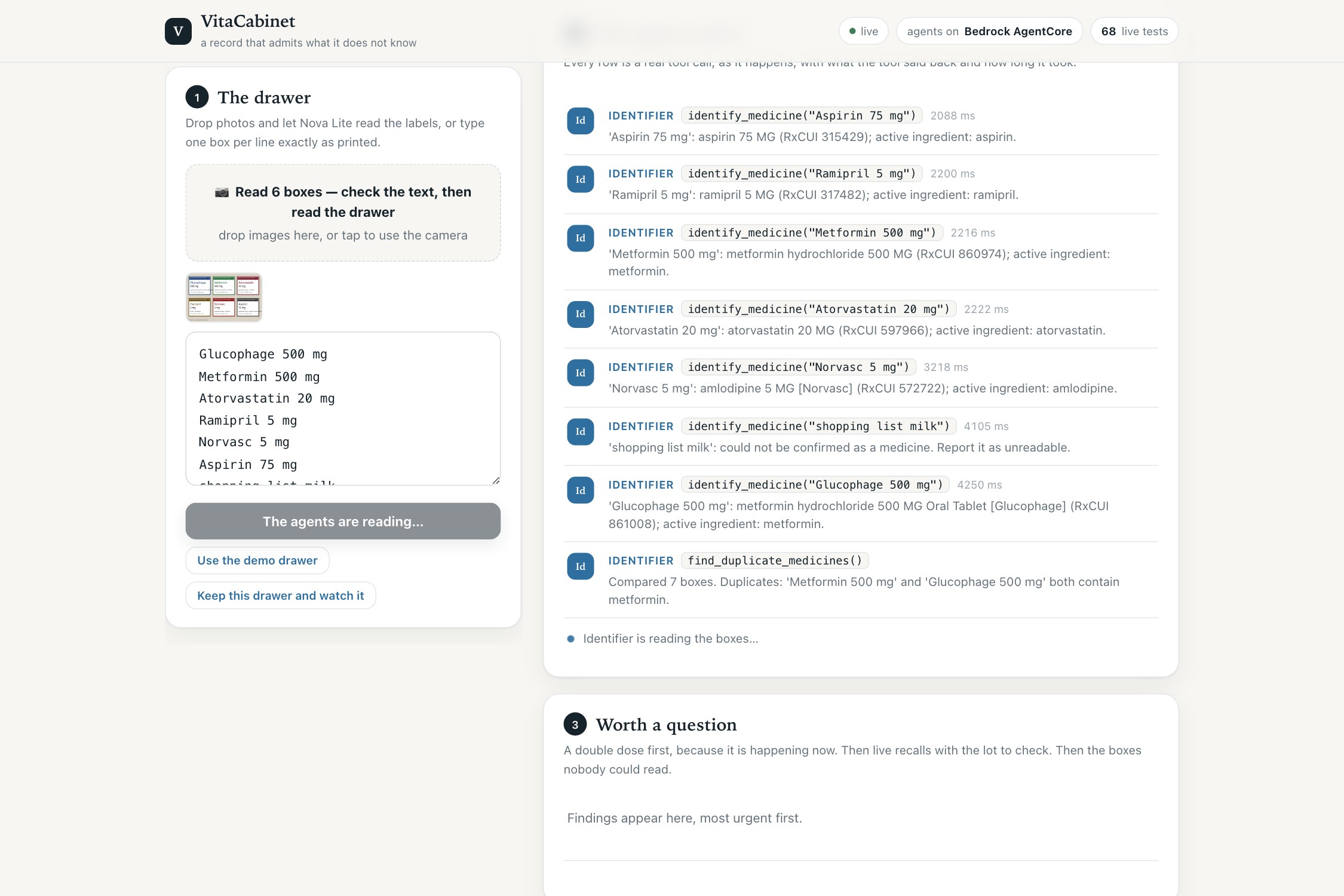
- The Identifier reads the drawer — a Strands agent calling
identify_medicineonce per box against RxNorm (NIH), thenfind_duplicate_medicinesacross all of them. A box it cannot confirm is reported as unreadable, never guessed. - The Watchman checks the safety record — a second agent calling
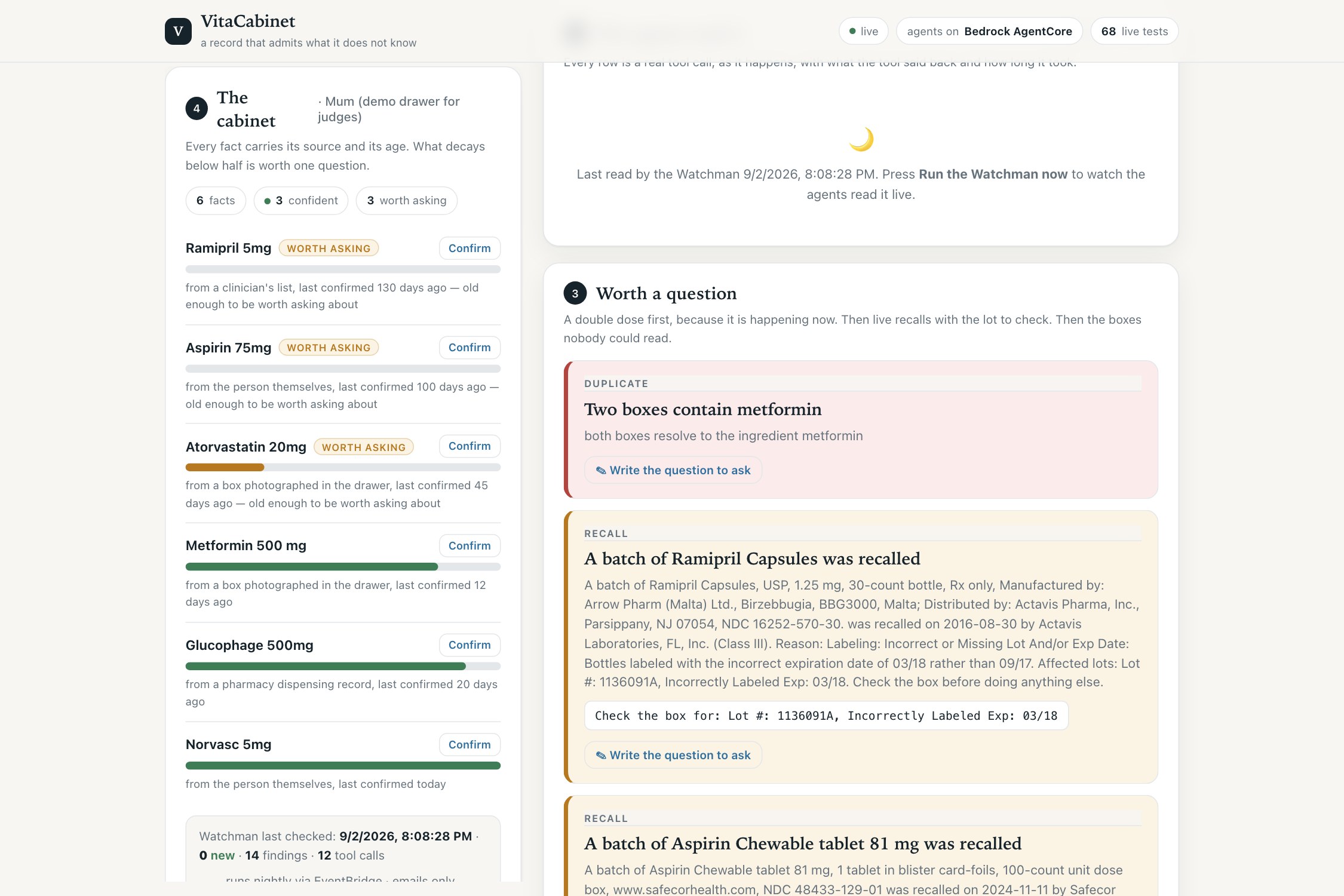
check_for_recallsonce per ingredient against openFDA. Live recalls only, lot numbers carried, combination products flagged. - You watch them work. Every tool call is written to the job as it happens and drawn on the page while the agents are still running — tool, argument, what it said back, how long it took.
- Keep the drawer. Facts persist in DynamoDB with their source and age, and decay. A box in a drawer is believed for 60 days; confirming a fact moves it to the person and resets it.
- It keeps watching. EventBridge runs the Watchman nightly over every kept drawer. SNS emails only when something is new.
- The Scribe writes the question. One sentence per finding, for a pharmacist. It holds no tools.
How it is built
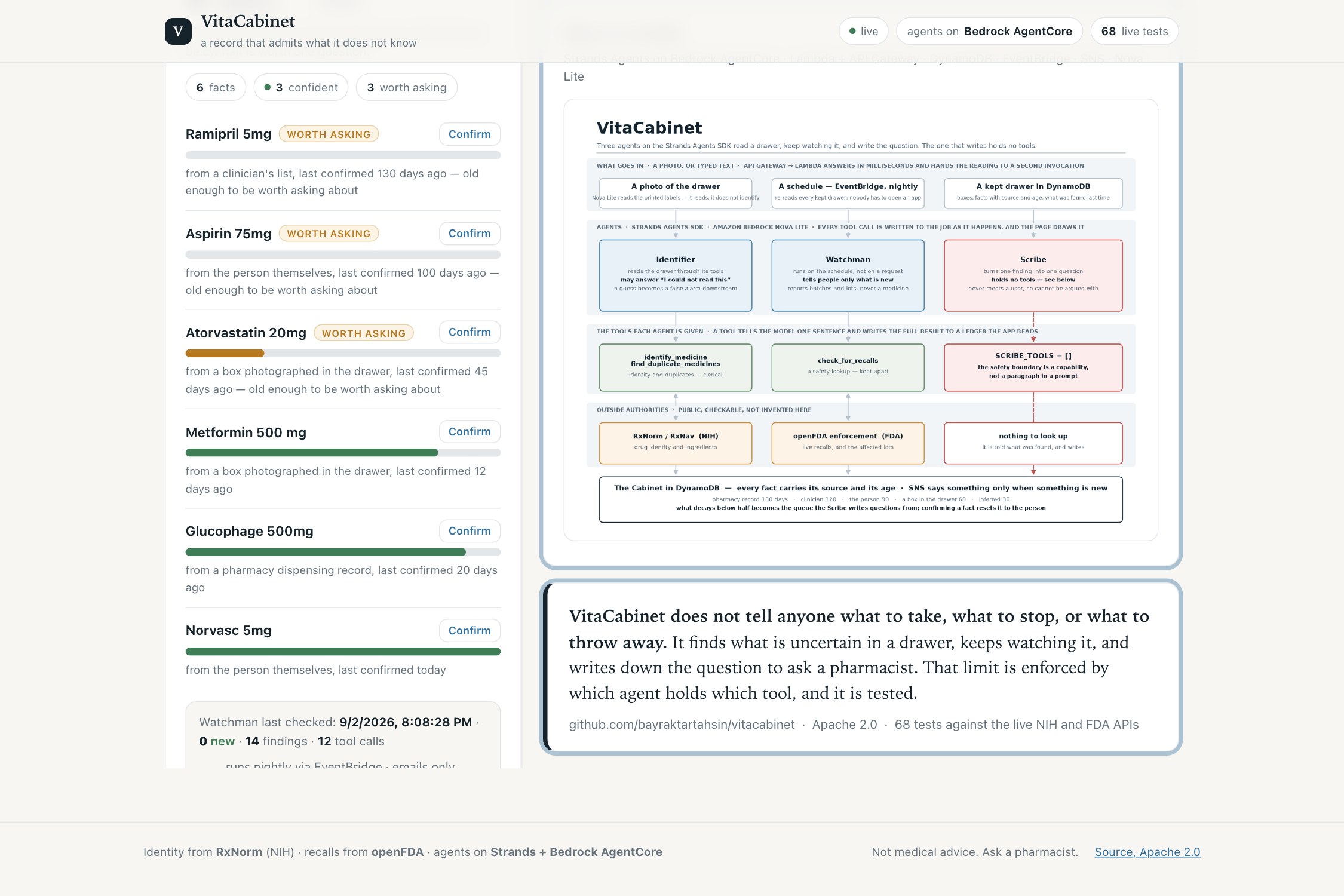
Strands Agents SDK — three agents, three tools, a hook that records every tool call. Amazon Bedrock AgentCore Runtime hosts the fleet (ARM64 container built by CodeBuild; the runtime writes the trace to DynamoDB itself). AWS Lambda + API Gateway is the web tier: a reading is an asynchronous job, because the gateway gives a request thirty seconds and two agents want more. DynamoDB holds jobs and kept drawers; EventBridge runs the nightly pass; SNS speaks only when there is news. Nova Lite is the model throughout, including reading photographed labels.
The two ideas I'd defend
Confidence is stored, not assumed. Every fact carries where it came from and when it was last confirmed. A pharmacy dispensing record is believed for 180 days, because collecting a prescription is evidence of taking it. A box in a drawer gets 60, because a box is evidence it was bought and nothing more. Two sources disagreeing caps confidence low however fresh the fact is. What falls out is a queue — things worth one question each, least believable first — which is the shape a background agent can work through for years.
The safety boundary is a capability, not a paragraph. The Scribe writes to a human, so it must never form a medical opinion. It is not told not to; it cannot. It holds no tools:
def test_the_scribe_holds_no_tools_at_all():
    assert tools.SCRIBE_TOOLS == []
An agent that can look up whether a drug is dangerous will eventually write that down as advice, however firmly its prompt says otherwise. So it does not get the lookup.
What went wrong, and what it taught
The model drowned in its own tool results. check_for_recalls returned the openFDA payload; amlodipine has thirteen live recalls; the Watchman blew straight through Nova's output budget. Now every tool tells the model one sentence and writes the full structured result to a per-reading ledger the app assembles findings from. The model orchestrates; the data never passes through it.
The model rewrote its own arguments. Nova normalised Glucophage 500mg into metformin hydrochloride 500 mg before passing the boxes to find_duplicate_medicines, and the one pair this project exists to find collapsed into a single entry. Duplicates are now recomputed from the ledger after the agent finishes, regardless of what it passed. Findings come from tool results, never from the model's prose.
The fuzzy matcher named a chemical that wasn't there. RxNav's approximate endpoint returned bisphenol A for qqqzzz not a medicine 12345, and shopping list milk scored above a real atorvastatin box. A round-trip name check — half the query's words must appear in the candidate's own name — is what holds.
A recall is against batches, never a medicine. Two thirds of metformin's records are terminated; every live one names lots; half are combination products. There is deliberately no code path that can produce the sentence "your medicine was recalled."
The Scribe refused, and that was the failure. Handed a person's own words — "she is 78, just tell me which to throw away" — it became a health chatbot and offered a crisis line to somebody asking about two boxes of metformin. It now receives a structured finding and never meets a user.
A leak that only showed in one test order. The ledger was a ContextVar; Strands' concurrent tool executor runs tools on pool threads; a pool thread that once made its own ledger kept it. A locked module global is less elegant and correct.
Build journey, on builder.aws
- I gave one of my agents no tools at all
- The model orchestrates, the data never passes through it
- A medical record that admits what it does not know
What's next
The queue is what generalises. A drawer is one source; a discharge summary, a pharmacy record and a person's memory are three more, and they disagree constantly. A record that carries its own confidence is the only kind that can hold four disagreeing sources without pretending one of them is the truth.
VitaCabinet never tells anyone what to take, what to stop, or what to throw away. It finds what is uncertain, keeps watching, and writes down the question to ask a pharmacist. That limit is a capability boundary, and it is tested — 68 tests, all against the live models and public APIs.
Built With
- ai-agents
- amazon-bedrock
- amazon-nova
- amazon-web-services
- aws-lambda
- bedrock-agentcore
- computer-vision
- dynamodb
- eventbridge
- healthcare
- openfda
- python
- rxnorm
- strands-agents


Log in or sign up for Devpost to join the conversation.