Inspiration
Healthcare data today is deeply fragmented. Patients accumulate lab results, imaging reports, clinical notes, and prescriptions scattered across disconnected hospital portals, PDFs, and paper folders. When visiting a specialist, critical historical context is often missing—and complex medical jargon leaves patients anxious and disconnected from their own health.
I was inspired to build VITA ("Your Health, Connected") to invert this dynamic: putting patients at the center of a unified, longitudinal Personal Health Record (PHR) that translates medical complexity into clarity, detects early health trends, and keeps privacy firmly in the patient's hands.
What it does
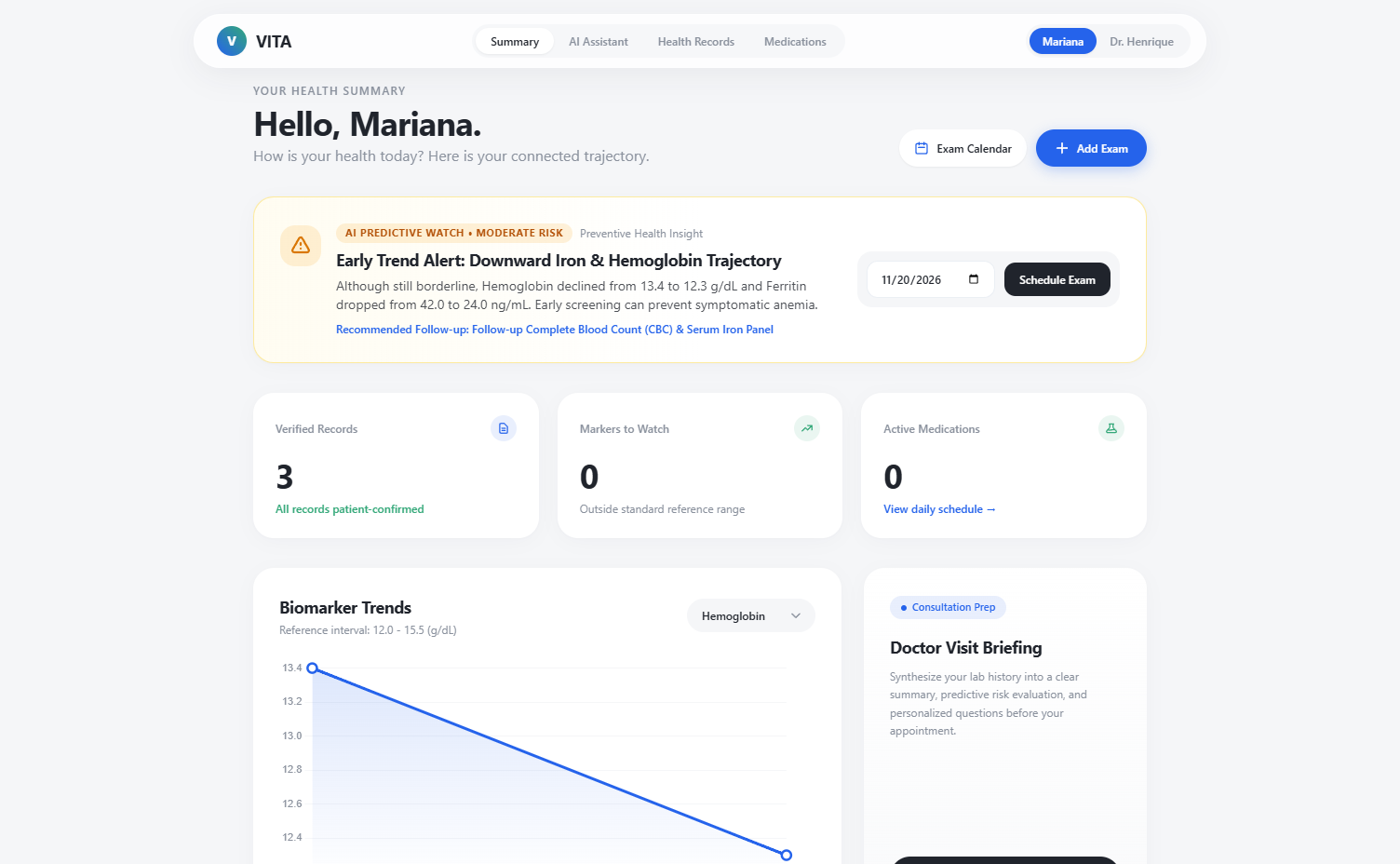
VITA is an AI-powered Personal Health Record SaaS designed with an Apple Health-inspired, calm, and intuitive interface:
- AI Document Intelligence & Jargon Translation: Patients upload any PDF lab panel or clinical note. VITA extracts structured biomarkers, normalizes reference ranges, and translates technical terminology into empathetic, plain-English explanations.
- Human-in-the-Loop Verification: Before any AI-extracted record enters the permanent timeline, the patient reviews and confirms the structured data—ensuring clinical accuracy and patient agency.
- Longitudinal Biomarker Trends & Predictive Risk Alerts: VITA tracks biomarkers across months and years. When the AI detects a progressive negative trajectory (such as declining Hemoglobin and Ferritin levels), it proactively alerts both the patient and their authorized physician and allows 1-click scheduling of follow-up diagnostic exams.
- Pre-Visit Clinical Synthesis: With one click, VITA synthesizes the patient's entire medical history into a concise clinical overview and generates tailored questions for their next appointment.
- Interactive Exam Calendar & Medication Tracker: Patients and doctors can inspect historical exams chronologically or on an interactive monthly calendar, while managing active treatments with visual pill identification, dosage schedules, and daily adherence logging.
- Patient-Controlled Sharing & Audit Trail (LGPD / HIPAA-aligned): Patients can grant or revoke physician access instantaneously, with every view and action logged in a transparent privacy audit trail.
How I built it
- Backend & Architecture: Built with Python and Flask, backed by a relational SQLite database structuring documents, longitudinal biomarkers, active medications, scheduled follow-ups, and access permissions.
- AI & Structured Extraction: Powered by Google Gemini (
gemini-2.5-flash) via thegoogle-genaiSDK, using Pydantic schemas (MedicalDocumentAnalysisandPreVisitBriefing) to guarantee strict, deterministic JSON outputs from unstructured PDFs extracted with PyMuPDF (fitz). - Frontend & Data Visualization: Crafted with Tailwind CSS and Chart.js following an Apple-inspired design system—featuring generous whitespace, SF Pro-inspired typography, translucent Liquid Glass floating navigation, and smooth microinteractions.
Challenges I ran into
- Balancing AI Autonomy with Clinical Trust: In healthcare, hallucinated lab values are unacceptable. I solved this by enforcing strict Pydantic schema validation on Gemini outputs and designing a mandatory human verification step before saving records.
- Designing Calm Healthcare UX: Medical dashboards often look intimidating and cluttered. Refining the UI into a minimalist, iOS-inspired layout required careful visual hierarchy so critical alerts stand out without causing unnecessary alarm.
- Unifying Multi-Date Biomarkers: Standardizing biomarker names and units across different lab report formats so they plot cleanly on a single longitudinal trend chart required careful prompt engineering and data normalization.
Accomplishments that I'm proud of
- Delivering a complete, end-to-end dual-role experience (Patient View vs. Authorized Physician View) where revoking permissions immediately blocks clinical access in real time.
- Turning static, hard-to-read medical PDFs into interactive longitudinal charts, predictive alerts, and actionable doctor-visit briefings in seconds.
- Designing, architecting, and shipping a cohesive, consumer-grade product solo within a tight hackathon deadline.
What I learned
- Structured outputs (
response_schemawith Pydantic) transform LLMs from conversational tools into reliable data-engineering pipelines capable of powering real-time charts and clinical alerts. - Great healthcare software isn't just about data storage—it's about translation, timing, and trust.
What's next for VITA
- HL7 FHIR & Wearables Integration: Connecting directly with laboratory APIs, Apple HealthKit, and Google Health Connect for automated biomarker and vital sign ingestion.
- OCR for Scanned Prescriptions & Imaging: Expanding multimodal Gemini vision capabilities to parse handwritten prescriptions and X-ray/MRI summaries.
- Encrypted Zero-Knowledge Sharing Links: Generating time-limited QR codes for emergency room and specialist visits.
