-
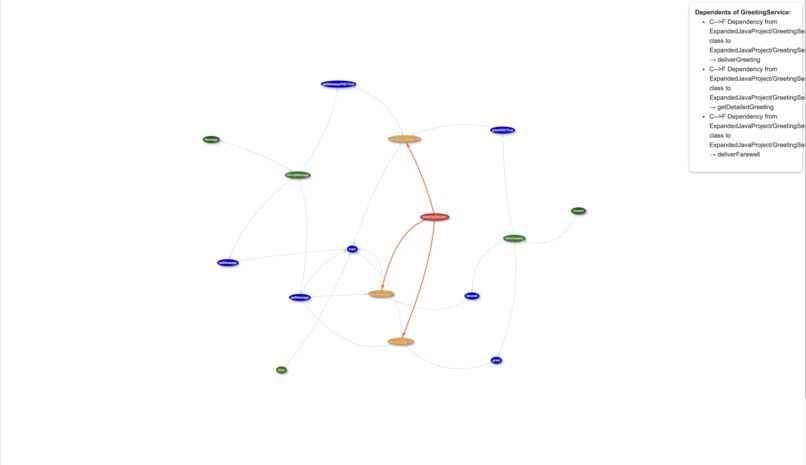
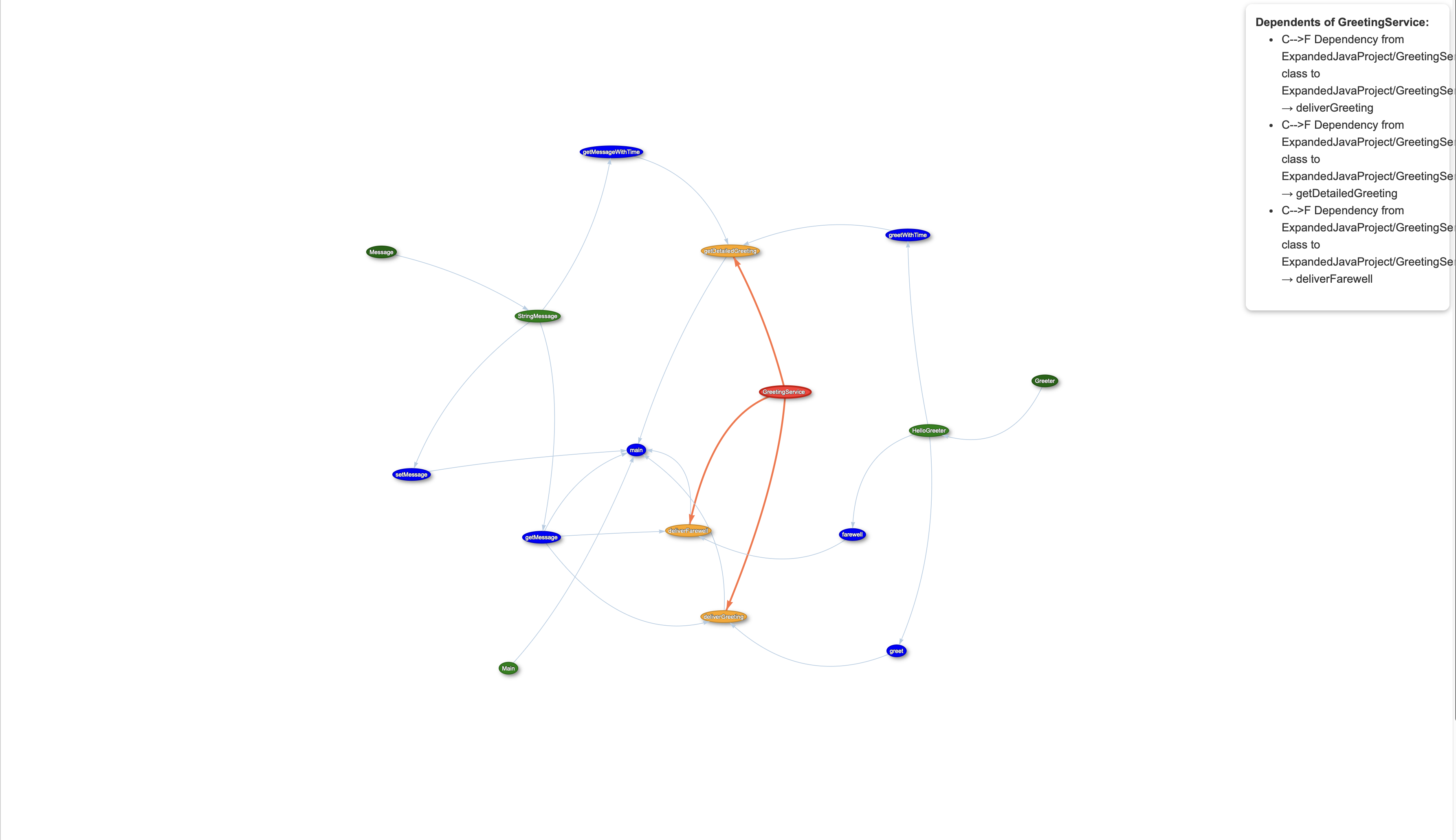
inheritance and class relationships.
Inspiration
What it does
How we built it
Challenges we ran into
Accomplishments that we're proud of
What we learned
What's next for Visualizing Code Bases at Scale
Visualizing Codebases At Scale 🚀
Overview 🔍
This tool is designed to analyze a Java (so far!) codebase provided as a zip file and generate a detailed, interactive dependency graph. This graph represents:
- Function-function propogation
- Object oriented relationships
- Inheritance relationships
This tool is a game-changer for educational environments, impact analysis in software changes, and accelerating project onboarding for interns and full time engineers. This tool transforms the way you understand and interact with code!
Purpose 🎯
With developed this tool with the following objectives:
Automate Code Analysis:
- Automatically extract, parse, and analyze a Java codebase from a zip file.
- Identify critical components such as functions, classes, and their interdependencies.
Visualize Complex Relationships:
- Render a comprehensive graph that visually maps out the code’s internal structure.
- Clearly highlight how functions, classes, and inheritance hierarchies interact.
Enhance Code Impact Analysis:
- Quickly pinpoint which parts of the code will be affected by changes.
- Serve as a decision-making aid for running targeted tests and understanding potential risks.
Streamline Onboarding and Education:
- Provide new team members with an immediate, high-level overview of the code architecture.
- Serve as an educational tool to help learners visualize and understand intricate code relationships.
Approach 🛠
Our approach is outlines in in the following sections. Skip to Outcomes or Future here. The tool employs a systematic and robust approach to generate the dependency graph:
1. Input Handling and Code Parsing 📥
Zip File Extraction:
- The tool accepts a zip file containing the Java codebase, extracts the contents, and organizes them for analysis.
Source Code Parsing:
- The tool scans each Java source file to identify functions, classes, and inheritance hierarchies, and generated an abstract syntax tree to represent these interactions.
2. Static Analysis 🔬
Function Analysis:
- It examines the code to locate function definitions and maps out how these functions call each other.
Class Analysis:
- The tool identifies class definitions and details the associations between classes and the functions they contain or interact with.
Inheritance Detection:
- It determines inheritance relationships, showcasing the class hierarchy within the codebase.
3. Object Definitions 📚
This project is structured around clear object definitions that encapsulate the core elements of the codebase. Key object definitions include:
JavaFile:
- Represents individual Java source files, holding metadata and parsed content.
JavaClass:
- Encapsulates class definitions, including attributes like name, parent classes, and associated methods.
JavaFunction:
- Represents individual functions or methods within the classes, tracking their parameters, return types, and the functions they call.
Relationship Objects:
- Define the various types of interactions (calls, associations, inheritance) between the Java classes and functions.
4. Graph Construction and Visualization 🎨
Node and Edge Creation:
- Each function and class is modeled as a node, while the relationships (calls, associations, inheritance) are represented as edges between these nodes.
Graph Rendering:
- The tool uses visualization libraries to generate a clear, interactive graph. Users can explore the graph to see exactly how each part of the code is interconnected.
Output Generation:
- The final output is a detailed dependency graph that is both visually engaging and functionally informative.
Outcomes 🌟
The outcomes of this project are very exciting:
Enhanced Code Understanding:
- Provides a clear, visual representation of a Java codebase, making it easier to understand complex code structures at a glance.
- Serves as an invaluable resource for both experienced developers and newcomers.
Impact Analysis and Risk Mitigation:
- Quickly identifies which parts of the code are affected by changes, aiding in precise and efficient testing.
- Helps teams assess the risk associated with modifications, thereby enhancing overall code quality.
Accelerated Onboarding:
- New team members can rapidly get up to speed by exploring the dependency graph, reducing the time required to understand the codebase.
- Offers an intuitive overview that speeds up the onboarding process, ensuring that developers can contribute sooner.
Educational Aid:
- Acts as a superb teaching aid in academic and training settings.
- Allows students and professionals to visually explore code dependencies, thereby deepening their understanding of software architecture and design patterns.
Modular and Extendable Architecture:
- The modular design based on well-defined object definitions allows for easy extension and integration with other tools.
- Future enhancements can be implemented with minimal disruption to the existing system.
Future Directions 🔮
The potential applications and extensions of this tool are vast and exciting:
Deciding What Tests to Run:
- Application: Use the dependency data to determine which parts of the code are affected by recent changes.
- Outcome: Focus testing efforts on impacted areas, reducing time and increasing testing efficiency.
Automated Documentation Generation:
- Application: Leverage the dependency information to auto-generate detailed, up-to-date documentation.
- Outcome: Enhance code maintainability and clarity by providing visual documentation that complements traditional text-based formats.
Enhanced User Interface for Deeper Insights:
- Application: Develop a more interactive UI that allows users to navigate, zoom, and filter the dependency graph.
- Outcome: Improve the educational value and user experience, making it even easier to understand and interact with the code structure.
Integration with Continuous Integration Pipelines:
- Application: Incorporate the tool into CI/CD pipelines to automatically generate dependency graphs with every code update.
- Outcome: Provide continuous insights into code changes, enabling proactive decision-making regarding testing and documentation.
Expansion to Other Programming Languages:
- Application: Adapt the tool’s framework to support other languages and include additional code quality metrics.
- Outcome: Broaden the scope and applicability of the tool, making it useful for a wider range of projects and technologies.
Conclusion 📝
This tool redefines how we analyze, understand, and interact with codebases. By automating the analysis process and delivering a interactive, detailed dependency graph, this project enhances educational experiences, improves risk analysis, and accelerates onboarding. Its modular design, underpinned by clear object definitions, ensures that the tool is both robust and extendable, and we plan on making significant additions/improvements in the future.

Log in or sign up for Devpost to join the conversation.