visualization-antiferromagnetic-dynamics Project Description
Inspiration
The field of antiferromagnetic spintronics represents a frontier in condensed matter physics and material science with promising applications in next-generation computing technologies. However, understanding the complex dynamics of antiferromagnetic materials has been challenging due to their "hidden" magnetic order—their magnetic moments cancel out macroscopically, making them difficult to detect and manipulate.
I was inspired to create this visualization tool after struggling to intuitively grasp the complex dynamics of antiferromagnetic systems during my graduate research. Existing tools were either too specialized for experts or too simplified to capture the rich physics. I wanted to bridge this gap by creating an accessible yet powerful visualization package that could help researchers and students alike to explore antiferromagnetic dynamics without getting lost in pages of equations.
What it does
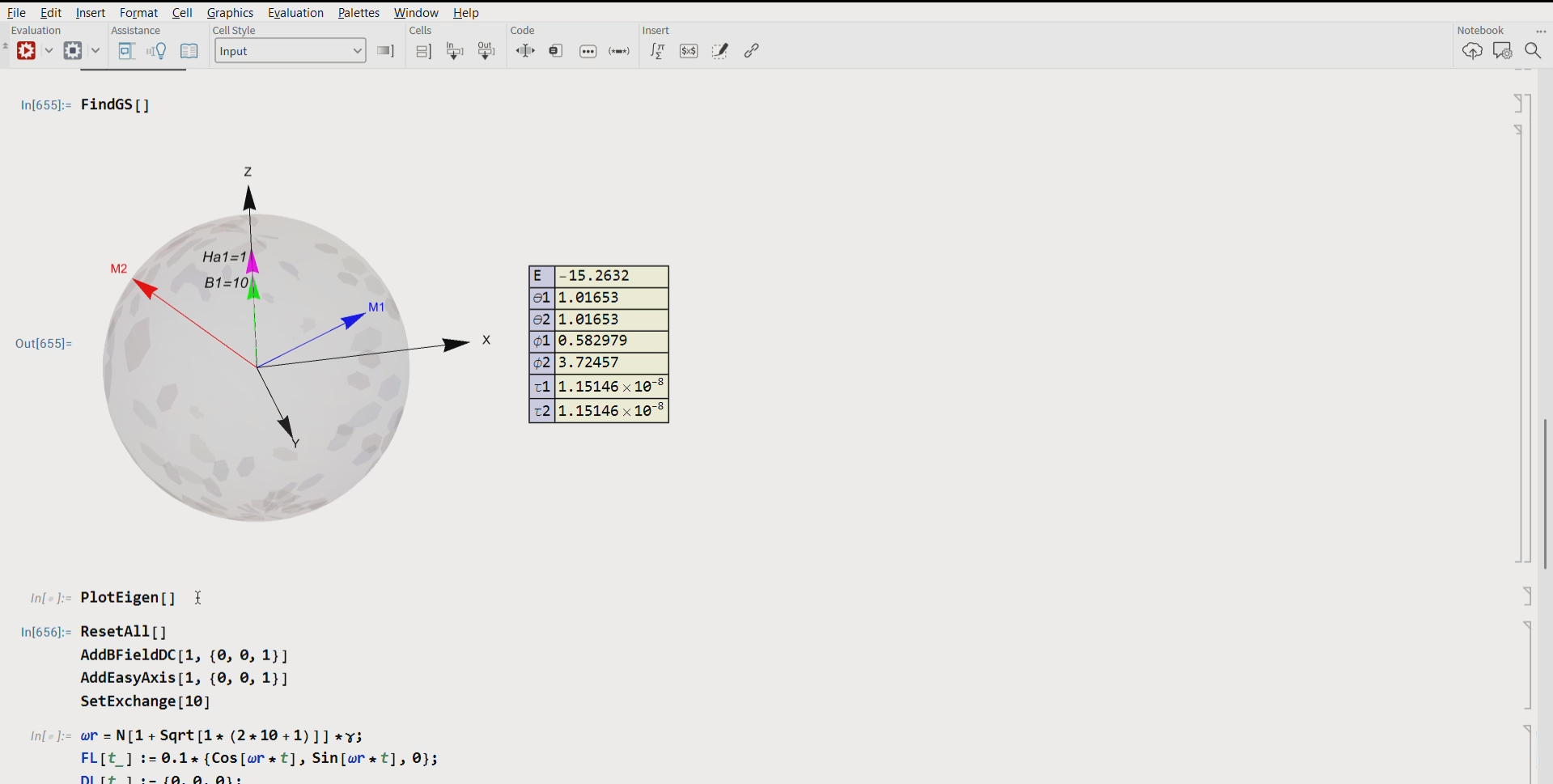
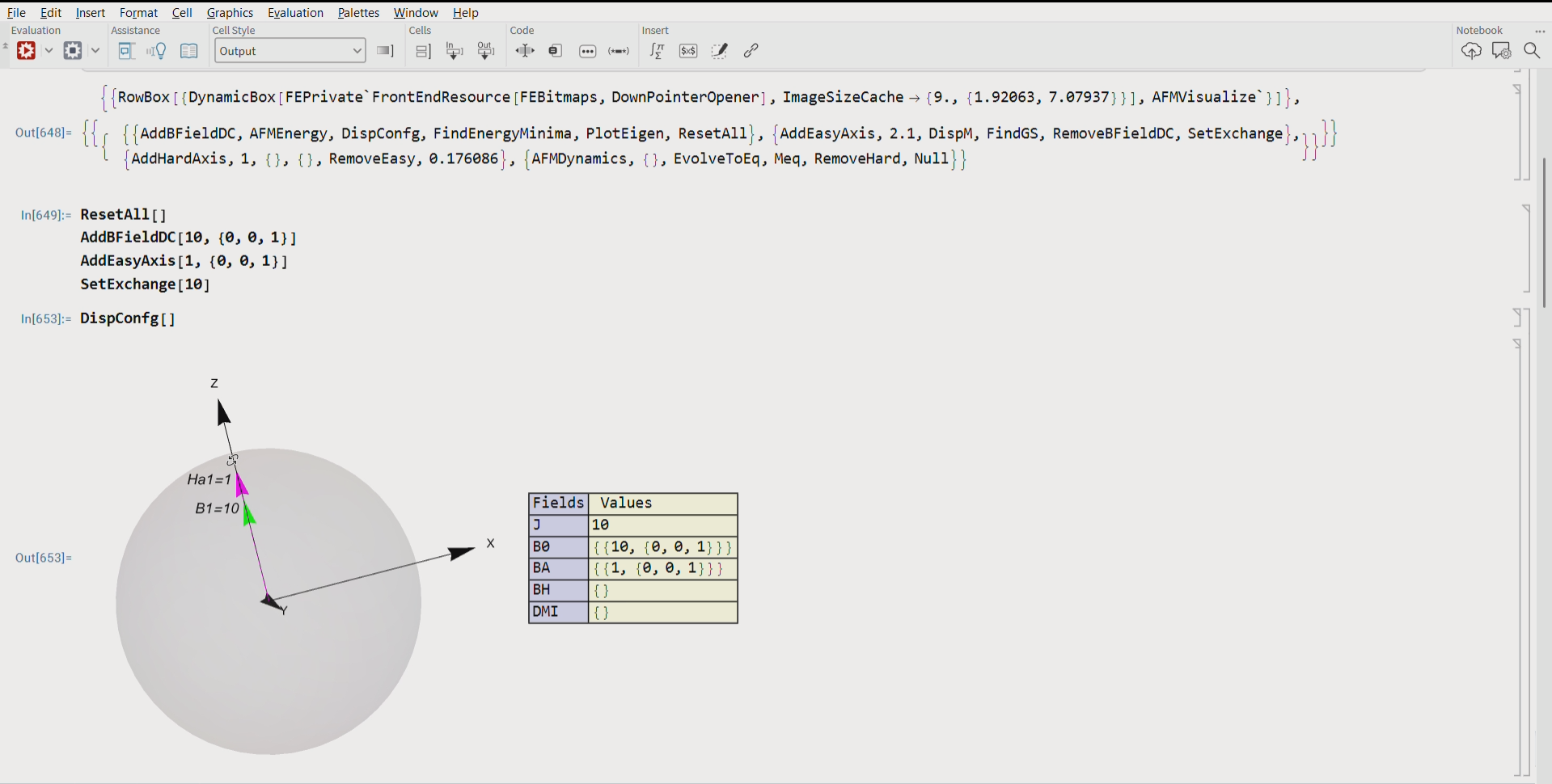
AFMVisual is a Mathematica package that allows for intuitive visualization and simulation of two-sublattice antiferromagnetic dynamics. It enables users to:
Set up customizable magnetic parameters including:
- Easy-axis anisotropy fields
- Hard-axis anisotropy fields
- Zeeman fields (external magnetic fields)
- Spin torques for dynamic manipulation
- Dzyaloshinskii–Moriya interactions (DMI)
Find equilibrium positions (ground states) of the magnetic system
Solve and visualize eigenmodes (resonance modes) with interactive controls
Simulate and visualize antiferromagnetic dynamics under custom driving fields
The package solves the Landau-Lifshitz-Gilbert (LLG) equations in the local reference frame of two magnetic moments, providing both numerical solutions and intuitive 3D visualizations of the system's behavior.
How we built it
AFMVisual was built using Wolfram Mathematica as the primary development platform. The implementation follows these key steps:
Mathematical Foundation: I started by formulating the energy functional for a two-sublattice antiferromagnet, including all relevant interaction terms like exchange coupling, anisotropies, Zeeman energy, and DMI.
Numerical Methods: I implemented advanced numerical methods to:
- Find energy minima using constrained optimization techniques
- Solve the LLG equations using a simplified implicit mid-point method for stable integration
- Linearize the equations around equilibrium positions to find eigenmodes
- Calculate resonance frequencies and mode profiles
Visualization Framework: I developed a comprehensive visualization system that allows for:
- Interactive 3D representation of magnetic moments
- Time-evolution animations of magnetic dynamics
- Customizable visualization parameters for clarity and insight
User Interface: I created an intuitive functional interface that makes complex physics accessible through simple, well-documented function calls.
Documentation and Examples: I developed comprehensive documentation and example notebooks to help users quickly learn how to use the package.
Challenges we ran into
Developing AFMVisual presented several significant challenges:
Numerical Stability: Solving the nonlinear LLG equations can be numerically unstable, especially at resonance conditions. I had to implement specialized integration schemes and apply appropriate constraints to ensure solutions remained physically valid.
Visualization Complexity: Creating intuitive visualizations of complex 3D dynamics that effectively communicate the physics required many iterations. I needed to balance visual clarity with physical accuracy.
Performance Optimization: Calculating magnetic dynamics, especially for long time series or fine parameter sweeps, is computationally intensive. I had to optimize the code to make interactive exploration feasible on standard hardware.
Physical Edge Cases: Certain physical configurations (like perfectly degenerate modes or specific symmetry conditions) created special cases that required careful handling to avoid mathematical singularities.
Package Deployment: Creating a package that works across different Mathematica versions and operating systems required addressing various compatibility issues.
Accomplishments that we're proud of
I am particularly proud of several aspects of AFMVisual:
Accessibility: Creating a tool that makes complex antiferromagnetic physics accessible to both experts and students.
Comprehensive Physics: Successfully implementing the full range of physical interactions relevant to modern antiferromagnetic research, including the recent addition of DMI.
Interactive Exploration: Enabling truly interactive exploration of parameter spaces that would be prohibitively time-consuming to explore through traditional methods.
Educational Value: Developing a package that serves not just as a research tool but as an educational resource that helps visualize concepts that are typically only understood through equations.
Research Applicability: Creating something that has genuine utility in cutting-edge research, helping to accelerate discoveries in antiferromagnetic spintronics.
What we learned
Throughout the development of AFMVisual, I gained valuable insights and skills:
Advanced Numerical Methods: Deepened my understanding of numerical approaches to solving complex nonlinear differential equations and optimization problems.
Scientific Visualization Techniques: Learned effective strategies for communicating complex physical phenomena through visual representation.
Package Development: Mastered the process of creating robust, well-documented, and user-friendly scientific software.
Physics of Antiferromagnets: Gained deeper physical intuition about antiferromagnetic systems by implementing and visualizing their dynamics.
User Experience Design: Learned the importance of balancing technical capabilities with usability considerations when designing scientific software.
What's next for visualization-antiferromagnetic-dynamics
The future development of AFMVisual will focus on several exciting directions:
Multi-sublattice Extension: Expanding the framework to handle more complex antiferromagnetic structures with more than two sublattices.
Spatial Variations: Incorporating spatial degrees of freedom to simulate domain walls, skyrmions, and other topological structures in antiferromagnets.
Temperature Effects: Including thermal fluctuations to model finite-temperature behavior of antiferromagnetic materials.
Machine Learning Integration: Developing capabilities to use machine learning for parameter optimization and inverse design of materials with desired properties.
Hardware Acceleration: Implementing GPU acceleration for computationally intensive operations to enable simulation of larger and more complex systems.
Web Interface: Creating a web-based version that allows users to explore antiferromagnetic dynamics without needing a full Mathematica installation.
Expanded Educational Resources: Developing a comprehensive tutorial series to help newcomers to the field understand antiferromagnetic physics through visualization.
These developments will help AFMVisual continue to evolve as a valuable tool for both research and education in the rapidly advancing field of antiferromagnetic spintronics.
Built With
- mathmatica

Log in or sign up for Devpost to join the conversation.