-
-

Architecture
Inspiration
There are plenty of benefits that can be gained by exploring different places. Studies show that traveling can improve overall health and enhance creativity. However, the language barrier often causes some people to truly enjoy their vacation in other countries. Travel experiences often improve when there's a translator to help. Hence, this project proposed a chatbot which serves as a personal translator for everyone!
What it does
The chatbot can recognize text in an image and translate the recognized text to the user desired language. Currently, the bot supports 3 languages which are English, Spanish and Portuguese. This enables the user to understand real-world text such as signboard or warning board when traveling easily.
How I built it
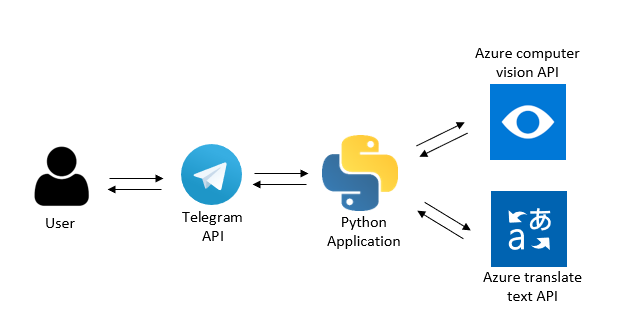
The chatbot was built using telegram bot API and azure cognitive services API and was developed in python. The telegram bot API enables communication between the python script and the telegram bot while azure computer vision API was used for text recognition and azure translate text API was used for translation.
Challenges I ran into
Some of the challenges I faced were handling different types of data received from the telegram, avoiding the script from reading the same message received as a new message, retrieving the image from the telegram server and integrating all the APIs into one functional code.
Accomplishments that I'm proud of
I'm so proud when the chatbot was functioning well since I was able to build something that has real-world application and beneficial for myself and others
What I learned
With this project, I have learned to use the telegram to create a chatbot and use the bot API to interact with it. In addition, this project helped me to learn to use some of azure services like cognitive service and make me comfortable integrating them in my python applications.
What's next for Visual Translator Bot
The Visual Translator Bot will support more language and be able to recognize handwritten text in the future and this can be done simply by the addition of a few lines of code since it is already available through the azure cognitive service API. In addition, future version will incorporate recognition of non-Latin alphabet such as characters from Chinese and Japanese language. Besides that, the chatbot may incorporate the ability to recognize speech so that the user can communicate with locals in their native language when traveling.
Built With
- azure-ai
- python
- telegram-api

Log in or sign up for Devpost to join the conversation.