-
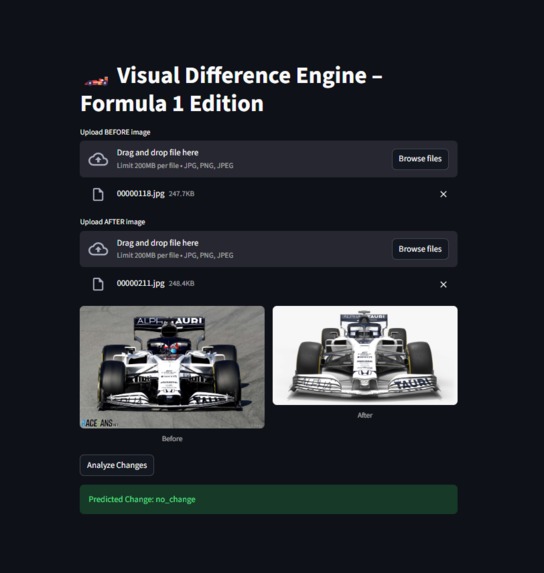
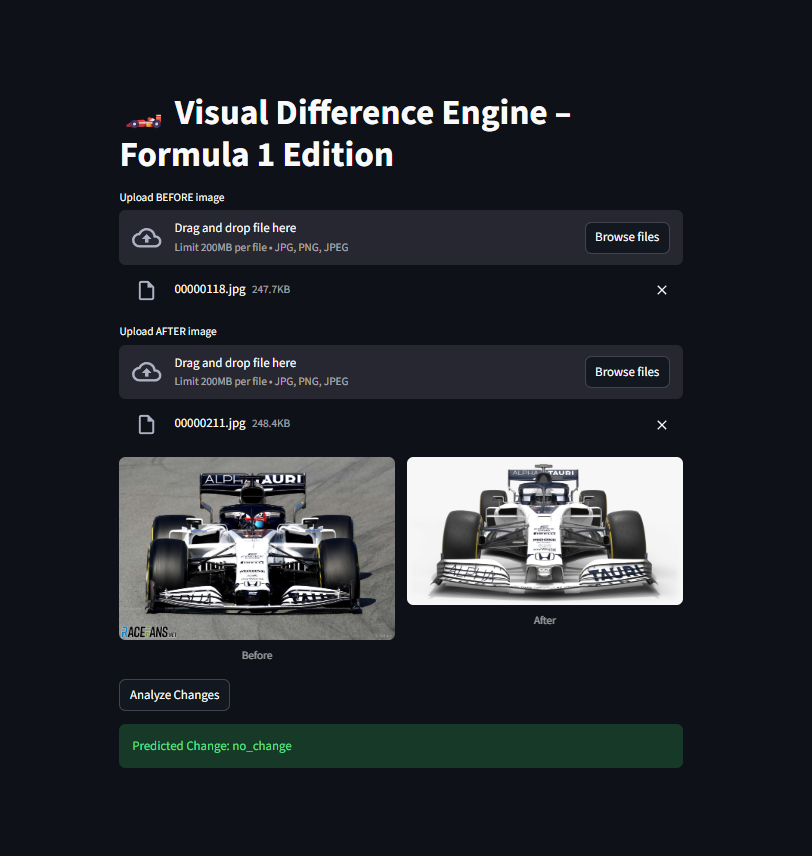
prototype for motorvehicle that no changes are depicted from the two image of differnet timestamps.
Inspiration-
Marshal incident in Mexico GP 2025-When marshals nearly crossed the track mid-race at the Mexico GP, the margin between safe and unsafe was invisible — we build the “invisible” change engine so you don’t miss what matters.
What it does-
The Visual Difference AI Engine identifies and highlights visual changes between two images — such as track surface wear, barrier shifts, weather-induced effects, or layout modifications. It helps race analysts, engineers, and broadcasters visualize how tracks evolve across races or conditions, enhancing safety checks and strategic insights.
How we built it-
We collected F1/MotoGP track images from multiple races and time frames, then: • Preprocessed image pairs to ensure alignment and normalization. • Used a ResNet-based Siamese network for change detection. • Trained the model using automatically generated balanced image pairs (similar vs. changed). • Applied normalization and augmentation to handle lighting and environmental variations. • Created a Streamlit dashboard for interactive visualization and prediction comparison.
Challenges we ran into-
• Handling unbalanced datasets where most images showed “no change.” • Aligning and normalizing track images captured under different lighting or angles. • Ensuring the model distinguishes real visual changes from camera artifacts or reflections. • Managing long training times and fine-tuning the model for generalization.
Accomplishments that we're proud of-
• Built an end-to-end AI pipeline that detects subtle scene-level changes with minimal supervision. • Designed an automated pair generator that balances the dataset for robust training. • Integrated a clean and interactive Streamlit visualization tool for result analysis. • Adapted the solution to a motorsport context — bridging AI with racing analytics.
What we learned-
We deepened our understanding of contrastive learning, data balancing, and model normalization. We also learned how minor preprocessing improvements dramatically impact performance when handling visually similar datasets.
What's next for Visual Difference AI Engine-new-
• Expanding to video-based temporal change detection for continuous race monitoring. • Integrating with telemetry and environmental sensors for multi-modal analysis. • Deploying the model for real-time use in race simulations or track inspections. • Enhancing the dataset with synthetic and drone-captured imagery for better robustness.
Built With
- anaconda
- github
- languages:-python-frameworks:-pytorch
- matplotlib
- matplotlib-overlays-cloud/storage:-google-drive-/-local-file-system-for-dataset-and-model-weights-version-control:-github-development-environment:-anaconda
- opencv
- pandas
- pil-model-architecture:-siamese-cnn-/-resnet-based-change-detection-data-handling:-custom-image-pair-generator-with-balancing-and-normalization-visualization:-streamlit-interactive-dashboard
- scikit-learn-libraries:-numpy
- streamlit
- torchvision
- visual-studio

Log in or sign up for Devpost to join the conversation.