Inspiration
VistaForge 360 was inspired by a straightforward yet impactful query:
What if the ability to explore one's imagination was instantaneous?
Although there are text-to-image and text-to-video AI tools, creating visuals and genuinely immersive experiences are still far apart. The majority of generative systems generate static results. By converting written prompts into completely navigable 360° environments, we hoped to close the gap between language and spatial computing.
By enabling anyone, regardless of technical expertise, to create immersive virtual environments by merely describing them in natural language, we aimed to democratise world-building.
What it does
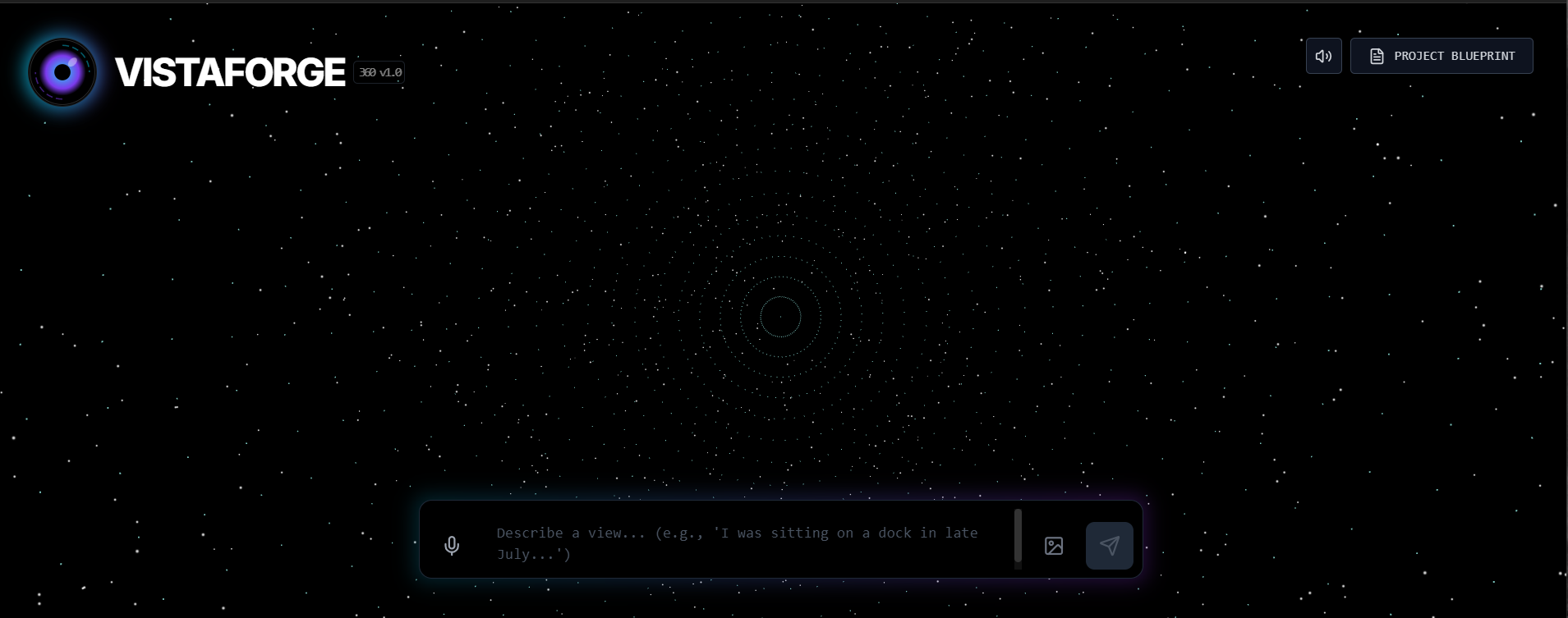
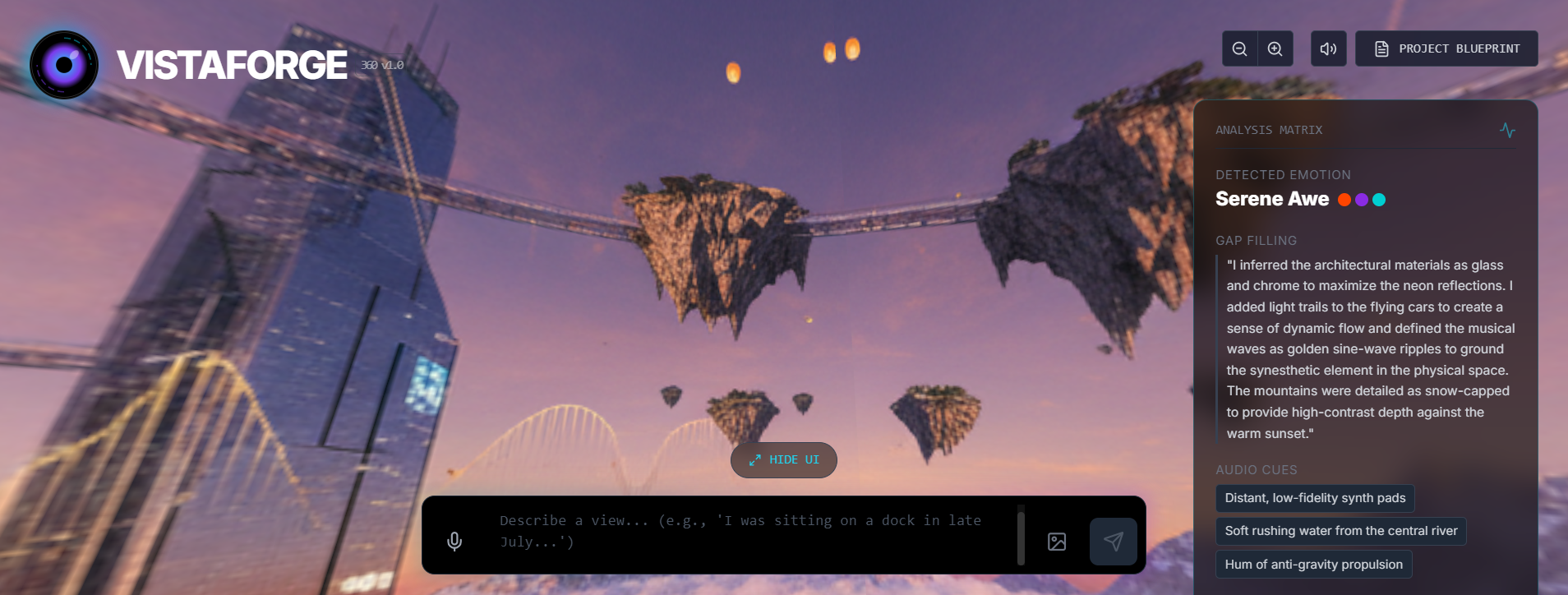
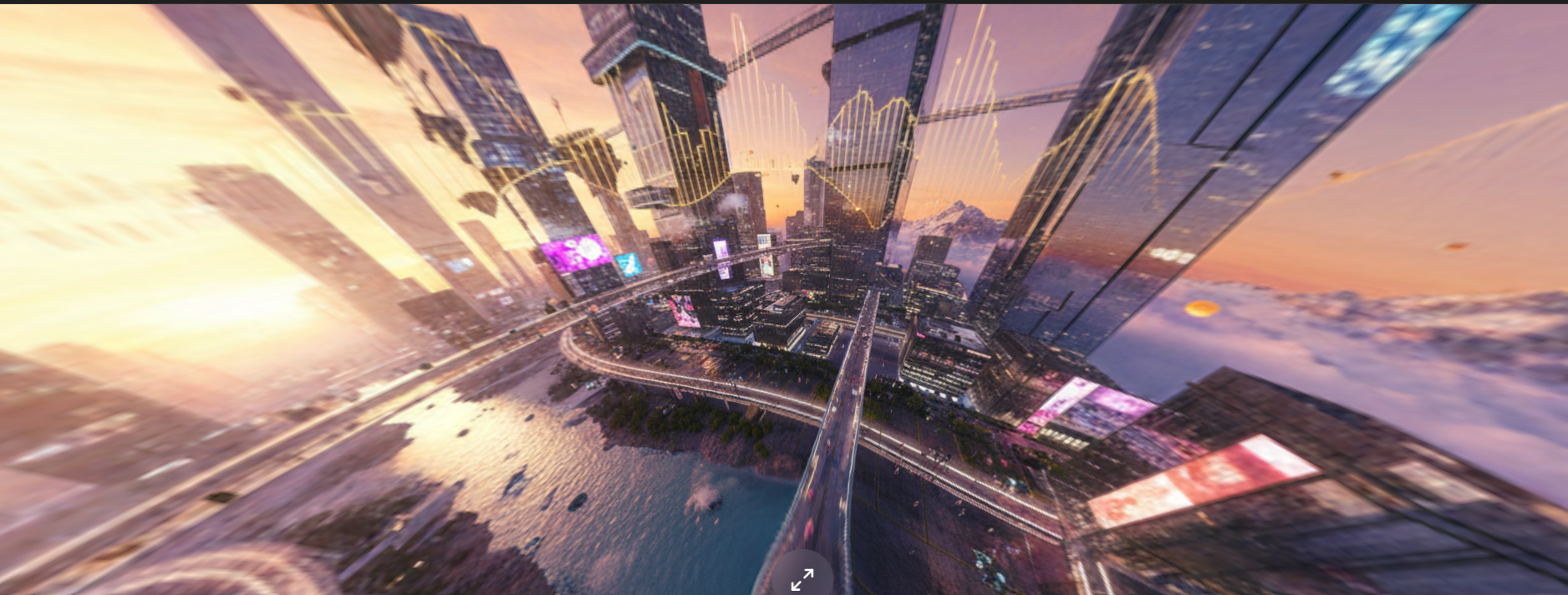
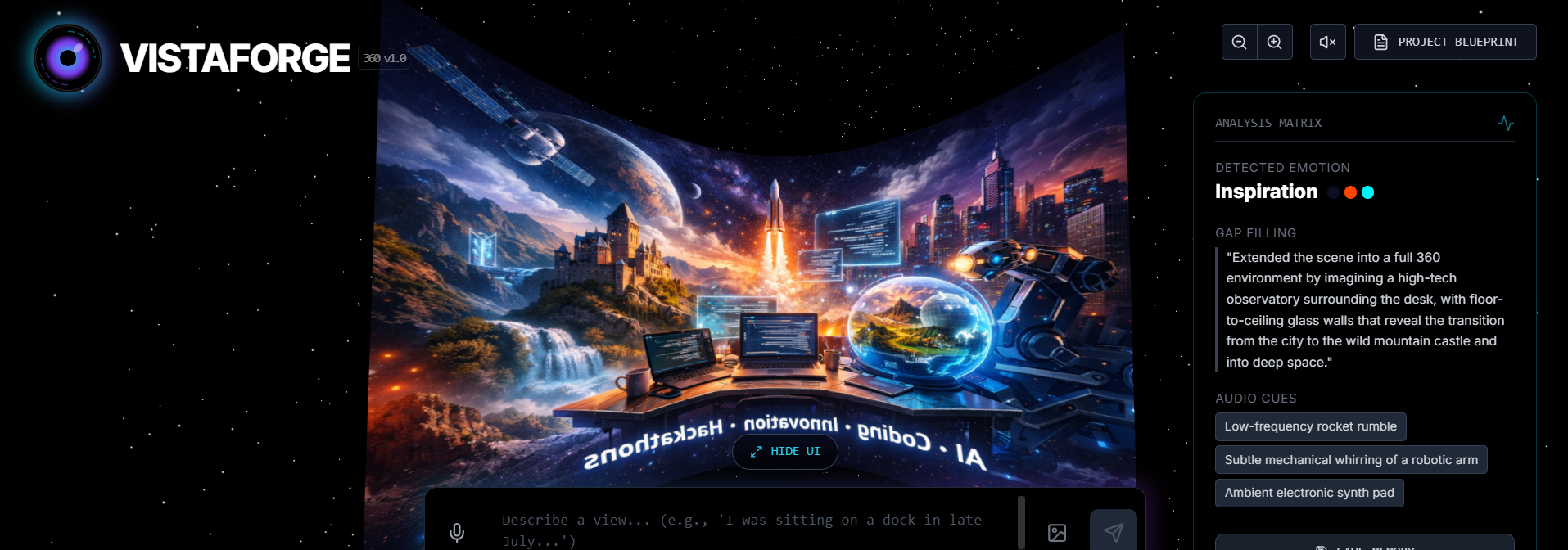
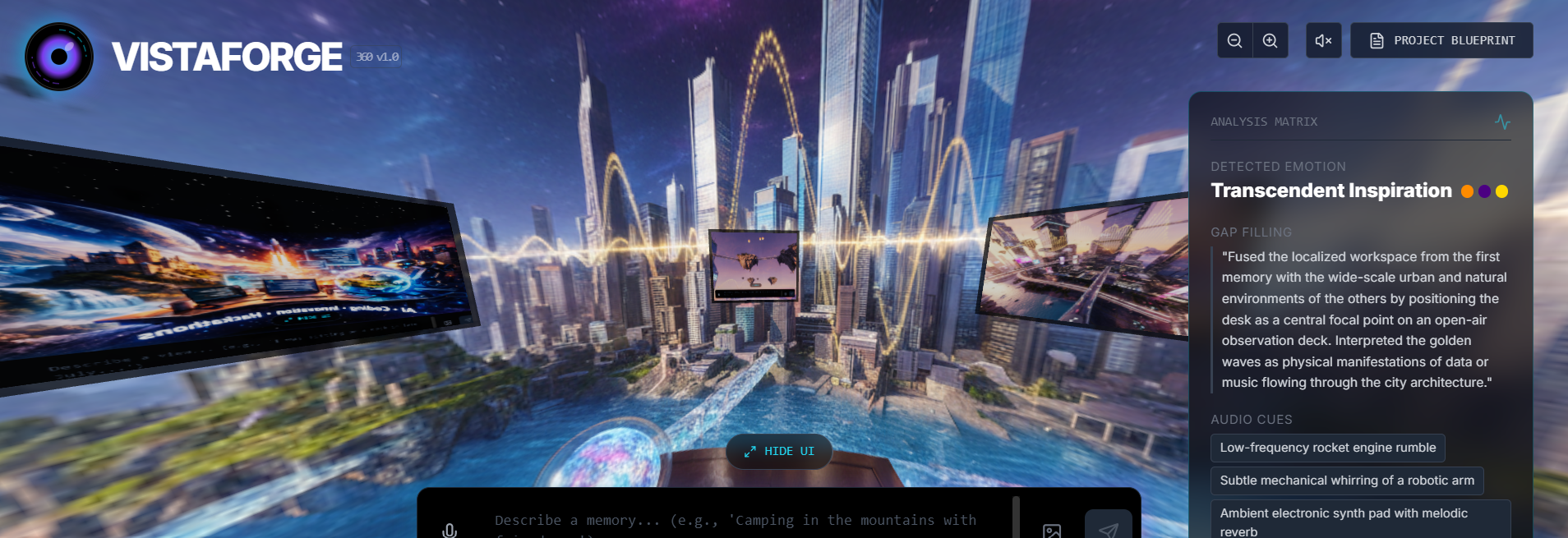
Text prompts can be transformed into fully explorable 360° environments using VistaForge 360, an AI-powered immersive scene generation engine.
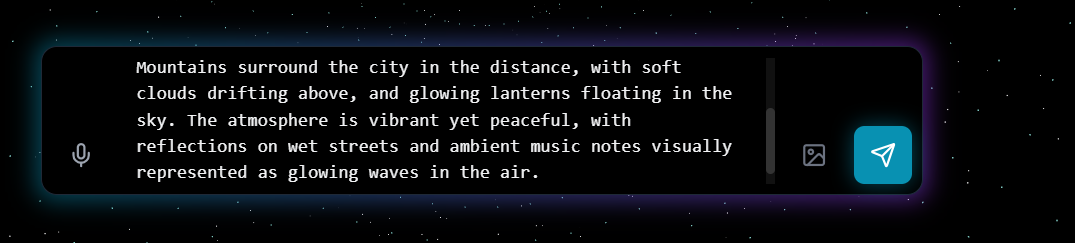
Users: Add a description of the situation.Semantic context is processed and interpreted by our AI.It creates a 360-degree spatial scene.
The environment can be interactively explored by the user. Essential Skills: --Text → creation of a 360° panoramic world -- Scene comprehension using** NLP** --Real-time 3D rendering -- Changing lighting and surroundings --Web-based immersive viewer
How we built it
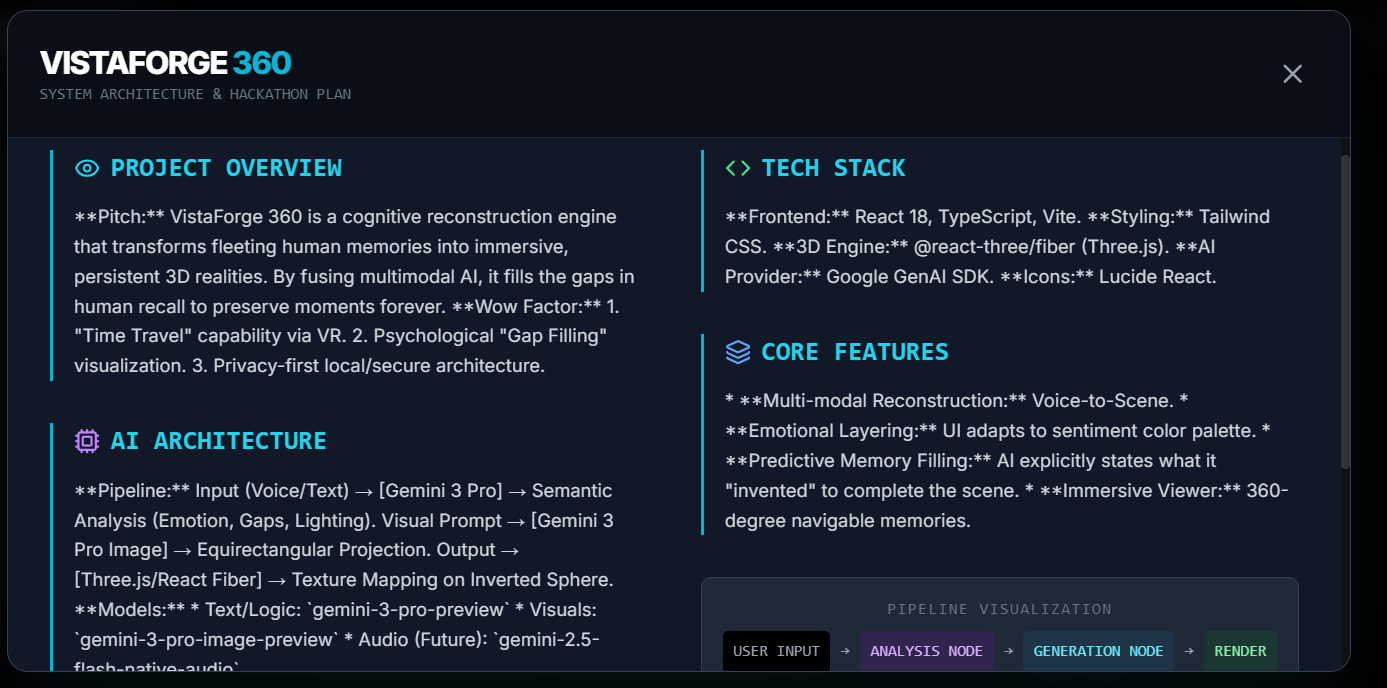
We use transformer-based language models to extract structured scene data from user prompts.
Example (Prompt Parsing Logic):
def parse_prompt(prompt): scene_data = { "environment": extract_environment(prompt), "lighting": extract_lighting(prompt), "objects": extract_objects(prompt), "mood": extract_mood(prompt) } return scene_data
2️⃣ Scene Generation Engine
We convert parsed data into structured JSON used by our rendering engine.
Example Scene Blueprint:
{ "skybox": "cyberpunk_night", "lighting": { "type": "neon", "intensity": 0.8 }, "objects": ["skyscraper", "flying_car", "wet_street"], "effects": ["reflection", "fog"] }
3️⃣ 360° Rendering System (WebGL / Three.js)
We built an interactive panoramic renderer using WebGL.
Example Scene Setup:
import * as THREE from 'three';
const scene = new THREE.Scene(); const camera = new THREE.PerspectiveCamera(75, window.innerWidth/window.innerHeight, 0.1, 1000); const renderer = new THREE.WebGLRenderer();
renderer.setSize(window.innerWidth, window.innerHeight); document.body.appendChild(renderer.domElement);
const geometry = new THREE.SphereGeometry(500, 60, 40); geometry.scale(-1, 1, 1);
const texture = new THREE.TextureLoader().load('generated_scene.jpg'); const material = new THREE.MeshBasicMaterial({ map: texture });
const mesh = new THREE.Mesh(geometry, material); scene.add(mesh); camera.position.set(0, 0, 0.1);
function animate() { requestAnimationFrame(animate); renderer.render(scene, camera); } animate();
Challenges we ran into
🔥 1. Semantic Ambiguity
Natural language is highly ambiguous. A prompt like:
“A dark fantasy castle”
could imply gothic horror, medieval realism, or surreal architecture.
Solution: We implemented contextual weighting and semantic tagging to better understand user intent.
⚡ 2. Real-Time Performance
Rendering high-quality 360° environments in-browser required performance optimization.
Solution:
Texture compression
Lazy asset loading
Optimized shaders
Scene asset caching
🧠 3. Mapping Language to Spatial Logic
Converting textual relationships like:
“Mountains behind the castle with a river flowing in front”
into spatial positioning required a custom rule engine.
Example:
if "behind" in prompt: position(object_a, relative_to=object_b, axis="z", offset=-20)
Accomplishments that we're proud of
🚀 Fully working text-to-360 pipeline 🌍 Real-time immersive rendering in browser ⚡ Scene generation under 5 seconds 🧠 Context-aware scene structuring engine 🎮 Cross-platform compatibility (Desktop + VR-ready)
Most importantly: We transformed language into immersive digital reality — not just images.
What we learned
Building VistaForge 360 taught us:
Natural language is spatially complex Performance optimization is critical in immersive systems UX simplicity determines adoption Iterative prompt testing improves AI accuracy Immersive computing is the future of human-computer interaction
We learned that the true challenge is not generation — but interpretation.
What's next for VistaForge 360
🥽 VR headset integration (WebXR) 🏗 Real-time world editing tools 🤝 Multiplayer collaborative scene building 🎬 Export to Unreal / Unity 🧠 Fine-tuned scene-specialized AI model 🌐 Metaverse-ready deployment engine
Future Vision: VistaForge 360 will become a universal engine where words are no longer read — they are lived.

Log in or sign up for Devpost to join the conversation.