Inspiration
I lose things. Phone chargers, keys, a coin that rolled off a desk. Video cameras see all of it, but nobody can ask a video "where did it go?" and trust the answer. I wanted a system that answers with the exact frame that proves it, and that admits when it doesn't know.
What it does
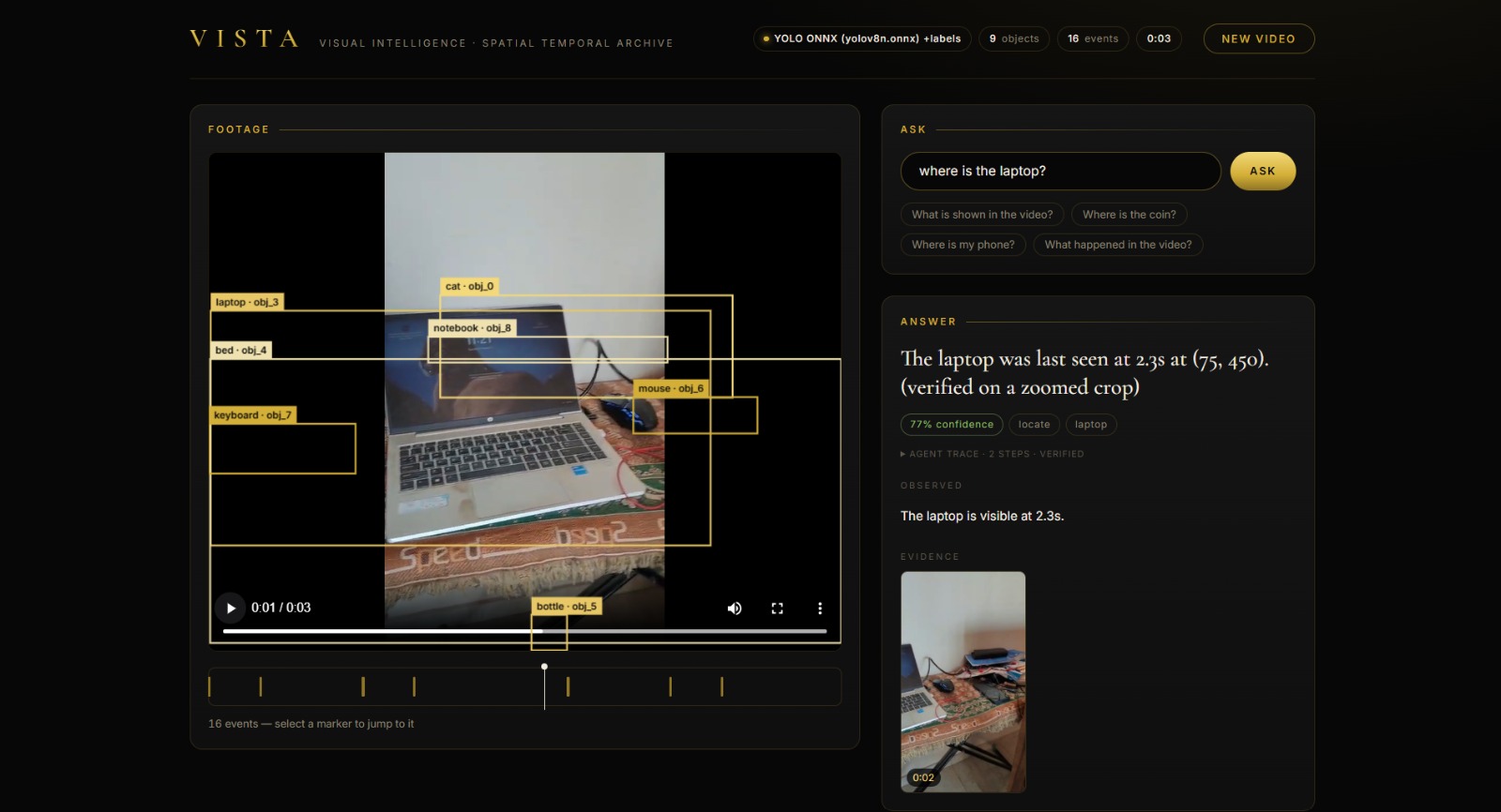
VISTA (Visual Intelligence and Spatial Temporal Archive) turns a video into a persistent, queryable memory of objects. Upload a clip and ask "where is the laptop?" The answer cites a frame, and clicking it jumps the video to that moment. Observed facts are kept separate from inferences, and "I cannot determine" is an allowed answer.
A verify agent then checks each answer. It crops the claimed region, zooms in, and re-runs detection. Depending on what it sees, it accepts the answer, tries another candidate, re-scans at higher sampling, or asks the human. It never guesses a location, and every step is shown as a trace in the UI.
How I built it
- OpenCV 5: video decode, adaptive frame sampling with optical flow and background subtraction, YOLOv8n detection through
cv2.dnn, ORB and histogram re-identification, Kalman tracking, and zoom crops for verification. - AWS: an EC2 Graviton5 instance running the Cloud Optimized OpenCV (COOL) image with OpenCV 5.1, Amazon S3 for video, memory and evidence, a bucket-scoped IAM role, a one-IP security group, and a budget alert. All of it is scripted in the repo.
- Stack: Python, FastAPI, React and SQLite, with dependencies pinned in
uv.lock. - Agent: a deterministic loop of lookup, crop and re-detect, re-scan, then ask the human. It uses no language model.
What I measured
- Graviton ran the pipeline about 1.3x faster and 31% cheaper per frame than x86.
- COOL matched stock OpenCV on the same Arm hardware, within noise (+2.8%). I report that as measured.
- On 20 real phone videos, the first answer was right 75% of the time on my laptop and 60% on the deployed instance. I haven't isolated why.
- On four MOT17 sequences, MOTA ranged from 0.15 to 0.53. Precision was high, and recall was low on crowded 1080p scenes.
- On held-out clips, the agent's automatic accuracy was about equal to the plain answer. It doesn't improve accuracy. It makes answers checkable and handles failure safely.
Challenges
I first blamed one poor result on objects fragmenting into many tracks. Looking at the data showed the real cause was persistent false-positive boxes from a patterned table, so I corrected my own write-up. I also found that my first crop check stretched thin objects like bottles, fixed it, and then tested on clips I hadn't touched. The weakest spots are a small evaluation sample, a closed-set detector that struggles with flat objects, and a printed photo of a face being reported as a person.
What I learned
Measure before claiming. Several of my first guesses were wrong, and the honest numbers were more useful than flattering ones.
Responsible use
VISTA stores video and per-person tracks. Use it only on footage you have consent to process.
What's next
A larger detector for crowded scenes, and isolating the gap between the laptop and the deployed instance.
Built With
- amazon-ec2
- amazon-web-services
- fastapi
- graviton
- opencv
- python
- react
- sqlite
- yolo


Log in or sign up for Devpost to join the conversation.