Inspiration
Industries such as infrastructure maintenance, manufacturing, and brand compliance rely heavily on manual visual inspections that are time-consuming, error-prone, and expensive. Undetected cracks, corrosion, or inconsistencies in product packaging often lead to safety risks, financial loss, and regulatory non-compliance. The inspiration behind this project is to create an AI-powered visual inspection system that can act as a continuous, reliable "machine’s eye"—one that never forgets what is normal and instantly flags any subtle changes across time-series images. This aims to vastly improve inspection efficiency and accuracy while reducing human labor and error.
What it does
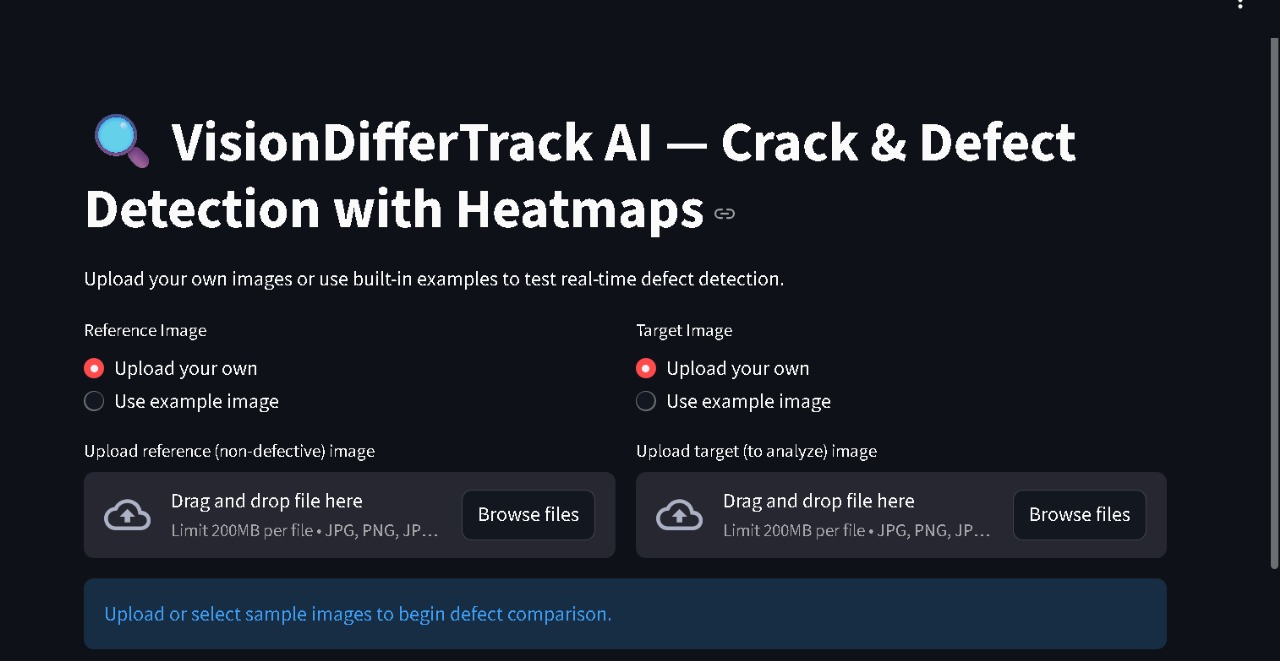
This system automatically detects, tracks, and classifies subtle visual changes in sets of images captured at different time points. It highlights differences such as cracks, corrosion, deformations, or logo mismatches by generating visual heatmaps that indicate precise areas of change. The engine helps industries perform intelligent, automated visual inspections without human intervention, facilitating faster decision-making and improved quality assurance.
How we built it
The core architecture is a hybrid Siamese deep learning model: A CNN encoder extracts detailed spatial features capturing fine image textures and structures. A Siamese network compares pairs of images to identify differences based on feature similarity, making the model robust to variations like lighting or shadows. Optional temporal modules like RNNs or LSTMs can be used to track change progression in time-series data. The preprocessing pipeline includes image alignment and normalization to minimize false positives. We use cosine similarity or Euclidean distance in the Siamese structure to quantify differences
D = ∥ f(x1) - f(x2) ||
where $$f(x)$$ represents the CNN feature vector for an input image. The model is built in Python using TensorFlow or PyTorch, with OpenCV for image processing and a Flask or Streamlit interface for user interaction. Visual explanations are provided via Grad-CAM heatmaps that pinpoint exact regions of change.
Challenges we ran into
Ensuring robust image alignment and illumination normalization to reduce erroneous detections due to lighting or perspective changes. Overcoming limited labeled training data by adopting a Siamese approach that learns similarity rather than absolute classes. Balancing sensitivity to subtle changes while reducing false alarms from environmental variations and artifacts. Managing high computational demands from twin CNN networks through transfer learning and optimization.
Accomplishments that we're proud of
Engineering a hybrid Siamese CNN model capable of both granular and semantic-level visual change detection. Achieving significantly reduced false positive rates through refined preprocessing and architectural enhancements. Delivering interpretable, actionable visual outputs via clear heatmaps aligning with real-world inspection needs. Designing a system demonstration across multiple domains such as infrastructure safety, manufacturing quality assurance, and brand conformity auditing.
What we learned
High-quality preprocessing dramatically influences model accuracy and reliability. Visualization tools like Grad-CAM are indispensable for interpreting model decisions and fostering trust in AI. Combining spatial and temporal learning mechanisms is crucial to mimic human-like visual inspection. Siamese and hybrid architectures are particularly effective for applications dependent on differential similarity instead of rigid classification.
What's next for VissionDifferTrack AI
Integrate temporal analysis modules (RNN/LSTM) to better capture change evolution over multiple time steps. Extend visualization from 2D heatmaps to 3D inspection views, useful in infrastructure and asset management. Incorporate live anomaly detection and real-time alerting capabilities for preventative maintenance. Expand multi-modal data incorporation by integrating thermal, hyperspectral, or LiDAR data alongside RGB imagery for richer inspection contexts.

Log in or sign up for Devpost to join the conversation.