About Visora AI
The inspiration behind Visora AI came from a simple question: What if a computer vision system could do more than just detect a problem—what if it could actually decide what to do next?
Computer vision is already being used in manufacturing, safety, agriculture, and many other fields. But detecting something unusual is only the first step. In real-world situations, a system also needs to understand what it sees, handle uncertainty, and decide whether to investigate further or ask a human for help.
That is the problem we wanted to explore with Visora AI.
What We Built
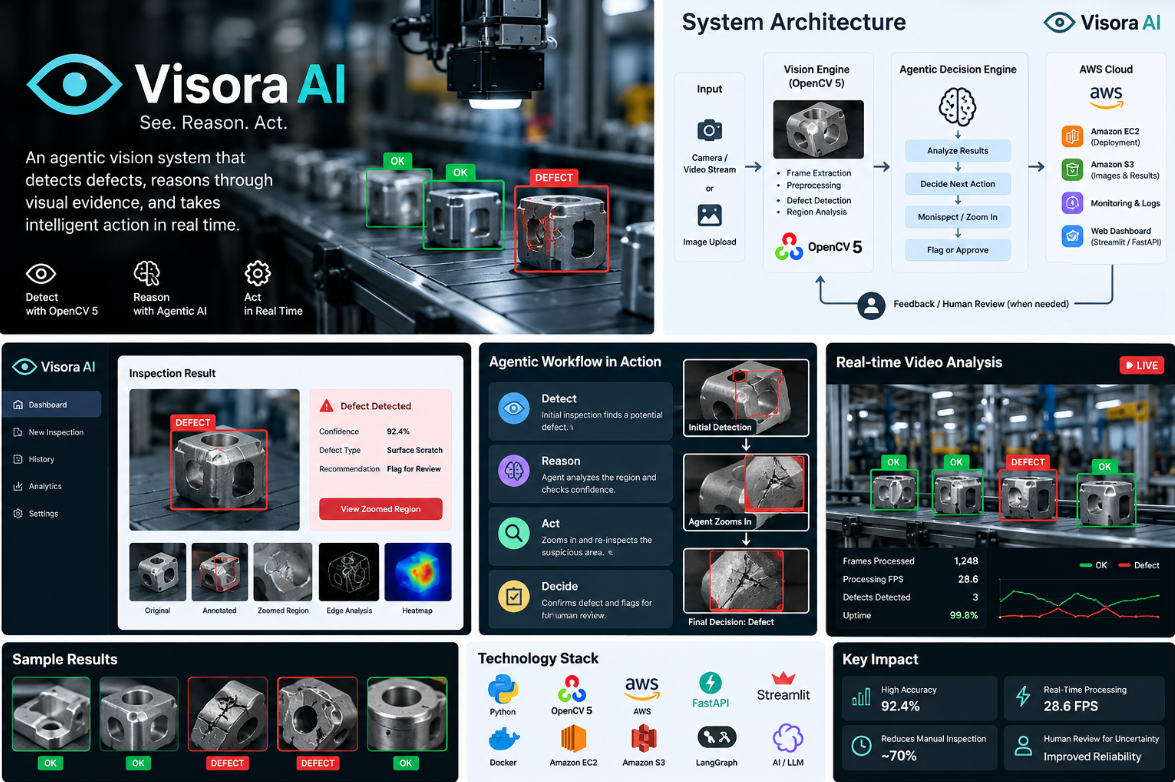
Visora AI is an agentic vision system built around OpenCV 5 and AWS. It analyzes images and video, identifies potentially suspicious regions, and uses the visual evidence to determine the next step.
Instead of following a fixed sequence of actions, the system is designed to respond to what it observes. When something looks unusual, it can inspect the relevant region more closely, evaluate the result, and flag uncertain cases for human review.
OpenCV 5 forms the core of the visual analysis, while AWS provides the cloud infrastructure needed to run and demonstrate the application. Our goal is to connect visual perception with practical, explainable decisions.
How We Built It
We approached the project by breaking the problem into smaller pieces: visual input, image processing, decision-making, and the final output. We focused on making each step understandable and testable rather than building a system that simply produces a prediction without showing how it got there.
We also wanted the project to be useful beyond a demo. That meant thinking about how to evaluate the results, record decisions, handle uncertain cases, and make the application accessible through a simple interface.
Challenges and Learnings
One of the biggest challenges in building an agentic vision system is that not every visual result is clear-cut. Lighting, image quality, unusual patterns, and false positives can all affect a system's decisions. A useful solution must recognize these limitations instead of treating every prediction as correct.
This project has pushed us to think beyond model accuracy. We are exploring how to make visual decisions more reliable, how to evaluate failures honestly, and how to keep humans involved when the system is uncertain.
We are also learning how to bring computer vision out of a local development environment and into a cloud-based application using AWS.
What's Next?
Visora AI represents our belief that the next generation of computer vision systems should not only see but also reason, adapt, and act responsibly.
Our aim is to build a practical foundation for vision applications that can assist people with repetitive inspections, identify potential problems earlier, and make visual intelligence more useful in real-world settings.
This is an ongoing learning journey, and we see Visora AI as a starting point for exploring what happens when computer vision and agentic AI work together.
Built with OpenCV 5 and AWS, Visora AI turns visual evidence into the next intelligent action.
Built With
- agentic-ai
- amazon-ec2
- amazon-web-services
- amazon-web-services-(aws)
- artificial-intelligence
- cloud-computing
- computer-vision
- docker
- fastapi
- generative-ai
- human-in-the-loop
- image-processing
- langgraph
- machine-learning
- object-detection
- opencv-5
- python
- real-time
- streamlit
- video-analytics

Log in or sign up for Devpost to join the conversation.