-
-
Slack-Demo
Inspiration
What it does
How we built it
Challenges we ran into
Accomplishments that we're proud of
What we learned
What's next for Vismriti
Inspiration
A GDPR erasure request arrives as one email address. The obligation is to find every copy of that person across the warehouse, and the fines are for the copies you miss. Denmark fined IDDesign 1.5M DKK in 2019 for exactly this: "failure to delete personal data from an older system."
Privacy teams answer these by hand today, with Slack and a spreadsheet, because the data that gets missed is not the data anyone forgot about. It is the data no catalog could see. PII tags are applied at ingest, but derived tables rename, hash, and join that PII into synthetic keys the tags cannot follow, and an analyst's sandbox fork carries no tags and no owner at all.
That makes erasure a lineage question. Lineage is what DataHub already knows. The gap was that nobody was walking it at request time.
What it does
Give Vismriti one email address and it:
- Finds every PII-tagged column DataHub knows about
- Resolves the email to the identifiers the warehouse actually keys on, including the SHA-256 hash that hash-keyed derived tables carry
- Walks forward lineage across datasets, dashboards, and ML models
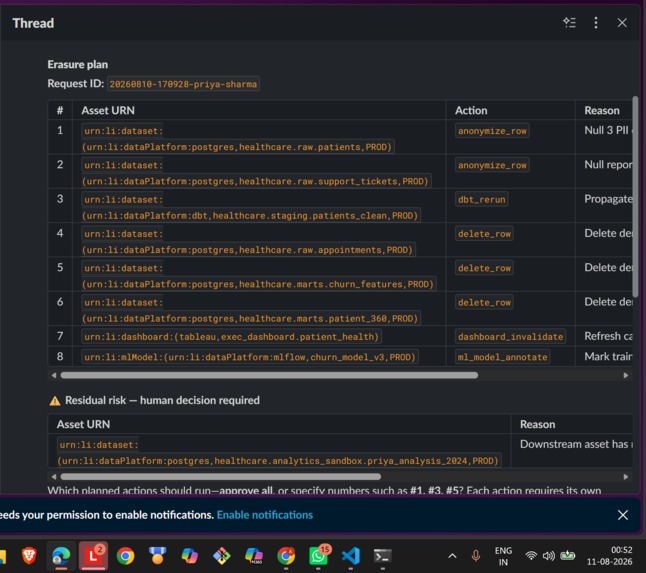
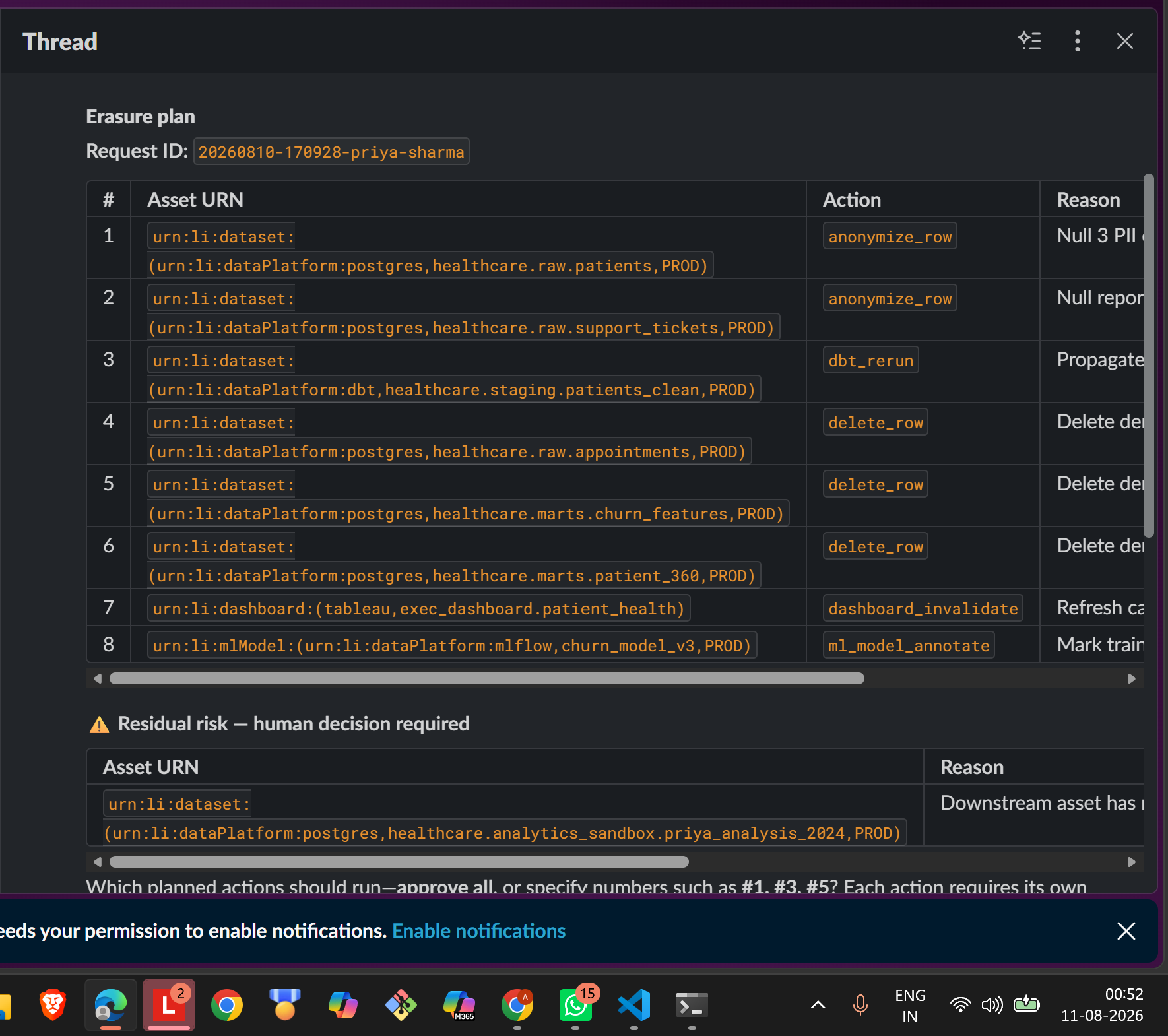
- Emits one deterministic action per asset: anonymize the source row, delete derived rows, re-run the dbt model rather than deleting from it, invalidate the dashboard extract, flag the model for retrain, or escalate for review
- Halts and waits for a human to approve or reject each action individually
- Executes only what was approved, dry-run by default
- Writes an audit trail so the next auditor inherits proof, not a Slack thread
The action we are proudest of is the one it refuses to take. An asset with no owner and no PII tag sitting downstream of a tagged source gets flagged as residual risk instead of deleted, because nobody can confirm what depends on it and a wrong delete is not reversible.
How we built it
The core design constraint: a language model is good at deciding which question to ask, and is the wrong tool for deciding what to delete. So the system is split with a hard boundary.
ErasureOrchestrator is the deterministic core - resolve, discover, traverse,
plan, execute, write back, report. It contains zero LLM calls and no agent
framework import, which is why the CLI, the Streamlit UI, and the test suite
drive the full pipeline offline with no API key, in under a second.
The LLM layer is Agno wrapping that core in four tools. The model picks tools and explains results. It never composes SQL. Destructive SQL comes from Jinja templates driven by ordered rules, and identifiers arriving from metadata are validated and quoted before they reach a template.
# The execute tool ignores any SQL in its arguments and looks the
# statement up from the stored plan. The model cannot fabricate a
# destructive statement, only request execution of a planned one.
found = _find_action(request_id, asset_urn)
The DataHub client has three interchangeable backends: fixtures for offline CI,
direct REST against live GMS, and mcp-server-datahub over stdio. The runtime
is AgentOS on FastAPI, which also exposes Vismriti as an MCP server, so
other agents can call its erasure tools.
Challenges we ran into
Our Azure Container Apps DataHub runs GMS v1.7.0 without Kafka and with empty search and graph indexes. We found this with curl, not documentation:
| Operation | Result |
|---|---|
GET /entities/{urn} |
Works |
POST /entities?action=search |
HTTP 200, numEntities: 0 |
GET /relationships |
HTTP 200, total: 0 |
POST /aspects?action=ingestProposal |
Blocks, times out at 45s |
That removed discovery, traversal, and writes over the API in one go. We seeded the client with an explicit URN set and reconstruct lineage from each entity's own aspects, which are readable.
The tempting shortcut was to return success from the write path so the demo looked clean. We took the other option. The execution report states that the DataHub write failed and why, and a live run exits non-zero with "Run incomplete: part of this erasure did not happen. Do not close the request."
One judgement call we want to name. The ML model's description literally reads "Trained on marts.churn_features", and we could have regexed that string to synthesize the lineage edge and shown 9 of 9 assets instead of 7. We did not. Scraping prose to decide what a right-to-erasure run touches is the kind of thing that demos green and misfires in production. It flags rather than fabricates, and the two missing assets are documented ingestion gaps.
A subtler bug: lineage lives in different aspects per entity type. Datasets
declare UpstreamLineage, dashboards declare inputs in DashboardInfo, ML
models in MLModelProperties. Reading only the first silently dropped the
dashboard from live plans - exactly the class of miss this project exists to
prevent.
What we learned
Deciding where the model is not allowed to operate turned out to be the main design work. Everything good about the system follows from the orchestrator containing no LLM calls: it is auditable, testable offline, and the blast radius is bounded by construction.
We also learned that a compliance tool that fakes a successful deletion record is worse than no tool at all. Every limitation above came from probing the real endpoint, and being straight about them is worth more than a green checkmark that lies.
What's next for Vismriti
Deploy Kafka so the write path lands, then drop the seeded URN list in favour of the search and relationships endpoints. Pluggable executors for dbt and Airflow, so the plan is consumed by whichever system already holds warehouse credentials. And retention on stored plans - they contain subject identifiers, and a right-to-erasure tool holding those forever is its own problem.
Built with
python agno datahub mcp fastapi streamlit slack postgresql
jinja2 pydantic typer azure-container-apps azure-openai

Log in or sign up for Devpost to join the conversation.