-
-
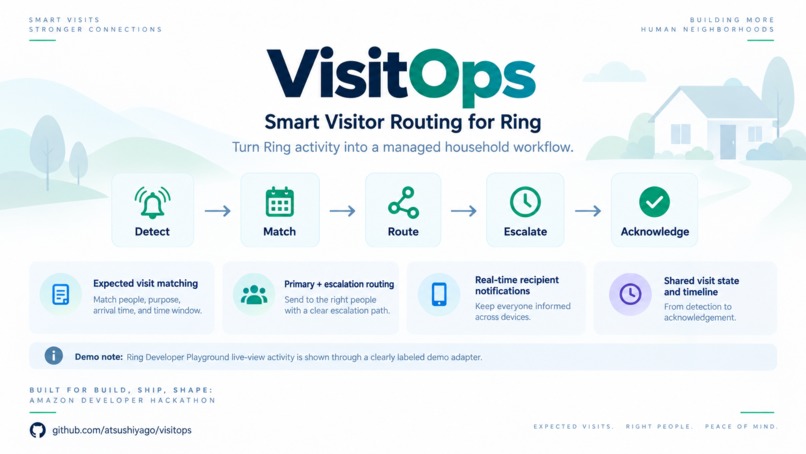
What is VisitOps
-
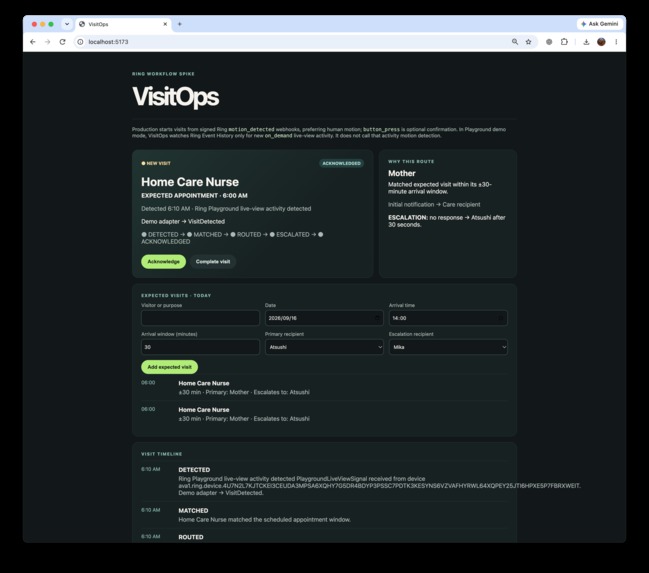
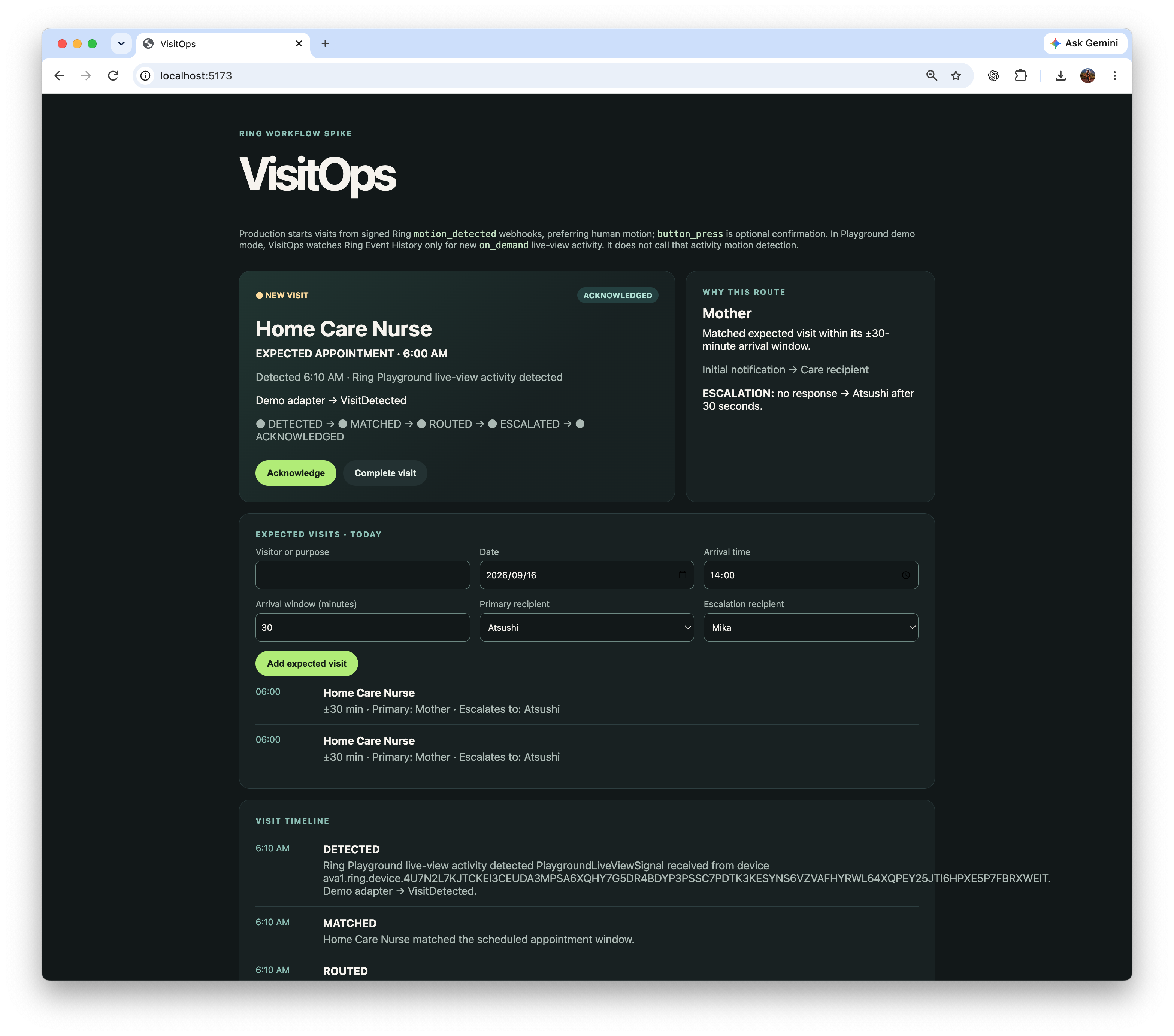
Main Dashboard
-
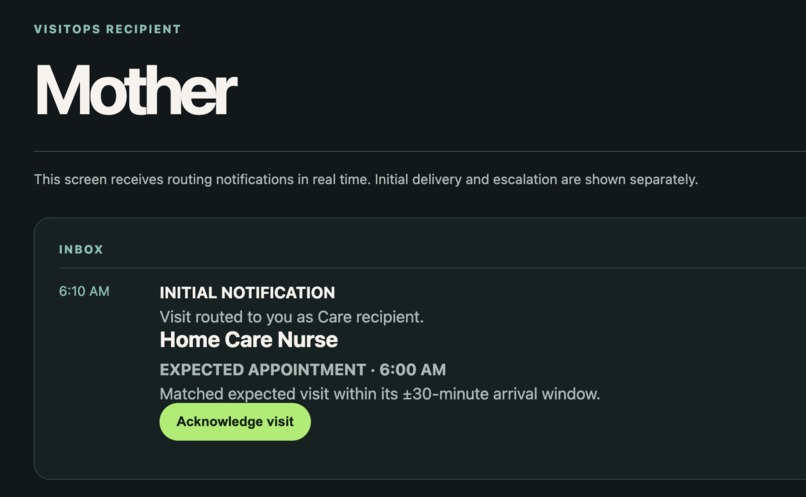
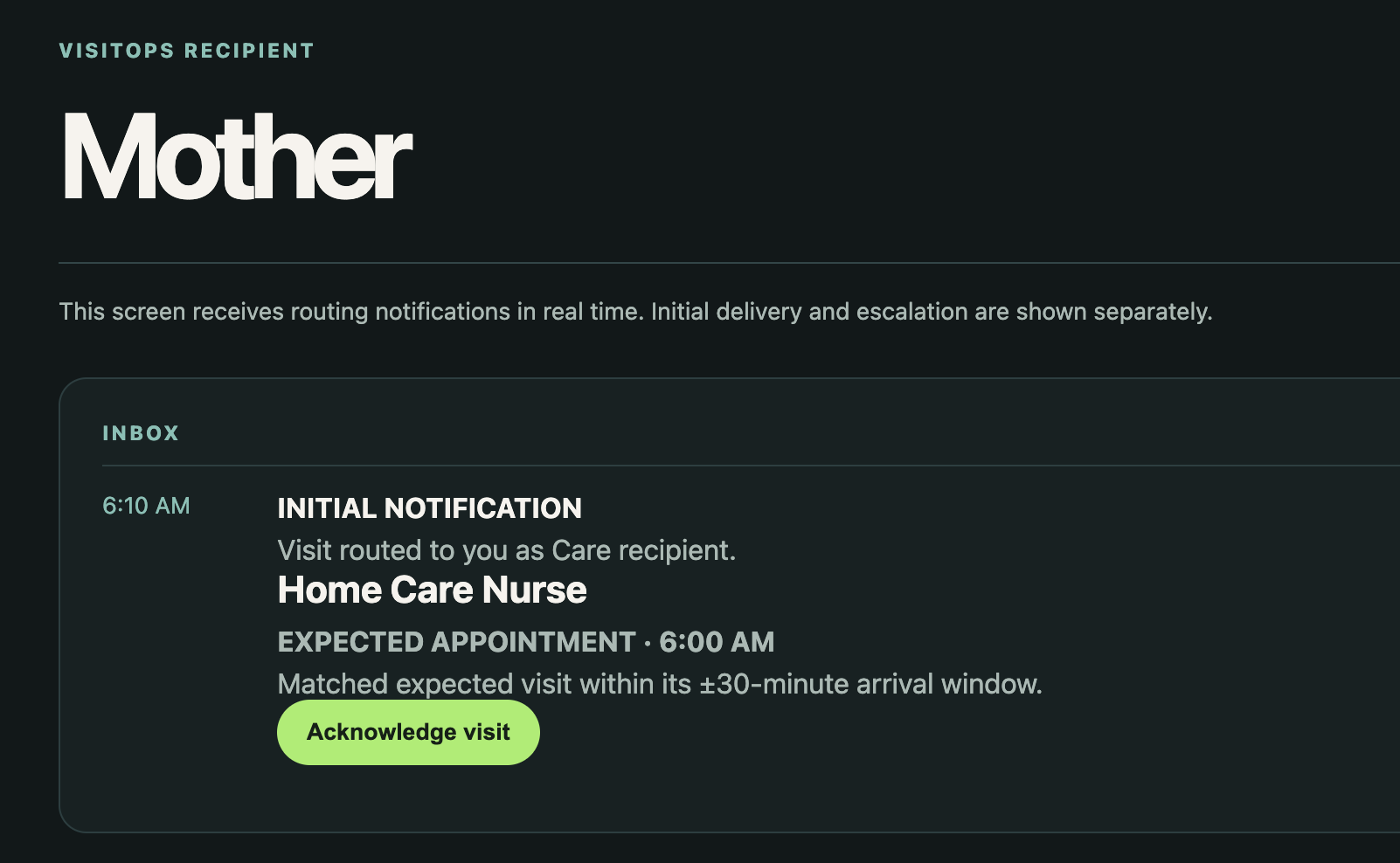
INITIAL NOTIFICATION
-
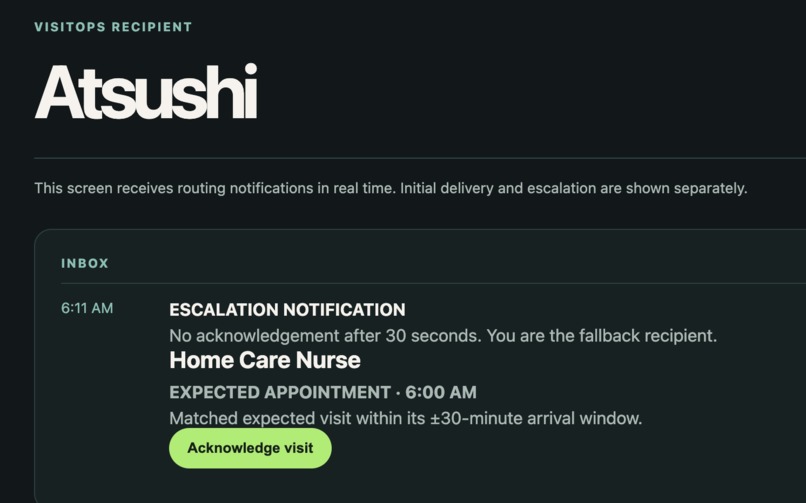
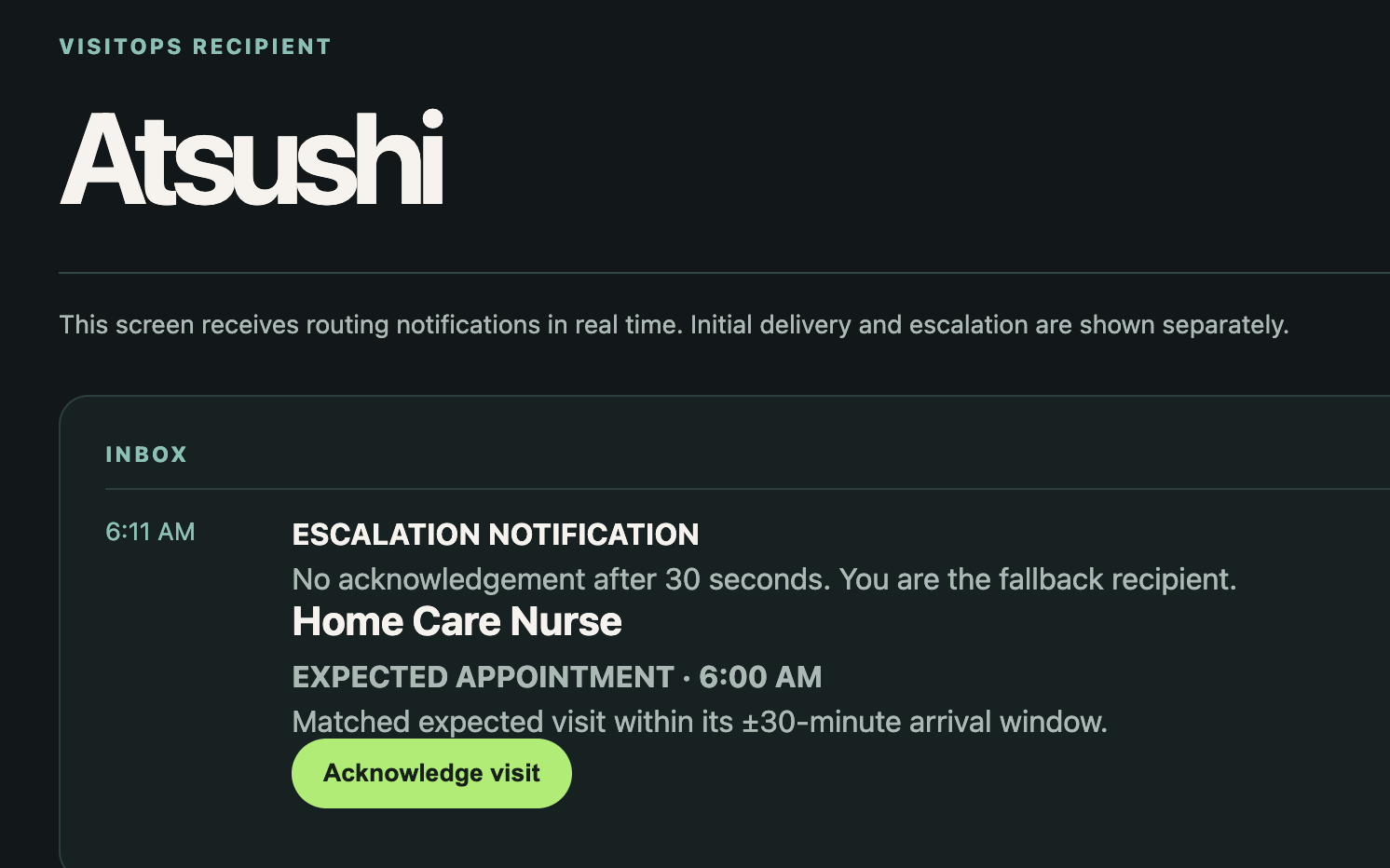
ESCALATION NOTIFICATION
-
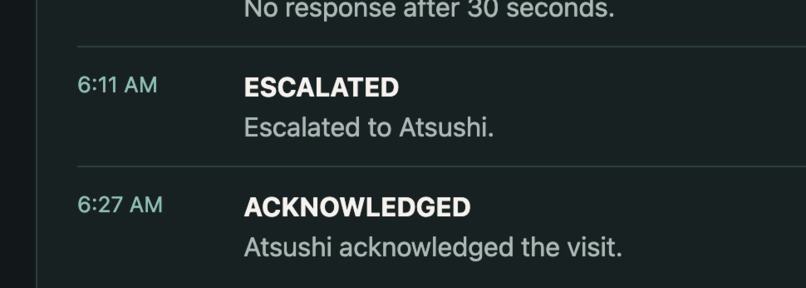
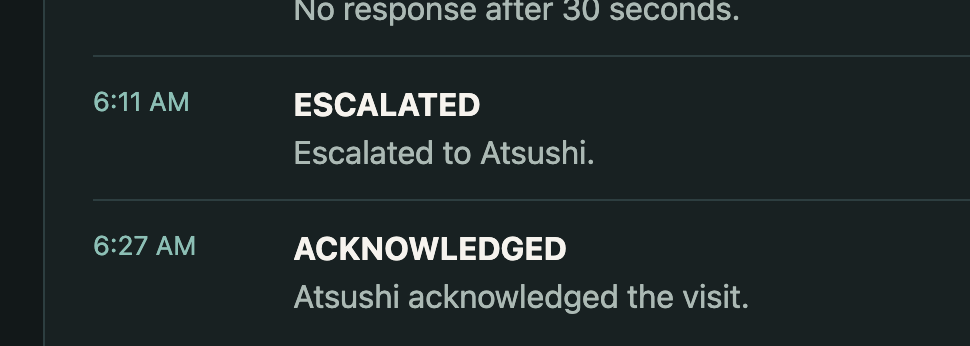
Acknowledged
-
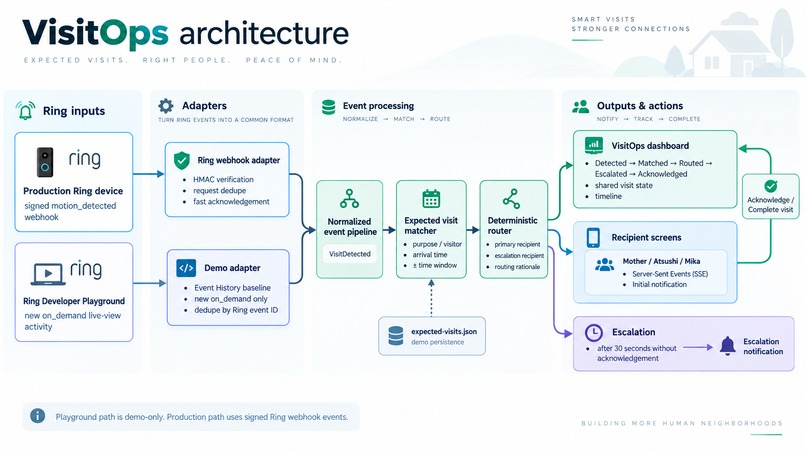
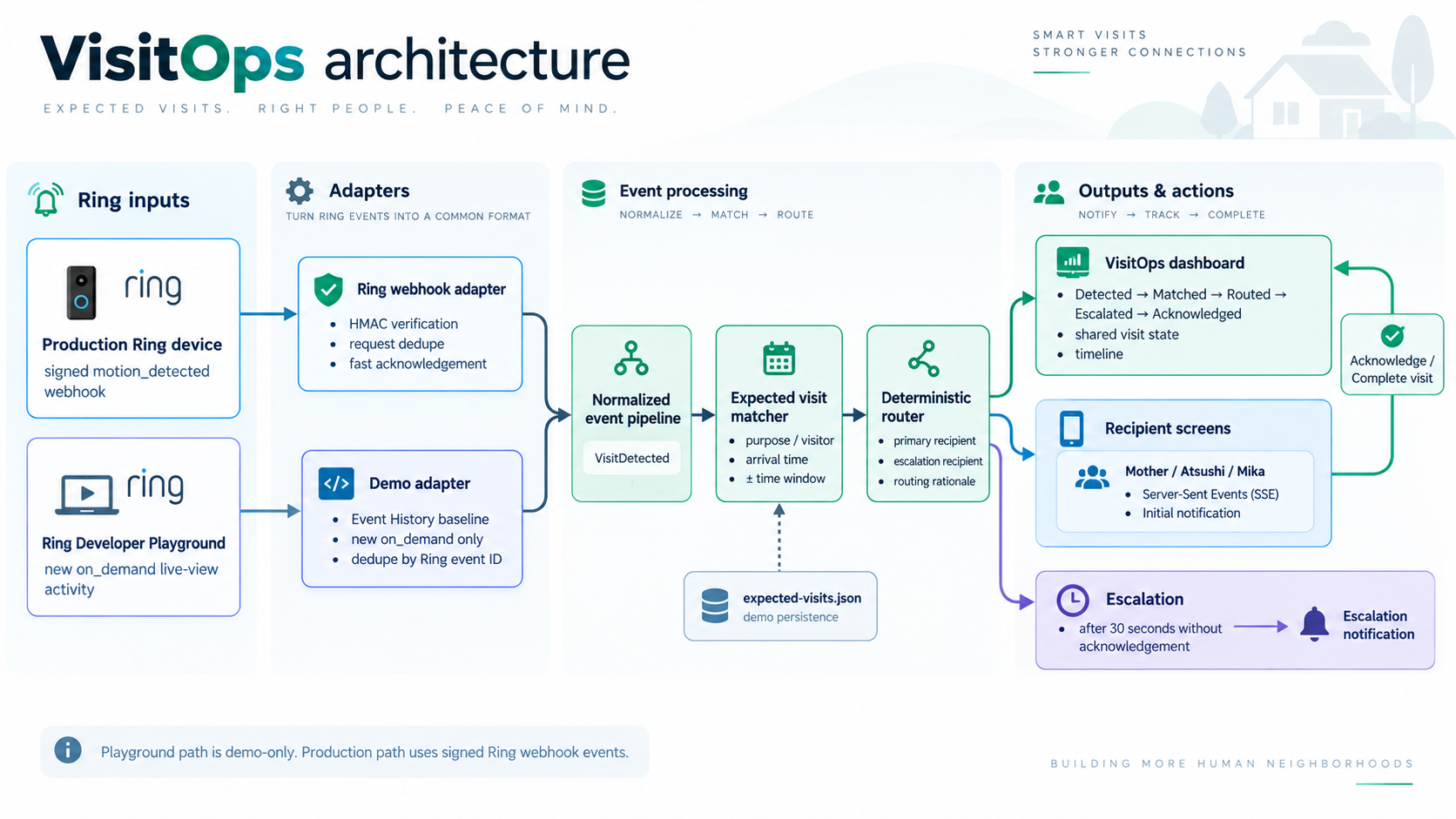
architecture
Inspiration
In a typical home, a doorbell interrupts everyone equally.
But the person who should answer is not always the person closest to the door. In a larger or multigenerational household, someone may be working in another room, an elderly family member may be expecting a caregiver, or a delivery may only matter to one resident.
I wanted to explore a different role for Ring: not just detecting that someone is at the door, but helping the household decide who should be interrupted, when, and what should happen if they do not respond.
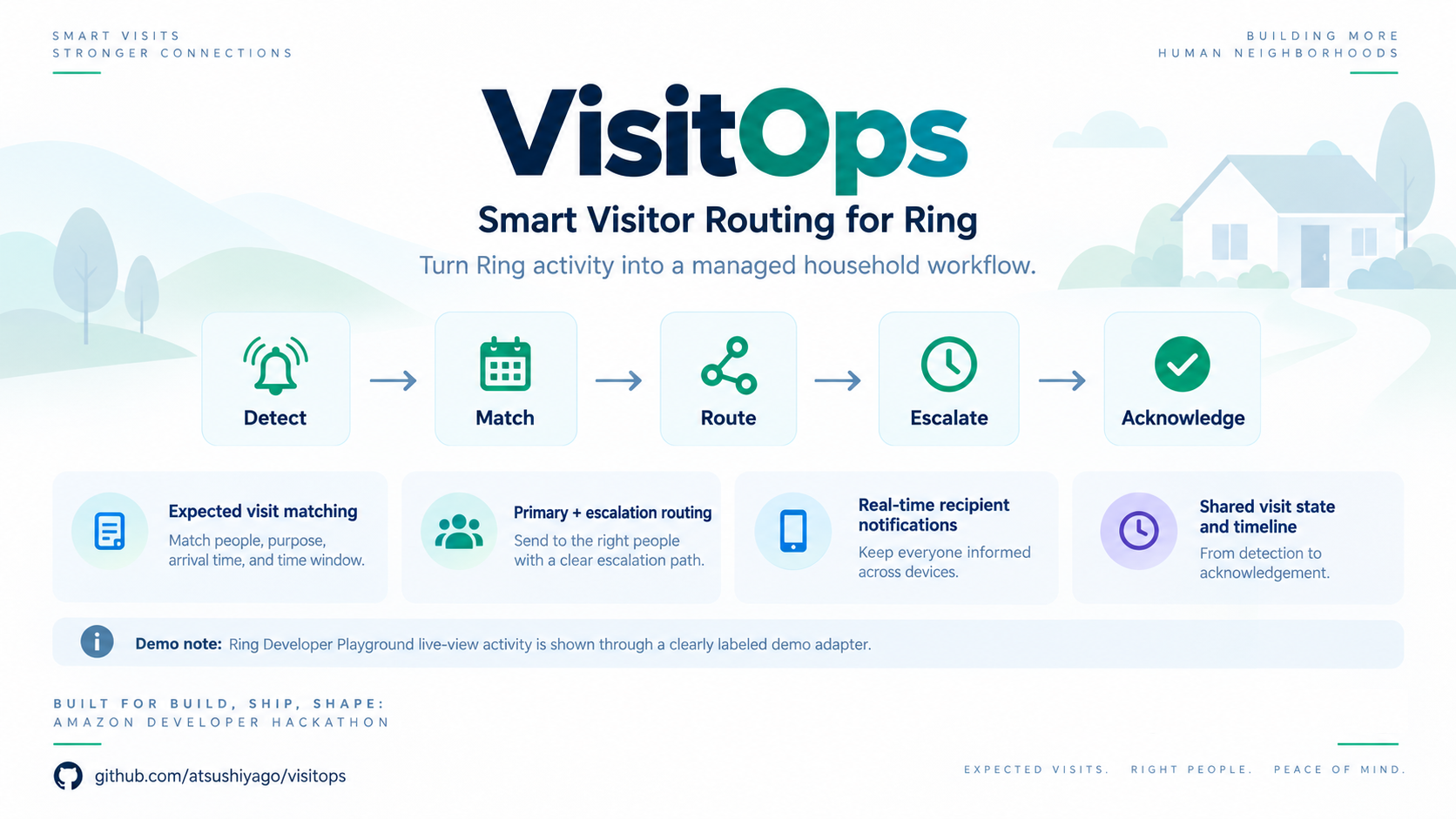
That became VisitOps — a lightweight visitor operations system built around Ring activity.
What it does
VisitOps lets a household register expected visits such as a caregiver, contractor, delivery, or guest.
Each expected visit can include:
- visitor or purpose
- expected arrival time and arrival window
- a primary recipient
- an escalation recipient
When Ring activity is detected, VisitOps normalizes it into a visit event and checks it against the expected-visit schedule.
If there is a match, VisitOps routes the visit to the appropriate household member instead of notifying everyone equally.
The primary recipient receives an Initial Notification. If they do not acknowledge the visit within the configured timeout, VisitOps automatically sends an Escalation Notification to the backup recipient.
Both recipients share the same visit state, so an acknowledgement from either person immediately updates the VisitOps dashboard.
The dashboard shows the full lifecycle:
Detected → Matched → Routed → No Response → Escalated → Acknowledged
It also explains why the visit was routed to that person, making the automation understandable rather than opaque.
How I built it
VisitOps is built with a React + Vite frontend and a Node.js / Express backend.
The backend uses a normalized visit-event pipeline so Ring-specific input is separated from the routing logic:
Ring event → VisitDetected → expected-visit matcher → deterministic router → recipient delivery → escalation → acknowledgement
Expected visits are persisted locally as structured JSON data.
Recipient pages receive real-time updates using Server-Sent Events (SSE), allowing different household members to receive different notifications while sharing the same visit state.
For production use, VisitOps includes a signed Ring webhook endpoint designed to receive motion_detected events. A doorbell press can act as an additional signal, but motion is the primary trigger because VisitOps is intended to react before the visitor necessarily presses the button.
I also created a private Ring staging integration with account-linking, token-exchange, and webhook plumbing.
Ring Developer Playground integration
One of the most interesting implementation discoveries came from the Ring Developer Playground.
The Playground provides simulated Package, Vehicle, and Motion Live View experiences. During testing, however, I found that triggering the Playground Motion experience did not produce a real motion_detected webhook.
Instead, Ring Event History received a new Ring-originated on_demand live-view session.
To keep the demo technically accurate, I added a clearly labeled demo adapter rather than pretending that this event was a production motion webhook.
The adapter:
- establishes a baseline of existing Ring Event History entries
- detects only newly created
on_demandentries - deduplicates them using their Ring event IDs
- converts them into a
PlaygroundLiveViewSignal - feeds that signal into the same normalized
VisitDetectedpipeline used by VisitOps
The UI explicitly identifies this path as:
Ring Playground live-view activity detected → Demo adapter → VisitDetected
The production webhook path remains separate and unchanged.
Challenges I ran into
The biggest challenge was making the demo both functional and technically honest.
At first, it seemed natural to use the Playground Motion simulation as though it represented a production motion webhook. Manual testing showed that this assumption was incorrect.
Rather than hide the difference, I treated it as a developer-experience constraint and built a thin adapter around the behavior that the Playground actually exposes.
I also investigated whether incoming Ring audio could be used as another confidence signal for identifying an expected visitor.
A WHEP/WebRTC spike successfully negotiated a live audio track and received RTP packets, but the synthetic Playground audio contained no measurable signal energy.
Because there was no usable speech signal, I deliberately did not add speech-to-text or visitor voice matching to the submission.
That kept the final product focused on functionality I could actually demonstrate and verify.
Accomplishments that I'm proud of
I am especially proud that VisitOps does more than display Ring activity.
A Ring-originated event causes a real workflow:
detect → match → route → wait → escalate → acknowledge
The primary and escalation recipients see different notifications in real time, while the dashboard maintains one shared visit state.
I am also proud that the Playground limitation is visible in both the architecture and the UI instead of being disguised as something it is not.
The result is a small prototype, but the workflow itself is complete and can be demonstrated end to end.
What I learned
Building VisitOps changed the way I thought about smart-doorbell automation.
The interesting problem was not simply:
"Who is at the door?"
It was:
"Given what the household already knows, who should handle this visit right now?"
That distinction turns a detection system into a coordination system.
I also learned how useful it is to separate device-specific events from product logic.
By normalizing Ring input into a generic VisitDetected event, the scheduling, routing, escalation, and acknowledgement system does not need to know whether the original trigger came from a production webhook or the Playground demo adapter.
What's next for VisitOps
The next step would be testing VisitOps with an eligible physical Ring device so the production motion_detected webhook path can be exercised end to end.
Other future improvements include:
- Web Push or native mobile notifications
- calendar integration for automatically importing expected visits
- using real-device visitor audio as an additional confidence signal, where supported
- optional visual context to improve visit matching
- QR codes or temporary credentials for visits that require stronger verification
- automatic visit completion and richer visit analytics
- routing policies for small offices, property managers, and caregiving households
The longer-term idea is simple:
Turn Ring from a doorbell into a visitor operations system.
Built With
- cloudflare
- express.js
- node.js
- react
- ring
- sse
- vite
- webrtc

Log in or sign up for Devpost to join the conversation.