-
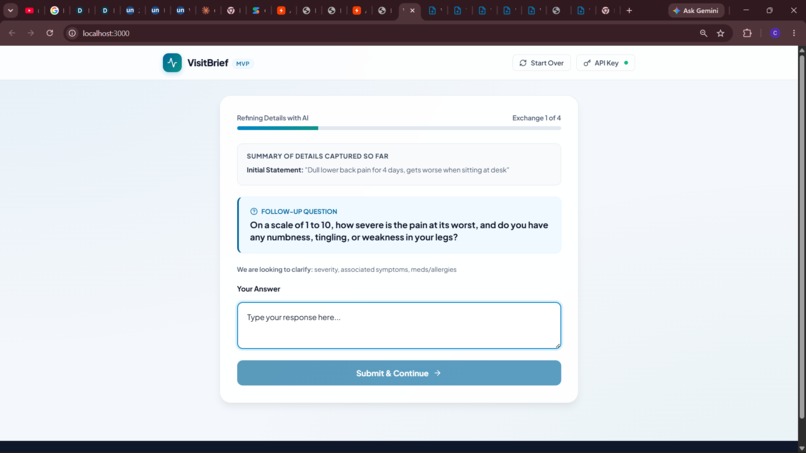
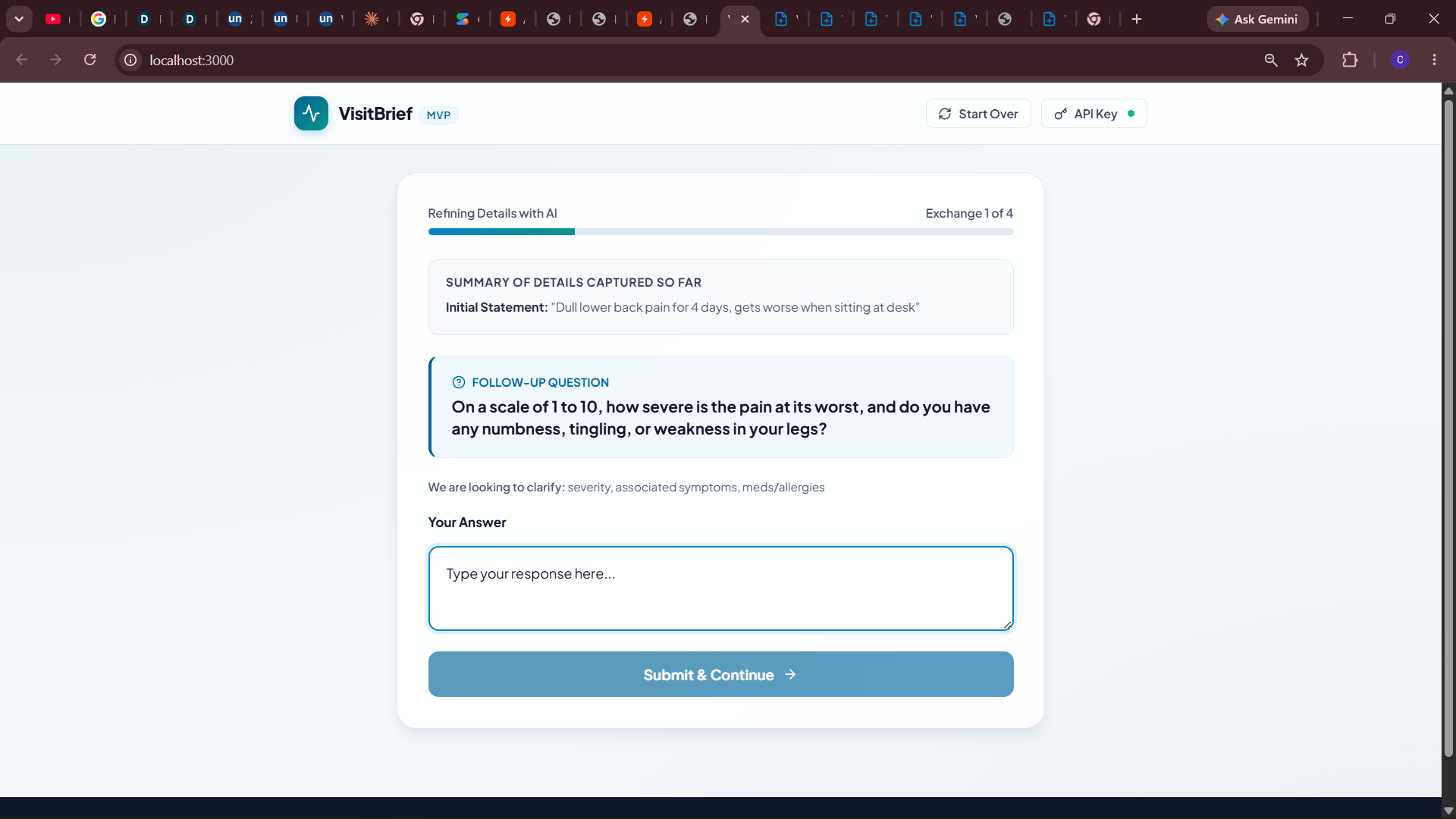
Home Intake & Hero Screen 2
-
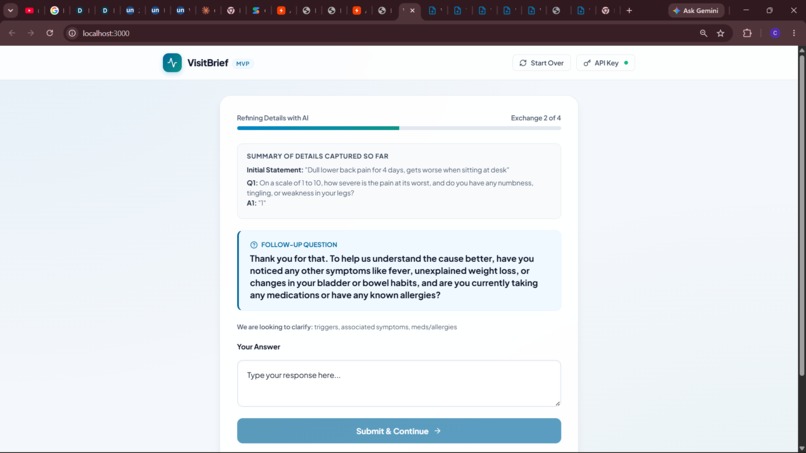
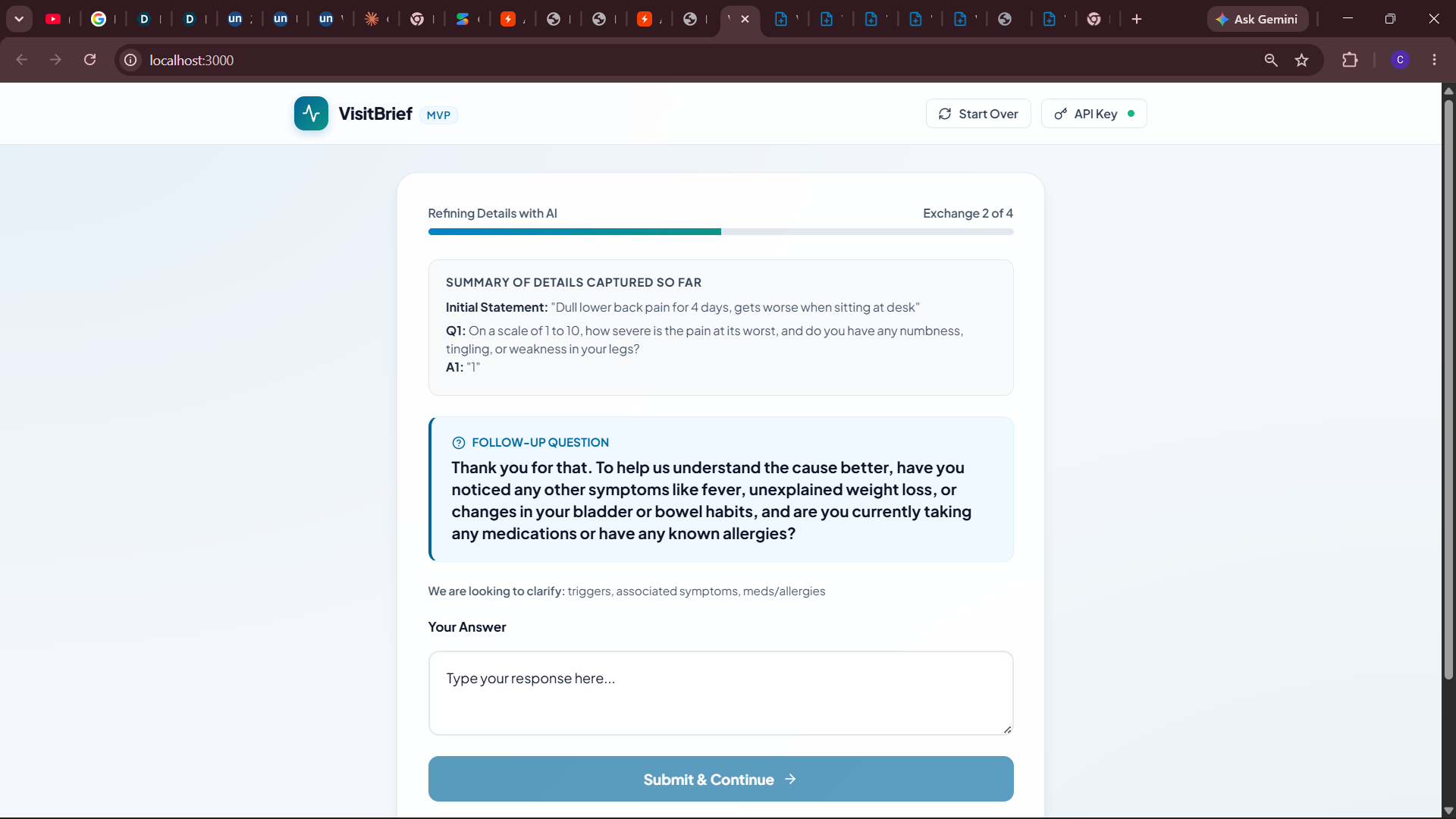
Home Intake & Hero Screen 3
-
-
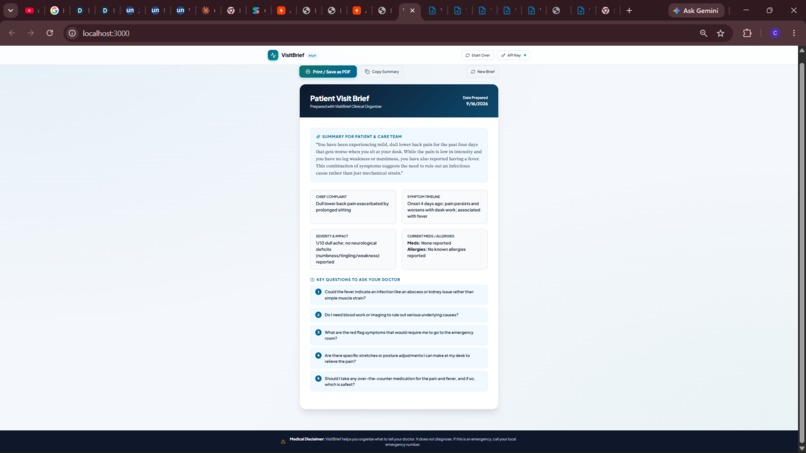
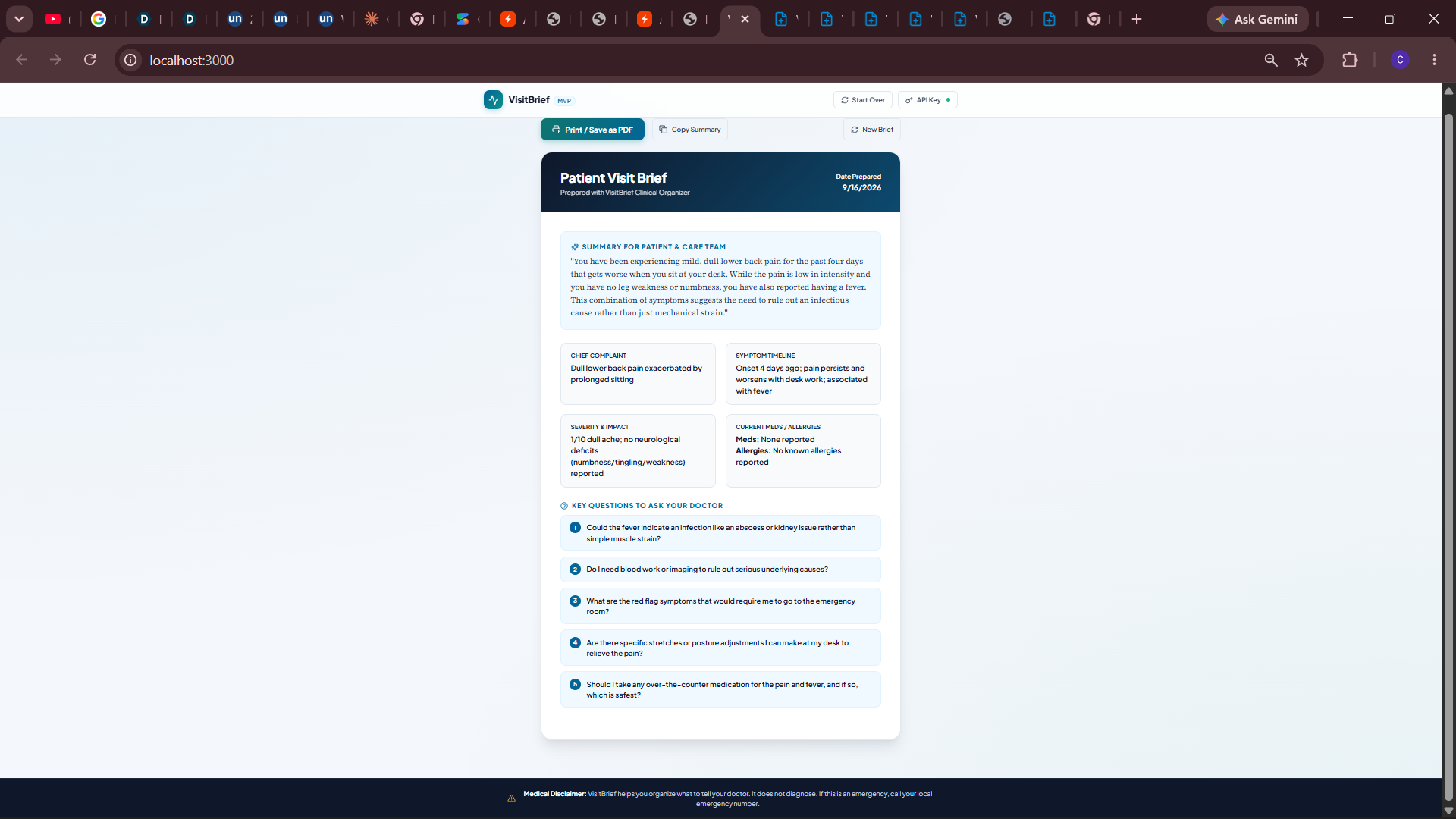
result
-
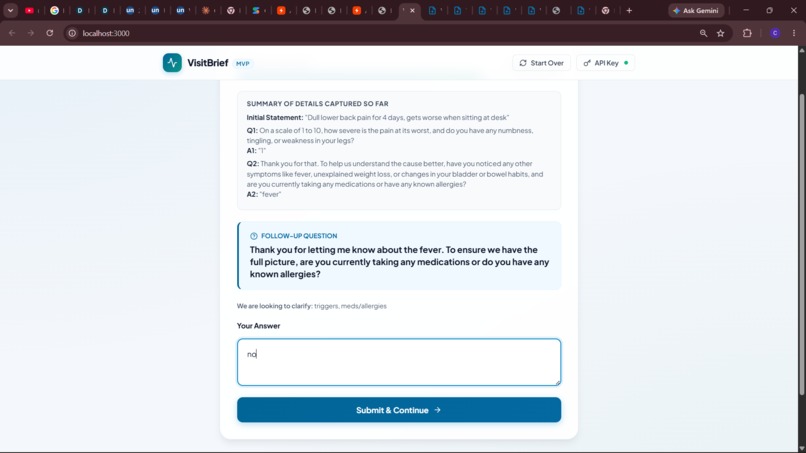
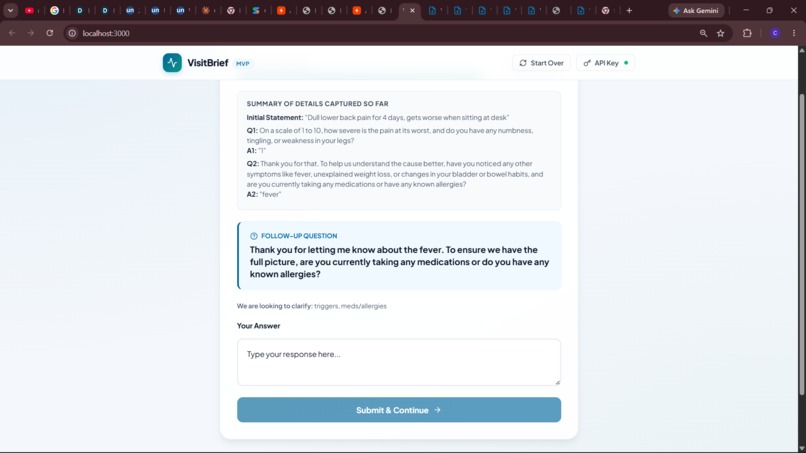
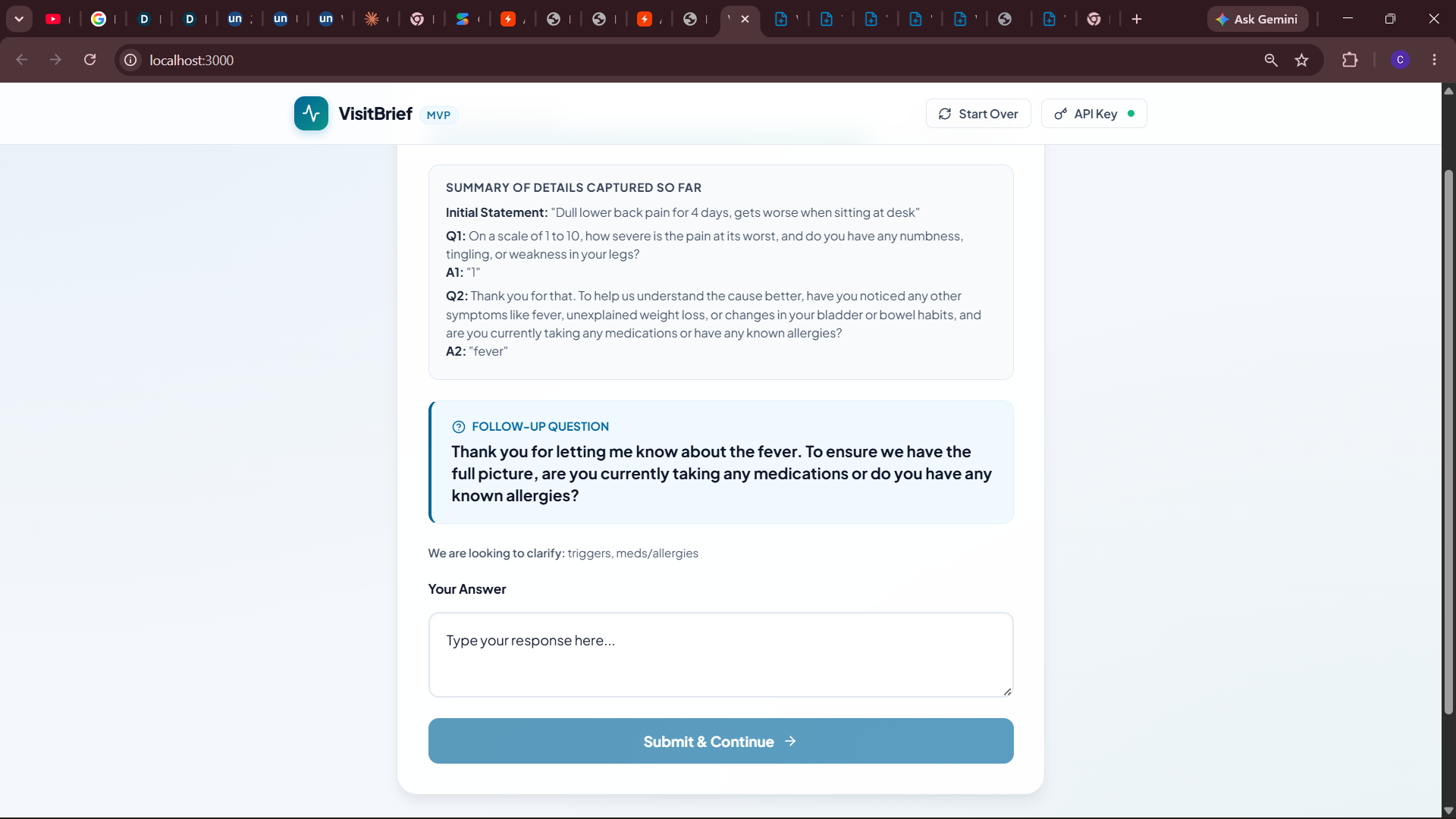
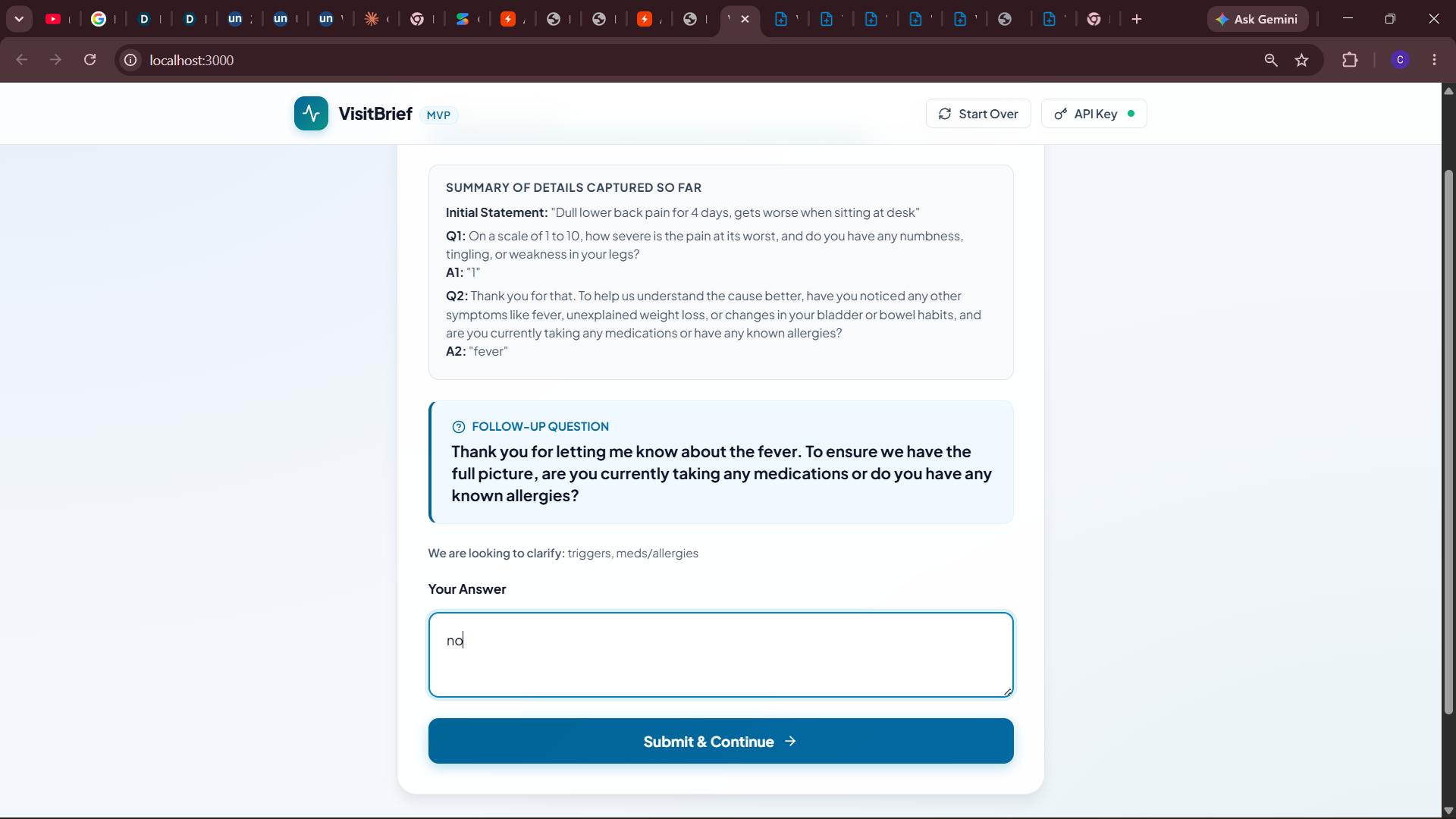
Exchange 3 & Medication / Allergy Gathering
-
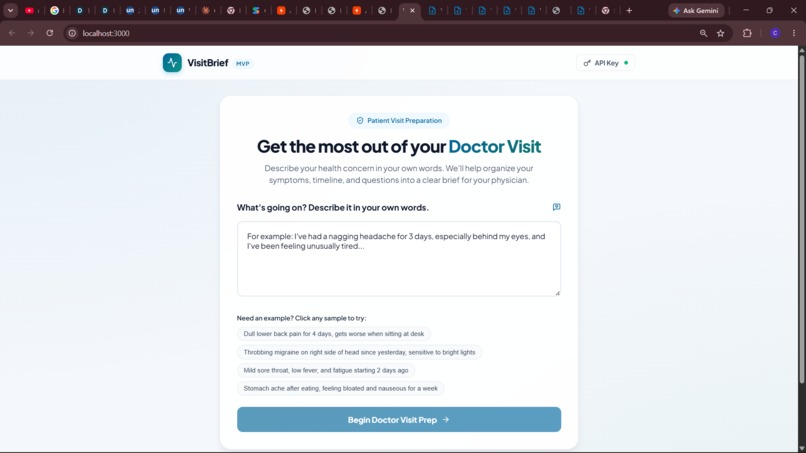
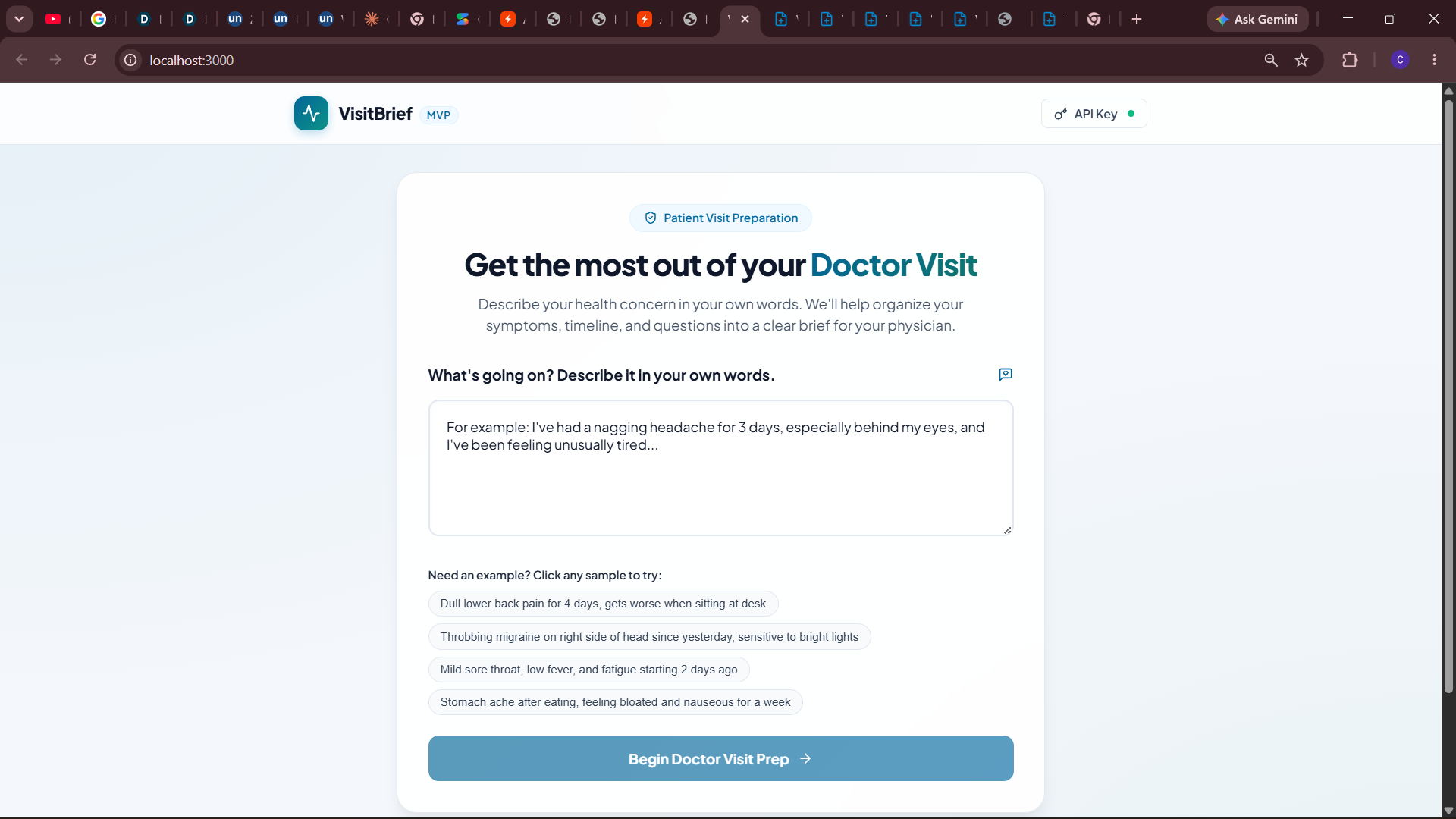
Home Intake & Hero Screen
💡 Inspiration
The average doctor visit lasts between 13 and 16 minutes. During that tight window, patients are often nervous, overwhelmed, and rushed. They struggle to articulate when symptoms started, how pain progresses, or which medications they take—and they frequently leave the clinic realizing they forgot to ask their most important questions.
On the clinician side, primary care physicians and urgent care teams are drowning in administrative burden, spending precious face-to-face consultation time untangling vague, scattered patient histories into structured notes.
Meanwhile, when patients turn to internet search engines, they face the opposite extreme: alarmist diagnoses that induce panic, or worse, subtle life-threatening red flags (stroke indicators, cardiac distress, atypical dyspnea) that go unrecognized.
We built VisitBrief to fix this broken communication bridge. VisitBrief is an empathetic, real-time clinical intake assistant that empowers patients to describe concerns in their own natural language, gathers critical missing parameters without survey fatigue, instantly intercepts medical emergencies through a deterministic safety net, and synthesizes everything into a high-utility, printable Doctor Visit Brief.
🩺 What It Does
VisitBrief guides the patient through a seamless, 3-stage clinical intake workflow:
- Natural Language Symptom Intake: Patients describe their health concern in everyday language—or pick one-click example scenarios. There are no medical jargon requirements.
- Instant Offline Emergency Safety Net: Before any network request or LLM call, a deterministic, zero-latency rule screener evaluates the input for critical emergencies (cardiac red flags, stroke FAST signs, severe respiratory distress, suicidal ideation, anaphylaxis, severe hemorrhage). If triggered, the app immediately halts processing and surfaces high-priority emergency guidance, direct 911 calling, and crisis lifeline links.
- Adaptive Clinical Assessment (Dynamic Follow-Up): Powered by sub-second Groq LPU inference (
qwen/qwen3.8-27b,openai/gpt-oss-120b, with automated fallback), VisitBrief identifies clinical information gaps (e.g., onset timing, severity scale, triggers, medications, allergies) and asks up to 4 empathetic, conversational follow-up questions. - Doctor-Ready Clinical Brief Synthesis: Once sufficient detail is gathered, VisitBrief outputs a structured, clinical-grade summary card containing:
- Chief Complaint: Concise clinical headline.
- Symptom Timeline & Progression: Chronological breakdown of symptom evolution.
- Severity & Functional Impact: Standardized pain/discomfort scale and physical restrictions.
- Medications & Allergies: Clear medication reconciliation section.
- Plain-English Overview: An empathetic 2–3 sentence executive summary for the care team.
- Patient Advocacy Questions: 3–5 high-value questions tailored to the patient's specific symptoms to ask their physician.
- Physician Exam Notes Section: Dedicated lined space designed for doctors to handwrite notes during physical examination.
- Universal Export & Print Optimization: One-click Print / Save as PDF featuring custom
@media printstyling that turns the digital brief into a professional, clean physical document ready to hand to a nurse or doctor at check-in.
📐 Clinical Efficiency & Information Fidelity Formulation
VisitBrief improves consultation utility by optimizing clinical intake bandwidth. We model the Clinical Intake Fidelity Score \(\mathcal{F}\) as a weighted sum of essential diagnostic dimensions:
$$\mathcal{F} = \frac{\sum_{i=1}^{n} w_i \cdot c_i}{\sum_{i=1}^{n} w_i} \times 100\%$$
Where:
- \(c_i \in {0, 1}\) indicates whether essential clinical parameter \(i\) (onset, timeline, severity score, aggravating factors, medications, allergies) was captured.
- \(w_i\) represents the clinical weight assigned to each diagnostic domain.
By pre-populating these dimensions prior to entering the examination room, consultation time saved \(\Delta T_{\text{consult}}\) is given by:
$$\Delta T_{\text{consult}} = T_{\text{unstructured intake}} - T_{\text{VisitBrief review}} \approx 4.5\text{ to }6.0\text{ minutes}$$
This grants doctors up to 35% more time for physical examinations, empathetic listening, and shared decision-making.
🛠️ How We Built It
VisitBrief was architected from the ground up with a clean separation of concerns, high performance, and patient privacy:
- Frontend & UI Layer (
frontend/):- React 18 and Vite 5 for instant hot-module reloading and lightning-fast load times.
- Modern glassmorphic design system using pure Vanilla CSS (no heavy CSS frameworks) for smooth performance and total layout control.
- Lucide React clinical iconography for intuitive visual cues.
- Canvas Confetti for positive patient reinforcement upon brief generation.
- Dedicated
@media printCSS stylesheet ensuring printable medical documents are clean, ink-friendly, and formatted for physical clinic use.
- AI & Clinical Engine (
backend/):- Groq Cloud API (LPU Inference): Harnessing state-of-the-art open-source LLMs (
qwen/qwen3.8-27b,openai/gpt-oss-120b,groq/compound) running with sub-second response times (<800ms) to eliminate user waiting anxiety. - Universal LLM Router & Fallback Chain: Multi-model failover support that automatically retries across models and supports Google Gemini (
gemini-2.5-flash,gemini-2.0-flash) if an alternative key is provided. - Deterministic Emergency Safety Screener (
safetyNet.js): An offline, zero-latency regex pattern screening engine running locally on the client to intercept life-threatening symptoms before any cloud inference.
- Groq Cloud API (LPU Inference): Harnessing state-of-the-art open-source LLMs (
- Privacy & Security:
- Bring-Your-Own-Key (BYOK) modal stored securely in browser
localStorage. - Zero telemetry or third-party tracking of private medical descriptions.
- Bring-Your-Own-Key (BYOK) modal stored securely in browser
🧗 Challenges We Faced
- Safety vs. Generative Freedom in Healthcare:
Medical AI must prioritize patient safety above all. An LLM might engage in conversational pleasantries while a patient is experiencing atypical signs of a myocardial infarction or stroke. We solved this by creating a two-tier defense architecture:
- Tier 1: Local deterministic regex safety net running instantly offline.
- Tier 2: Strict system prompts in the LLM triage stage that flag red flags and halt non-emergency intake immediately.
- Preventing "Survey Fatigue":
Patients dealing with illness get frustrated by lengthy questionnaires. We designed an adaptive loop capped at a maximum of 4 exchanges, dynamically calculating
readyForBrief: trueas soon as sufficient clinical fidelity is reached. - Structured JSON Stability Across LLMs:
LLMs can occasionally wrap JSON in explanatory text or markdown backticks. We implemented resilient regex-based JSON extraction (
cleanAndParseJSON) and forced native JSON object mode (response_format: { type: 'json_object' }), guaranteeing that the UI never crashes on malformed responses. - Print & Real-World Utility: A digital summary is useless if a patient cannot take it into an exam room where phones may be prohibited or inconvenient. Designing an ink-friendly print template that hides action buttons, preserves typography, and adds a dedicated physical "Physician Notes" section was crucial.
🏆 Accomplishments That We're Proud Of
- ⚡ Sub-Second Clinical Analysis: Achieving round-trip clinical categorization and dynamic question generation in under 800ms using Groq's LPU hardware.
- 🛡️ Fail-Safe Emergency Intercept: Engineering a deterministic offline safety screener that catches critical medical emergencies instantly.
- 📄 Doctor-Ready Artifacts: Producing structured briefs that clinicians can read in 15 seconds, complete with a printable doctor's notes section and empowered patient questions.
- 🎨 Empathetic, Accessible UI: Designing a calming, clean healthcare interface that feels reassuring to anxious patients.
📚 What We Learned
- Complementing AI with Determinism: Non-deterministic LLMs excel at empathy and synthesis, but deterministic rule engines are indispensable when patient safety is on the line.
- The Power of Patient Advocacy: Patients often hesitate to ask questions during appointments. Giving them a curated list of relevant questions fundamentally alters the power dynamic and improves health outcomes.
- Prompt Engineering for Structured Clinical Intake: How to craft prompts that balance clinical rigor with warm, accessible patient-facing language.
🚀 What's Next for VisitBrief
- 🗣️ Multilingual Voice Intake: Real-time voice-to-text intake in 30+ languages to assist elderly patients and non-native speakers.
- 🏥 SMART on FHIR / EHR Export: Direct one-click export into Epic, Cerner, and AthenaHealth patient portals.
- ⌚ Wearable Health Sync: Integrating Apple HealthKit and Google Health Connect to auto-attach resting heart rate, sleep duration, and ECG trends to the brief.
- 📱 Offline Edge AI (WebLLM / ONNX): Running lightweight triage models directly in browser WebAssembly for 100% offline, privacy-first use in remote areas.
⚠️ Medical Disclaimer
VisitBrief is an AI-assisted demonstration tool developed for hackathon and clinical support exploration purposes. It is not a certified medical diagnostic device and is not intended to replace professional medical judgment, diagnosis, or treatment. In the event of a medical emergency, patients must immediately contact emergency medical services (911/112).


Log in or sign up for Devpost to join the conversation.