Inspiration
Misinformation spreads rapidly on social media and news platforms, often causing confusion and harm. We wanted to create a tool that helps people verify news quickly and encourages responsible sharing. Fact Shield was born from the need to make fact-checking accessible to everyone.
What it does
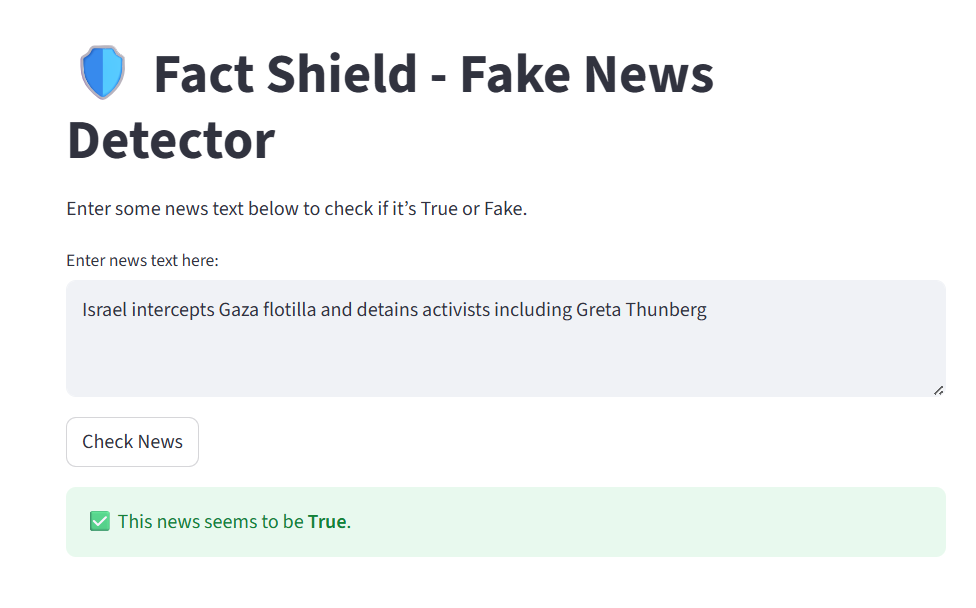
Fact Shield allows users to input text or news articles and predicts whether the content is true or fake. With a clean, user-friendly interface, it provides instant feedback, helping users make informed decisions before sharing information.
How we built it
Frontend/UI: Streamlit for an interactive web interface. Backend/ML: Python with scikit-learn for the machine learning model, trained on labeled datasets of real and fake news. Text Processing: NLTK or TextBlob for tokenization, cleaning, and feature extraction. Deployment: Runs locally or can be hosted on platforms like Streamlit Cloud or Heroku.
Challenges we ran into
Data Availability: Finding a clean, reliable dataset of labeled news articles. Accuracy vs Simplicity: Balancing model performance while keeping the app lightweight and fast. UI Design: Making the interface simple enough for non-technical users while still functional.
Accomplishments that we're proud of
Successfully built a working fake news detection app with an interactive UI. Created a project that’s both educational and practical for end-users. Learned to integrate ML models with real-time web interfaces.
What we learned
The importance of data preprocessing in text-based ML tasks. How to deploy Python applications with interactive UI for users. The challenges of designing user-friendly interfaces for technical applications.
What's next for FactShield
Integration with social media APIs to check news directly from platforms. Improve model accuracy with more advanced NLP models like transformers. Multi-language support to reach a global audience. Add explanations for predictions to educate users about why content is flagged.
