-
-
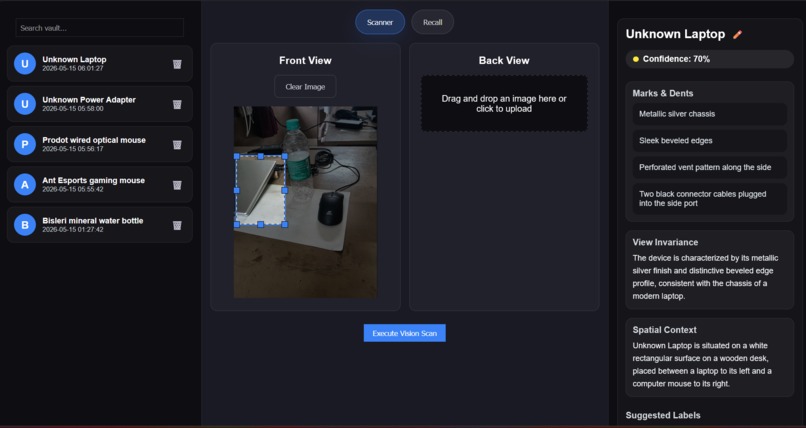
VisionVault's strict OCR constraints: identifying physical traits without hallucinating a brand name when logos are hidden.
Inspiration
Physical memory is fragile. When we want to remember where we put a piece of hardware or a specific component, we usually just snap a picture. But standard photo galleries are broken—they hoard pixels, but they don't understand context or spatial location. I wanted to build an external, structured memory system.
However, the biggest roadblock was that standard vision AI suffers from "Focus Hallucination". If you show an AI a messy desk, environmental noise corrupts the extraction. It gets distracted by the monitor or cables instead of looking at the specific hardware asset you want to log.
What it does
VisionVault acts as an intelligent, persistent memory layer for your physical assets. It digitizes reality into a reliable, structured digital ledger.
You scan an item, and VisionVault automatically isolates it, reads any visible text or logos, identifies unique physical marks (like dents or textures), and calculates its exact spatial context in the room. It remembers what your hardware is and exactly where you left it.
How we built it
The Engine: Powered by the Gemini 3.1 Flash Lite multimodal API.
The Backend: I skipped fragile cloud databases and built a high-speed, local-first backend using FastAPI. The memory ledger is crash-resilient and saved directly to a local
vault_history.jsonfile.The Optimization: To keep API latency low without destroying OCR fidelity, the React frontend dynamically applies highly specific WebP compression payloads before transmission (90% quality for cropped bounding boxes to preserve text, 80% for background spatial mapping).
Challenges we ran into
The biggest hurdle was stopping the AI from guessing. Initially, if the OCR engine couldn't clearly read a logo on a black mouse, it would hallucinate a brand name based on its training weights rather than the actual pixels. Second, the system was getting easily hijacked by background clutter.
Accomplishments that we're proud of
To solve the AI bottleneck, I engineered a Dual-Agent Parallel Pipeline.
Instead of asking one AI to figure out everything, the backend uses Python's asyncio.gather to fire two specialized Gemini agents simultaneously:
Agent A (Identity): A forensic micro-inspector that only looks at the cropped bounding box to extract exact hardware identifiers and OCR.
Agent B (Spatial): A spatial engine that only looks at the full background image to map room coordinates.
The compiler then stitches these asynchronous results into a single, unified memory record in real-time. Standard systems see the room; VisionVault sees the asset.
What we learned
I learned a massive amount about multimodal constraints. You cannot just ask an AI "what is this?" You have to build strict negative prompts. By rewriting the prompt rules, I forced the model into a fail-safe state: if it can't read a logo, it defaults to purely describing physical chassis features (e.g., returning "Unknown Laptop" with "Metallic silver chassis" instead of guessing a manufacturer).
What's next for VisionVault
The next step is building out a deep semantic search routing engine so users can naturally query their vault (e.g., "Where did I leave that silver laptop with the dents?"), and introducing real-time video stream processing for continuous spatial logging.
Built With
- asyncio
- fastapi
- gemini
- javascript
- json
- python
- react


Log in or sign up for Devpost to join the conversation.